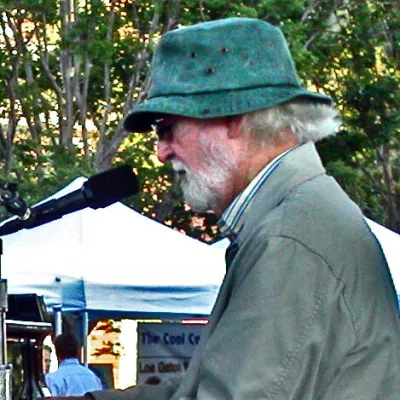
Photo: Wikimedia Commons
Mose Allison
Human Design Chart
Biography
Mose Allison — Generator with Profile 6/2
Generator 6/2 — Design at a Glance
Mose Allisons design points to a tendency towards great endurance and almost animal-like work ethic. He was someone who possessed an enormous reservoir of sacral energy – comparable to a strong working horse that provides power as long as it burns for its task. This configuration did not describe spontaneous impulsivity, but rather a fundamental ability to materialize things in life, provided the energy was properly channeled.
The central mechanics of his design were responding instead of initiating. His energy was not released by pushing himself forward, but by reacting to signals from his environment. The motto “Do not initiate, but react” served as the key to maintaining this power. When Mose Allison reacted to an impulse and his inner self signaled a clear “Yes! Let’s get started!”, he could experience deep satisfaction and a sense of fulfillment through this action.
His design warned him about two specific pitfalls, however. The first was wasting energy on things that did not interest him; this inevitably led to frustration or burnout as the internal potential was not utilized. The second danger lay in holding back from his heart project when he still had plenty of power and wanted to continue working. If he lived against this principle – for example, by constantly initiating without external prompting – he encountered a lack of energy. In harmony with his nature, acting from the gut, however, he was unstoppable.
Sacral Authority
Mose Allisons design points towards direct, physical decision-making. As a Generator, he possessed sacral authority as the sole internal instance for his choice decisions. This configuration simplified his process: His strategy and inner authority aligned. He did not intellectually respond to external stimuli but waited for an immediate physical resonance. This often manifested as a gut feeling, a grunting sound, or a soft “Hmm”. When this reaction occurred, it was followed by a surge of power. Mose Allison then felt vital and alive. His sacral motor kicked in, providing him with seemingly inexhaustible energy. He approached his work with great enthusiasm. His life task consisted of going through life with joy and satisfaction. He immersed himself in his activities without them needing to be bound to an external purpose. The necessity to wait for this physical response rather than planning in the head shaped his way of acting. When the Spleen Center was activated and connected to the Sacral Center, it supported this authority. This allowed him quick, spontaneous reactions and reliable access to his instinctive perception as well as his physical wellbeing. He let himself be guided by this inner voice that signaled where his energy truly belonged.
The 6/2 Profile — Role Model / Hermit
Mose Allisons design was characterized by a clear shift from youthful experimentation to mature detachment and wisdom. In the first decades of life, before turning thirty, the sixth line of his profile configuration still acted as the third. This shaped an intense phase of trial and error: He sought out personal experiences, learned from mistakes, and retreated after setbacks to reflect. The mechanism of the 6/2 line described a process where distance from one’s own life story only became possible with increasing age.
Around thirty years old, the sixth line was fully activated. Mose Allison now showed a tendency towards withdrawal into a metaphorical “cave” to observe his earlier experiments from afar. This period of introspection served for healing and deep self-knowledge. From this phase, he emerged as an authoritative figure whose wisdom attracted others. His creativity was marked by objectivity; the sixth line allowed him to judge the true value of his work and distinguish it from fleeting trends. Simultaneously, the second line promoted tolerance and acceptance towards limitations. He understood that misunderstandings often stemmed from poor timing. This combination of objective judgment and patient waiting created a basis for authentic expressions that needed time to prove their validity.
Split Definition — Defined & Open Centers
Mose Allison's design established a foundation of constant inner authority, characterized by defined G-, Heart-, Sacral-, and Spleen centers. He had a firm self-identity and direction (G), supported by reliable willpower (Heart) as well as a vital energy source that relied on reaction rather than initiation (Sacral). His intuitive body awareness (Spleen) provided momentary protective mechanisms. These four centers formed his unchanging core-self: he knew who he was and where he was going, without being led by external expectations.
At the same time, his open Head-, Ajna-, Throat-, Solar Plexus-, and Root centers acted as antennae for the environment. The open Head center made him susceptible to mental confusion and pressure to find answers to others' questions that were not his own problem. His undefined Ajna center reflected concepts without holding them as personal truth; he tended to collect ideas or feel uncertain about his own thinking. The open Throat led to situational communication flow – he spoke spontaneously when invited, rather than actively seeking attention.
The open Solar Plexus absorbed emotions from the environment, making him vulnerable to foreign moods; he could amplify emotional waves of others and misunderstand them as his own instability instead of letting go. Finally, the undefined Root center took on external stress, often exposing him to an adrenalized pressure that did not originate with him. The challenge lay in not personalizing these fleeting influences but maintaining the integrity of his defined centers: He acted correctly by trusting his inner authority and using outer conditioning as information or discarding it rather than accepting it as his own truth.
Channel 26-44: Surrender — Channels & Gates
Mose Allison showed himself to be someone who instinctively recognized what his environment needed before it knew itself. His design laid a tendency towards entrepreneurial vigilance, paired with a deep persistence in the experience process. This attitude stemmed from Channel 44-26, which connected the Spleen Center with the Heart Center. Through Gate 44, he had a fine nose for historical patterns and tribal needs, while Gate 26 endowed him with the willpower to convey these insights persuasively. He was not a passive observer but an active mediator who sold his gifts by waiting until the market asked him to contribute. This created a balance between work and rest; he accomplished more in short, intense phases than others did over entire days.
At the same time, his essence demanded a deep commitment without preconceived expectations. Channel 29-46 connected his Sacral Center with the G Center. Gate 29, the Yes-Saying Gate, provided access to a well of endurance, while Gate 46 kept him in the right place at the right time. Mose Allison learned only through fully going through processes. He had to lose himself in experiences without wanting to exercise control to make an eventual discovery valuable for the collective. This combination of instinctive selling gift and patient discovering energy shaped his path: He used his ego strength to offer solutions but trusted blindly on the persistence of his Sacral until the meaning of an experience only became apparent retrospectively.
Tribal Circuitry — Circuit Signature
Mose Allison's design presented two separate, parallel operating power fields. One pole processed past emotions cyclically for collective insight; the other built timeless resources through cooperation. This duality between wave-like learning and traditional exchange shaped his energetic structure.
The Meaning-Finding Circuit connected his Identity and Sacral centers in him. Here, emotions flowed out of the Solar Plexus in a wavelike manner: Each cycle had a beginning, middle, and end. These felt insights served not only personal processing but were shared with the collective to learn from the past together. It was about finding meaning behind events – a process that was more mysterious than logical.
Completely differently worked the Ego Circuit, which connected Heart and Spleen centers. This area belonged to the tribal level and focused on cooperation as well as the joint creation of resources. Through the Channel of Devotion (26-44), an energy of giving and taking emerged: 'Today I give you, tomorrow you give me.' Since there was no connection to the Sacral center, constant life force was lacking; instead, rest periods were necessary to generate new resources for the tribe. The energy worked conservatively and traditionally, like a ratchet.
In Mose Allison, these systems existed side by side without direct flow between them – separated by shared definition. He moved between reflecting on the past emotionally and pragmatically building prosperity in social contexts.
Left Angle Cross of Defiance 2
Mose Allison's design carried the signature of the Challenge 2 Left Cross. This configuration established a specific inner structure that shaped his experience of conflicts and growth. In Human Design mechanics, this cross marks a particular archetypal path through life crises towards deeper self-realization. It describes not external circumstances but rather the energetic landscape in which Mose Allison moved.
As the raw content does not provide further details about involved gates or channels, the analysis is limited to this fundamental archetypal classification. The Challenge 2 Left Cross implies a dynamic where outer resistances serve as catalysts for inner transformation. For Mose Allison, this meant that his life task was closely linked to overcoming obstacles that allowed him to fully realize his potential.
Without specific event dates, no concrete historical evidence can be cited for this mechanism. The structure stands, however, as a framework for his entire existence. It shows how challenges are not seen as barriers but as necessary steps on his individual path. Mose Allison's chart thus reveals a deeply rooted willingness to develop through difficulties and discover his true nature in the process. This energetic alignment significantly determined how he dealt with life's demands.
Saturn Return · Uranus Opposition · Chiron Return · 2nd Saturn Return — Life Cycles
Mose Allison's life journey followed structural turning points defined by four classical astrological cycles. These phases marked not arbitrary time periods but served as mechanical markers for profound inner transformations and outer structure changes. His design suggested that maturation, rebellion, and the unfolding of purpose occurred in these specific rhythms.
The first Saturn return around age 29 signaled the transition from youth to adult responsibility, often accompanied by a major test of previously chosen paths. The Uranus opposition around age 40 typically brought a phase of rebellion against established structures and a strong desire for individual freedom and change.
The Chiron return between ages 50 and 52 was not a process of healing old wounds in the psychological sense but rather a fulfillment cycle. In this phase, the 'bloom' occurred: If Mose Allison had lived according to his strategy and authority up until then, here unfolded increasingly his own incarnation cross. Meaning and purpose became experiential, the life task revealed itself in full clarity.
The second Saturn return around age 58 completed this process by transferring previously gained insights into a new, more stable structure. These cycles shaped the rhythm of his existence by opening temporal windows for inner developments to manifest outwardly and adapt the life structure accordingly.
Generator · Sacral Authority — Synthesis
Mose Allison was a Generator whose life was marked by deep inner authority and a steady flow of sacral energy. His design pointed towards someone who is most fulfilled when responding to external impulses through action—not initiating. Defined Root and Heart Centers endowed him with endurance and willpower, while the open Solar Plexus and Head Centers sensitized him to the emotional landscape around him and fostered flexible thinking. This combination allowed him to absorb the energy of others and transform it into creative expressions, always trusting his instinctive perception.
A central paradox in his design lay in the interplay between defined strength and open receptivity. While the Heart Center gave him clear direction and willpower, the open centers enabled a deep immersion in the experiences of others without losing himself. This led to a tension between the need for self-determination and the ability to connect with the world around him—a dynamic balance that fueled his creativity and allowed him to respond authentically rather than follow prescribed paths.
2 Defined Channels
Incarnation Cross - Left Angle Cross of Defiance 2
Solar Return
The Solar Return shows the moment when the sun returns to its exact birth position - your personal solar year.
Life Cycles
Discover the life cycles with a detailed triple view (birth chart, cycle chart, composite).
Human Design Profile
- Type
- Generator
- Strategy
- To respond - wait for something to respond to
- Authority
- Sacral Authority
- Profile
- 6/2 - Role Model / Hermit
- Definition
- Split Definition
- Incarnation Cross
- Left Angle Cross of Defiance 2
- Date of Birth
- 11.11.1927 11:00
- Place of Birth
- Tippo, MS, United States
Frequently Asked Questions
What Human Design type was Mose Allison?
Which Profile did Mose Allison have?
What Authority did Mose Allison have?
What incarnation cross did Mose Allison have?
When was Mose Allison born?
Discover your own Human Design
Are you also a Generator? Find out in a personal reading how to use your sacral energy correctly and discover deep satisfaction.
More Personalities
Back to overviewAaliyah

Alexia

Alizée

Angèle

Anne-Marie

Arcángel