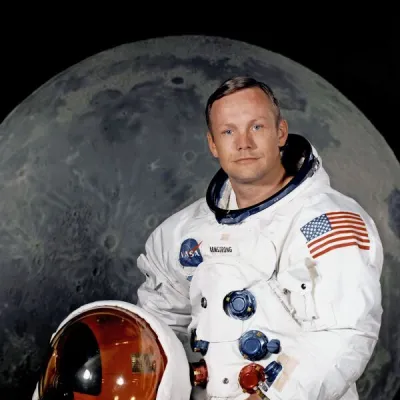
Neil Armstrong
Human Design Chart
Biography
Armstrong got his private pilot's license on 5 August 1946 at the age of 16. He became a Navy aviator 1949-52, flying 72 combat missions in Korea. He was shot down once and was awarded three air medals. He became an aeronautical research pilot in 1955 and was selected for astronaut training on 16 September 1962.
He flew as backup command pilot of the Gemini space shot on 16 March 1966, when he made the first manual space docking. In May 1968, his jet trainer crashed and he parachuted safely from 12,000 feet. Armstrong was a crewman on the Apollo 11 on 16 July 1969, and made his historic first step on the Moon four days later.
He left NASA in 1971, becoming a professor of aeronautical engineering until January 1980. From then, he was semi-retired, playing golf three to five times a week. He kept his hand in with a cattle farm in Ohio. He flies his own plane, sits on the boards of various companies and is Chairman of the Board of Computing Technologies for Aviation in Charlottesville, VA.
Armstrong married in January 1956; he had a son, Eric, in 1957 and a daughter, Karen, in 1959 who is now deceased.
Armstrong underwent surgery on 7 August 2012, to relieve blocked coronary arteries. Despite the surgery, however, Armstrong died on 25 August 2012.
The Human Design of Neil Armstrong: Manifesting Generator 5/1
Manifesting Generator 5/1 — Design at a Glance
Neil Armstrong's design conveyed a hybrid dynamism: the constant energy of a Generator paired with the lightning-fast impact power of a Manifestor. This configuration allowed him to skip steps when implementing projects and quickly draw results into his life. Yet, this speed also carried risks; he tended to overlook important phases or juggle multiple projects simultaneously, which without inner consent rapidly led to frustration – his specific Non-Self theme.
His strategy did not lie in initiating but rather in responding to impulses. Only once his sacral center gave a clear "yes" was the path open for action. Through this inner confirmation alone could he sustainably utilize his creative power without falling into burnout or dissatisfaction.
Happiness for Neil Armstrong did not arise from linearly completing task lists, but in the "play mode." He needed variety and impulse-driven projects that simultaneously fascinated him. The requirement to finish one thing before moving on to the next stood against his nature. Instead, he thrived in an environment that allowed him to switch between various interests as long as each activity found his inner approval. Thus, his hybrid potential transformed from a source of possible friction into a driving force for deep satisfaction and effective creation.
Emotional Authority
Neil Armstrong's design indicated a tendency towards thoughtful decision-making, where emotional clarity took precedence over quick reactions. His inner authority came from the defined Emotional Center. In Human-Design mechanics, this means: As long as the Emotional Center is activated, it serves as the central authority for all life decisions, regardless of other defined Centers in the chart.
This Center was subject to a constant emotional wave characterized by upward and downward mood swings. The perception of the world was always colored by the current emotional state; a topic could appear highly relevant at one moment but be entirely differently evaluated the next. Immediate feelings were not considered ultimate truth, but merely as first impressions. Consequently, spontaneous decisions made directly from this emotional heat carried the risk of negative consequences.
Instead, his design required time and patience. The mechanism involved allowing questions to "sleep" overnight, thereby establishing emotional distance. The longer a decision could mature, the deeper the insight became. Armstrong strategically waited and sought multiple confirmations until initial waves subsided. This process led to calmness and clarity, which was especially crucial for long-term life steps. Through this waiting period, he gained necessary distance from his current emotions and thus took well-founded, sustainable steps.
The 5/1 Profile — Heretic / Investigator
Neil Armstrong's Design was characterized by the Profile 5/1, known as "Hero/Researcher." This created a dynamic tension between external attraction and internal withdrawal. Line 5 gave him a magnetic presence; others instinctively sought solutions and knowledge from him. However, this expectation could quickly lead to exhaustion if clear boundaries were not set, similar to an expert wilting under the weight of countless inquiries.
At the same time, Line 1, the researcher aspect, demanded strict privacy and time for deep reflection before any action. Here lay the core need for confidentiality and the right timing. Without a protected space, this reflective depth lost its effectiveness. Armstrong's challenge was to maintain balance: he had to learn to say No in order to protect his energy. Only then could he sustain the beneficial synthesis of his own research process and providing solutions to others. The necessity of this boundary was crucial to counteract the overwhelming demands created by Line 5 and preserve the inner clarity of Line 1.
Split Definition — Defined & Open Centers
Neil Armstrong's Human Design reveals an immense internal drive, characterized by a defined Heart and Sacral Center. This endowed him with natural willpower and vital energy, which he did not use impulsively but filtered carefully. His defined Solar Plexus served as emotional authority: He waited patiently for the waves of his emotions to subside before acting. Only this emotional clarity allowed him to communicate his decisions through his defined Throat Center precisely and reliably. His intuition from the defined Spleen Center supported this process with spontaneous, existential knowledge in the present moment.
This structure contrasted with his open centers. His open G Center meant that Armstrong did not have a fixed inner identity or direction. Instead, he reflected situational energy around him; his sense of orientation emerged only through finding the correct place and context. Similarly, his open Head and Ajna Centers freed him from rigid mental pressure. He tended to absorb inspiration from the environment rather than impose his own conceptual theories. This protected him from falling into endless questioning or doubt – a typical pattern for open mental centers trying to force answers through intellectual effort instead of waiting for inner clarity.
Thus, Armstrong's mechanics showed a person who only allowed their strong willpower and energy to become effective when emotional calm and intuitive certainty were present. His openness in identity and thought enabled him to react flexibly to situations without clinging to rigid self-images or mental dogmas. The combination of defined motoric function and emotional waiting strategy created a robust foundation for action that was neither impulsive nor dictated by external expectations, but arose from a deep inner resonance with the moment.
Channels for intimacy, values, care and life purpose.
Neil Armstrong's Human Design profile was characterized by a deep desire for fusion coupled with the necessity to wait out emotional waves. The Union Channel 59-6 connected sacral sexuality with the emotional wave of the Solar Plexus; intimacy here required patience and waiting for one’s own emotional clarity to sustain relationships. Simultaneously, there was a strong need for material control and independence. The Money Line 21-45 drove the will to take responsibility and be "one's own boss"; this channel sought balance between hard work and securing resources, with ego authority working in tandem with the voice of the Throat Center to ensure material security.
At the same time, he was marked by a natural sense of duty towards care and the ability to carry responsibility for the tribe. The Preservation Channel 27-50 connected selfless interest in others with traditional values; it ensured that support and protection were ready based on the understanding that one must first take care of oneself to be able to nourish others. This readiness to provide care worked automatically to build trust.
Simultaneously, Neil Armstrong possessed a stubborn determination to walk his own path and find meaning in life struggles. The Life Struggle Channel 38-28 connected the pressure for individual integrity with intuitive knowledge of what is worth fighting for; he found significance not merely in survival but in resistance against external forces and pursuing a personal purpose. This combination of emotional depth, material will, caring structure, and combative individuality formed the mechanical foundation of his character.
Tribal Circuitry — Circuit Signature
Neil Armstrong's design showed a tension between cooperative structure and individual innovation. Two separate circuits worked in parallel without direct energetic exchange. The Ego Circuit connected the Heart Center with the Throat Center through the "Money Line." This created an operational identity based on resource management and the principle of giving and taking. Since there was no connection to the Sacral Center, this energy was not constant; rhythmic pauses for regeneration were necessary to support the tribe.
Parallel to this, the Knowledge Circuit operated. It connected the Spleen Center with the Root Center through Channel "Life Struggle." This promoted the search for new knowledge and transformation. The energy here was pulsing and acoustically marked, driven by instinctive perception and root intensity. It served the expression of a unique identity through new insights.
Another defined area was the Protector Circuit. It connected the Sacral, Solar Plexus, and Spleen Centers. Through Channels "Conservation" and "Coupling," here ancient energies of protection, care, and preservation of family worked. This group stood energetically isolated from the other two circuits. Neil Armstrong's characteristic emerged from this divided definition: on one hand, the traditional resource-oriented cooperation of the Ego Circuit, on the other hand, the innovative dynamics of the Knowledge Circuit and the protective power of the Protector Circuit as separate, coexisting systems.
Left Angle Cross of Refinement 1
Neil Armstrong's design carried the signature of the left Refinement Cross. This configuration established a foundational stance aimed at precision and refining processes. It was not about rough overhauls but rather the consequent optimization of existing structures. The energy of this cross acted as a driving force for detail accuracy and technical perfection.
In Human Design, this specific arrangement focuses on the essential aspects. It filters out disruptive factors and concentrates on the core function of something or an idea. For Neil Armstrong, it meant a natural alignment towards tasks that required utmost care. The design promoted a deep understanding of how complex systems could be improved through small, precise adjustments.
This mechanism created an internal compass for quality. It prompted him not to settle with the first solution but to seek out the optimal variant. It was about reducing to the essentials and eliminating superfluous elements. This impulse towards refinement shaped his approach to challenges. He sought clarity in execution and aimed for a form that was both functional and aesthetically harmonious. The left Refinement Cross ensured a constant attention to nuances others might overlook.
Saturn Return · Uranus Opposition · Chiron Return · 2nd Saturn Return — Life Cycles
Neil Armstrong's design indicated a phase of radical transformation, where old structures broke down and sudden realignments occurred. This dynamic manifested concretely in 1970 when he was promoted at the age of 40 to deputy director of NASA's Washington Aeronautics Bureau. The Uranus opposition marks a time of liberation: established patterns were left behind for new degrees of freedom or areas of responsibility. For Neil Armstrong, this meant not only a career change but a profound shift in his life paths. The pressure to leave old roles behind created space for unexpected developments. This configuration fostered the ability to quickly adapt to changed circumstances and take new paths without being hindered by past commitments. The promotion was thus not an isolated event but an expression of an inner necessity for release and renewal. Through this transformation, he could channel his energy into novel directions, which shaped his further work profoundly. The mechanics of this opposition underscore the importance of flexibility and the courage to leave behind the known in order to serve higher goals. Neil Armstrong's path illustrated how such astrological influences can shape concrete life decisions by paving the way for fundamental changes.
Manifesting Generator · Emotional Authority — Synthesis
Neil Armstrong's design reveals a central red thread of a deep, instinctive connection to overcoming challenges and protecting what is important to him. This manifests in the combination of defined sacral authority, the defined Root Center, and activated channels of the Archer Circuit (27-50, 6-59). He was someone who listened to his inner reaction to find energy for tackling tasks while simultaneously feeling a strong commitment to care and protect what he had created. This combination is reinforced by the defined Heart Center, which implies a strong will and the ability to take responsibility – a pattern that drove him to accept challenges and use resources effectively.
Armstrong's chart reveals a central paradox between the urge for quick reaction and the need for emotional clarity. As an Manifesting Generator, he possessed the ability to act swiftly (Design View), yet his emotional authority required waiting out the emotional wave to make grounded decisions (Authority). This tension between impulsivity and reflection likely shaped his approach in complex situations – a blend of rapid action followed by careful evaluation and adjustment.
4 Defined Channels
Incarnation Cross - Left Angle Cross of Refinement 1
Solar Return
The Solar Return shows the moment when the sun returns to its exact birth position - your personal solar year.
Life Cycles
Discover the life cycles with a detailed triple view (birth chart, cycle chart, composite).
Human Design Profile
- Strategy
- To respond - wait for something to respond to
- Authority
- Emotional Authority
- Profile
- 5/1 - Heretic / Investigator
- Definition
- Split Definition
- Incarnation Cross
- Left Angle Cross of Refinement 1
- Date of Birth
- 05.08.1930 00:31
- Place of Birth
- Wapakoneta, OH, United States
Frequently Asked Questions
What was Neil Armstrong's Human Design type?
Which Profile did Neil Armstrong have?
What was Neil Armstrong's Authority?
What incarnation cross did Neil Armstrong have?
When was Neil Armstrong born?
Discover your own Human Design
Are you also a Manifesting Generator? Find out in a personal reading how to unfold your multi-talents and direct your energy wisely.
More Personalities
Back to overviewAldair

Alizée

Angeli

Arletty
Artus

Balthus