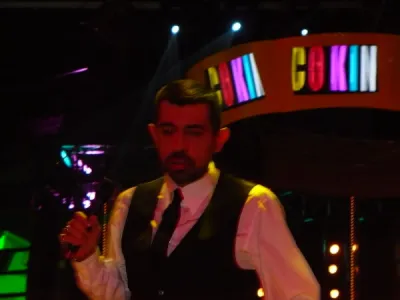
Okan Bayülgen
Human Design Chart
Biography
What does Projector 5/1 mean for Okan Bayülgen?
Projector 5/1 — Design at a Glance
Okan Bayülgen revealed himself through an aura that seemed like a bright flashlight, immediately uncovering systemic errors. This focused perception allowed him to recognize weaknesses in structures or relationships of others instantly. However, directly pointing these out often triggered resistance as if he shone the light uncomfortably into their faces.
Instead, his strategy was to attract through his own harmony. When Okan Bayülgen himself showed a functioning, radiant presence, he naturally became attractive to his surroundings. Others then actively sought his advice, walking the path of honest invitation. This waiting for the respectful request was crucial to exercising his leadership function effectively and without friction.
Since Okan Bayülgen as a Projector does not have a defined Sacral Center, he did not possess constant life energy. His rhythm therefore consisted of phases of high productivity followed by necessary rest periods to avoid burnout. Ignoring this cycle would have exhausted him. Living according to his design – through focus, patience for the invitation, and respectful recovery – rewarded him with success. If he did not soften himself to these mechanisms, it led sooner or later to bitterness as an expression of his non-self-living.
Emotional Authority
Okan Bayülgen showed a clear tendency not to accept emotional impulses as ultimate truth but rather to consciously let them rest. His design suggested that spontaneous reactions to highs or lows were often deceptive and could lead to misjudgments. This resulted from his emotional authority, carried by the defined Solar Plexus Center. Regardless of other definitions in his chart, this authority always took precedence in decision-making.
The mechanics describe a constant emotional wave, a permanent up and down of feelings. In this state, Okan Bayülgen was asked not to interpret the world through the current, often colored mood. A sudden burst of enthusiasm or deep disappointment were only momentary snapshots, not final insights. Quick decisions from this situation were risky and could have negative consequences.
Instead, his system required patience and strategic waiting. Through time gain and multiple considerations of important questions, intense feelings could subside. Only when emotional distance was gained did the necessary clarity and calmness set in. This process of maturation was essential for long-term life decisions. Okan Bayülgen had to learn to let himself be delayed to ensure that his choice came from deep insight rather than temporary excitement or sadness.
The 5/1 Profile — Heretic / Investigator
Okan Bayülgen revealed a tension-filled interplay between the magnetic call to offer solutions as a hero and the necessary retreat tendency for knowledge deepening. His design marks him as a 5/1, the 'Hero/Explorer'. The line 5 acts like a projection line: others project on him the ability to heal or save them. This creates an almost irresistible attraction pole, making people actively seek his solutions.
At the same time, line 1 demands retreat into the depth of one's own knowledge. It stands for love of life and experimentation but requires mindfulness to avoid frustration. Without this protective space, exhaustion looms. The risk lies in Okan Bayülgen being overwhelmed by other’s unguarded projections onto his healing power. Similar to a scientist exhausted after long conferences and confronted with a flood of further inquiries, he can quickly feel drained if clear boundaries are not set.
The challenge of his design is to maintain balance: between serving others through problem-solving (line 5) and the necessary research for himself (line 1). Only by learning to say no can he stabilize this beneficial dynamic. Line 5 teaches the process of healing in the here and now, while line 1 requires cyclical quality and correction to navigate patterns safely. Okan Bayülgen must therefore learn to optimally use his gifts by protecting his retreat rather than constantly exposing himself to the outside world.
Single Definition — Defined & Open Centers
Okan Bayülgen was characterized by a design marked by deep emotional intelligence and constant inner drive. His defined Solar Plexus Center served as an internal authority, meaning that for him, truth did not lie in the immediate moment. Instead, clarity only emerged after experiencing the entire emotional wave. This required patience: impulsive decisions at the high or low points of this wave led to chaos and confusion, while waiting - often overnight - resulted in well-founded judgments. His emotions were not just personal but colored the entire environment; he was responsible for the emotional climate as others reflected his waves.
This depth was supported by his defined Root Center, which provided a steady, adrenaline-fueled pressure. This biological drive served to handle stress and maintain life force, especially in dealing with emotional challenges. It was a constant energy source for survival and progress that only worked healthily if it did not become obsessive or projected onto others.
In contrast, his Head, Ajna, and G Centers were open. This meant no fixed mental structure or identity. Okan Bayülgen tended to be guided by external inspirations and was vulnerable to the pressure of finding answers that weren't his own. His open G Center indicated he did not have an inherent direction but only found identity in place and relationship. Attempts to fill these gaps through willpower (open Heart Center) or constant availability (open Sacral Center) would be counterproductive. His strength lay in enduring emotional depth and using the Root pressure constructively, rather than getting lost in mental confusion or identity search.
Channels for restless drive and emotional imagination.
Okan Bayülgen exhibited a fundamental disposition marked by an intense, restless yearning for new experiences. His design combined the deep drive of the Root with the emotions of the Solar Plexus, creating a strong desire to feel life deeply rather than just observe it. This configuration caused fantasies and expectations to build immense internal pressure, pushing him constantly into new situations.
This mechanism is determined by Channel 29-41. Here energy flows from Gate 41 (Limitation) to Gate 30 (Feeling Recognition). Gate 41 initiates a new cycle and stores all possibilities of human experience driven by the expectation that action will dispel boredom. When this Root energy meets emotions, it further intensifies the urge. The result is an impulsive desire to leap from inexperience into experience, often accompanied by hope that fate (Gate 30) fulfills the longing.
For Okan Bayülgen, it was crucial not to simply follow this blind restlessness. The mechanics of this channel require waiting for emotional wave movement. Only through this pause could clarity arise and transform the raw impulse into a conscious decision. Without patience, there was the risk of succumbing to the pressure of unfulfilled expectations or being drawn into intense situations without fully realizing their potential for insight. Balance lay in enjoying dreams and every experience for themselves rather than using them as means to satisfy an endless hunger.
Additionally, Gates like Gate 25 with its stance of mystical innocence and centering, Gate 46 focusing on full immersion in the present moment, Gate 58 bringing experimental pressure and cheerfulness, and Gate 38 setting boundaries for preserving individual integrity supported this process by bringing structure to emotional intensity: Gate 25 promoted unconditional love as an opposite pole to the drive, Gate 46 reminded of the importance of the physical body as a temple of experience, and Gate 38 ensured that the struggle for life meaning was conducted with integrity.
Collective Circuitry — Circuit Signature
Okan Bayülgens design tended towards cyclical emotional processing. His energy followed wave movements with clear beginning, middle, and end rather than linear progression. This resulted from his active Perception Circuit (Sensing), which focused on the past in contrast to future-oriented logic.
In Okan Bayülgen, this circuit was connected through Channel 'Recognizing' between Solar Plexus and Root Centers. This connection directly linked his emotional waves with his fundamental survival energy. Emotional states were thus not just fleeting moods but immediately shaped his physical well-being and drive.
The focus lay on visually and emotionally grasping the meaning behind past events. These inner insights served to share with the collective to learn together from the past. As Okan Bayülgen had a Simple Definition, these connected centers formed a coherent, direct flow. There were no separate or conflicting energetic systems within this circuit; emotional reflection and resulting survival energy worked as unified power.
Left Angle Cross of Healing 1
Okan Bayülgen revealed himself through a profound alignment with healing processes as his central life task. His design pointed to a clear energetic focus on recognizing injuries and offering transformative solutions. This aligned with the mechanics of the Healing Cross 1, which not only describes personal recovery but also the ability to help others overcome crises.
For Okan Bayülgen, this role was no mere side interest but a structural core of his being. The energy of this cross often acts like a catalyst: it brings hidden wounds to the surface for lasting treatment. Okan Bayülgen could therefore intuitively assess situations where true healing was needed rather than offering only superficial relief.
This configuration grants a special empathy for suffering and pain, paired with the practical competence to develop a path forward from it. Okan Bayülgen used this gift to build bridges between brokenness and wholeness. It wasn't about passive sympathy but active intervention in the dynamics of suffering. Through his presence or actions, he created spaces where regeneration was possible.
The challenge lay in not perceiving this intense energy as a burden but rather as a service in itself and for the environment. Okan Bayülgen understood that true healing often begins with breaking old patterns. His path involved accompanying these processes – whether in private or professional contexts – to make the transformative power of the Healing Cross 1 effective.
Saturn Return · Uranus Opposition · Chiron Return · 2nd Saturn Return — Life Cycles
Okan Bayülgens design shows a structure marked by recurring, cyclical phases of condensation and realignment. These patterns do not appear as random events but follow an inner rhythm that connects stability with necessary breaks. First, a foundation is established: The first Saturn return marks the transition from an experimental phase to serious structuring of life's work. Here, what is sustainable is tested.
Following this, a phase of destabilization through the Uranus opposition occurs. This transit forces the release of outdated patterns to make room for new freedoms. It is not a chaotic break but a necessary correction that breaks rigid structures so growth can occur.
Midlife brings the Chiron return with it. In this fulfillment cycle, one's incarnation cross unfolds increasingly in everyday life. If Okan Bayülgen has followed his strategy and authority, the meaning of his design becomes experiential here. It is a blooming time when inner clarity manifests outwardly.
Finally, the second Saturn return completes the circle. It consolidates the gains from previous phases and anchors the acquired wisdom in a new, more mature structure. This sequence describes not a linear career but a deep process of self-discovery and fulfillment, where each phase builds on and transforms the preceding one.
Projector · Emotional Authority — Synthesis
Okan Bayülgens design reveals a central thread of recognition and profound emotional processing. The combination of defined emotional centers, open centers for mental clarity, identity, and life force, along with the Channel of Recognition (Gate 30/41), points to someone who can intuitively grasp patterns and hidden truths. This ability is enhanced by his open Heart Center, which allows deep understanding of others' energies – yet without his own fixed imprinting. He takes in much, processes it emotionally, and gains deep insights as long as he does not let himself be led by conditioning.
A central paradox lies in the tension between his ability to recognize profound truths (Channel of Recognition) and the lack of consistent inner reference points through his open centers. As a Projector, his strength lies in bringing light into others' darkness, yet he needs clear invitations and recognition for himself not to get lost in conditioning and other people's energy. This field of tension between recognizing problems in others and his own emotional wave demands patience and the ability to rely on his inner authority rather than acting impulsively or getting lost in others' problems.
1 Defined Channel
Incarnation Cross - Left Angle Cross of Healing 1
Solar Return
The Solar Return shows the moment when the sun returns to its exact birth position - your personal solar year.
Life Cycles
Discover the life cycles with a detailed triple view (birth chart, cycle chart, composite).
Human Design Profile
- Type
- Projector
- Strategy
- Wait for the respectful invitation
- Authority
- Emotional Authority
- Profile
- 5/1 - Heretic / Investigator
- Definition
- Single Definition
- Incarnation Cross
- Left Angle Cross of Healing 1
- Date of Birth
- 23.03.1964 05:45
- Place of Birth
- Istanbul, Turkey
Frequently Asked Questions
What is Okan Bayülgen's Human Design type?
What Profile does Okan Bayülgen have in Human Design?
What Authority does Okan Bayülgen possess?
Which incarnation cross is assigned to Okan Bayúlgen?
When was Okan Bayúlgen born?
Discover your own Human Design
Are you also a Projector? Find out in a personal reading how to unfold your leadership qualities and recognize the right invitations.
More Personalities
Back to overviewSissy Spacek

Alain-Fournier

Anémone

Ann-Margret

Arletty

Arno