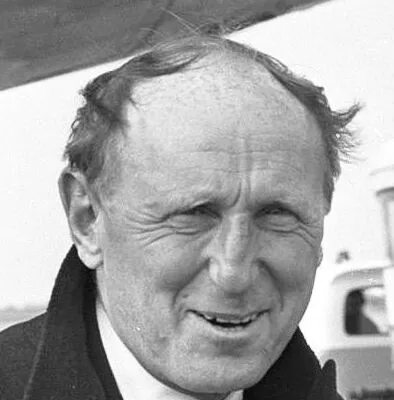
Pascal Martinot-Lagarde
Human Design Chart
Biography
His brother Thomas is also a promising hurdler.
What does Projector 1/3 mean for Pascal Martinot-Lagarde?
Projector 1/3 — Design at a Glance
Pascal Martinot-Lagarde revealed himself as someone who could identify systemic weaknesses with immediate precision. His Human-Design type Projector shaped this ability: He acted like a focused light source that directed itself directly at inefficient spots in his environment, thereby showing the path to solutions. This dense aura allowed him to recognize errors in systems faster than others but required a strategic approach to this perception.
A direct attack on these flaws would often have triggered resistance from those around him, comparable to shining a bright light into someone else's face. Instead, his most effective method was attracting through his own harmony and competence. When Pascal Martinot-Lagarde embodied a functioning system himself, others automatically sought his advice rather than feeling attacked. This underscores the central strategy of his design: waiting for an honest, appreciative invitation before bringing in his knowledge or leadership.
Since Projectors do not have a constant energy center, his power level naturally fluctuated. Phases of intense activity had to be balanced with necessary rest periods to avoid burnout. Society's focus on constant availability often stood against this need. However, when Pascal Martinot-Lagarde lived by these principles – bringing in his unique insights only when asked and sufficiently resting himself – he was rewarded with success. Ignoring this structure threatened emotional strain in the form of bitterness, a clear signal that he was not following his design.
No Inner Authority
Pascal Martinot-Lagarde demonstrated a decision-making stance that did not rely on a fixed internal compass but formed itself through exchanges with others. His design lacked inner authority – a rare trait distinguishing him from most people. Instead of listening to a single physical impulse, he gathered information through dialogic processes. In interactions with various individuals, dormant potentials in his open centers were activated. This allowed him to view issues from numerous perspectives and express these impressions diversely. His high resonance capability served as a filter to identify the appropriate environment and right conversation partners for this exchange.
Evaluating this complex information flow required time and withdrawal. Pascal Martinot-Lagarde had to withdraw alone to recognize the red thread and distinguish what truly made sense and belonged to him. Through this targeted structuring of a mass of impressions, he developed his specific intelligence: the ability to filter out the essential. This formed his capital for success as a Projector. A key element for him was always choosing an environment where he felt comfortable and could exchange trustfully. Only there did his sense deepen over time of what was right for him, as the energetic interactions in dialogue provided the necessary information to clearly recognize his own identity and direction.
The 1/3 Profile — Investigator / Martyr
Pascal Martinot-Lagarde revealed himself as someone whose judgments were based on double verification: theoretical knowledge and practical experience. His design suggested that he only trusted when he had penetrated a matter himself – both secretly and openly experimenting.
This corresponded with Profile 1/3, the Researcher and Experimenter. Line 1, represented by Gate 46, drove him to dedication in the background. Here he gathered knowledge often without external confirmation, true to the belief that experience in the here and now is more important than reflection or expectation. This phase of learning was fundamental; it formed the foundation upon which everything else rested.
However, Line 3, embodied by Gate 15, demanded the step into practice – the trial and error. Here it was no longer just about knowledge but testing strategies in real life. Pascal Martinot-Lagarde learned through mistakes by trying extreme approaches and seeing what worked. The danger lay in Line 1 holding him back out of fear of ignorance while Line 3 urged simple action.
When Pascal Martinot-Lagarde finally made a recommendation or decision, this was the result of this dialectical process. He had recognized the potential of the situation (Gate 46) and tested it through his own, often painful experience (Gate 15). His judgment was therefore considered absolutely trustworthy as it was neither pure theory nor blind guessing but self-earned truth.
Single Definition — Defined & Open Centers
Pascal Martinot-Lagarde was characterized by a constant internal mental pressure. His defined Head and Ajna Centers created a continuous inspiration that pushed him to ask questions and understand connections. However, this state was not connected with the energy needed to directly implement ideas; instead, his mind served as a source for others who had the potential to turn these thoughts into action. The challenge lay in accepting the pressure of unresolved inspiration without falling into self-doubt or hasty actions.
At the same time, Pascal Martinot-Lagarde was strongly influenced by several open centers from his environment. His open G Center meant a lack of stable identity; he tended to orient himself towards the place and people around him rather than asserting his own path. This combined with an open Heart Center made him vulnerable to the pressure of proving his worth through performance or promises – a cycle that often ended in disappointment when he did not trust his inner authority.
Additionally, his open Solar Plexus absorbed the emotions of others, making him emotionally vulnerable and susceptible to conditioning. He risked personalizing the moods of others instead of observing them objectively. His open Sacral Center lacked consistent generative energy; he tended to be driven by the vitality of others, which could lead to exhaustion if he did not learn to set boundaries and rest. Finally, his open Root Center took on external stress, putting him under pressure to remain constantly active to escape this adrenalized feeling. The wisdom of his design lay in not seeing these open fields as a lack but rather as mirrors for the environment while using his defined mental process to foster clarity instead of confusion.
Channels for logical thinking through critical doubt.
Pascal Martinot-Lagarde was marked by a mind that used skepticism as a necessary filter for truth. This analytical approach came from Channel Logic 63-4, connecting the Head Center with the Ajna Center. Through Gate 63 of Doubt and Gate 4 of Formulation, a permanent process is created: patterns are checked to recognize their consistency. If a pattern is unreliable, mental pressure intensifies until it forms a question demanding a verifiable answer. For Pascal Martinot-Lagarde, logical acceptance was only possible if something functioned practically and could also be rationally explained; unfounded belief had no place here. This mechanism did not serve personal future prediction but the collective benefit through well-considered predictions based on current data.
Alongside this logical structure, other energetic focal points were at work. Gate 46 emphasized dedication to the process and care for the body as a temple, resulting in happiness from full participation. Gate 25 brought an attitude of mystical innocence and individualization, coupled with unconditional love. Gate 10, the most complex gate in the G Center, supported integration through genetically fixed behavioral rules and beliefs, while Gate 15 promoted natural rhythms and collective humility. Finally, Gate 47 helped to find meaning from past experiences and transform confusion into clarity, a process that required sharing of distress to create collective understanding.
Collective Circuitry — Circuit Signature
Pascal Martinot-Lagarde showed an orientation towards logical clarity and strategic structuring. His design focused on improving things through rational thinking and guiding them toward a better future. This happened free from emotional coloring, as his Mind Circuit specifically emphasized the 'emotionless ratio' – the Solar Plexus Center was not involved.
This trait results from his simple definition: Head and Ajna Centers were directly connected by Channel Logic (Gates 63/4). This connection created a closed loop between initial inspiration or question formulation in the Head Center and concrete formulation and visualization of these ideas in the Ajna Center. Pascal Martinot-Lagarde thus possessed an integrated ability to translate abstract concepts into clear, logical structures.
The central theme of this circuit is sharing such rational insights, ideally unburdened by conditioning. In Pascal Martinot-Lagarde's case, this energy was focused and visually oriented. As Head and Ajna Centers formed the only connected group in his chart, this logical processing unit was a standalone, coherent force. It did not operate directly in an energetic flow with other centers but functioned as an isolated system of analysis and strategy formation. This shaped his approach: first understand the problem, then clearly formulate the solution before carrying it out externally. The mechanism here supports precise, future-oriented thinking aimed at structure and improvement.
Right Angle Cross of the Vessel of Love 3
Pascal Martinot-Lagarde carried the design of the right cross of the Love Vessel. This configuration established a specific energetic alignment that did not manifest through loud presence or dominant influence. Instead, his impact often worked subtly and from within, characterized by a deep connection to emotional currents and interpersonal dynamics.
The right cross of the Love Vessel describes a life task based on gathering and transforming experience. It is not about actively steering events but rather the ability to serve as a container for intense emotional processes. This aspect in Human Design shows a person who influences through their inner stance and resonance, without necessarily having to be at the center. The energy of this cross fosters a deep understanding of human nature and the power of love as a connecting element. Pascal Martinot-Lagarde's design thus points towards a path of inner depth where authenticity and emotional integrity play central roles. It is a configuration that requires patience, with its effects often becoming visible only retrospectively or in subtler forms, since it aims less at external results than at the quality of internal experience and empathy.
Saturn Return — Life Cycles
Pascal Martinot-Lagarde displayed an underlying orientation towards structural stability and persistence until mature results are achieved. This alignment shaped his path: he did not seek quick, fleeting victories but built a solid foundation that holds under pressure.
This tendency crystallized in 2019 when, at the age of 28, he won the bronze medal at the World Championships in Doha. For his design, this was a typical moment of the first Saturn return. During this phase, what has been built over years often becomes clear. The slow, methodical work that may have gone unnoticed before found its first major, visible confirmation here. It was less about a sudden breakthrough than about validating a consistently pursued line.
The Saturn return marks the transition from an experimental phase to serious engagement with one's role in the world. Pascal Martinot-Lagarde used this period to solidify his position. The success in Doha was no coincidence but the result of a structure that slowly and surely took shape. This cycle laid the groundwork for an attitude valuing reliability and sustainable performance rather than being guided by short-term impulses. The medal symbolized the fruit of this patient development.
Projector · No Inner Authority — Synthesis
A central red thread runs through the design: the deep necessity to understand and pass on this understanding. The defined connection between Head Center and Ajna Center (Logic Channel) creates a constant mental pressure to filter patterns and formulate questions – a process amplified by the profile as Researcher and Experimenter. This ability to recognize connections and question them is not only a personal driving force but also an offer to the environment, 'to bring light into darkness,' typical for the Projector type. The success in 2019 (Saturn Return) seems to have been enabled by this combination of deep analysis and practical application of insights.
The design reveals a central paradox between the need for verification and openness to new experiences. Logic demands constant testing, while the profile as Experimenter urges experimentation. This tension is further intensified by the lack of inner authority: decisions do not arise from internal certainty but emerge in exchange with others where different perspectives and energies influence the search for stability. Thus, a dynamic interplay between the desire for clear structure and acceptance of uncertainty arises.
1 Defined Channel
Incarnation Cross - Right Angle Cross of the Vessel of Love 3
Solar Return
The Solar Return shows the moment when the sun returns to its exact birth position - your personal solar year.
Life Cycles
Discover the life cycles with a detailed triple view (birth chart, cycle chart, composite).
Human Design Profile
- Type
- Projector
- Strategy
- Wait for the respectful invitation
- Authority
- No inner authority - learn more
- Profile
- 1/3 - Investigator / Martyr
- Definition
- Single Definition
- Incarnation Cross
- Right Angle Cross of the Vessel of Love 3
- Date of Birth
- 22.09.1991 14:55
- Place of Birth
- St.Maur des Fossés, France
Frequently Asked Questions
What is Pascal Martinot-Lagarde's Human Design type?
Which Profile does Pascal Martinot-Lagarde have?
What Authority Does Pascal Martinot-Lagarde Have?
Which incarnation cross is active for Pascal Martinot-Lagarde?
When was Pascal Martinot-Lagarde born?
Discover your own Human Design
Are you also a Projector? Find out in a personal reading how to unfold your leadership qualities and recognize the right invitations.
More Personalities
Back to overviewSissy Spacek

Alain-Fournier

Aldair

Anémone

Ann-Margret

Bourvil