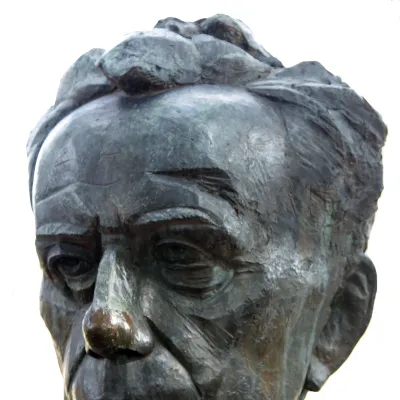
Paul Tillich
Human Design Chart
Biography
Tillich is the noted author of a three-volume masterpiece "Systematic Theology." His influence is characterized by an attempt to mediate between traditional Christian culture and the secular orientation of modern society.
He died of a heart attack on 22 October 1965 at age 79 in Chicago, Illinois.
The Human Design of Paul Tillich: Generator 3/5
Generator 3/5 — Design at a Glance
Paul Tillich revealed himself as someone with immense inner endurance and the ability to remain productive over long periods of time. His design identified him as a Generator, a type that possesses a large amount of sacral energy. This power functioned like an engine: it was available for him to use to bring things into his life and complete projects, provided he used it correctly.
The central mechanics of his design did not lie in initiating actions but rather in responding to them. His energy was primarily released when he responded to impulses from his environment. The strategy involved waiting until a signal came and his inner self—the sacral center—responded with a clear "yes." Only then would he act. When Paul Tillich followed this inner resonance, he not only worked efficiently but also experienced deep feelings of satisfaction and fulfillment.
Conversely, ignoring this principle led to problems. If he did things that he had no inner desire for, or if he tried to go against his natural rhythm, he risked frustration and a lack of energy. Even holding back on tasks when he was still full of power posed a stumbling block. His success therefore depended on learning to make decisions from the gut and using his great work capacity only where the inner response was positive.
Emotional Authority
Paul Tillich was guided by an inner authority that did not manifest as immediate certainty but rather as a wave-like process. His defined Emotional Center carried this decision-making function with absolute priority—regardless of which other centers were also defined in his design. This meant that no other internal voice took precedence over the emotional wave.
His perception was always colored by the current mood; he saw the world one moment enthusiastically positively and the next negatively. However, this initial emotional reaction was only a snapshot and not yet his deeper truth. Spontaneous decisions made from this first wave of feeling often proved problematic as they anticipated clarity prematurely.
The mechanics of his emotional authority required patience and time. Paul Tillich had to let decisions "ripen" by hesitating and sleeping on them multiple times before acting. Only when the intense feelings subsided and an emotional distance was gained did calmness set in. This process of waiting was essential for moving from superficial mood to deeper insight. Especially with long-term life decisions that significantly shaped his course, this period of emotional condensation was necessary to gain clarity rather than reacting merely to fleeting affects.
The 3/5 Profile — Martyr / Heretic
Paul Tillichs Design inclined him towards experimental action that had to be validated through practical experience. As a person with the Profile 3/5, he initially believed nothing was predetermined and learned exclusively through his own experimentation as well as analyzing failures. This line of the Adventurer emphasized evaluating situations through trial and error, where inaction often proved wiser than rash action.
He then used this self-acquired knowledge to solve other people's problems – the role of the fifth line, the Hero. His contribution was attractive because it was based on a rich treasure trove of practical life experiences that he presented to others. Yet, this heroic role could be painful when experiments failed in public view. His authority demanded self-correction and a deep engagement with responsibilities.
The contribution was time-limited; after performance came withdrawal to explore new directions. Jupiter at Gate 29 pointed to a preference for this principled retreat. Parents who did not let go could cause sadness, but Dharma emphasized transient relationships and group contributions. Thus, Paul Tillich emerged as someone who gained knowledge through personal experience and shared it before withdrawing.
Triple Split Definition — Defined & Open Centers
Paul Tillich was someone who constantly felt mental pressure to ask questions and understand connections. His defined Head and Ajna centers created a reliable but unceasing mental activity; he thought continuously, processed data, and formed concepts. However, this definition did not provide energy for direct implementation. Attempting to force these pure thoughts into the world immediately would have frustrated him. Instead, he acted as an inspirational source: His aura pressured those with undefined Head centers to think while he waited for the right moment to convey his questions and answers in a way that could be received.
In addition to this intellectual structure, Paul Tillich had a firm inner identity through his defined G center. He knew his own direction and could show others new paths without being dependent on them. At the same time, he possessed clear willpower in his defined Heart center. He determined his life himself, kept promises, and sought recognition for his contribution. This combination of stable identity and robust ego allowed him to actively shape his role in the community as long as he followed his inner guidance and did not try to dominate others.
In contrast, his undefined Throat center revealed a specific vulnerability. Without his own definition for manifestation or communication, he tended to be guided by fear of not being noticed. The lack of self-understanding could push him to speak unnecessarily or demand attention rather than waiting for an invitation to speak. This open throat often reflected the pressure of his environment; when he tried to communicate in a controlled manner where there was no definition, this led to unpredictable results and inner unrest. The wisdom of his design lay in letting go of this compulsion and allowing spontaneous communication inspired by others.
Channels for community, growth, logic, values and discovery.
Paul Tillich showed a mind that used doubt as an essential filter. The Logic channel 63-4 connected Head and Ajna centers by testing patterns for consistency; skepticism was not an obstacle but a prerequisite for logical proof. Unfounded belief found little room, as answers were only valid if they produced verifiable, consistent patterns.
His design also promoted deep care for the tribe through the Preservation channel 27-50. This connected Sacral and Spleen centers, merging selfless interest (Gate 27) with the protection of traditional values (Gate 50). Tillich was designed to take responsibility and provide sustenance, where his own health formed the basis for this support.
At the same time, he was driven by the Discovery channel 29-46 to fully immerse himself in experiences. Through saying yes (Gate 29) in the Sacral center and the determination of self (Gate 46) in the G center, he lost expectations to gain new insights at the end of a process. This path required persistence as meaning often only became clear after completing the experience.
Social bonds were shaped through the Community channel 37-40. He sought recognition (Gate 37) and built bridges between individuals, where willpower (Gate 40) ensured that agreements benefited all sides. This did not happen spontaneously but through careful formulation over time.
The Ripe channel 53-42 structured his life as a cyclical process. He entered new experiences (Gate 53), fully went through them and then reflected on them, thereby creating growth (Gate 42). Each experience had to find a satisfying conclusion before a new cycle began, so that wisdom from the past could be useful for the collective.
Additionally, gates like Gate 18 with its correction of corruption and Gate 30 with recognizing feelings as well as accepting limitation as fate emphasized his ability to discriminate between life-critical and non-critical corrections and see through emotional illusions.
Collective Circuitry — Circuit Signature
Paul Tillich's design leaned towards analytical clarity that distinguished itself from immediate emotionality. The Understanding Circuit connected his Head and Ajna centers via the Logic channel (63-4). This promoted cool, rational thinking free of conditioned emotions, focusing on future-oriented structures.
Parallel to this was a separate but intense emotional power. The Meaning-Finding Circuit linked Identity, Sacral, and Root centers in a group. Here Paul Tillich went through cyclical waves of experience: Discovery (46-29) and Ripe (42-53). This energy related to the past, reflected on meaning connections, and sought sharing felt insights with the collective.
A third independent area concerned social resources. The Ego Circuit connected Heart and Solar Plexus centers via the Community channel (40-37). This created a system of giving and taking as well as mutual support without direct connection to the constant life force of the Sacral center. Rest pauses were necessary here to generate resources for the tribe.
Finally, the Archer Circuit linked Sacral and Spleen centers via the Preservation channel (27-50). This gave him instinctive energies for protection and preservation of family as well as his own genetics. Since Paul Tillich had a triple definition, these four circuits existed as separate groups: Head-Ajna, Identity-Sacral-Root, Heart-Solar Plexus, and Sacral-Spleen. They worked alongside each other, not as one connected flow but as parallel specific forces in his life.
Right Angle Cross of Contagion 3
Paul Tillichs design indicated a tendency towards a specific, often unconscious radiance. This was characterized by the configuration 'The right infection cross 3'. In Human Design mechanics, this pattern describes an energetic dynamic that operates in the subconscious rather than a conscious strategy or character trait. It acts like a magnetic field that influences others subconsciously without Paul Tillich being able to control it actively.
This energy acted as an invisible anchor. It ensured that certain topics or emotional states were automatically activated in his environment. Others often reacted intuitively to this radiance before they rationally understood what was happening. For Paul Tillich, this meant living with a background energy that subtly shaped his interactions with the world. It wasn't something he could turn on and off at will but rather an inherent condition of his design.
The mechanics of this cross are evident in its ability to create connections on a very deep, often unarticulated level. Paul Tillich carried this energy within him, leading others to perceive him as someone who radiated a certain weight or intensity. This happened independently of his will. The effect was real and noticeable for those around him, even if it rarely took center stage in conscious conversation. It formed the invisible undercurrent of his interpersonal dynamics.
Saturn Return · Uranus Opposition · Chiron Return · 2nd Saturn Return — Life Cycles
Paul Tillichs design indicated a tendency towards profound life changes that manifested as concrete career shifts. In 1912, at age 26, he was ordained as a Lutheran pastor. This coincided with his first Saturn return, a cycle often marked by the condensation of years of internal work and development into a tangible external structure. The ordination wasn't an accident but rather a moment when his inner orientation translated into a firm societal role.
Later, in 1933 at age 47, his Chiron return occurred. In this fulfillment cycle often seen as the peak of one's purpose, he emigrated to the USA and was dismissed from state service. For his Human Design, this moment didn't signify healing old wounds but rather the concrete unfolding of his incarnation purpose through radical change. The emigration was the external expression of what had long been forming internally: breaking free from old structures to follow his true essence. Both events illustrate how his design used life phases to bring inner truth outward – first by integrating into a tradition, later by leaving it behind for a new existence.
Generator · Emotional Authority — Synthesis
Paul Tillich was a Generator whose life was marked by a deep urge to learn through experimentation and share this knowledge with others. The Profile of the experimenter and helper (3/5) reflected his readiness to accumulate personal experiences in order to help others from them – a pattern evident in career shifts (1912, 1933). This active engagement with the world was fueled by the sacral energy of the Generator, allowing him to persistently work on his endeavors over long periods. The defined Head-Ajna channel (Logic) further strengthened this process by creating a constant mental pressure towards analysis and questioning.
A central paradox in his design lay in the interplay between emotional authority and the logical filter channel. Although his decisions required time to mature through an emotional wave, his mind was perpetually seeking consistency and evidence (Gate 63/4). This led to tension between the need to feel and enjoy emotions and the desire to understand them rationally and articulate them clearly. This internal dynamic shaped his approach to complex issues and created space for deep reflection.
5 Defined Channels
Incarnation Cross - Right Angle Cross of Contagion 3
Solar Return
The Solar Return shows the moment when the sun returns to its exact birth position - your personal solar year.
Life Cycles
Discover the life cycles with a detailed triple view (birth chart, cycle chart, composite).
Human Design Profile
- Type
- Generator
- Strategy
- To respond - wait for something to respond to
- Authority
- Emotional Authority
- Profile
- 3/5 - Martyr / Heretic
- Definition
- Triple Split
- Incarnation Cross
- Right Angle Cross of Contagion 3
- Date of Birth
- 20.08.1886 00:30
- Place of Birth
- Starosiedle, POL
Frequently Asked Questions
What was Paul Tillich's Human Design type?
What Profiles did Paul Tillich have?
Which Authority guided Paul Tillich?
What incarnation cross did Paul Tillich have?
When was Paul Tillich born?
Discover your own Human Design
Are you also a Generator? Find out in a personal reading how to use your sacral energy correctly and discover deep satisfaction.
More Personalities
Back to overviewAaliyah

Alexia

Angèle

Anne-Marie

Arcángel

Arno