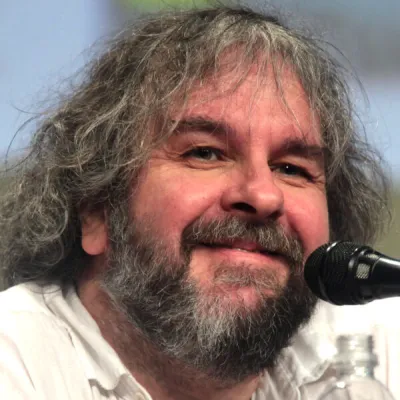
Peter Jackson
Human Design Chart
Biography
Other notable films include the critically lauded drama Heavenly Creatures (1994), the horror comedy The Frighteners (1996), the epic monster remake film King Kong (2005), the World War I documentary film They Shall Not Grow Old (2018) and the documentary The Beatles: Get Back (2021). He is the fourth-highest-grossing film director of all-time, with his films having made over $6.5 billion worldwide.
Jackson began his career with the "splatstick" horror comedy Bad Taste (1987) and the black comedy Meet the Feebles (1989) before filming the zombie comedy Braindead (1992). He shared a nomination for Academy Award for Best Original Screenplay with his collaborator Fran Walsh for Heavenly Creatures, which brought him to mainstream prominence in the film industry. For The Lord of the Rings: The Return of the King (2003), Jackson has been awarded three Academy Awards for Best Picture, Best Director, and Best Adapted Screenplay. His other accolades include three BAFTAs, a Golden Globe, two Primetime Emmy Awards, and four Saturn Awards among others.
His production company is WingNut Films, and his most regular collaborators are co-writers and producers Walsh and Philippa Boyens.
Human Design Analysis: Peter Jackson as Projector 6/3
Projector 6/3 — Design at a Glance
Peter Jackson's Design showed a tendency towards precise system analysis: He could spot errors in complex structures immediately and guide others. As a Projector, he had a dense, focused aura, comparable to a bright flashlight directed at blind spots in the environment. However, this ability to 'shed light into darkness' often felt uncomfortable when used uninvited – similar to shining a beam directly into someone's face.
His strategy was to channel this intensity through inner harmony and wait for appreciative invitations rather than imposing advice. Only then could his attractive influence be fully unleashed. Since he lacked a defined Sacral Center, he did not have constant intrinsic life energy. Instead, he worked in phases of high productivity followed by mandatory rest periods for regeneration. Without these recovery phases, there was a risk of burnout.
Waiting for the invitation was key to avoiding bitterness and maintaining his energy. If Peter Jackson lived according to this pattern, he was rewarded with success; if he ignored it, sooner or later his Non-Self theme 'Bitterness' would surface. His Design thus required a balance between sharp observational skills and patient restraint to sustainably exercise his leadership role.
Emotional Authority
Peter Jackson's Design showed a tendency towards thoughtful decision-making: Immediate reactions were deceptive and dangerous. His inner authority resided in the defined Emotional Center, meaning he was subject to constant waves of ups and downs in feelings. The world appeared colored by his current mood; a moment of enthusiasm could turn into deep skepticism in the next. This emotional state was only a snapshot, not a final judgment. Quick, spontaneous decisions from such a situation risked negative consequences as they were based on fleeting impulses rather than clarity.
The mechanics of his emotional authority required cycle distance. The more time he took to let a decision mature, the deeper and broader could he perceive the situation. This demanded patience and consciously sleeping over important questions. By hesitating and rethinking decisions multiple times, intense feelings gradually subsided. Only then did he gain the necessary emotional distance that led to calmness. This process was essential for long-term course setting with significant influence on his life path. Only by enduring in the emotional wave could he identify his true truth and take grounded steps not dictated by transient moods.
The 6/3 Profile — Role Model / Martyr
Peter Jackson's Design showed a tendency towards constant inner restlessness and the pursuit of extraordinary perfection. As a 6/3 Profile ('Role Model / Experimenter'), he lived primarily as an experimenter in the first three decades, driven by Line 3's urge to find his identity through numerous self-experiments. This continuous testing never ended completely, as the adventure line remained present throughout his life.
At the same time, he did not seek ordinary order but a unique life path far from standards. The sixth line in his Design pushed him to take extreme risks to secure fame and profit – a will to pay any price for success rather than succumbing to decline. After his Saturn return around age 30, this energy shifted: Restlessness turned into the mature role of a wise model.
From the necessary withdrawal required by Line 3 from Gate 33, Peter Jackson developed the ability to reflect and adapt. Crucial was the step out of this isolation to take responsibility and share his often unusual accumulated experiences as wisdom with others. Thus, his Design combined the bold risk-taking spirit of a youth with the humorous, far-sighted authority of a mentor who has learned that true strength lies in sharing insights, not just individual triumph.
Single Definition — Defined & Open Centers
Peter Jackson's Human Design suggests a tendency towards deep emotional processing and constant inner drive. His defined Solar Plexus served as an internal authority, meaning that decisions were not made in the moment of excitement but rather after waiting for the emotional wave to clear – often overnight. This patience was essential to avoid impulsiveness and the resulting chaos; the truth revealed itself over time, not in the 'now'. Simultaneously, his defined Root Center provided a steady, adrenalized pressure for survival and forward movement. This energy flow nourished emotional awareness but could lead to obsession or projecting exaggerated expectations onto others if used unsustainably.
In contrast, his open centers – Head, Ajna, Throat, G, Heart, Sacral, and Spleen – did not offer a reliable internal authority but rather reflected the environment. Peter Jackson tended to be distracted by mental pressure or the search for answers when he didn't trust his emotional clarity. His open G Center made him vulnerable to identitylessness through environmental reflection, while his open Heart Center could trigger a compulsion to prove self-worth. Additionally, he was at risk of energy takeover and exhaustion from his open Sacral Center as well as fear of spontaneity from his open Spleen Center. Therefore, his mechanics required observing situational influences without accepting them as personal truth and instead following the rhythm of his emotional wave and inner survival drive.
Channels for mystical synthesis and basic needs.
Peter Jackson's Human Design suggests a tendency towards deep tribal loyalty paired with a finely tuned perception of one's position within the whole. He had a need to be needed and supported, where satisfaction arose from balancing feasibility and fairness within his community.
This attitude was primarily shaped by Channel Synthesis 19-49. This channel connects Root and Solar Plexus Centers through Gate of Claims (19) and Gate of Principles (49). It defines the emotional frequency of belonging and protection, developing from the pressure for food, shelter, and territory. Gate 19 pushed towards manifestation of togetherness while Gate 49 rejected anything incompatible with the highest ideals or undermining the 'tribal spirit'. This wave of acceptance or rejection functioned as glue for relationships, determined by a code of love, honor, and obedience without logical deliberation.
Additionally, Gates like 28 (Decision in Here and Now), 27 (Care and Survival), and 33 (Reflection) influenced his design. Gate 30 contributed to the recognition of feelings and longing for positive experiences while Gate 60 brought pressure towards transformation through acceptance of limitations. Peter Jackson's gift was being recognized as someone who always finds a balance between feasibility and fairness, with family – however defined – at the center of his enterprise, ready to do whatever necessary work.
Tribal Circuitry — Circuit Signature
Peter Jackson's Human Design suggests a tendency towards cooperative action based on balancing giving and taking. This dynamic did not manifest as an individual race but rather as collective resource creation within a group or community. The Ego Circuit shaped this mode of interaction: it was about support and exchange in the spirit of 'today I give, tomorrow you give'.
This structure connected Peter Jackson's Solar Plexus Center with his Root Center through the Synthesis Channel (Gates 49-19). This connection generated an emotional wave characterized by patience and traditional values. The energy moved rhythmically – like a ratchet – requiring time to fully manifest. This promoted a conservative, stable foundation for shared endeavors.
Since the Ego Circuit does not connect to the Sacral Center, there was no constant source of life force. Instead, resource creation depended on necessary pauses. Without these breaks, energy could not be sustainably renewed. The mechanics thus emphasized that cooperation and prosperity could only be maintained through respectful periods of rest. Peter Jackson's design showed a clear dependence on this rhythm of tension and release to achieve the common goal.
Left Angle Cross of Alignment 2
Peter Jackson's design points towards a clear and strategic orientation. His chart shows the left cross of orientation 2, which describes a life task characterized by focused action and direction. This configuration promotes stability and focus.
The mechanics of this cross act like a compass, creating inner clarity to support decision-making based on solid foundations. Peter Jackson was someone who was marked by this internal order. The left cross of orientation 2 provides a stable basis for action, helping to minimize distractions and concentrate energy on what is essential.
This characteristic does not necessarily mean rigid planning but rather a natural inclination towards structuring. Peter Jackson used this power effectively to pursue his goals. Orientation 2 emphasizes the importance of relationships and partnerships, which in the context of the left cross becomes a source of strength. It's about setting a clear direction while connected with others.
Peter Jackson's design thus fostered a balance between individual clarity and collective orientation. This dynamic shaped how he moved through the world. He did not act impulsively but followed an inner logic. The left cross of orientation 2 gives this stance a special depth, as it is a pattern that remains constant over time. Peter Jackson lived out this structure in his own way.
Saturn Return · Uranus Opposition · Chiron Return · 2nd Saturn Return — Life Cycles
Peter Jackson's design shows a structure where fundamental life transitions are validated by concrete milestones. These four major planetary cycles mark maturation phases that manifest not abstractly but through tangible events.
In 1987, at the age of 26, he married Fran Walsh. This first Saturn return condensed years of groundwork into a solid relationship foundation. The stability of this moment laid the basis for future creative phases.
When the Uranus opposition appeared in 2001, Peter Jackson released 'The Lord of the Rings: The Fellowship of the Ring'. At age 40, he entered a phase where established structures were broken down and new things became effective on a broad scale. This cycle promoted innovation and breakthrough into public consciousness.
In 2011, he began filming 'The Hobbit'. At 50 years old, he reached his Chiron return, a fulfillment cycle. Here, the individual's incarnation cross unfolds; meaning and purpose become experiential. It is not healing of past wounds but a blooming period when life tasks find full expression.
In 2018, 'They Shall Not Grow Old' premiered as a documentary film. His second Saturn return at age 57 confirmed the long-term viability of his work. This cycle solidifies reputation and enduring impact by transferring past achievements into a new phase of recognition.
Projector · Emotional Authority — Synthesis
Peter Jackson's design shows deep continuity in how he perceives and interacts with the world: as a projector, equipped with emotional authority and a profile of role model/experimenter, he is designed to recognize potential in others (through his 'bright flashlight' design) and show paths where improvements are possible. This ability for synthesis – recognizing patterns and needs within a group context (ego circuit) – seems to manifest in recurring career moments marked by cycles like the Uranus opposition when new paths were taken. The emotional wave allows him to gain deep insights that then flow into creative projects.
Simultaneously, a central paradox reveals itself: between the drive to uncover patterns and errors within systems (Gate 19) and the necessity of letting decisions mature over longer periods (emotional authority). Quick recognition of potential collides with an internal process requiring patience. This leads to tension between the desire for immediate impact and wisdom that arises from waiting – a dynamic reflected in recurring cycles of experimentation (Line 3) and responsibility (6/3 Profile).
1 Defined Channel
Incarnation Cross - Left Angle Cross of Alignment 2
Solar Return
The Solar Return shows the moment when the sun returns to its exact birth position - your personal solar year.
Life Cycles
Discover the life cycles with a detailed triple view (birth chart, cycle chart, composite).
Human Design Profile
- Type
- Projector
- Strategy
- Wait for the respectful invitation
- Authority
- Emotional Authority
- Profile
- 6/3 - Role Model / Martyr
- Definition
- Single Definition
- Incarnation Cross
- Left Angle Cross of Alignment 2
- Date of Birth
- 31.10.1961 18:45
- Place of Birth
- Porirua, Wellington, New Zealand
Frequently Asked Questions
What is Peter Jackson's Human Design type?
What Profile does Peter Jackson have in Human Design?
What Authority guides Peter Jackson?
What incarnation cross is assigned to Peter Jackson?
When was Peter Jackson born?
Discover your own Human Design
Are you also a Projector? Find out in a personal reading how to unfold your leadership qualities and recognize the right invitations.
More Personalities
Back to overviewSissy Spacek

Alain-Fournier

Anémone

Ann-Margret

Arletty

Arno