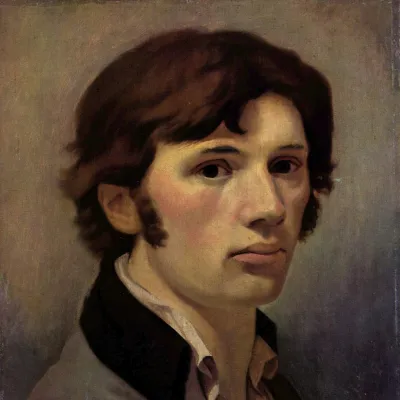
Philipp Otto Runge
Human Design Chart
Biography
Runge is considered among the best German Romantic painters.
In 1799 his brother Daniel supported Runge financially to begin study of painting at the Copenhagen Academy. In 1801 he moved to Dresden to continue his studies, where he met Caspar David Friedrich, Ludwig Tieck, and his future wife Pauline Bassenge. In 1803, on a visit to Weimar, Runge unexpectedly met Johann Wolfgang von Goethe and the two formed a friendship based on their common interests in color and art. Runge's interest in color was the natural result of his work as a painter and of having an enquiring mind.
In 1804 he married and moved with his wife to Hamburg. Due to imminent war dangers (Napoleonic siege of Hamburg) they relocated in 1805 to his parental home in Wolgast where they remained until 1807. In 1805 Runge's correspondence with Goethe on the subject of his artistic work and color became more intensive. Returning to Hamburg in 1807, he and his brother Daniel formed a new company in which he remained active until the end of his life. In the same year he developed the concept of the color sphere. In 1808 he intensified his work on color, including making disk color mixture experiments. In 1809 Runge completed work on the manuscript of Farben-Kugel (Color sphere), published in 1810 in Hamburg. In the same year, ill with tuberculosis, Runge painted another self-portrait as well as portraits of his family and brother Daniel. The last of his four children was born on the day after Runge's death on 2 December 1810, age 33 in Hamburg.
Runge was of a mystical, deeply Christian turn of mind, and in his artistic work he tried to express notions of the harmony of the universe through symbolism of colour, form, and numbers.
Philipp Otto Runge as a Generator 5/1 in Human Design
Generator 5/1 — Design at a Glance
Philipp Otto Runge revealed himself as someone with tremendous inner endurance and strength, comparable to a workhorse ready to provide large amounts of energy for his tasks. His design as a Generator indicated that this strength would only be effective if he responded to signals from his environment rather than initiating independently. The strategy involved waiting until his sacral center – the motor of his energy – sent a clear "yes" before taking action.
This mechanism offered him the path to deep satisfaction and fulfillment, provided he followed his impulses. Conversely, two specific dangers loomed: either he would expend his energy on things that did not touch him internally, leading to exhaustion, or others would prevent him from continuing projects for which he was still full of motivation. His success therefore depended crucially on whether he learned to respond intuitively rather than fighting against the flow of his own energy or initiating unnecessarily. If he did not live by this principle of reacting to inner confirmation, sooner or later he encountered persistent frustration and a noticeable lack of vitality.
Emotional Authority
Philipp Otto Runge exhibited a basic attitude where inner clarity arose only through emotional detachment. His inner authority was Emotional Authority, carried by the defined Emotional Center. This mechanism operated independently of other defined centers in his chart and significantly influenced his decision-making process.
Runge was subject to an emotional wave that manifested as constant ups and downs in his feelings. He saw the world colored by his current mood: one moment completely enthused, the next moment viewing the same thing negatively. Since his immediate feeling was only a snapshot and not necessarily his truth, quick, spontaneous decisions based on emotion could have negative consequences.
Therefore, he took time to let decisions mature. This process required patience and repeatedly sleeping on important questions. The longer he waited, the deeper and more comprehensive his understanding became. Over time, intense feelings subsided, he gained emotional distance, clarity emerged, and calmness set in. Only then had he gone through the process. This method primarily served long-term decisions that could have a significant impact on his life course by ensuring that actions were not based on transient excitement but rather deep insight.
The 5/1 Profile — Heretic / Investigator
Philipp Otto Runge distinguished himself through his unique way of telling stories, capturing attention. His Human-Design Profile 5/1 combined the depth of a researcher with the role of a hero. Line 1 in him emphasized the fundamental need for self-care and a stable foundation. At the same time, the world projected expectations onto him that he would be inspiring and offer solutions due to his fifth line.
This configuration created almost magnetic qualities: Others often sought advice or answers from him regarding their problems. For Runge, however, this was only sustainable if he set clear boundaries. Without these limits, there was a risk of being drained by constant requests from others, similar to an expert feeling exhausted after long consultations. His design suggested that he needed to learn to say no at times to maintain the balance between his own research work and serving others. The world saw him as someone with unusual innovations, yet his inner focus lay on building a solid foundation for himself without harming others.
Single Definition — Defined & Open Centers
Philipp Otto Runge was a person whose actions were guided by a deep inner authority that did not reside in the mind but rather in physical resonance and emotional process. His design featured a defined Sacral Center, providing him with a constant source of vital energy. However, this power required patience: he responded to life instead of initiating it. His sacral response - an instinctive yes or no - determined whether he had the energy for a task. Simultaneously, his defined Solar Plexus acted as emotional authority. Decisions were not made in the heat of the moment but after running through waves of emotion and reaching clarity. This combination of sacral endurance and emotional depth endowed him with a unique sensitivity to spiritual connections.
Additionally, Runge possessed a defined Spleen Center, which gave him spontaneous intuition and strong existential awareness. He trusted these immediate warning signals and intuitive conclusions that protected his well-being. His defined Root Pressure supported this structure by providing the necessary impulse to process existential questions and thrive materially.
In contrast, his vulnerability was revealed in the undefined centers. The open Head Center tended to be overwhelmed by foreign inspiration or mental confusion; he avoided answering endless questions of self-understanding. His open Ajna Center made him a mirror for others' concepts without internalizing them as personal truth. An open G Center meant that his identity and direction were not fixed but crystallized through correct places and relationships. He did not actively seek a firm 'who', but allowed himself to be initiated. Finally, his open Heart Center protected him from falling into the cycle of promises and proving self-worth. Instead, he learned to live out of the calmness of his inner authority.
Channels for change, emotions, care and persistence.
Philipp Otto Runge lived in constant tension between the urge for evolutionary change and the need for preservation. His design inclined towards melancholic phases that did not signify lack but rather heralded deeper creative impulses.
The Channel of Mutation 60-3 connected his Root Center to his Sacral Center through the Gate of Limitation (60) and the Gate of Order (3). This configuration generated a pulsing on/off energy, enabling evolutionary change only if he accepted limitation and moved beyond the confusion of a new beginning. The associated melancholy was a mechanical process; arguing against it was counterproductive. Instead, patience was required to wait for the next pulse that suddenly appeared like music between notes, forcing innovation.
Simultaneously, the Channel of Preservation 27-50 shaped his attitude through the Gate of Care (27) in his Sacral Center and the Gate of Values (50) in his Spleen Center. This created a natural ability to take responsibility and protect the clan through selfless interest in others as well as defending traditional laws. His aura automatically drew trust; he was a natural provider who, however, had to learn to give energy only when his Sacral Center responded correctly - a form of 'enlightened selfishness' to stay healthy.
The Channel of Transformation 54-32 drove him through the Gate of Ambition (54) and the Gate of Continuity (32). Here, his desire to improve his position in life through constant effort and talent was evident, seeking recognition from the clan. This ambition was driven by fear of the clan's failure and aimed for a transformation that only had value if it led to stable continuity.
Additionally, Gates like 56 (Abstraction of mental processes) and 28 (risks in the here and now) shaped his ability for figurative storytelling and intuitive decision-making, while Gate 53 enabled the beginning of new developmental cycles.
Tribal Circuitry — Circuit Signature
Philipp Otto Runge's energetic design showed a continuous connection between instinctive perception and emotional resonance. His simple definition linked the Sacral, Root, Spleen, and Solar Plexus Centers into one cohesive flow. This allowed him to directly convert inner impulses into action-oriented energy without interruption from undefined centers.
The Knowledge Circuit shaped him through the Channels 'Mutation' and 'Release Emotions'. These connected his Sacral with his Root Center as well as his Solar Plexus Center. Here, a pulsing energy aimed at transforming new insights and expressing them emotionally colored. His individuality was evident in his ability to initiate changes through the expression of his own identity.
Parallel to this, the Ego Circuit worked through the Channel 'Transformation', linking Spleen and Root Centers. This part of his design promoted the joint creation of resources and support within a group. Since this circuit did not connect with the Sacral Center, he required quiet phases for regenerating energy for these cooperative tasks.
The Archer Circuit completed his profile through the Channel 'Preservation', connecting the Sacral with the Spleen Center. This gave him ancient energy for protection and preservation of family and genetic heritage. Themes like care, nutrition, and defense were central here. Overall, Philipp Otto Runge's actions and decisions were significantly shaped by a harmonious interplay between individual creative power, group-oriented cooperation, and instinctive familial pride.
Left Angle Cross of Distraction 1
Philipp Otto Runge was marked by the left cross of distraction, a configuration that often drew his attention away from his true essence. This structure caused him to be easily captivated by external stimuli or internal trains of thought, leading to a scattered focus. Instead of a clear and direct alignment with his goals, his design was characterized by a tendency towards distraction. He tended to distribute energy in many directions, making it difficult to concentrate on the essentials. This distraction was not due to a lack of will but rather a mechanical property of his system that made him vulnerable to disruptions. His inner peace was often compromised by this scattering as his consciousness constantly pursued new impulses. The left cross of distraction thus created a pattern where Philipp Otto Runge frequently lost sight of his primary intentions. He had to learn to deal with this inclination towards distraction by consciously retreating to the essential. Without this discipline, his energy risked dissipating. This configuration significantly determined how he dealt with information and tasks – often with a certain restlessness in the background. His design suggested that clarity could only be achieved through conscious focus, as the natural tendency towards distraction was always present. Philipp Otto Runge lived in a tension field between seeking depth and the constant danger of being distracted by the surface.
Saturn Return — Life Cycles
Philipp Otto Runge showed himself during this life phase through an intensified mental exchange readiness, which reached its peak at the age of 28 in 1805. In that year, he intensified his correspondence with Goethe about art and color – marking the first Saturn return. This cycle condensed years of internal groundwork into a tangible external result. The mechanics of the Saturn return work like a maturation process: What was previously only potential or uncertain direction gains structure and durability now. For Runge, this meant that his artistic and theoretical considerations were no longer mere experimentation but manifested in a stable form that enabled dialogue with a contemporary of Goethe's stature. This correspondence was not coincidental but the expression of a design ready at this point to grasp and exchange insights. The Saturn return often demands confrontation with one's own substance; here, it showed itself in the ability to articulate complex color theories precisely and place them into a significant cultural context. It was a moment of validation where inner knowledge was confirmed through external recognition and structural clarity.
Generator · Emotional Authority — Synthesis
Philipp Otto Runge lived a profound process of knowledge acquisition and transformation. As a Generator with emotional authority, he needed time to let decisions ripen and find his inner truth – a process fueled by the intense sacral energy when he ignited for a task. His profile as Hero/Researcher (5/1) amplified this trait: He actively sought new challenges, gathered knowledge, and shared it willingly with others, while Channel of Mutation (3-60) led him to unconventional paths. This combination of readiness for action, emotional depth, and thirst for knowledge shaped his work approach and his pursuit of expression.
A central tension field in his design lay between the need for deep immersion into research processes and the accompanying melancholy of change (Channel 3-60), as well as the desire to share this knowledge and serve others by solving problems. The pulsating energy of the Knowledge Circuit challenged him to live out his individuality while emotional waves required constant adaptation. Intensive correspondence with Goethe about art and color (documented event) points to this inner drive to both explore and share insights – a dance between deep self and the need for connection.
4 Defined Channels
Incarnation Cross - Left Angle Cross of Distraction 1
Solar Return
The Solar Return shows the moment when the sun returns to its exact birth position - your personal solar year.
Life Cycles
Discover the life cycles with a detailed triple view (birth chart, cycle chart, composite).
Human Design Profile
- Type
- Generator
- Strategy
- To respond - wait for something to respond to
- Authority
- Emotional Authority
- Profile
- 5/1 - Heretic / Investigator
- Definition
- Single Definition
- Incarnation Cross
- Left Angle Cross of Distraction 1
- Date of Birth
- 23.07.1777 06:00
- Place of Birth
- Wolgast, GER
Frequently Asked Questions
What was Philipp Otto Runge's Human Design type?
What Profile did Philipp Otto Runge have in Human Design?
Which Authority guided Philipp Otto Runge?
What incarnation cross did Philipp Otto Runge carry?
When was Philipp Otto Runge born?
Discover your own Human Design
Are you also a Generator? Find out in a personal reading how to use your sacral energy correctly and discover deep satisfaction.
More Personalities
Back to overviewAaliyah

Alexia

Angèle

Anne-Marie

Arcángel

Arno