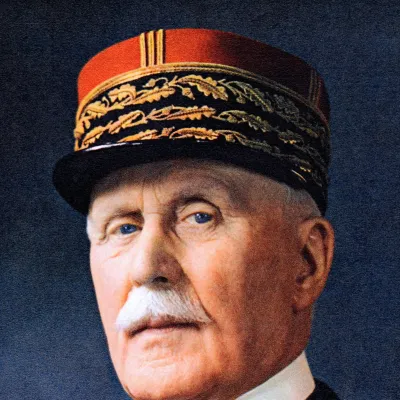
Philippe Pétain
Human Design Chart
Biography
A graduate of the St. Cyr military academy in 1878 and Ecole de guerre, comporting himself well as a colonel in WW I he was promoted to brigadier at Arras in 1915. At Verdun in late February 1916, Petain was made a commander in chief in late April 1917 and a marshal of France under Foch in 1918. In late summer of 1918 he led the successful push of the Germans back to Ardennes. He successfully commanded the French-Spanish campaign against Riff forces in Morocco in 1926 and became Minister of War in 1934.
A handsome, affable man, he liked action and adventure and was capable of hard work and deep concentration. Sent to Spain as an ambassador in 1939, he was loved by the Spanish people but as France started to collapse with the German onslaught of 1940, he returned to Paris, succeeding Reynaud as premier and arranging the capitulation to the Nazis.
He became chief of state in the Vichy government on 11 July 1940. Involved with active collaboration with Germany, he sentenced Charles de Gaulle to death for disciplinary reasons to keep other officers from deserting to the Free French. He sent laborers to Germany, sometimes bluffed the Germans, persecuted the resistance and shamed France with his bumbling contradictions. Fleeing to Switzerland after the liberation of France, Petain was brought back and tried for treason in 1945. Convicted and sentenced to death, his sentence was commuted to life by De Gaulle two days later with incarceration on Ile d'Yeu.
Petain died on the Ile d'Yeu, France on 23 July 1951.
Philippe Pétain — Manifesting Generator with Profile 4/6
Manifesting Generator 4/6 — Design at a Glance
Philippe Pétain was someone who possessed hybrid energy: the constant power of a Generator paired with the lightning-fast action capability of a Manifestor. His design suggested that he could skip steps and quickly pull things into his life. This gave him enormous dynamism but also risked overlooking important intermediate steps, leading to the necessity of going back later to fill in gaps – a process often causing frustration.
As a Manifesting Generator, Pétain had a defined Sacral Center providing him with constant energy. The key mechanism was not initiating himself but reacting to external impulses. Only when his Sacral Center responded with a clear “yes” did action feel powerful and satisfying. Without this confirmation, he tended to juggle multiple projects driven by the speed of his design. This often led to overload as the compulsion for linear completion of individual tasks went against his nature.
Happiness arose for him only in “play mode,” with variety and enjoyment of the process. The advice to finish one thing before starting another was counterproductive. Instead, his design required that he regularly check whether his inner authority and Sacral Center still supported current activities. Only through this continuous reaction to impulses rather than rigid planning could he sustainably utilize his creative power without falling into frustration.
Emotional Authority
Philippe Pétain possessed emotional authority, meaning his defined Emotional Center was his internal decision-making entity. This center underwent a constant wave motion of feelings showing in steady ups and downs. The world appeared colored by his current mood; one moment he might be enthusiastic about something, the next see it negatively. His immediate feeling was only a snapshot, not yet necessarily his truth.
Quick, spontaneous decisions from such emotion risked negative consequences. For Philippe Pétain, taking time to allow decisions to mature was essential. Only through patience and multiple reconsiderations could he gain deeper insights. He had to be patient and repeatedly questioned himself. Over time, intense feelings subsided, giving him emotional distance. Then clarity and calm set in – marking the end of the process. This necessity for delay served as a protective mechanism against deception by momentary mood feelings. The truth only became apparent after the emotional wave subsided, making this strategy particularly important for long-term decisions influencing his life course.
The 4/6 Profile — Opportunist / Role Model
Philippe Pétain’s design was characterized by a clear developmental line: from experimental social behavior in the first three decades of life to the role of wise role model. In his youth, the sixth line of his Profile 4/6 still acted like a third one, encouraging him to experiment much in relationships and friendships. Once the sixth line became active, however, a central conflict emerged: the contradiction between the deep need for belonging (Line 4) and the later emerging urge for transcendent distance and individual superiority (Line 6). This tension between heart and head shaped his entire life.
In his later years, he was expected to meet the high standards of a wise role model and stand out through cooperation. His fourth line showed a transpersonal perspective on care and generosity. However, aimless sharing had to be avoided as it could lead to exhaustion; instead, he needed to learn who the right partners in the network were to preserve his strength. The sixth line brought forth new superiority that was passed onto others, positioning him as a trendsetter. At the same time, this configuration indicated that such superiority could be kept secret to avoid losing special advantages. His care was thus always selective and cautious, protected from false people who might hurt his heart.
Split Definition — Defined & Open Centers
Philippe Pétain was characterized by a design that combined constant energy with an absence of fixed identity. His defined Sacral and Throat centers endowed him with mechanical endurance: he had a daily supply of vitality that felt like a steady hum, enabling reliable communication and action. However, this energy was filtered through his defined Solar Plexus center; his decisions were subject to emotional waves, so clarity often only emerged after waiting for the trend to peak or trough. Additionally, his defined Spleen center shaped his spontaneous intuition in the here and now.
In contrast, Heart, G, and Head centers were open. This meant no internal source of willpower or fixed identity. Philippe Pétain was vulnerable to mirroring himself in his environment and taking direction from outside rather than owning it. The open Heart center led him not to be consistently willful; instead, he tended to want to prove his worth through promises or performance, which often ended in frustration due to the lack of energy for this purpose. The open G center left him without a fixed compass for 'Who am I?', causing him to blend with others' identities. Similarly, the open Head center did not provide consistent mental focus; instead, he sought external inspiration to answer mental questions that were not his own problem. This tension between inner available power and situational dependence on external affirmation shaped his dynamics: he acted out of reaction but suffered from the pressure to find an identity or prove willpower that structurally was not available.
Channels for emotional depth, care and traditional values.
Philippe Pétain's design showed a dominant life force of selfless care, paired with social interaction strongly dependent on his inner emotional wave. This configuration defined him as someone who took responsibility for the weak, yet whose communicative impact was whimsical and transformative.
The Channel of Preservation 27-50 connected the Sacral center to the Spleen center through Gate of Care (27) and Gate of Values (50). With the Sun in Gate 27, this energy made up about seventy percent of his life force. It was about maintaining values and laws as well as providing for the tribe. Philippe Pétain acted as a caregiver who created order and offered protection, taking responsibility for those unable to care for themselves. This channel generated a strong awareness of stability and community welfare driven by an altruistic instinct to preserve the tribe.
Simultaneously, the Channel of Openness 22-12 connected Solar Plexus center with Throat center. It included Gate of Openness (22) and Gate of Caution (12). His social interaction depended on the ebb and flow of his emotional wave. When the mood was right, he could transform others through his voice; at the wrong time, he appeared harsh or withdrew. The restraint in Gate 12 regulated the openness of Gate 22 so that communication only became transformative when the emotional timing was correct. Philippe Pétain had to wait until he felt ready to socially interact to fully express himself.
Additionally, Gates like Player (28) with its focus on present moment risks and Evolutionary Development (41) contributed to complexity. Gate 31 emphasized power transmission while Gate 42 saw experience as the key to development. In the background, Gates such as 32 for continuity, 36 for crisis management, and 23 for amoral negotiation played roles. Gate 3 stood for mutation in the Sacral center, Gate 49 for upheaval at the tribal level, Gate 57 for intuitive clarity in the Spleen, Gate 37 for organic community structures, and Gate 18 for correction in the collective process. These elements formed a design oscillating between stable provision and emotional whims.
Individual Circuitry — Circuit Signature
Philippe Pétain's design presented two separate, parallel operating energy fields. One field connected Throat to Solar Plexus center through the Channel of Openness (22-12). This connection generated a pulsing, acoustic expression of individual identity and emotional transformation. The energy here was effective in the now, driven by creative impulses and the need to express one's uniqueness vocally or through actions.
The second field linked Sacral and Spleen centers via the Channel of Preservation (27-50). This represented timeless, primal instincts for protection, nourishment, and preservation of genetics – a classic 'Mother/Father' energy defending the core circle.
As Philippe Pétain had a split definition, these two systems existed as independent forces alongside each other without direct energetic flow between them. This created an internal tension: sometimes he was driven by the urgent need for individual emotional self-expression (Know-How Circuit), at other times the calm, instinctive duties of care and defense of his tribe (Guardian Circuit) dominated. His action patterns oscillated between impulsive creative expression and a deep, preserving dedication to the survival of his community. This separation meant that the emotional dynamics of expression did not directly merge with instinctive protection mechanisms but were experienced as separate, sometimes competing life tasks.
Right Angle Cross of the Unexpected 1
Philippe Pétain's life path was shaped by the archetypal pattern of the 'Right Cross of the Unexpected'. This structure established a profound, often unconscious motivation: his actions were less driven by conscious planning and more influenced by sudden turns and surprising insights that decisively directed the course of his existence. For him, life was not a linear path but a sequence of unexpected events he could not control but had to react to. The challenge lay in accepting this unpredictability and using it as a catalyst for personal development rather than fighting against the flow of destiny. This configuration described an existential level where the 'why' behind his actions emerged from coping with surprises. Thus, Philippe Pétain was someone whose direction was continually redefined by external shocks or inner revelations that forced him to continuously adapt his stance and path. It represented a fundamental dynamic that less reflected his conscious personality but rather illustrated the underlying mechanism through which his fate was formed – always ready for the unexpected that propelled him forward.
Saturn Return · Uranus Opposition · Chiron Return · 2nd Saturn Return — Life Cycles
Philippe Pétain's design inclined towards structural anchoring and authority formation, particularly in the second half of life. This configuration marked him as someone who solidified his position not through spontaneous impulses but through consolidated experience and clear hierarchical placement. The second Saturn return marks a phase of maturation in Human Design: it is about transitioning from seeking to established authority and taking on responsibility at a higher level. In this cycle, years of groundwork condenses into a sturdy foundation that combines external recognition with inner stability.
In 1914, at the age of 58, Pétain was promoted to Général de brigade. This event served as concrete evidence for the mechanics of the second Saturn return: the promotion was not an accidental career step but the visible result of a long-term consolidation of his role within a structural system. Rather than trying himself in new, untested fields, he solidified his established position and thereby assumed the authority due to him at a higher level. This moment showed how Pétain's design was geared towards integrating responsibility not as a burden but as a natural continuation of his development. Saturn energy here worked stabilizing by translating his previous work into a formal, recognized structure and thus providing him with the foundation for further steps in assuming responsibility.
Manifesting Generator · Emotional Authority — Synthesis
He lived as an Manifesting Generator whose actions were deeply marked by emotional authority. This combination led to a life characterized by rapid initiation and sacral energy but always subject to the necessity of allowing decisions to mature over time. The profile as Networker/Role Model suggests that he oscillated throughout his life between the desire for community and the need for independent reflection – an inner conflict between heart and head that shaped his interactions with others. His defined Throat Center, connected with various centers, gave him a strong expressive power modulated by emotional impulses (Channel 22-12).
A central paradox in his design lay in the tension between the urge for rapid implementation and the emotional wave. He could initiate things swiftly but needed time to gain clarity about the correctness of his decisions. This field of tension between initiation and reaction, between quick action and mature deliberation, ran through his life and shaped his way of interacting with the world – a dance of impulsive energy and the need for emotional affirmation.
2 Defined Channels
Incarnation Cross - Right Angle Cross of the Unexpected 1
Solar Return
The Solar Return shows the moment when the sun returns to its exact birth position - your personal solar year.
Life Cycles
Discover the life cycles with a detailed triple view (birth chart, cycle chart, composite).
Human Design Profile
- Strategy
- To respond - wait for something to respond to
- Authority
- Emotional Authority
- Profile
- 4/6 - Opportunist / Role Model
- Definition
- Split Definition
- Incarnation Cross
- Right Angle Cross of the Unexpected 1
- Date of Birth
- 24.04.1856 22:30
- Place of Birth
- Cauchy-à-la-Tour, France
Frequently Asked Questions
What was Philippe Pétain's Human Design type?
What Profile did Philippe Pétain have in Human Design?
What Authority did Philippe Pétain have?
What incarnation cross did Philippe Pétain have?
When was Philippe Pétain born?
Discover your own Human Design
Are you also a Manifesting Generator? Find out in a personal reading how to unfold your multi-talents and direct your energy wisely.
More Personalities
Back to overviewAldair

Alizée

Angeli

Arletty

Artus

Balthus