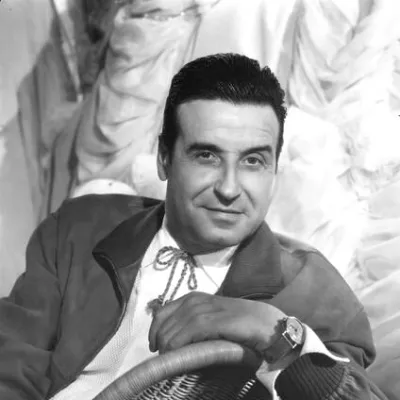
Photo: Wikimedia Commons
Pier Cesare Baretti
Human Design Chart
Biography
He died in an airplane accident at Pinerolo on 5 December 1987, 11:38 AM, Pinerolo, Italy.
Pier Cesare Baretti — Projector with Profile 1/3
Projector 1/3 — Design at a Glance
Pier Cesare Baretti displayed an intense, focused aura that seemed like a bright flashlight, immediately revealing system errors in his environment. His design suggested that he could recognize malfunctions in others instantly but should not address them directly through criticism as this would trigger defensive reactions. Instead, his strategy was to attract by maintaining harmony himself; for example, by cultivating functional relationships, he became attractive and invited others to inquire about his insights. This passive approach proved an effective way to illuminate paths for others without blinding them with direct light.
Since Pier Cesare Baretti did not have a defined Sacral Center, he lacked constant intrinsic life energy. His energy balance followed cycles of high productivity phases and necessary rest periods to avoid burnout. Societal structures often demanded continuous performance, which did not align with this natural rhythm. Living according to this mechanism – waiting for appreciative invitations and conserving his energy – rewarded him with success. Deviations from this design tended towards his non-self theme of bitterness, a feeling of disappointment over an environment that did not seek or accept his leadership.
Self-Projected Authority
Pier Cesare Baretti's design inclined toward extreme openness coupled with the risk of being distracted by motoric energies. As a Projector with rare 'Self Authority', his inner truth was anchored in his identity. Decision-making occurred through spontaneous self-dialogues or physical directional impulses. Crucial was distinguishing between true self and intellect. What Pier Cesare Baretti spontaneously expressed without thinking reflected his true essence, making his uniqueness recognizable to others. This authentic, spontaneous expression served as the key to his potential success.
Alternatively, he felt a physical sensation guiding him geographically or thematically in a specific direction – towards or away from something. Recognizing and following this personal direction could make him a directional guide for others. The greatest trap lay in losing himself in openness and constantly chasing energy. Instead, it was important to wait for invitations and trust his inner compass, which worked either through the direct, unfiltered expression of self or physical pulling within the body. This mechanism allowed him to perceive his specific leadership function despite constant external distraction risks by focusing on his internal identity rather than reacting to others' energy.
The 1/3 Profile — Investigator / Martyr
Pier Cesare Baretti's design was characterized by Profile 1/3, the researcher and experimenter. He showed a fundamental attitude combining theoretical depth with practical experimentation. His path was marked by the principle of 'trial and error': Line 1 demanded patience, introspection, and the need to initially intellectually penetrate insights. Simultaneously, Line 3 urged him to actively test things and learn from mistakes.
This tension between wanting complete security before acting and the urge for immediate experimentation shaped his development. In early phases, fear of insufficient knowledge could dominate, delaying action implementation. Yet, only through lived experience and enduring errors did he gain self-confidence. His authenticity rested on judgments being not just theoretically examined but also practically validated. When Pier Cesare Baretti deemed something valuable, it had passed both the intellectual analysis of Line 1 and the practical test of Line 3. This combination of deep understanding and experiential validation created an authority others could trust. His design indicated that true insight only arose through this double verification – in mind and deed.
Single Definition — Defined & Open Centers
Pier Cesare Baretti's Human Design shows a tendency towards constant mental activity and clear expression. His defined Ajna Center ensured consistent conceptual thinking; he processed data and creativity in the same way, making it hard for external influences to change his approach. These thoughts flowed directly into his defined Throat Center, ensuring that his voice reliably articulated what his mind conceptualized. Paired with his defined G Center, he had a firm self-love and inner direction. He acted as a magnetic anchor point, showing others new perspectives without needing their consent.
This stable triangle axis (Ajna-Throat-G) shaped his identity: He knew who he was and spoke it out loud. The risk lay in projecting this personal direction onto others or contradicting it when he succumbed to external expectations.
In contrast, several open centers revealed areas of receptivity. His open Head Center tended to absorb mental pressure and questions from others, putting him into a state where he constantly sought inspiration or answers that were not his own. The open Heart Center lacked consistent willpower; he was vulnerable to proving his worth through promises despite lacking the sustained energy to do so. His open Sacral Center made him sensitive to the vital energy of his environment. He risked using borrowed energy and overextending himself, as he did not have a steady internal rhythm of energy. Additionally, his open Solar Plexus absorbed emotional waves from others, leading him to personalize feelings that were not truly his own. This openness required him to not identify with the thoughts, emotions, or stress of his environment but rather use them as mirrors.
Channels for logical leadership and structured insight.
Pier Cesare Baretti exhibited a fundamental tension between the need for collective trust and the necessity to communicate unique insights at the right time. His design inclined towards logical leadership that always had to wait for an invitation from the collective.
The Alpha Animal Channel 7-31 connected his G Center with his Throat Center, creating a profile for leadership based on tested patterns and logic. Pier Cesare Baretti possessed the ability to understand trends and guide as the 'power behind the throne.' His authority was not absolute but dependent upon whether the majority chose him. He could show the way but had to accept that he only became effective when the collective was ready to follow him. This mechanism required patience and the skill of exerting influence from a powerful position rather than through coercion.
Simultaneously, the Channel of Structuring 23-43 shaped his mode of expression. It connected his Ajna Center with his Throat Center and received spontaneous insights (Gate 43), which he then assimilated and clearly articulated (Gate 23). This allowed him to formulate innovative perspectives that could change people's thinking. However, this process was highly dependent on timing. If his unique ideas did not come at the right moment or were not guided by strategy, he risked rejection. His mind often worked faster than his environment, leading him to sometimes feel like an outsider waiting for an invitation to contribute his knowledge.
Additionally, other Gates played a role: Gate 4 promoted the formulation of formulas for future security, while Gate 17 emphasized logical teaching and succession. Gate 25 brought a stance of spiritual innocence, and Gate 49 responded sensitively to emotional waves within the tribe. Gate 47 helped in deriving collective meaning from past experiences, and Gate 56 enabled abstract mental processes to be depicted through vivid storytelling. This combination created a person who both respected the structure of the collective while having the potential to further develop it through individual innovations - provided he found the right moment for his contribution.
Individual Circuitry — Circuit Signature
Pier Cesare Baretti's design inclined towards structured, individual expression. He was someone who directly translated inner visions into acoustic forms without emotional filters. This mechanism came from the Knowledge Circuit, whose energy pulsed and focused on the 'now' moment. In him, this power specifically flowed through Channel 43-23 (Structuring), which connected his Ajna Center with his Throat Center. This enabled the transformation of thoughts into clear speech, allowing him to articulate his unique identity and initiate change.
Parallel to this, the Understanding Circuit was at work. Here rational energy flowed through Channel 31-7 (The Alpha Animal), connecting his Throat Center with his Identity Center. This connection stood for logical, strategic thinking and sharing insights free from conditioning. Since Pier Cesare Baretti had a Simple Definition, these two circuits formed a coherent flow: Visual ideas from the Ajna Center were spoken out in structured form (Channel 43-23) and supported by rational identity (Channel 31-7). His expression was thus both creatively bold and logically grounded, a synthesis of individual mutation and strategic clarity.
Right Angle Cross of Explanation 4
Pier Cesare Baretti's design was deeply rooted in an unconscious yet compelling drive: the irresistible urge to explain things and bring truth to light. His essence was marked by a need to pierce through illusions and introduce clarity into the chaos of the world. This formed his ultimate purpose, the 'why' question behind all his actions.
This orientation stemmed from the right cross of Manifestation 4. This configuration focused less on mere information than on understanding connections – the 'how' and 'why'. Pier Cesare Baretti did not merely seek facts but aimed to convey them in a way that others could grasp the underlying mechanisms. It was about enlightenment in its truest sense: removing veils and deception to allow for clear sight of reality.
His life task involved bringing hidden insights to light and making them accessible to others. The process of explanation always took precedence over the result. Through this mechanism, he acted as someone destined to unravel complex matters and make them comprehensible. His influence was seen in his ability to inspire others to think critically and provide tools for their own enlightenment. Thus, the structure of his design determined an existence geared towards not just possessing knowledge but actively using it as a means to free oneself from confusion.
Saturn Return · Uranus Opposition — Life Cycles
Pier Cesare Baretti's life followed universal astrological rhythms structured around two central time points. These milestones defined the temporal framework of his existence, independent of individual Human-Design mechanics. The first Saturn return occurred at about 29 to 30 years old. This cycle traditionally marked a transition into a phase of greater responsibility and structuring of one's life path so far. Later, around 69 to 70 years old, Pier Cesare Baretti reached the Uranus opposition. This second standard time point often signaled a profound reevaluation or release from established patterns of the first half of life. Both events served as fixed reference points in his chronological development. They defined the outer boundaries and turning points within which his personal design could unfold. Without specific content expressions through other factors, these two astrological markers remained purely temporal conditions. They shaped the course of his life through their unchanging periodicity while internal dynamics were determined by other systems. Pier Cesare Baretti thus moved within these prescribed astronomical windows that are equally valid for every person and depict the broad rhythm of human existence.
Projector · Self-Projected Authority — Synthesis
Pier Cesare Baretti lived a life marked by a profound drive towards understanding and logical structure. The combination of defined mental center and the channel of structuring (Gates 23/43) indicates an ability to grasp complex information, recognize patterns, and present them in understandable forms. This manifested as a constant pursuit of knowledge – a researcher profile (1/3), eager to learn and experiment through experience. The connection between G Center and Throat Center in the Alpha animal channel suggests that he not only gathered knowledge but also had a natural inclination to communicate it and lead others, should he be invited to do so.
A central paradox in Baretti's design lies in the tension between his need for clarity and structure and his open emotional wave as well as undefined centers of energy and identity. He was capable of developing and conveying logical systems (Channel 23/43), yet simultaneously absorbed emotions from others more intensely and was susceptible to external influences. This discrepancy might have led to internal conflict, as he sought stability while his open nature constantly exposed him to changing energies.
2 Defined Channels
Incarnation Cross - Right Angle Cross of Explanation 4
Solar Return
The Solar Return shows the moment when the sun returns to its exact birth position - your personal solar year.
Life Cycles
Discover the life cycles with a detailed triple view (birth chart, cycle chart, composite).
Human Design Profile
- Type
- Projector
- Strategy
- Wait for the respectful invitation
- Authority
- Self-Projected Authority
- Profile
- 1/3 - Investigator / Martyr
- Definition
- Single Definition
- Incarnation Cross
- Right Angle Cross of Explanation 4
- Date of Birth
- 12.11.1939 21:00
- Place of Birth
- Dronero, Italy
Frequently Asked Questions
What was Pier Cesare Baretti's Human Design type?
Which Profile did Pier Cesare Baretti have in Human Design?
What authority did Pier Cesare Baretti have?
What incarnation cross was Pier Cesare Baretti assigned?
When was Pier Cesare Baretti born?
Discover your own Human Design
Are you also a Projector? Find out in a personal reading how to unfold your leadership qualities and recognize the right invitations.
More Personalities
Back to overviewSissy Spacek

Alain-Fournier
Anémone

Ann-Margret

Bourvil
Christian-Jaque