Photo: Wikimedia Commons
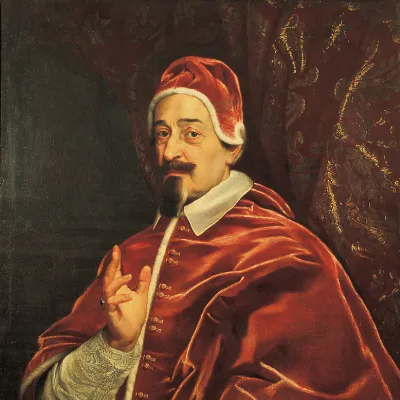
Pope Alexander VII
Human Design Chart
Biography
The Human Design of Pope Alexander VII: Generator 6/2
Generator 6/2 — Design at a Glance
Pope Alexander VII was someone with immense inner endurance whose strength unfolded through reactive actions rather than constant pushing forward. As a Generator, he had a large sacral energy source that made him comparable to a workhorse – provided he acted in harmony with his internal impulses. His design determined that this energy was primarily released when he responded to signals from his environment instead of initiating independently. The motto 'not initiate but react' defined his operational baseline: Only when his sacral center signaled a clear 'yes', could he act with full power and without energetic loss.
This mechanism protected him from the typical pitfalls of his type. As long as he was not forced to complete tasks that did not resonate internally or prevented from pursuing his heart's project despite still having energy, his strength remained intact. Living by this principle of reacting to gut feelings rewarded him with a deep sense of fulfillment. Initiating against his inner compass or acting without this impulsive trigger led sooner or later to frustration and a lack of energy. His effectiveness thus relied on leaving the initiative to others and functioning as a powerful reactor, securing his endurance and satisfaction through consistent responses to life impulses.
Sacral Authority
Pope Alexander VII was a Generator whose decision-making was shaped by sacral authority. This inner guidance is unique to this type and simplifies the process of choice since strategy and authority are identical. His open emotional center ensured that impulses did not stem from fleeting moods but were based on deeper physical truth.
His reactions appeared as immediate responses to external stimuli: an internal gut feeling or a noticeable surge of energy. These signals often manifested as loud bodily sounds like grunts, hums, or groans – a 'mhm' for agreement or a dismissive sound for misalignment. When his sacral center responded to something, Pope Alexander VII had vital energy and inexhaustible enthusiasm. He performed his work with great joy and immersed himself in it without the need for external purpose.
Furthermore, his activated spleen center served as an auxiliary instance to sacral authority. This connection allowed him quick, spontaneous reactions and direct access to his instinctive perception and physical well-being. Reliably guided by these inner signals, he was able to make decisions in the moment of occurrence, supported by a deep physiological resonance with the environment.
The 6/2 Profile — Role Model / Hermit
Pope Alexander VII emerged as someone who learned through intense experimentation and trial-and-error during his youth. His design as a 6/2-line strongly influenced this phase before age thirty: He gathered diverse experiences but withdrew after mistakes to reflect. This early period was marked by the necessity of exploring personal paths and learning from failures before developing a more stable approach.
With the onset of the sixth life phase, triggered by Saturn return, his approach fundamentally changed. Pope Alexander VII metaphorically retreated into a 'cave' to look back at his past experiments with great distance. This period of intense introspection served for healing and deep self-awareness. He used this time to question and transform the principles of his earlier decisions while waiting for emotional clarity.
After this long maturation phase, Pope Alexander VII emerged as a wise person from his retreat. Others sought him out to partake in his life wisdom. His ability for deep introspection became an example. Simultaneously, the second line of his profile showed: He understood how to delegate responsibility and trust experts rather than proving everything himself. This prevented frustration and allowed him to focus on essential principles while giving others the opportunity to contribute their expertise. His wisdom arose from the synthesis of earlier restlessness and later calm distance.
Single Definition — Defined & Open Centers
Pope Alexander VII revealed himself as someone who drew his strength from a deep inner source rather than forcing it through external will. His design was characterized by a defined Sacral Center, which provided him with constant vital energy. However, this power wasn't unleashed through initiatives but rather through reactions to life; he waited for opportunities to arise so that each action was carried out with genuine satisfaction. Additionally, his defined Spleen and Root Centers complemented this: The Spleen Center gave him a sharp intuitive instinct for what was healthy and correct in the moment, while the Root Center provided the necessary pressure to maintain this existential perception in the material world.
In contrast, his design revealed several areas of receptivity. His open Head and Ajna Centers meant that he did not have a fixed mental structure; he tended to mix with others' thoughts or be overwhelmed by doubts when trying to force answers through pure intellect. Similarly, his open Heart Center was vulnerable to the need to prove his worth through promises and performance, often leading to frustration due to the lack of consistent energy for such competitions. His open G Center left him acting without a fixed identity; he did not actively seek direction but relied on being initiated by the environment to find his place and role. Finally, his open Solar Plexus absorbed the emotions of his surroundings, causing him to experience foreign moods as his own unless he consciously distanced himself from this emotional conditioning.
Channels for intuitive self-determination and mature growth cycles.
Pope Alexander VII demonstrated an instinctive alertness and the ability to lead cycles to maturity. The Power Channel 57-34 connected his intuitive insight with sacral life force. This gave him a primitive survival intelligence that protected him from dangers and enabled spontaneous physical reactions. He was acoustically attentive and selective in perception to maintain his well-being. Simultaneously, the Ripe Channel 53-42 shaped his approach to experiences. Through this Gate of Beginnings and Growth, he entered new cycles to complete them fully and reflect on them. This mechanism required patience as premature endings led to repetitions; only completed processes generated wisdom for the collective.
Additionally, specific Gates influenced his behavioral patterns. Gate 14 ensured skillful power preservation and direction finding, while Gate 8 propelled him individually towards group goals and acting as a role model. In the emotional field, Gate 49 promoted adherence to principles and reacting to emotional waves within the tribe. Gate 4 supported him through logical formulas for future security by clarifying suspicious patterns. On a deeper level, Gate 41 drove evolutionary development forward, while Gate 39 triggered mutations through provocation and analysis. Gate 44 helped manage transformations through vigilant acceptance, and Gate 50 preserved conservative values and traditions as protective reflexes. Finally, Gate 48 allowed the recognition of deep patterns in the collective, and Gate 29 fostered a persistent, life-affirming attitude towards challenges. This constellation created an individual who acted instinctively, deepened experiences, and maintained structure.
Individual Circuitry — Circuit Signature
Pope Alexander VII was revealed through a design based on the connection between survival energy and intuitive self-preservation. His defined structure linked the Sacral Center with the Spleen and Root Centers into a cohesive energetic flow. This shaped an attitude where inner strength was guided by proper action and deep intuitive knowledge to be effective in the present moment. The Power Channel between Sacral and Spleen Centers promoted the ability to draw strength from reactions to life and channel this through intuitive insight. Simultaneously, the Meaning Circuit over the Ripe Channel connecting Sacral with Root Center influenced processing past experiences; emotions and insights from history were cyclically traversed to derive common lessons for the collective. As Pope Alexander VII had a simple definition, these centers formed an integrated whole without internal fractures or separate energy fields. His energy was thus aligned both towards securing individual survival in the present moment as well as emotional reflection on the past, with both drawing from the same central source.
Left Angle Cross of Revolution 1
Pope Alexander VII's Human Design showed a tendency towards a profound, revolutionary transformation within himself. This configuration, the left cross of revolution, did not describe an external political rebellion but rather an intense process of self-transformation. It was a life task to dissolve old identities and fixed beliefs in order to make room for a new, often unexpected truth.
This mechanism acted as an inner motor that urged Pope Alexander VII to question established structures within his own consciousness. It was not a gentle change but a radical break with the known to achieve deeper authenticity. The energy of this cross promoted the ability to open up new perspectives in moments of uncertainty or loss of support, which often remained inaccessible to others.
Without specific events in the raw content, the description remains limited to this structural imprint: Pope Alexander VII lived with the potential power for an inner revolution. His design showed him as someone ready to dig deep into the foundation of his self to find a more original form of being. This shaped his internal stance more than external actions; it was an ongoing process of letting go and re-creating that could lead him away from conventional paths to follow a deeper, individual truth.
Saturn Return · Uranus Opposition · Chiron Return · 2nd Saturn Return — Life Cycles
Pope Alexander VII's Human Design indicated a tendency towards strategic patience, which manifested in clear phases of professional consolidation. His first Saturn Return around the age of 29 marked the transition from preparation to binding positioning. In fact, Fabio Chigi entered the service of Pope Urban VIII in 1628 at the age of 29. This step condensed years of preparatory work into a solid career start and firmly established him within papal structures.
Later came his Chiron Return around the ages of 50 to 52, a cycle of fulfillment where one's incarnation cross unfolds and meaning becomes tangible – provided that one lives according to their strategy. For Pope Alexander VII, this blooming phase was in 1651 when he consecrated Maximilian Heinrich von Bavaria as Bishop at the age of 52. This event underscored his growing authority and realization of his spiritual purpose on a high level.
His second Saturn Return around ages 56 to 58 brought final confirmation of long-term development. In 1655, at 56 years old, Fabio Chigi was elected Pope and named himself Alexander VII. This election represented the pinnacle of a carefully planned life path where earlier positioning now led to the highest leadership role. His journey was marked by gradual consolidation, with each cyclical turning point initiating a new level of responsibility and impact within his authority.
Generator · Sacral Authority — Synthesis
Pope Alexander VII lived deeply rooted in his sacral energy (Sacral Center), which drove him to tireless action as long as he found joy in his activities. This power source, however, was inseparably linked with a cyclical pattern: phases of intense activity alternated with the need for withdrawal and reflection (6/2 Profile) to learn from experiences and gain wisdom. He drew his strength from an immediate reaction to life, an intuitive perception of danger and opportunity (Channel 34-57), which made him capable of action and strengthened his will to survive.
This vitality stood in a tension relationship with his need to gather experiences and find himself through trial and error – a process that played a formative role until the Saturn Return. Later, he sought distance to process these accumulated insights (Sensing Circuit) while simultaneously his sacral authority continually drew him back into the active world. Thus, he lived a life between the urge for experience and the necessity of reflection, driven by a deep, cyclical energy.
2 Defined Channels
Incarnation Cross - Left Angle Cross of Revolution 1
Solar Return
The Solar Return shows the moment when the sun returns to its exact birth position - your personal solar year.
Life Cycles
Discover the life cycles with a detailed triple view (birth chart, cycle chart, composite).
Human Design Profile
- Type
- Generator
- Strategy
- To respond - wait for something to respond to
- Authority
- Sacral Authority
- Profile
- 6/2 - Role Model / Hermit
- Definition
- Single Definition
- Incarnation Cross
- Left Angle Cross of Revolution 1
- Date of Birth
- 13.02.1599 07:15
- Place of Birth
- Sienna, Italy
Frequently Asked Questions
What was Pope Alexander VII's Human Design type?
What Profile did Pope Alexander VII have in Human Design?
Which Authority guided Pope Alexander VII?
Which incarnation cross characterized Pope Alexander VII?
When was Pope Alexander VII born?
Discover your own Human Design
Are you also a Generator? Find out in a personal reading how to use your sacral energy correctly and discover deep satisfaction.
More Personalities
Back to overviewAaliyah

Alexia

Angèle

Anne-Marie

Arcángel

Arno