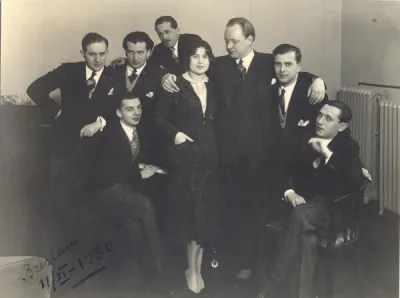
Robert Biberti
Human Design Chart
Biography
Biberti was expelled from school in 1914 at the age of twelve and went into a woodcarving apprenticeship with his father, a once famous opera singer, who had previously ruined his voice with alcohol and an unhealthy lifestyle. However, he sparked his son's interest in music: Biberti sang in operas and theatres, where he eventually met Roman Cycowski and Asparuch Leschnikoff, two other members of the later Comedian Harmonists.
After reading a newspaper advertisement for a new ensemble, he auditioned in 1927 in Frommermann's apartment in Berlin-Friedenau. Both men had a preference for the sound of the American band, The Revelers. They decided to found a similar German-speaking ensemble, the Comedian Harmonists. In 1941, after the ensemble had broken up as a master sextet following the emigration of Jewish members, Biberti was drafted by the Berlin air raid warning centre.
Between 1950 and 1980 he maintained an antique trading business and wrote articles about the Comedian Harmonists for broadcasting. However to make his livelihood he managed the royalties from the Comedian Harmonists' releases.
On 2 November 1985 he died at the age of 83 of kidney failure. Biberti was portrayed by Ben Becker in Joseph Vilsmaier's 1997 film Comedian Harmonists.
The Human Design of Robert Biberti: Generator 4/6
Generator 4/6 — Design at a Glance
Robert Biberti possessed immense endurance and the ability to shape his life through reactive action. His Generator design was characterized by abundant sacral energy, making him similar to a strong workhorse in terms of performance – provided he dedicated himself to tasks that inspired inner enthusiasm. This configuration brought two specific risks: On one hand, there was the danger of wasting energy and burnout if he tackled things he had no interest in. On the other hand, external circumstances could prevent him from working on his heart project even though he still felt full of strength.
The key to his effectiveness lay not in initiating but in reacting. His energy became free primarily when he responded to signals from life. The successful strategy was to listen to inner impulses; if the sacral center said, “Yes! Let’s get started!” it was the right moment for action. If Robert Biberti lived by this principle, his design rewarded him with a deep sense of fulfillment and satisfaction. However, counteracting these mechanisms through constant initiating or ignoring inner signals led to frustration and a lack of energy sooner or later. His path towards materializing life therefore always ran through confirmation from the gut, not arbitrary planning.
Sacral Authority
Robert Biberti lived as a Generator whose decision-making was marked by sacral authority. This configuration simplified his process: strategy and internal authority merged. He did not act hastily but waited for an impulse from outside. His confirmation came from the body – as a gut feeling or surge of energy.
The mechanics of this authority manifested in physical sounds like grunting, humming, or a soft “mhm”. These signals marked a clear “Yes.” When his sacral motor kicked in, he felt vital and alive. Then almost inexhaustible energy was at his disposal. He tackled his tasks with great enthusiasm.
This configuration allowed him to move through life with joy and satisfaction. He immersed himself in his activities without them needing to be bound by external purpose. The work itself was the reward. His design promoted a direct connection to his own well-being and instinctive perception, enabling him to react spontaneously and make reliable decisions that resonated internally. Sacral authority defined the sacral center, which always took precedence over other defined centers regardless of additional active energy centers in his chart. This ensured him a clear, body-based compass for his actions.
The 4/6 Profile — Opportunist / Role Model
Robert Biberti was someone whose life trajectory moved from an intense experimental drive towards reflective wisdom. His Human Design Profile 4/6, the Networker and Role Model, significantly shaped this development. In the first thirty years of his life, before Saturn returned, the energy of Line 4 dominated. Robert Biberti actively sought belonging and gathered experiences during this phase, often by opening his heart to others. This period was marked by misunderstandings and injuries as his large heart had to be careful not to trust the wrong people.
With the Saturn Return around his thirtieth year, Line 6 activated. The focus shifted from individual search to transpersonal leadership. Robert Biberti now faced an internal tension between the desire for community (Heart) and the need for detached meaning-making (Head). This polarity required constant integration. Instead of merely looking back, he used nostalgia to overcome old doubts and ask new questions. In his later years, it was expected that he would meet the demands of a wise role model. His role was to be a trustworthy leadership figure through cooperation with others, enabling mutation in the individual circuitry through valuable impulses.
Single Definition — Defined & Open Centers
Robert Biberti showed a firm foundation through his defined G and Sacral Centers: reliable self-love and clear life direction, paired with powerful vitality that only acted on invitation. This inner stability contrasted with seven open centers – Head, Ajna, Throat, Heart, Solar Plexus, Spleen, and Root – which served as mirrors for environmental influences.
The defined G Center gave him a secure identity and sense of his correct direction. He could love others without becoming dependent and helped them find their paths instead of directing them. His Sacral Center generated constant energy that was only available in response to life; initiation led to exhaustion. The sacral answer – an immediate yes or no – determined whether he had the strength for a task.
The open centers made him vulnerable to conditioning. The open Head and Ajna Centers absorbed mental pressure and foreign inspiration; he tended to dwell on doubts that were not his own, or tried to find answers where none were needed. His open Throat drew attention when he spoke before an invitation came, often leading to unpredictable statements.
The open Heart Center lacked consistent willpower; he was not designed to give promises or compete successfully. Such giving would plunge him into a cycle of failure and self-doubt. The open Solar Plexus absorbed emotional waves from the environment; he had to learn to recognize these feelings as foreign and not personalize them to avoid making false decisions based on emotion.
The open Spleen warned against spontaneous decisions out of survival fear. He tended to cling to things that did him no good, just to gain a sense of security. The open Root Center absorbed external stress; he could amplify this pressure but was not designed to carry it permanently, which could lead to burnout if his own authority was ignored.
His challenge lay in not accepting the situational influences of his open centers as his own truth, but always trusting his defined G direction and sacral response. Only then could he protect his energy and live authentically.
Channels for fixed rituals and extreme life span.
Robert Biberti showed himself to be someone whose inner rhythm unconsciously determined the flow of energy around him. His design had a magnetic quality that drew others into a natural forward-moving rhythm – provided he stayed in tune with his own reactions. This orientation stemmed from Channel Rhythm 5-15, which connected his Sacral Center with his G Center. Gate 5, the Gate of Fixed Rhythms, held fast to habits and rituals, while Gate 15, the Gate of Extremes, integrated the diversity of society into this life flow. This combination created a universal biological pulse, driven not by intellect or emotional waves but by a deep logical necessity.
The magnetism of this channel acted like a monopoly in his G Center: it projected an impersonal love for humanity and drew others magnetically into his timing flow. When Robert Biberti surfed on this inner compass, everything felt effortless; his timing became the fine-tuning for the collective. Outside of this flow, however, he could disrupt the rhythm of others, leading to confusion.
Additionally, other gates shaped his approach: Gate 63 propelled him forward through doubt and a search for security, while Gate 64 helped him transform past experiences into clear concepts. Gate 35 challenged him to seek change through interaction, and Gate 27 endowed his actions with genetic care for the tribe. Finally, Gate 13 ensured that he reflected experiences in the context of time and tended to collective memory. Together, these elements formed a pattern aimed at continuity, improvement, and integrating extremes into a stable life rhythm.
Collective Circuitry — Circuit Signature
Robert Biberti showed himself through a clear rhythmic flow between his identity and drive. His energy was not fragmented but followed a natural pulsing logic that gave rise to actions from the depths of his being. This stemmed from the Rhythm Channel (Gate 15–5), which connected his Identity Center with his Sacral Center. This connection created a direct line from “Who I am” to “What I do,” where sacral energy acted as constant rhythmic power supporting decisions and actions in steady waves.
This channel was part of the Understanding Circuit, but in Robert Biberti it activated only this specific piece. The circuit generally aims at improving society through logic, strategy, and structure by sharing rational insights free from conditioning. Since he had only the connection between Identity and Sacral Centers, this aspect manifested as an inner rhythmic affirmation of his own nature, driven by focused formative energy. It was an “emotionless ratio,” since the Solar Plexus Center was not involved; his judgments and conclusions arose through clear visual logic and future-oriented thinking, unburdened by momentary moods. His simple definition also meant that this energetic line was clear and coherent, without internal contradictions or divided forces, giving him a consistent yet perhaps limited but very authentic presence.
Right Angle Cross of Consciousness 2
Robert Biberti was marked by the archetypal energy of the Right Cross of Consciousness 2. This configuration formed the structuring background for his entire life decisions and strategic orientation. It conveyed a specific way to see the world and position oneself in it, less through external constraints than through an inner, deeply rooted disposition.
The Right Cross of Consciousness 2 stands for a stance of unconditional love and acceptance that is not dependent on conditions or quid pro quo. It's about trusting the natural flow of life and the ability to give space to oneself and others without controlling or manipulating them. This energy promoted an inner peace and calm, which allowed him to meet challenges with a certain distance and wisdom.
For Robert Biberti, this meant that his path was marked by a deep need for authenticity and connection. He did not seek power or control but rather harmony and understanding. His decisions were often guided by this inner compass, encouraging him to connect with what is truly important and let go of what appears superficial. This attitude created a foundation for a life based on empathy and insight rather than egoistic interests or short-term goals.
Saturn Return · Uranus Opposition · Chiron Return · 2nd Saturn Return — Life Cycles
Robert Biberti's design was characterized by two structural turning points framing his life phases: the Saturn Return as a moment of consolidation and the Uranus Opposition as a phase of radical detachment. These astrological cycles acted in Robert Biberti's chart as fixed conditions for professional and personal developments.
The first Saturn Return occurred in 1927 when he was 25 years old. During this period, he founded the Berlin ensemble Comedian Harmonists. For his design, this marked the transition from preparation to a stable structuring of his career. The Saturn cycle condensed years of groundwork into a concrete result that solidified his professional identity. Robert Biberti used this energetic framework to transform his artistic vision into a stable organization.
The Uranus Opposition affected Robert Biberti in 1941 when he was 39 years old. This event led him to enter the Berlin air raid warning center. The Uranus energy often brings sudden changes or crises that dissolve existing structures. For Robert Biberti, this meant a forced detachment from normal life and entry into a state of isolation and surveillance. This cycle showed itself as a moment of radical reorientation in which external circumstances drastically limited his field of action and created a new, enforced reality. Both cycles shaped Robert Biberti's life through clear phases of consolidation and disruptive change.
Generator · Sacral Authority — Synthesis
Robert Biberti lived a life marked by the dynamic tension between inner reaction and outer expression. As a Generator with sacral authority, he found his energy in doing, reacting to impulses from life – a force that was strengthened by his defined Sacral and G Centers. His profile as Networker/Role Model suggests that he experimented much in his early years before later reaching an inner wisdom and the ability to inspire others. The openness of his centers for mental consciousness, emotions, willpower, and root energy suggests that he spent a lifetime learning not to identify with external influences but rather to perceive them as mirrors of his own internal states.
Central to Robert Biberti was the paradox between the need for connection and the ability to distance oneself. His open Heart and Root Centers made him receptive to other people's energies, while his undefined Ajna and Head Centers protected him from getting lost in rigid thought patterns. This combination led to a constant struggle with self-worth and external expectations but also to the ability to live authentically and follow one's path independent of external evaluations – a life marked by rhythm (Channel 24) and the search for meaning (Gate 35).
1 Defined Channel
Incarnation Cross - Right Angle Cross of Consciousness 2
Solar Return
The Solar Return shows the moment when the sun returns to its exact birth position - your personal solar year.
Life Cycles
Discover the life cycles with a detailed triple view (birth chart, cycle chart, composite).
Human Design Profile
- Type
- Generator
- Strategy
- To respond - wait for something to respond to
- Authority
- Sacral Authority
- Profile
- 4/6 - Opportunist / Role Model
- Definition
- Single Definition
- Incarnation Cross
- Right Angle Cross of Consciousness 2
- Date of Birth
- 05.06.1902 21:45
- Place of Birth
- Berlin, Germany
Frequently Asked Questions
What was Robert Biberti's Human Design type?
Which Profile did Robert Biberti have?
What Authority guided Robert Biberti?
What incarnation cross did Robert Biberti have?
When was Robert Biberti born?
Discover your own Human Design
Are you also a Generator? Find out in a personal reading how to use your sacral energy correctly and discover deep satisfaction.
More Personalities
Back to overviewAaliyah

Alexia

Angèle

Anne-Marie

Arcángel

Arno