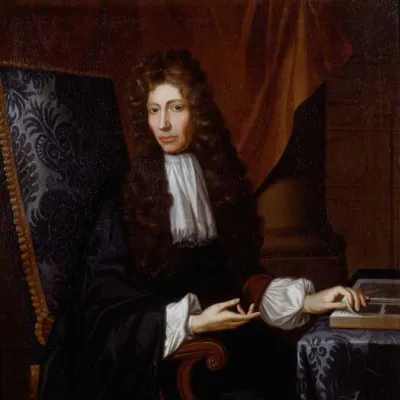
Robert Boyle
Human Design Chart
Biography
Died on 30 December 1691 OS, London.
Robert Boyle as a Manifesting Generator 4/6 in Human Design
Manifesting Generator 4/6 — Design at a Glance
Robert Boyle revealed himself as an individual with a hybrid energy configuration: He possessed the constant power of the Generator combined with the ability to move swiftly like a Manifestor. His design suggested that he could draw things into his life by skipping steps – a speed, however, that carried two risks. Firstly, he tended to be too quick and skip important stages, forcing him to backtrack and fill in gaps, often leading to frustration, his specific Non-Self theme. Secondly, through his speed, he began to take on multiple projects simultaneously as he responded to many different impulses.
To effectively harness this creative power, the strategy was crucial: He had to wait until life spoke to him and only then act when his sacral center gave a clear “yes”. Only with this reaction could he experience deep satisfaction. When this condition was met, Boyle benefited from variety; the pressure to complete one thing before starting another felt restrictive for him. Instead, he found his energy in the “play mode”, where parallel work at sustained interest led to fulfillment. Without this inner consent and response to external impulses, his joy of creation quickly tipped into overextension and dissatisfaction.
Emotional Authority
Robert Boyle’s design indicated a tendency towards emotional wave movement that significantly shaped his decision-making process. He appeared as someone whose inner authority was carried by the defined Emotional Center. In Human Design mechanics, this configuration is prioritized: Whenever the Emotional Center is activated, it takes charge regardless of other defined areas in the chart.
This meant for Robert Boyle that he was subject to constant emotional fluctuation. His perception of the world was always colored by his current mood; what seemed inspiring at one moment could turn negative the next. His immediate feeling merely represented a snapshot, not necessarily the deeper truth. Quick, spontaneous decisions from such an emotional state often proved problematic and had negative consequences.
Instead, his system required patience and time. The longer he let a decision mature, the deeper and more comprehensive he could perceive the situation. This process demanded multiple nights of sleeping on important questions. Through this delay, intense emotions subsided, emotional distance was gained, and eventually clarity and calmness set in. Only then was the inner process complete. This applied particularly to long-term decisions that had a significant impact on his life course. Robert Boyle thus needed to take time and repeatedly ask himself to reach the right insight.
The 4/6 Profile — Opportunist / Role Model
Robert Boyle’s design indicated a tendency towards social networking that evolved over the years. In his first thirty years, he was experimental and actively sought friendships and relationships as his Profile Line six still functioned like a three. This early period was characterized by adaptability and a strong need to make experiences valuable through exchange with others.
With Saturn’s return, his focus fundamentally shifted. An internal conflict emerged between the desire for community belonging and the urge to withdraw to ponder higher questions. This tension between heart and head shaped his further development. In later years, he was expected to take on the role of a wise mentor. His success depended on living this wisdom through cooperation with other people. Yet, his large heart remained cautious; it opened only to selected individuals to avoid injury. The sixth line also brought a readiness for extreme risks to prove life worthwhile and achieve glory. Robert Boyle thus navigated between collective exchange and individual, risk-taking search for truth, where friendships always remained crucial for his success.
Split Definition — Defined & Open Centers
Robert Boyle's design tends towards constant mental pressure to ask questions and grasp connections conceptually. His defined Head and Ajna Centers create a continuous impulse for inspiration and conceptualization, but lack direct energy for implementation. Instead, this mental activity acts as an inspirational source that motivates or pressures others to think independently. His answers and theories are communicated through his defined Throat Center, serving as the pivot point to translate these mental processes into language and action.
This cognitive flow is supported by a strong foundation of willpower and identity. His defined Heart Center gives him the ability to fulfill promises and self-determinedly control resources, while the defined G Center ensures reliable inner direction and self-love. Boyle's energy source comes from his defined Sacral Center; as a Generator, he relies on external stimuli before deploying his vital force to avoid frustration and resistance. Additionally, the defined Solar Plexus and Spleen Centers ensure that decisions are emotionally refined and intuitively made in the moment.
In contrast stands his open Root Center. This center absorbs adrenalized stress from the environment, making him susceptible to external pressure. Without this external stimulus, he tends to feel compelled to constantly achieve or complete tasks to escape a sense of restlessness. The wisdom of his design lies in not misinterpreting foreign stress as personal drive but distinguishing between healthy focus and conditioned frenzy by trusting his inner authority.
Channel 31-7: The Alpha — Channels & Gates
Robert Boyle's design leans towards deep, persistent experiential exploration. Channel Discovery 29-46 connects the endurance of the Sacral Center with the direction of the G Center, allowing him to immerse completely in processes and commit positively until completion to gain insights that expand the collective. Simultaneously, Channel Beat 14-2 links material resources (Gate 14) with higher knowledge for new directions (Gate 2), driving mutative innovations while helping others find their own direction through his aura without actively leading.
His analytical mind is shaped by Channel Logic 63-4. Here, doubts (Gate 63) and formulation (Gate 4) continuously filter patterns to accept only reliable, verifiable answers, creating healthy skepticism that excludes unfounded beliefs and ensures logical conclusions are sound.
In interpersonal dynamics, Channel Pairing 59-6 connects sexual energy (Gate 59) with the emotional wave (Gate 6), leading to intense intimacy. Robert Boyle needs patience to gain clarity in this emotional wave and nurture relationships based on genuine familiarity.
The Alpha Animal channel 7-31 grants him the ability for collective leadership through logical roles (Gate 7) and influence (Gate 31). He seeks his own 'pack' to lead from an influential position, based on tested patterns and community trust.
Entrepreneurially, Channel Devotion 44-26 allows him to instinctively recognize what the tribe needs and offer it persuasively. He acts as a promoter generating resources and supplying the team.
Additionally, Channel Preservation 27-50 ensures care (Gate 27) and protection of traditional values (Gate 50), anchoring his activities in a stable tribal structure that takes responsibility and sustains communities.
Collective Circuitry — Circuit Signature
Robert Boyle's design tends towards rhythmic, pulsating expressive strength. The Knowledge Circuit connects Identity and Sacral Centers through the channel 'The Beat', generating inner acoustic energy that strengthens his unique individuality through mutative paths.
Parallel to this, two separate segments of the Understanding Circuit work: Head and Ajna Centers on one side, Throat and Identity Centers on the other. This configuration promotes logical, rational strategies as well as sharing insights free from emotional influence. The energy is focused and future-oriented.
Another element forms the Meaning Circuit, also connecting Identity and Sacral Centers – here through the channel 'Discovery'. This aspect cyclically turns to the past to reflect emotional waves and learn collectively with the collective.
In the Ego Circuit, Channel Devotion connects Heart and Spleen Centers. This supports cooperation and joint creation of resources through mutual support, where pauses for regeneration are necessary.
Finally, the Archer Circuit links Sacral, Solar Plexus, and Spleen Centers via channels 'Preservation' and 'Pairing'. This primal energy serves protection, care, and preservation of family and genetic continuity. Overall, these separate but parallel existing power fields shape Robert Boyle's energetic landscape.
Right Angle Cross of the Unexpected 4
Robert Boyle's design indicated a tendency towards unpredictable turning points. The right cross of the Unexpected 4 shaped his fate through sudden and often inexplicable changes in external reality. This configuration did not describe inner restlessness but rather a pattern in life itself: moments when circumstances shifted radically without prior warning or logical preparation.
For Robert Boyle, this meant that his path was not linear. Instead of continuous development along a predictable trajectory, he repeatedly entered phases where old structures collapsed and new, often surprising paths opened up. The design showed that he had to learn to live with this discontinuity. The challenge lay in not seeking causes for sudden failure or abrupt success but accepting change as given and responding accordingly.
This mechanism worked independently of his will. It created situations where control seemed illusory. Robert Boyle's experiential world was characterized by the fact that security often proved fleeting, and the unexpected became a normal companion to his life. The right cross of the Unexpected 4 demanded an attitude of flexibility. Those who tried to stop the flow or predict it found themselves at odds with their own energetic structure. Instead, the strength of this design lay in quickly rising again after a sudden fall and embracing the new without needing to fully understand it first.
Saturn Return · Uranus Opposition · Chiron Return · 2nd Saturn Return — Life Cycles
Robert Boyle's design indicated a tendency towards structured, scientific work that condensed into clear milestones throughout his life. His first Saturn Return marked 1655 with his establishment in Oxford as a turning point – here, years of groundwork often ripened into a solid result and ushered in new phases of life. At the age of 39 during the Uranus Opposition, he published 'Hydrostatical paradoxes' and 'The origine of formes and qualities'. This phase brought a profound transformation: old structures were questioned to make way for innovative insights. The Chiron Return in 1675 when he was 48 years old coincided with the publication of 'Some considerations about the reconcileableness of reason and religion' as well as further experiments. This cycle symbolized a period of flourishing where his incarnation purpose could unfold – a moment of fulfillment and meaning-making. Finally, the second Saturn Return in 1684 brought the publication of 'Experiments and considerations about the porosity of bodies in two essays'. Here again, long-term efforts led to maturation that was significant both personally and professionally. Each of these events underscored the importance of his strategy and authority: through continuous reflection and action according to his inner compass, he created works intended to have an impact beyond his life.
Manifesting Generator · Emotional Authority — Synthesis
Robert Boyle lived a path shaped by a dynamic interplay between sacral energy and mental pressure. His defined Sacral Motor (from the Manifesting Generator design) gave him the ability to react to impulses and quickly initiate things – a drive that was particularly strengthened by the Channel of Beats (14/2). Simultaneously, his defined Head Center generated constant mental pressure to question and understand things, which continually inspired him anew but could also sow confusion. This combination of reactive energy and intellectual curiosity created continuity in his work, evident in documented career events: a steady experimentation, formulation, and publication of new insights.
Central for Robert Boyle was the tension field between the desire for community (Line 4 in Profile) and the necessity to forge his own path (Line 6). Emotional authority required maturing time for decisions while the Manifestor component inclined him to skip steps. This internal conflict between the need for validation from others and the drive towards individual knowledge seemed to play out repeatedly over cycles – a dance of cooperation and independent thinking that shaped his work.
7 Defined Channels
Incarnation Cross - Right Angle Cross of the Unexpected 4
Solar Return
The Solar Return shows the moment when the sun returns to its exact birth position - your personal solar year.
Life Cycles
Discover the life cycles with a detailed triple view (birth chart, cycle chart, composite).
Human Design Profile
- Strategy
- To respond - wait for something to respond to
- Authority
- Emotional Authority
- Profile
- 4/6 - Opportunist / Role Model
- Definition
- Split Definition
- Incarnation Cross
- Right Angle Cross of the Unexpected 4
- Date of Birth
- 25.01.1627 15:00
- Place of Birth
- Lismore, Ireland
Frequently Asked Questions
What was Robert Boyle's Human Design type?
What was Robert Boyle's Profile in Human Design?
What authority did Robert Boyle have in his design?
What incarnation cross did Robert Boyle have?
When was Robert Boyle born?
Discover your own Human Design
Are you also a Manifesting Generator? Find out in a personal reading how to unfold your multi-talents and direct your energy wisely.
More Personalities
Back to overviewAldair

Alizée

Angeli

Arletty
Artus
Balthus