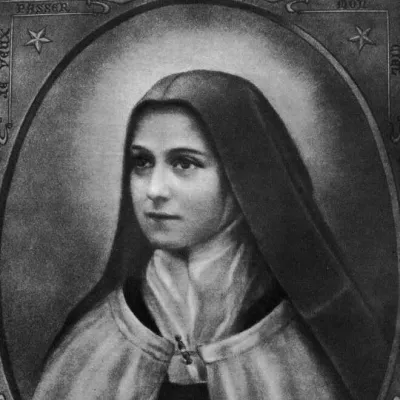
Saint Thérèse of Lisieux
Human Design Chart
Biography
She was the youngest of nine children; five of the girls survived and they all became nuns.
Assigned to pray for Maurice Belliere, Therese responded to the young seminary student and in 21 letters, the two young people shared tenderness and affection, but with a love that focused on the kingdom of God instead of the desires of the world. A model of simplicity, sincerity, patience and devotion, she suffered with TB and died of a pulmonary hemorrhage on 30 September 1897, 7:30PM, Lisieux, France at the age of 24.
The Human Design of Saint Thérèse of Lisieux: Manifesting Generator 4/6
Manifesting Generator 4/6 — Design at a Glance
Saint Thérèse of Lisieux revealed herself as someone who worked with hybrid energy: she had the constant power of a Generator, yet also possessed the ability to swiftly set actions into the world. Her design inclined towards skipping steps and rapidly pulling things into her life. This speed was a double-edged sword. If she moved too quickly and skipped important stages, she often had to backtrack to make up for the missing pieces - a process that quickly led to frustration, a specific challenge of her type. Additionally, she tended to respond to many different impulses and pursue multiple projects simultaneously. This only worked smoothly if her inner authority and strategy fully cooperated; otherwise, her creative enthusiasm quickly turned into exhaustion. The key to her satisfaction lay in not initiating herself but responding to life. Only when her Sacral Center gave a clear 'yes' did she start to act. In this state of 'play mode', she could draw deep satisfaction from her creativity. Parallelism was no obstacle for her, but a source of vitality, as long as she enjoyed the variety and did not feel the pressure to finish one thing before starting the next. Her energy flowed best when she responded rather than forced, and when she used her speed in harmony with her inner confirmation.
Emotional Authority
Saint Thérèse of Lisieux revealed herself as someone who never made decisions in the heat of the moment. Her design inclined towards being guided by the current emotional wave without immediately accepting it as the final truth. She possessed emotional authority, carried by her defined Emotional Center. This mechanism means that her inner guidance always went through this emotional wave, regardless of which other centers were defined in her graph. Emotional authority always takes precedence over all other defined centers; it is the primary compass.
Saint Thérèse of Lisieux was subject to a constant up and down of her feelings. The world appeared to her always colored by her current mood: once enthusiastic, in the next moment negative. She recognized, however, that this feeling was only a snapshot, a first impression, not yet her deeper truth. Quick, spontaneous decisions from this emotional heat could have had negative consequences. Instead, she took her time. She let decisions mature, often over several nights. This process required patience and conscious hesitation. Over time, the intense feelings subsided, she gained emotional distance. Only then did clarity and calmness set in, necessary for long-term, life-defining decisions. She took her time properly and asked herself multiple times until the emotional wave subsided and the true direction became visible.
The 4/6 Profile — Opportunist / Role Model
Saint Thérèse of Lisieux's design inclined towards experimental behavior in her early decades. The Profile 4/6 acted in this phase similarly to a Line 3, which prompted her to try various things in relationships and friendships and to explore boundaries. This early phase served the collection of experiences before the deeper structure of the profile unfolded.
With the activation of Line 6, typically after the first Saturn return, an inner conflict emerged. Saint Thérèse of Lisieux stood between the heart need of Line 4 to belong to a community and the head need of Line 6 to withdraw to think about the meaning of life. This contradiction between belonging and spiritual distance shaped her inner landscape.
In her later years, she was expected to take on the role of a wise mentor. Line 6 enabled her to share deep inspiration and patterns with others, confirming their value. At the same time, Line 4 required caution to not hurt the big heart through false alliances. Aggressive resistance hindered the necessary individual processes and trust, crucial for her development. Saint Thérèse of Lisieux thus stood out through cooperation and sharing of insights, while she also learned to strategically protect her emotional openness.
Split Definition — Defined & Open Centers
Saint Thérèse of Lisieux was revealed as a person with a deep, enduring inner strength, characterized by a clear voice and profound emotional depth. Her design was marked by defined centers for communication (Throat), vital energy (Sacral), emotional awareness (Solar Plexus), intuition (Spleen), and stress management (Root). This configuration endowed her with the ability to express herself reliably, use her energy purposefully, and trust her inner intuition. At the same time, her open Head Center revealed a receptivity to inspiration, while the open Ajna Center fostered a flexible, learning mental awareness. Her open G Center allowed her to reflect in various roles and relationships without adhering to a rigid identity. The open Heart Center freed her from the pressure to prove herself through willpower or promises. Saint Thérèse of Lisieux lived in accordance with her strategy by waiting for her sacral response and her emotional will before making decisions. Her intuition guided her through daily life, and her defined root energy helped her manage stress and move forward. Through her open-mindedness, she could embrace new ideas and adapt to different environments without being led by external expectations or the need for recognition. Her design supported an authentic, inner-driven spirituality based on trust in her own inner processes.
Channels for emotional waves, powerful impact and life's meaning.
Saint Thérèse of Lisieux was characterized by an immediate, almost uncontrollable urgency in her energy. Her design inclined her towards rapid action with little room for hesitation. This resulted from the Channel of Charisma 34-20, which channeled the physiological power of the Sacral Center directly into the expressive ability of the Throat Center. This connection generated a charismatic presence, but it was only effective when reacting to external stimuli rather than acting from inner will. Without this sacral guidance, her energy tended to behave like a misdirected rocket, explaining her difficulty in sitting still or remaining calm.
At the same time, she carried the Channel of Life Struggle 38-28, which drove her to find deep meaning in her conflicts. This was not about arbitrary disputes but a conscious resistance against external forces threatening her individual integrity. She actively sought battles with value and found her life purpose in this stubborn determination. This channel helped her break free from collective expectations and forge her own path, even if this came with inner stress that she had to alleviate through movement.
Her emotional landscape was shaped by the Channel of Emotion Release 39-55, bringing a natural moodiness, a continuum between ecstatic joy and melancholic uncertainty. Saint Thérèse of Lisieux learned to accept these waves without rationalizing them. Her provocation served to test the minds of others and find suitable relationships. She understood that her impact strongly depended on her current mood and used times of solitude to nurture her emotional depth and creativity rather than burdening herself with false company.
Individual Circuitry — Circuit Signature
Saint Thérèse of Lisieux's design inclined her towards emotional intensity and impulsive reactions, yet this was complemented by a separate, parallel channel for communicative charisma. As she had a Shared Definition, these energies did not flow as a continuous stream but as two independent fields.
The Knowledge Circuit connected her Spleen, Root, and Solar Plexus Centers. Through the Channel 28-38 (Life Struggle), a pulsating energy responded to survival instincts and emotional waves, creating an inner tension between intuitive perception and emotional processing. The second channel of this circuit, 55-39 (Emotion Release), allowed for the expression of these accumulated feelings, often accompanied by melancholy or creative impulses. This configuration fostered a unique identity marked by emotional turbulence and a drive for transformation.
Parallel to this, the Integration Circuit connected her Throat with her Sacral Center. The Channel 20-34 (Charisma) utilized the power of reacting to life (Gate 34) and directed it into the immediate present (Gate 20). This endowed her communication with an acoustic, present-oriented quality. She could articulate intuitive impulses directly into words without them being filtered through the emotional or survival-related processes of the other part of her design. Both systems worked alongside each other: one for inner emotional dynamics and individual expression, the other for a powerful, direct articulation in the here and now.
Right Angle Cross of Tension 4
Saint Thérîse of Lisieux's Human Design profile indicated a tendency towards inner tension that was not resolved through external action but rather through a quiet, persistent dedication. This configuration, the right cross of tension 4, described a life task that worked in the background. It was not about a visible project or public achievement, but rather an inner attitude that touched others through her mere presence.
The mechanics of this cross point to an energy that unfolds in the background. She did not seek recognition or validation from the outside. Instead, she dedicated herself to something of deep, personal significance without imposing it on the world. This kind of tension arose from the need to support something greater than herself, yet without taking control.
Her influence was subtle and often invisible. She acted as a catalyst, setting processes in motion in others without herself being in the spotlight. This configuration required patience and trust in her own path, even when the results were not immediately visible. Saint Thérîse of Lisieux lived this tension by channeling her energy into a quiet, constant dedication that over time had a profound impact on her environment. Her profile showed that true strength often lies in the ability to work in the background and support others without standing in the limelight.
Manifesting Generator · Emotional Authority — Synthesis
Saint Thérîse of Lisieux lived a life marked by a deep interplay of sacral energy and emotional depth. As a Manifesting Generator (with defined Sacral Center), she responded to impulses and could quickly draw things into her life (Channel of Charisma), yet always filtered through a pronounced emotional wave (Emotional Authority). This combination led to a dynamic lifestyle characterized by phases of intense experience followed by emotional processing. The profile as a Networker/Role Model suggests that in her later years, she took on a role of connection and example, always mindful of opening authentically (Line 4) while maintaining her inner truth (Line 6).
A central paradox in her profile lay in the tension between the need for community (Line 4) and the desire for inner reflection (Line 6). This duality, amplified by the right cross of tension 4, created a life in which she engaged with the world while continually seeking retreat for inner reflection. The quick, sacral energy that drove her was tempered by the need for emotional maturity and reflection, leading to a continuous interplay between action and contemplation.
3 Defined Channels
Incarnation Cross - Right Angle Cross of Tension 4
Solar Return
The Solar Return shows the moment when the sun returns to its exact birth position - your personal solar year.
Life Cycles
Discover the life cycles with a detailed triple view (birth chart, cycle chart, composite).
Human Design Profile
- Strategy
- To respond - wait for something to respond to
- Authority
- Emotional Authority
- Profile
- 4/6 - Opportunist / Role Model
- Definition
- Split Definition
- Incarnation Cross
- Right Angle Cross of Tension 4
- Date of Birth
- 02.01.1873 23:30
- Place of Birth
- Alençon, France
Frequently Asked Questions
What Human Design Type was Saint Thérîse of Lisieux?
Which Profile did Saint Thérèse of Lisieux have?
What Authority did Saint Thérèse of Lisieux have?
Which Incarnation Cross did Saint Thérèse of Lisieux have?
When was Saint Thérèse of Lisieux born?
Discover your own Human Design
Are you also a Manifesting Generator? Find out in a personal reading how to unfold your multi-talents and direct your energy wisely.
More Personalities
Back to overviewAlain-Fournier

Aldair

Alizée

Angeli

Arletty

Artus