
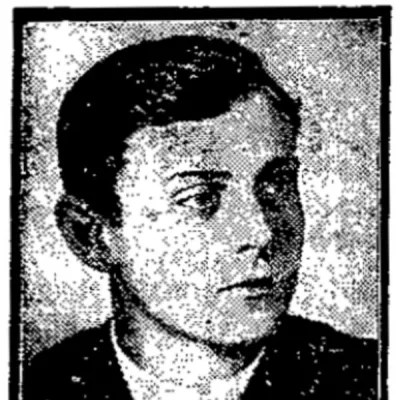
Siegfried Borries
Human Design Chart
Biography
Borries studied at the Rheinische Musikschule in the master class of professor Bram Eldering from 1929. At the first International Competition for Voice and Violin in Vienna in 1932, he was the only German among 300 applicants to receive the "Großen Internationalen Preis" and a few months later, in October 1932, also the "Mendelssohn Prize Berlin" from the State Academy of Music in Berlin.
At the age of 20, on 1 January 1933, he was appointed 1st concertmaster of the Berlin Philharmonic by Wilhelm Furtwängler. In May 1936, he was awarded the first ever "Musikpreis der Reichshauptstadt Berlin". Also in 1936, he became a teacher at the Stern Conservatory. At the Reich Music Days in the summer of 1939, Borries was awarded the National Music Prize 1939 as the best German violinist of the next generation of soloists. From 1941 to 1945, Borries was special concert master of the Staatskapelle Berlin under Herbert von Karajan's authority.
As a chamber musician, he played from 1933 to 1945 together with his Philharmonic colleagues Heinrich Breiden, flute and Hans Ahlgrimm, 2nd violin in the Borries-Breiden-Ahlgrimm Trio. Borries was listed as an important violinist of the NS State on Goebbels' Gottbegnadeten list.
After the end of the war, in 1945, he took over the master classes for violin at the newly founded "International Music Institute Berlin". He also resumed his position as concertmaster of the Philharmonic Orchestra and became director of its chamber music association. From 1948, he taught violin (since 1949 as professor) at the Berlin University of the Arts and developed in the following years a lively concert activity as soloist and chamber musician in Germany and abroad.
The Human Design of Siegfried Borries: Manifesting Generator 3/5
Manifesting Generator 3/5 — Design at a Glance
Siegfried Borries revealed himself through a hybrid energy configuration: The constant life force of a Generator combined with the direct and swift action power of a Manifestor. This design allowed him to skip steps when implementing ideas and draw quick results into his life. However, this speed carries specific risks. Often he tended to overlook important intermediate steps or take on multiple projects simultaneously, driven by reactions to numerous different impulses. If during this multitasking he did not wait for the inner "yes" signal from the sacral center, his initial creative enthusiasm quickly turned into frustration – his specific non-self theme.
The effective strategy for him was to initially wait and react to life despite the high speed. Only when the sacral center gave a clear approval should he act. Regular checks to see if his inner authority still approved of ongoing projects were crucial to avoid this frustration. When these conditions were met, Siegfried Borries derived deep satisfaction from his work. In this state, parallel working was no problem; in fact, variety and playful mode were essential for him to fully unleash his creative power and remain sustainably satisfied.
Emotional Authority
Siegfried Borries showed a decision-making approach that required time and distance: spontaneous reactions were unreliable for him, true clarity only set in after "sleeping on" questions. This tendency stemmed from his emotional authority, carried by the defined Solar Plexus Center. In Human Design mechanics, this authority is always considered primary, regardless of other defined centers in the chart.
This center was subject to a constant wave motion of feelings that continually recolored his perception. What appeared inspiring at one moment could become negative the next. However, this emotional coloring did not mean that the initial impulse was the truth; it was merely a snapshot. Quick decisions based on immediate emotion often risked negative consequences since they relied on fleeting impressions.
Instead, his design required patience. The longer Siegfried Borries gave space to a decision, the more intense feelings subsided. Through multiple "sleeping on" periods, he gained emotional distance. This process of clarification did not lead to confusion but rather to deeper insight and calmness. Only when this peace arrived had the emotional cycle run its course and the decision hit the core of his truth. This mechanism particularly shaped long-term life decisions, where the temporal distance between impulse and clarity was crucial for the quality of the outcome.
The 3/5 Profile — Martyr / Heretic
Siegfried Borries revealed himself as someone who did not accept knowledge theoretically but acquired it through personal experimentation. His design established a basic attitude: initial skepticism towards prefabricated solutions, followed by the necessity to experience everything firsthand and make mistakes along the way. This learning process through trial and error formed the foundation of his later effectiveness.
As a person with Profile 3/5, the Experimenter and Hero, he accumulated a rich treasure trove of practical experiences. Line 3 challenged him not to rely on authorities but to find his own truth through failure and success. This authentic, practice-based competence attracted others. It allowed him to solve other people's problems with his self-acquired knowledge – the role of Helper or Rescuer as described by Line 5.
This dynamic created a tension: On one hand, he enjoyed recognition as a competent hero; on the other hand, he had to experiment publicly and risk failure in front of an audience. His ability to adapt and "sell" his ideas did not rely on manipulation but on the credibility of his lived experience. The charm that emanated from him resulted from this open presentation of his journey – including failures. As a result, he became a trustworthy source for others to learn from because his solutions were not abstract but tested.
Split Definition — Defined & Open Centers
Siegfried Borries revealed himself through a consistent, reliable voice. His defined Throat Center served as a focal point, transforming messages from the body into clear communication and action. This expressive ability drew upon his defined Sacral Center, the source of his vital energy. Here, the strategy was waiting: Only by reacting to external impulses - the spontaneous yes or no tone - did he have access to strength. Initiated actions, on the other hand, led to exhaustion and resistance as they stretched this generative source.
His decision-making was under the authority of his defined Solar Plexus Center. Emotional clarity did not arise in the moment but only after navigating the emotional wave. Siegfried Borries had to learn patience and hold back impulses at the peaks or troughs of these waves to avoid false conclusions. This was complemented by his defined Spleen Center, which gave him intuitive moment authority. It provided spontaneous judgments about health and well-being in the here and now that he needed to trust without rationalizing.
At the same time, a constant inner pressure from his defined Root Center propelled him forward. The challenge lay in not obsessively acting out this stress but channeling it through his strategy and authority.
His design also showed clear openings making him vulnerable to conditioning. His open G Center meant no fixed identity or direction; he tended to blend with the environment seeking borrowed security rather than walking his own path. Open Head and Ajna Centers lacked consistent mental awareness, leaving him prone to falling into mental monologues of doubt or confusion that were not his, as well as interpreting others' concepts as his truth. Additionally, his open Heart Center revealed a tendency to make promises and prove worth through willpower - a mechanism that could spiral him into cycles of self-doubt and overextension due to the lack of consistent energy for such commitments.
Channels for emotional transformation, change, openness and life purpose.
Siegfried Borries was characterized by an energy that worked in pulsing waves: phases of intense creative power alternated with times of stillness and melancholy. This stemmed from Channel 60-3, connecting Root Center to Sacral Center, bringing evolutionary change through a powerful on/off energy marked by Gate 60 (Limitation) and Gate 3 (Order). The accompanying melancholy was not a deficit but a sign of inner work beneath the surface; Borries had to learn not to rationalize these phases away but wait patiently until the next mutation ripened.
His communication followed an emotional wave. Channel 22-12, connecting Solar Plexus Center with Throat Center, regulated his social expression through Gate 22 (Openness) and Gate 12 (Caution). Borries opened up to others only when his mood was right. In these moments, he could deeply impact listeners and trigger transformative states of consciousness in them. Coercion or impulsivity would have destroyed this effect; authenticity emerged only by waiting for the right emotional tide.
Additionally, Channel 38-28 shaped his stance. It connected Root Center with Spleen Center via Gate 38 (Fighter) and Gate 28 (Player), giving him a stubborn determination to walk his own path and find meaning in life's struggles. Borries did not seek conformity but used resistance as fuel for his individuation.
Channel 36-35 drove him towards seeking new experiences. Through Gate 36 (Crisis) and Gate 35 (Change) in Solar Plexus and Throat Centers, he learned that feelings are transient. This realization helped him gain wisdom through experience and give others the courage to seize the moment without clinging to passing states.
Individual Circuitry — Circuit Signature
Siegfried Borries was marked by an identity shaped by a drive for individual deviation and emotionally filtered expression. His design featured a Split Definition, meaning two energetically separate power fields existed in parallel without directly flowing into each other.
The Knowledge Switch Circuit formed one of these poles. Here, Throat Center and Solar Plexus Center were directly connected, so new insights had to first mature emotionally before being articulated. Parallel to this was a separate connection between Sacral-, Root- and Spleen Centers. This group fueled the energy for life's struggle (Channel 28-38) while mutations (Channel 3-60) and openness (Channel 12-22) operated in this isolated area. There was no direct flow between the expression level in neck/Solar Plexus and action power in lower body; they were separate energy centers.
The second pole was the Meaning Switch Circuit, also connecting Throat with Solar Plexus Center (Channel 35-36). This emphasized the cyclical nature of his emotional processing: He reflected on past experiences to grasp their meaning and then passed these insights wave-like to others. Both switch circuits used the same expression channel in throat area, characterizing his communication through a blend of innovative change (knowledge) and historical reflection (meaning finding). The split definition meant however that these impulses did not automatically transition into each other but worked as distinct, parallel energy fields in his life.
Right Angle Cross of Rulership 1
Siegfried Borries had the Human Design architectural imprint of the 'Right Cross of Governing'. This configuration established a fundamental attitude that leadership and structuring were not external roles but internal life tasks. For him, it was about integrating power and responsibility; authority was for him not a means to control others but an instrument to create order and stability in his environment.
The 'Right Cross of Governing' describes a specific energetic alignment that enables the bearer to act strategically and make decisions with foresight. Siegfried Borries showed himself as someone who had the right to govern – in the sense of taking responsibility for systems or communities. This imprint challenged him to accept his own authority and use it constructively, rather than suppress or misuse it.
The mechanics of this cross indicate that true leadership arises from inner clarity. Siegfried Borries had to learn that his strength lay in creating structures that offered others support. It was a task of self-assertion in service of the whole. His energy focused on transforming chaos into order and instilling security through clear decisions. This shaped his actions sustainably: He did not seek recognition as a ruler but fulfilled his role as a designer of frameworks within which others could live and act. The connection between strategic thinking and the exercise of authority formed the foundation of his personal development and contribution to the world around him.
Saturn Return · Uranus Opposition · Chiron Return · 2nd Saturn Return — Life Cycles
Siegfried Borries’ design laid a tendency towards structural anchoring and continuous development, with the first Saturn return as a decisive phase of maturation. This cycle marked the transition from experimental youth to established identity, where years of inner work often condensed into tangible external results. For his design, this period was not just an age limit but a mechanism of confirmation: What had been formed internally now sought a firm form in the material world.
In 1939, at the age of 27, Siegfried Borries received the National Music Prize for the best German violinist among young soloists. This event served as concrete evidence of the effectiveness of this cycle. The prize was not an accident but a visible result of the consolidation required during the Saturn return. Instead of further dispersing his energy, he focused it on clear readiness to perform, which was externally recognized. Here, the mechanics show how inner structure is strengthened through external validation. Success confirmed not only his ability but also stabilized his self-understanding as a musician. It was the moment when potential became tangible reality and provided him with the necessary foundation for future steps.
Manifesting Generator · Emotional Authority — Synthesis
Siegfried Borries’ life was marked by a deep, internal dynamic between the need for authentic expression and the ability to adapt to changing circumstances. His design as an Manifesting Generator with emotional authority points to a person who had both the energy to set things in motion and the necessity to run these impulses through careful emotional scrutiny. The connection of Sacral and Root Centers gave him strong inner drive, while the open Heart Center made him receptive to external influences – a constant interplay between inner energy and outer resistance.
This interplay manifested in a central paradox: Borries’ design demanded both from him to find and follow his own direction (Sacral) as well as remain open for new experiences and influences (open heart). The tendency towards experimentation (Line 3) and the hero role (Line 5) pointed to someone who defined themselves through trying out new paths, while emotional authority compelled him to critically question these impulses and only implement them after a phase of emotional clarity. This tension between the drive for innovation and the necessity of inner maturation shaped his life path.
4 Defined Channels
Incarnation Cross - Right Angle Cross of Rulership 1
Solar Return
The Solar Return shows the moment when the sun returns to its exact birth position - your personal solar year.
Life Cycles
Discover the life cycles with a detailed triple view (birth chart, cycle chart, composite).
Human Design Profile
- Strategy
- To respond - wait for something to respond to
- Authority
- Emotional Authority
- Profile
- 3/5 - Martyr / Heretic
- Definition
- Split Definition
- Incarnation Cross
- Right Angle Cross of Rulership 1
- Date of Birth
- 10.03.1912 02:00
- Place of Birth
- Münster (Nordrhein-Westf.), Germany
Frequently Asked Questions
What was Siegfried Borries' Human Design type?
What Profile did Siegfried Borries have in his Human Design?
Which Authority guided Siegfried Borries?
What incarnation cross did Siegfried Borries have?
When was Siegfried Borries born?
Discover your own Human Design
Are you also a Manifesting Generator? Find out in a personal reading how to unfold your multi-talents and direct your energy wisely.
More Personalities
Back to overviewAaliyah

Aldair

Alexia

Alizée

Angèle

Angeli
