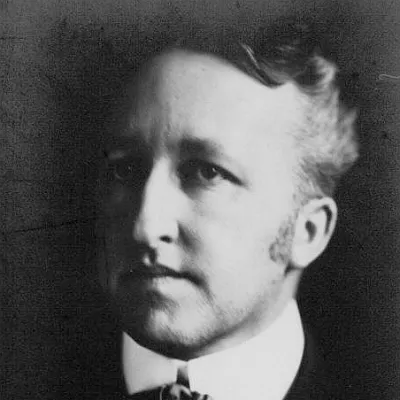
Photo: Wikimedia Commons
Siegfried Wagner
Human Design Chart
Biography
What does Manifestor 5/1 mean for Siegfried Wagner?
Manifestor 5/1 — Design at a Glance
Siegfried Wagner's design laid the foundation for a role as a pioneer and visionary. He was a Manifestor, a type destined to lead the world in new directions. His inner drive was akin to that of an emperor in ancient Rome: he had the grand vision but did not fight every battle himself. Instead, he gave impulses and let others carry out the concrete steps.
This style of leadership inevitably polarized him. Because his thoughts often reached further than those around him, Siegfried Wagner was frequently misunderstood. Some people loved and followed him for his big dreams, while others rejected or even hated him. This conflict was not a personal failure but a structural characteristic of his design: progress meets resistance.
To minimize this friction, his strategy was to inform. Before he acted, he had to clearly communicate his intentions and visions. Only then could the right followers find him and follow him. When Siegfried Wagner followed this strategy, he was rewarded with an inner peace. Living against this principle, however, left him feeling a persistent, deep anger. His path was therefore not that of a silent follower but that of a leader who created space for his vision through clear communication while accepting misunderstanding as part of the process.
Emotional Authority
Siegfried Wagner's decision-making was marked by an inner dynamic requiring time and distance. His internal authority lay in the defined Emotional Center – a mechanism that can occur in every type except Reflectors and always takes precedence over all other defined centers. This meant his perception was colored by constant emotional waves: at one moment he could be enthusiastic about something, in the next negatively assess the same situation. Such immediate feelings were only snapshots, not ultimate truth. Quick, spontaneous decisions based on this fleeting mood would often have negative consequences. Instead, his design showed a need for decision-making to mature over time. Through patience and consciously sleeping on important questions, he gained emotional distance. Initial intense emotions gradually subsided, allowing clarity and calmness to emerge. Only then was the inner process complete and a well-founded decision possible. This mechanism primarily affected long-term decisions that significantly influenced his life path. Siegfried Wagner therefore had to take time and ask multiple times to ensure his choice did not stem from a passing mood but rather his deeper emotional truth.
The 5/1 Profile — Heretic / Investigator
Siegfried Wagner's design established a foundation as a hero and researcher. He used the depth of his own knowledge base to provide concrete solutions for other people. This Profile 5/1 gave him almost magnetic qualities: others actively sought out his insights, believing they held answers to their problems.
This dynamic resulted from the connection between Line 1, which stands for intense self-knowledge and research, with Line 5, focusing on sharing experience in crisis times. Gate 35 promoted selflessness and altruism; his knowledge should be shared, not hoarded. Simultaneously, Gate 22 represented attention and courtesy, enabling profound changes that he transferred to society. Often this happened from a subordinate position without direct reward.
The challenge lay in balance: without clear boundaries, exhaustion threatened through constant demand from others. Learning to say no allowed him to maintain the beneficial tension between private research and public problem-solving. Thus, his essence revealed someone who uncovered hidden connections and conveyed them so that others could adopt them – always serving a greater order, not for personal glory.
Single Definition — Defined & Open Centers
Siegfried Wagner's Human Design reveals a tendency towards deeply rooted but emotionally filtered expression. His defined G-Center provided him with a firm sense of self-identity and clarity about his personal direction; he knew who he was and where life was leading him. This inner security allowed him to lead others or present new perspectives without becoming uncertain himself.
His communication was characterized by the defined Throat Center, serving as an anchor for all messages. Since this center is connected to his emotional system, he did not speak solely from reason but let his feelings and the depth of his emotional wave flow into his words. This gave his voice a special warmth and conviction, coming from an authentic inner source.
As an internal authority, his defined Solar Plexus Center guided him in making decisions without acting on impulse. He waited for his emotional wave to clear before taking action, ensuring that his choices were based on deeper truth rather than impulsive judgment.
At the same time, his design highlighted sensitive areas of conditioning. His open Head Center made him vulnerable to mental confusion; he tended to engage with questions not originating from himself and sought external inspiration to relieve inner pressure. The open Ajna Center amplified this: He absorbed many ideas but could not hold them as personal truth, sometimes appearing unsure when forced to answer questions before fully digesting them.
His open Heart Center lacked consistent willpower in competitive contexts; he tended to want to prove his worth through performance or make promises he couldn't keep due to a lack of constant energy. This could lead him into cycles of self-doubt. Additionally, his open Sacral Center was sensitive to the energy of his environment; he absorbed others' vitality and risked overextending himself with borrowed energy rather than listening to his own rhythms. His open Spleen Center also made him susceptible to fears; instinctively seeking safety from others to compensate for a feeling of non-survival, which could cause him to cling to unhealthy situations just to feel temporarily secure.
Channels for emotional depth, reflection and inner principles.
Siegfried Wagner's design shows a tendency towards emotional depth and reflective distance. He approached social interactions strictly based on his inner mood. This attitude stems from the Openness Channel 22-12, steering creativity, passion, and melancholy through the emotional wave. Here, Gate 12 regulates restraint, so Siegfried Wagner only communicated when he felt like it; forced social contacts led to harshness or misunderstandings.
Parallel to this, the Lost Son Channel 13-33 was active. This mechanism connects listening and storing information (Gate 13) with a need for withdrawal to reflect (Gate 33). Siegfried Wagner collected life stories and secrets but withdrew to reflect on these experiences before passing them along. This gave his way of imparting knowledge a weighty, delayed quality of wisdom.
Emotionally marked by the Synthesis Channel 19-49 and the Feelings Release Channel 39-55, he focused strongly on tribal belonging, loyalty, and finding balance between feasibility and fairness within close circles. The second channel brought in pulsing waves of joy and sadness that drove him to provoke the right spirit in others through authentic mood rather than rational pretense.
Additionally, gates like 35 (Change Through Interaction) and 47 (Meaning Finding in the Past) kept his experiential world dynamic. Gate 5 in his design further encouraged holding onto personal rhythms and habits to build energy. Overall, these mechanisms shaped a person oscillating between passionate openness and patient, introspective distance.
Individual Circuitry — Circuit Signature
Siegfried Wagner's Human Design shows a tendency towards emotional processing and individual path expression. His simple definition connected Throat, Solar Plexus, Root, and Identity Centers into a cohesive flow that fueled action from feeling and inner affirmation.
The Knowledge Circuit worked through the Channels 'Openness' and 'Feelings Release'. These directly linked his Throat, Solar Plexus, and Root Centers in him. This promoted pulsing, acoustic creativity: New knowledge emerged through emotional waves and was immediately expressed, initiating individual transformation. Parallel to this, the Meaning Finding Circuit operated via the Channel 'The Lost Son', connecting Throat with Identity Center. Here it was about sharing past experiences; insights were reflected upon and made accessible to the collective for learning from history together.
A third aspect was the Ego Circuit with the Synthesis Channel. This linked Solar Plexus and Root Centers. While this circuit belongs to the tribe group, emphasizing cooperation and resource creation, Siegfried Wagner lacked a direct connection to his Sacral Center within this specific channel. This required rhythmic pauses for energy regeneration for collective creation. Together these circuits formed a profile that combined emotional authenticity with the drive to solidify personal identity through expression and shared experience.
Left Angle Cross of Separation 1
Siegfried Wagner's design indicated a tendency towards internal conflict, manifesting as tension between the desire for clear boundaries and the urge to connect. This configuration is influenced by the left separation cross 1. In Human Design mechanics, this cross describes a specific energetic state where the individual learns to disengage from external expectations or inauthentic connections to maintain their integrity. It was not about rejecting isolation but rather a necessary process of differentiation. Siegfried Wagner emerged as someone who used this separation as a tool to gain clarity about himself. The energy of this cross promoted the ability to consciously sever old patterns or bonds that contradicted his true self, often painfully but essential for his inner development. Through this disengagement, he created space for more authentic relationships and decisions. The mechanics of this design required him not to experience separation as a loss but rather as liberation from external determination. Thus, the necessity of letting go became a source of personal strength and self-determination. Siegfried Wagner lived this dynamic by repeatedly focusing on what truly suited him and rejecting everything else. This characterized his way of dealing with his environment: distant enough to see clearly, yet engaged enough to actively shape his own life. The left side of this cross emphasized individual responsibility for these decisions.
Saturn Return · Uranus Opposition · Chiron Return · 2nd Saturn Return — Life Cycles
In 1908, at the age of 39, Siegfried Wagner took over from his mother the leadership of the Bayreuth Festival. This step marked a profound realignment for the festival and coincided precisely with his Uranus opposition. In this astrological cycle, a radical break with previous structures often precedes the creation of a new independent order. For Siegfried Wagner, it meant saying goodbye to his mother's established era and introducing modern concepts that brought the festival house into the modern age. The Uranus opposition acts as a catalyst for innovations that not only demand personal maturity but also compel external circumstances to change. Siegfried Wagner used this period to break free from traditional bonds and realize a vision based on progress and adaptation to contemporary society. This phase presented itself as a decisive turning point, leaving behind old patterns to make way for a new era. Taking over the leadership was thus not just an office inauguration but a conscious act of transformation, facilitated by the pressure and energy of this planetary cycle. Siegfried Wagner showed himself ready to break established structures to create a future-proof foundation.
Manifestor · Emotional Authority — Synthesis
Siegfried Wagner lived a life deeply marked by internal tension between the drive for innovation and the necessity of emotional maturity. His design as a Manifestor (with emotional authority) pointed towards a pioneer whose visions were modulated by the emotional wave, leading to a character that boldly charted new paths while also needing time for decisions to mature – a process amplified by the open channel 22-12 (Openness), making him receptive to external influences. The line 5 in his Hero/Researcher profile highlighted a tendency to accumulate knowledge and make it available to others, but with the risk of being overwhelmed by requests.
A central paradox in his design lay in the connection between the knowledge circuit and emotional authority. While the circuit propelled him to generate and express new insights, the emotional wave required careful consideration before these impulses could be carried outward. This led to him being perceived as a creative visionary whose ideas were often accompanied by internal fluctuations. A notable event, taking over leadership (at age 39), suggests that professional steps were connected with this inner dynamic.
4 Defined Channels
Incarnation Cross - Left Angle Cross of Separation 1
Solar Return
The Solar Return shows the moment when the sun returns to its exact birth position - your personal solar year.
Life Cycles
Discover the life cycles with a detailed triple view (birth chart, cycle chart, composite).
Human Design Profile
- Type
- Manifestor
- Strategy
- To inform others before acting
- Authority
- Emotional Authority
- Profile
- 5/1 - Heretic / Investigator
- Definition
- Single Definition
- Incarnation Cross
- Left Angle Cross of Separation 1
- Date of Birth
- 06.06.1869 04:00
- Place of Birth
- Lucerne, SWTZ
Frequently Asked Questions
What was Siegfried Wagner's Human Design type?
What profile did Siegfried Wagner have in Human Design?
What authority did Siegfried Wagner possess?
What was Siegfried Wagner's incarnation cross?
When was Siegfried Wagner born?
Discover your own Human Design
Are you also a Manifestor? Find out in a personal reading how to use your initiation power peacefully and dissolve resistance.
More Personalities
Back to overviewAaliyah

Alexia

Alizée

Angèle

Anne-Marie

Arcángel