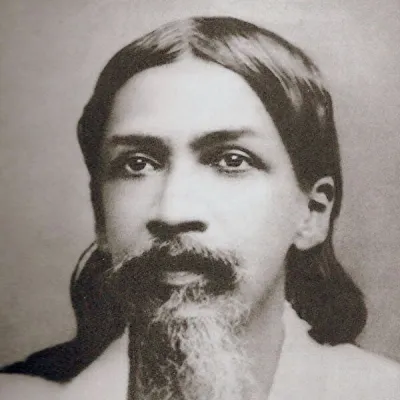
Sri Aurobindo
Human Design Chart
Biography
Aurobindo studied for the Indian Civil Service at King's College, in Cambridge, England from 1890 until his departure in 1892. After returning to India, he took up various civil service works under the Maharaja of the princely state of Baroda. He became increasingly involved in nationalist politics in the Indian National Congress and the nascent revolutionary movement in Bengal with the Anushilan Samiti. He was arrested in the aftermath of a number of bombings linked to the revolutionary group he was associated with. He faced charges in a public trial for treason in Alipore Conspiracy and then released, after which he moved to Pondicherry and developed a spiritual practice he called Integral Yoga. He wrote The Life Divine, which deals with the philosophical aspect of Integral Yoga and Synthesis of Yoga, which deals with the principles and methods of Integral Yoga. In 1926, he and Mirra Alfassa founded Sri Aurobindo Ashram.
Sri Aurobindo as a Projector 4/6 in Human Design
Projector 4/6 — Design at a Glance
Sri Aurobindo was someone whose design featured a sharp and focused perception. His Projector type created an aura that shone like a bright flashlight, immediately identifying areas in others' systems that were still in the dark or not functioning properly. He had the ability to recognize flaws in his environment's structure instantly.
However, this mechanism required restraint. Directly addressing these deficiencies often led to rejection from those around him, akin to shining a bright light directly into someone else's face. Instead, Sri Aurobindo attracted others through his own harmonious and radiant presence. People naturally came to him seeking advice because of the magnetic pull of his presence. His strategy was to wait for an honest invitation rather than confront them head-on.
With his undefined Sacral Center, Sri Aurobindo lacked a constant source of intrinsic life energy. His rhythm followed cyclical phases: periods of high activity and quick workability alternated with necessary rest phases to prevent burnout. Life according to this design rewarded him with success. Deviating from it would have led to bitterness as an expression of his non-self. Therefore, his effectiveness did not rely on constant effort but rather on the right dosage of focused energy and trust in others' invitations.
Self-Projected Authority
Sri Aurobindo's design established a unique decision-making structure: authority within himself. This rare Projector Authority anchored his inner truth not in logic but in his identity. Sri Aurobindo acted through spontaneous self-conversations or physical pulling and pushing. Crucial was the distinction between what his mind planned and what his true essence expressed without thinking. Only this spontaneous expression made him recognizable to others for his uniqueness.
At the same time, he carried a specific danger: due to the great openness of his design, there was always the risk of being distracted by external motoric energies. The greatest trap lay in losing oneself in this openness and constantly chasing after energy. Instead, it was necessary to recognize one's own direction – whether geographically or thematically determined – and follow it faithfully. When Sri Aurobindo followed this inner guidance, he became a guide for others. His specific success potential lay precisely in using this inner identity as a compass rather than being swept along by the surrounding activity.
The 4/6 Profile — Opportunist / Role Model
Sri Aurobindo's design set a tendency towards a fundamental internal conflict: the heart of Line 4 sought belonging, while the head of Line 6 yearned for isolated contemplation on the 'mountain'. Before Saturn returned in his first thirty years, the energy of Line 6 still acted like a Line 3. This led Sri Aurobindo to experiment frequently and extensively during his youth, particularly in the realm of relationships and friendships.
The mechanics of this profile describe a transition from youthful experimentation to mature synthesis. Line 4 brought with it acting qualities, imagination, and the risk of self-deception; there was the danger of seeing fantasies as facts or protecting oneself from one's own lies. Simultaneously, the sixth line required a complex three-phase process of knowledge synthesis and integration. This lifelong process involved the individual knowledge circuit.
With the activation of Line 6, the tension between community needs and the desire for wise solitude became evident. In his later years, Sri Aurobindo was expected to meet the high standards of a wise role model primarily through cooperation with other people. Clear communication of this synthesis was necessary to create individuality and collective value, while rejecting this integration was seen as futile and led to atrophy.
Single Definition — Defined & Open Centers
Sri Aurobindo's design inclined towards consequent mental structuring and clear expression. His defined Ajna Center ensured consistent conceptual thinking; he processed data and creativity in a trustworthy manner, unaffected by external opinions. This mental stability directly flowed into his equally defined Throat Center, enabling him to communicate his concepts reliably. The connection between Ajna and throat allowed him to articulate what he thought – a reliable voice for his ideas. Additionally, his defined G Center gave him a firm self-identity and an inner sense of direction. He knew who he was and could use this magnetic presence to guide others without being dependent on their expectations.
These three stable poles contrasted with five open centers that made him receptive to external energy. His open Head Center received situational inspiration; if he tended to interpret mental pressure waves as his own answers, he became confused due to the lack of a consistent source for 'aha' experiences. The open Heart Center lacked constant willpower; the non-self pattern pushed him to prove himself through promises or competitive thinking, often ending in disappointment cycles because this energy was not consistent. His open Sacral Center absorbed vital impulses from the environment; he could amplify this energy but not generate it on his own, leading to exhaustion when ignoring his rhythm and relying on 'borrowed' power.
Emotionally, his open Solar Plexus acted as a barometer for the surroundings; he picked up others' moods and amplified them, personalizing these waves as his own feelings, which could lead to internal unrest if he did not distance himself. The open Spleen Center made him sensitive to health and survival signals; the non-self pattern pushed towards spontaneity or holding onto unhealthy situations out of fear of losing security. Finally, his open Root Center absorbed stress and adrenalized pressure from the environment; he could use this boost but was not designed to carry it long-term, leading to burnout under overload. Sri Aurobindo's architecture thus showed a clear distinction: a stable core identity and expression surrounded by a highly sensitive, receptive periphery that required wisdom to avoid being overwhelmed by external currents.
Channels for vision, curiosity and structured clarity.
Sri Aurobindo emerged as a shaper of collective leadership through logical invitation and inspiring storytelling. His design connected the ability to analyze societal patterns with the art of translating knowledge into tangible stories. This configuration emphasized that true authority arises not through coercion but through engagement with existing structures.
Channel of The Alpha 7-31 linked the G Center with the Throat Center, creating a logical leadership perspective based on tested patterns and future security. Sri Aurobindo did not act as an autocrat but as an influencer who succeeded only when invited by the community. His authority depended on gaining the majority's trust and understanding their needs. Leadership here meant representation and shared responsibility, with the duration of influence determined by the satisfaction of those being led.
For knowledge dissemination, Sri Aurobindo used Channel of Curiosity 11-56 between Ajna and Throat Centers. This channel drove him to constantly seek new ideas and tell stories about them. Instead of delivering dry facts, he filled gaps with metaphorical narratives that engaged imagination and emotions. His presentations enabled others to experience new perspectives and decide whether to adopt them.
Channel of Structuring 23-43 complemented this by bringing spontaneous insights from the Ajna Center into the Throat Center for processing. Sri Aurobindo formulated innovative thoughts into efficient concepts, changing other people's thinking patterns. His expression was transformative and required patience until these new perspectives were accepted.
Additionally, Gates 4 (Formulation for Future Security), Gate 49 (Emotional Principles), Gate 16 (Collective Experimentation), Gate 35 (Change through Interaction), Gate 8 (Individual Contribution), and Gate 62 (Logical Detail Work) supported his role in creating logical frameworks to make complex patterns understandable while opening space for collective evolution.
Collective Circuitry — Circuit Signature
Sri Aurobindo's design inclined towards structured, rational communication deeply rooted in his individual identity. As a simple Generator with a continuous connection from G Center through Throat to Ajna Center, he expressed himself from a clear inner compass. This energetic unity formed the foundation for his specific circuits.
The Knowledge Circuit connected Sri Aurobindo's Ajna and Throat Centers via Channel of Structuring (Gates 43-23). This allowed him not only to intuitively grasp new insights but also to articulate them in a clear, logical form. It was about transforming knowledge through precise articulation.
Parallel to this, the Understanding Circuit linked his Throat and Identity Centers (Channel 'The Alpha', Gates 31-7), focusing on strategic thinking and conveying unconditioned insights. Sri Aurobindo used this connection to develop rational strategies aimed at guiding society towards a better future – a process free from emotional distortion.
A third aspect came from the Meaning Circuit, also connecting Ajna and Throat (Channel 'Curiosity', Gates 11-56). This circuit brought a cyclical quality to his reflections: he processed past experiences and emotions to draw collective lessons. While the Understanding Circuit was future-oriented and rational, this channel offered the chance to learn from the past and share these insights emotionally filtered with others. Together, these three circuits shaped Sri Aurobindo's ability to convey complex mental content in a structured, strategic, and reflective manner.
Right Angle Cross of Explanation 3
Sri Aurobindo's design carried the archetypal dynamics of the right cross of Revelation 3. This configuration shaped a fundamental stance oriented towards uncovering and conveying hidden truths. It was not merely about sharing information but rather a deep impulse to structure complex connections in such a clear way that others could actually understand and integrate them.
The energetic structure of this specific cross promoted a kind of clarity that often sprang from inner work or intuition before it was brought outwards. Sri Aurobindo revealed himself through this mechanism as someone called to bring light into dark corners – not by aggressively imposing, but through precise, explanatory power. The energy of this cross supports finding solutions or insights that are then formulated in a way that resonates and empowers others to walk their own paths.
This dynamic worked as an ongoing background process: a drive to transform confusion into order and make abstract concepts tangible. It was a life task to uncover hidden connections and convey them in such a way that they were not only heard but also lived. The structure of the design established that its true impact lay in building bridges between the unknown and the understandable.
Saturn Return · Uranus Opposition · Chiron Return · 2nd Saturn Return — Life Cycles
Sri Aurobindo's design laid out a tendency towards profound structural breaks, which served not as loss but as necessary prerequisites for new life forms. This configuration described a path where external upheavals triggered and anchored internal developmental stages.
In 1910, Sri Aurobindo reached Pondicherry at the age of 38 – a moment of Uranus opposition. This cycle acted as a catalyst for radical realignments. Instead of clinging to existing structures, he used this pressure point to develop Integral Yoga. The mechanics here show: sudden changes served to break old patterns and make space for a more holistic practice.
Later, in 1927 at the age of 55, Sri Aurobindo moved with 'The Mother' to Rue Francois Martin where he spent the rest of his life. This marked his second Saturn return. While the first return often solidifies identity, the second serves for long-term anchoring and relationship dynamics. The design described a phase of stabilization: after the revolutionary opening in 1910 came the simple yet decisive creation of a permanent home. Energy shifted from disruptive impulse to sustainable structuring of daily life and partnership. Both cycles together showed a clear developmental arc: first breaking old boundaries, then building new, solid foundations for further work.
Projector · Self-Projected Authority — Synthesis
Sri Aurobindo lived a life marked by a deep drive towards understanding and transformation. His design as a projector, combined with authority in the self and the profile of networker/role model, points to someone destined to recognize patterns and inspire others – yet only after making profound personal experiences himself. The connection of defined Head, Throat, and G Centers enhances his ability for insight and clear communication, while the open Sacral Center signals a sensitivity towards the energy of others he absorbed and processed in his environment. The Channel of Structuring (Gate 43/23) underscores his gift to order complex ideas into new forms, while the Alpha Animal Channel (Gate 7/31) suggests that he was destined to take on a leadership role, though only after community recognition.
A central paradox in Sri Aurobindo's design lies in the interplay of clarity and openness. On one hand, he possessed a defined mental center enabling him to think logically and express his insights precisely. On the other hand, his open centers – particularly Sacral, Solar Plexus, and Root – were receptive to external influences and conditioning. This tension between inner structure and outer openness created a dynamic force that propelled him to continuously learn, adapt, and develop new perspectives while simultaneously preserving his own inner truth.
3 Defined Channels
Incarnation Cross - Right Angle Cross of Explanation 3
Solar Return
The Solar Return shows the moment when the sun returns to its exact birth position - your personal solar year.
Life Cycles
Discover the life cycles with a detailed triple view (birth chart, cycle chart, composite).
Human Design Profile
- Type
- Projector
- Strategy
- Wait for the respectful invitation
- Authority
- Self-Projected Authority
- Profile
- 4/6 - Opportunist / Role Model
- Definition
- Single Definition
- Incarnation Cross
- Right Angle Cross of Explanation 3
- Date of Birth
- 15.08.1872 05:00
- Place of Birth
- Kolkata, India
Frequently Asked Questions
What was Sri Aurobindo's Human Design type?
What Profile did Sri Aurobindo have in Human Design?
What authority did Sri Aurobindo have?
What incarnation cross did Sri Aurobindo have?
When was Sri Aurobindo born?
Discover your own Human Design
Are you also a Projector? Find out in a personal reading how to unfold your leadership qualities and recognize the right invitations.
More Personalities
Back to overviewSissy Spacek

Alain-Fournier

Anémone

Ann-Margret

Bourvil
Hergé