
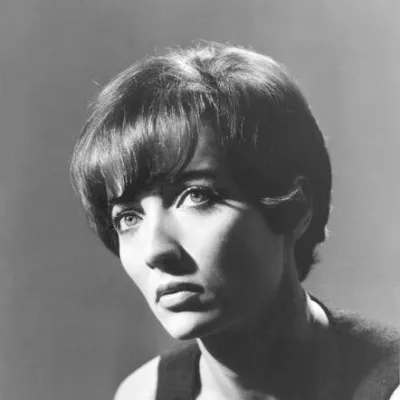
Stéphane Audran
Human Design Chart
Biography
She is the ex-wife of noted actor Jean Louis Trintignant and of Director Claude Chabrol to whom she was married from 1964 until their divorce in 1980. Her marriage to Chabrol produced one son, actor Thomas Chabrol, born 24 April 1963.
Her son Thomas told the AFP news agency that his mother had died early on 27 March 2018, following a long illness, saying: "She had been in hospital for 10 days and she had returned home. She died peacefully at around 2 am."
What does Generator 3/5 mean for Stéphane Audran?
Generator 3/5 — Design at a Glance
Stéphane Audran had high and enduring sacral energy that made him seem like a strong workhorse, provided he acted in harmony with his inner rhythm. As a Generator, his design suggested that his strength was unleashed not through self-initiative but by reacting to external impulses. This created a central dilemma: acting against his inner guidance or being held back by heart projects could lead to frustration and energy loss up to burnout.
The mechanics of his type required a clear strategy: waiting for signals from life and only then taking action when the sacral center gave a clear “yes.” This internal signal was the key to efficiency. If Stéphane Audran initiated without this impulse, he encountered resistance and wasted unnecessary energy. The reward for correctly reacting from the gut was deep satisfaction and a sense of true fulfillment. Thus, no one could stop him as long as he followed the principle “do not initiate but react.” Not living by this rule led to an earlier or later lack of energy and persistent frustration. His path to materializing life themes therefore always involved this conscious reaction to what was offered from outside rather than compulsive self-dynamics.
Sacral Authority
Stéphane Audran showed decision-making rooted firmly in the body. As a Generator with sacral authority, he did not react through mental analysis but through immediate physical signals on external stimuli. This inner instance manifested as gut feelings or palpable bursts of energy – often audible as grunts, hums, or an affirming “mm-hm.” Such sounds were not mere noises but precise yes-or-no signals indicating true resonance with a situation.
When his sacral motor responded to something, he felt vital and alive. An almost inexhaustible surge of energy was available to him, enabling him to carry out tasks with great enthusiasm. He acted from joy and satisfaction without the need for external purposefulness. This process was supported by an active spleen center functioning as instinctive authority. This configuration gave her the ability to react particularly quickly and spontaneously. She had direct access to her physical well-being and instinctive perception, which she reliably followed. The authenticity of her actions thus lay not in the head but in this physical response to life around her.
The 3/5 Profile — Martyr / Heretic
Stéphane Audran was marked by Profile 3/5 as someone who did not accept knowledge theoretically but gained it through his own, often risky experimentation. Line 3 of the experimenter dictated a skeptical self-experimentation stance: Stéphane Audran had to experience things himself and make mistakes to find authenticity and adapt to real circumstances. This stood in tension with Line 5, the Hero line. While Line 3 learned privately, his environment projected onto Stéphane Audran the role of competent rescuer or general – especially in crisis situations where authority was sought. This projection created high pressure: the public expected solutions and leadership while his inner process could still be in a stage of learning through mistakes. If Stéphane Audran failed publicly during an experiment, this role quickly became a scapegoat; if he succeeded, his reputation as a trustworthy advisor grew. The appeal of this design lay precisely in this wealth of practical experience that Stéphane Audran made accessible to others. It was a path between necessary private failure and public expectation, always ready when others needed orientation – without losing sight of his own learning curve.
Split Definition — Defined & Open Centers
Stéphane Audran had a stable inner driving force, characterized by defined Sacral and Root Centers. This configuration gave him constant vital energy as well as a persistent pressure to move forward in the world. At the same time, his design showed intense mental activity: The definitions in the Head and Ajna Centers created a permanent internal pressure to ask questions, understand things, and process inspiration. For Stéphane Audran, this mental state was not only a source of creativity but also constant worry, as ideas were often incomplete. The challenge lay in accepting this pressure without prematurely turning it into action, which would otherwise have led to frustration.
In contrast, his adaptability was revealed through several open centers. His open G Center meant a lack of fixed identity; he tended to blend with his environment and reflect the energies of others rather than having a rigid core. This allowed him to adopt various roles or perspectives but challenged him not to seek an unchanging direction for himself. Similarly, his open Solar Plexus made him susceptible to absorbing other people's emotions; he could easily identify with the moods around him, which could lead to emotional confusion if he did not recognize them as non-own.
Furthermore, his Throat and Heart Centers were also open. The open Throat Center meant that communication was spontaneous and situation-dependent; he had to wait for life to invite him to speak rather than actively seeking attention. The lack of consistent willpower in the sense of competition or promises in his open Heart Center meant Stéphane Audran learned not to feel compelled to prove himself and not to take on commitments from the mind to demonstrate value. Instead, he relied on his sacral reaction to provide energy for what was right while patiently enduring mental pressure and using emotional and identity-related influences of the environment as information, not as truth.
Channels for focused details and abstract patterns.
Stephane Audran revealed himself as someone living in a constant internal tension between mental restlessness and the necessity of absolute stillness. His design shaped a fundamental attitude: The mind was an unceasing kaleidoscope constantly searching for patterns, while the body exerted a quiet pressure to remain silent and focus on details.
This dynamic resulted from two defined channels. Channel of Abstraction 64-47 connected Head with Ajna, creating an extremely active, experience-based mind. This filtered mental images continuously to recognize stories and connections. Often this led to a feeling like that of a "drunken monkey," as the mind could never be one hundred percent sure and clarity emerged only through patience from confusion.
Simultaneously, Channel of Concentration 52-9 acted as format energy connecting Root with Sacral. It generated a permanent, quiet pressure towards stillness and focused detail work. This process was logical and step-by-step; it required enduring in a kind of "yoga pose" until the Sacral Center responded. Stephane Audran had to learn to endure the mental restlessness of Channel 64-47 to find the necessary stillness for the logical concentration of Channel 52-9. Only then could he use his energy precisely and perfect patterns, rather than getting lost in the multitude of mental possibilities. The challenge was not to be guided by fleeting thoughts of the mind but to wait for the deep, sacral response that truly focused him.
Collective Circuitry — Circuit Signature
Stéphane Audran was marked by two parallel, unconnected recognition strategies. On one hand, there was a cool, emotionless logic aimed at focusing on structures and strategically improving the future. This came from the Understanding Circuit where only the Sacral and Root Centers were directly connected. Here it was about sharing rational insights free of emotional conditioning, with a clear focus on visual and structural clarity.
Completely separate from this existed a second strand: the Meaning-Finding Circuit. In Stéphane Audran's case, it exclusively linked the Head and Ajna Centers. This energy did not look towards the future but cyclically reflected past emotional experiences. It was a wave-like movement that drew meaning from earlier events to share these insights with the collective afterwards.
Given that Stéphane Audran had a split definition, these two systems – rational future thinking on the left and emotional past reflecting on the right – were not energetically merged. They existed as separate forces alongside each other. The impulse to share was present in both areas but differently coloured: once through logical structuring for upcoming developments, another time through intuitive processing of historical experiences. This duality shaped his way of processing and sharing knowledge and experience without the rational analysis being influenced by emotional waves or vice versa.
Right Angle Cross of the Sphinx 4
Stéphane Audrans Human Design includes the imprint of the right cross of Sphinx 4. This configuration establishes a foundational stance characterized by a profound connection to the material and physical realm. It is a pattern that emphasizes dealing with resources, security, and concrete reality.
The right cross of Sphinx 4 describes in Human Design a specific archetypal path. It connects the energy of practical action with a certain weight or density, which should not be seen as a burden but rather as ballast. This archetype works to make the invisible visible and tangible. The number four stands for stability, structure, and having solid ground underfoot.
For Stéphane Audran, this meant a life task strongly linked with the theme of 'possession' and 'perception of reality'. It was not about superficial consumption but rather understanding how material circumstances shape human life. The Sphinx as a symbol stands for secrets and riddles; in the right cross, however, this mystery becomes earthly and concrete.
Stéphane Audran thus showed herself in a dynamic that mediated between the hidden and the visible. The focus was on bringing inner truths to the outside world and anchoring them in physical reality. This often required confronting personal limits and those of the environment to build a sustainable structure.
Saturn Return · Uranus Opposition · Chiron Return · 2nd Saturn Return — Life Cycles
Stéphane Audrans Human Design indicated a tendency towards decisive turning points marked by specific astrological cycles. These phases significantly shaped her career and artistic recognition.
In 1972, at age 40, she experienced the Uranus opposition. This cycle often represents sudden changes or liberating blows. Stéphane Audran worked with Spanish-Mexican director Luis Buñuel on 'The Discreet Charm of the Bourgeoisie' that year – a career-defining moment reflecting this dynamic energy.
Ten years later, in 1980 (age 48), she experienced Chiron return. In Human Design, this is not a traditional healing process but rather an achievement cycle where her incarnation cross unfolds and meaning becomes tangible. This was evident through her role in 'The Great Red'.
The second Saturn return around 1988 (age 56) condensed years of groundwork into sustainable results and structural confirmation. That year, Stéphane Audran was nominated for the British Academy Film Award as best actress and won the Danish film award Robert for 'Babette's Feast'. These accolades marked the concrete realization of her artistic substance, facilitated by this cyclical mechanism.
Generator · Sacral Authority — Synthesis
Stéphane Audran lived deeply rooted in reaction – a Generator whose energy came from the gut and was fueled by the connection between Sacral and Root Centers. This combination created an unstoppable force as long as she responded to external impulses rather than initiating herself. The profile of experimenter and hero indicates that he gathered experiences and shared them, with the constant urge to experiment fueled by Line 3. Open definitions in important centers like Head, Ajna, Heart, and Spleen strengthened his ability to adapt and perceive others' energies, making him a mirror for his environment. This allowed him to be authentic and learn from mistakes while simultaneously developing deep sensitivity towards the needs and feelings of others.
A central paradox in Stéphane Audrans Human Design lies in the interplay between her powerful sacral energy and largely open centers. On one hand, she possessed immense potential for endurance and commitment when responding to a fitting impulse (Gate 34). On the other hand, she was vulnerable to conditioning and influences from others, as her open definition made him a receiver of emotions and thoughts. This tension between inner strength and outer openness shaped his path by forcing him to always listen to his internal authority to protect himself from overstimulation and loss of identity.
2 Defined Channels
Incarnation Cross - Right Angle Cross of the Sphinx 4
Solar Return
The Solar Return shows the moment when the sun returns to its exact birth position - your personal solar year.
Life Cycles
Discover the life cycles with a detailed triple view (birth chart, cycle chart, composite).
Human Design Profile
- Type
- Generator
- Strategy
- To respond - wait for something to respond to
- Authority
- Sacral Authority
- Profile
- 3/5 - Martyr / Heretic
- Definition
- Split Definition
- Incarnation Cross
- Right Angle Cross of the Sphinx 4
- Date of Birth
- 08.11.1932 02:15
- Place of Birth
- Versailles, France
Frequently Asked Questions
What was Stéphane Audran's Human Design type?
What profile did Stéphane Audran have?
What authority did Stéphane Audran have?
What incarnation cross was assigned to Stéphane Audran?
When was Stéphane Audran born?
Discover your own Human Design
Are you also a Generator? Find out in a personal reading how to use your sacral energy correctly and discover deep satisfaction.
More Personalities
Back to overviewSissy Spacek

Aaliyah

Alexia

Anémone

Angèle

Ann-Margret
