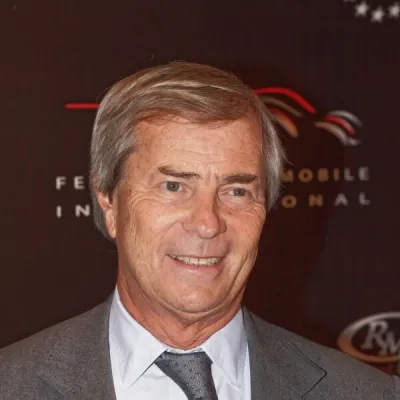
Vincent Bolloré
Human Design Chart
Biography
Vincent Bolloré — Generator with Profile 3/5
Generator 3/5 — Design at a Glance
Vincent Bolloré's design established a fundamental architecture of high endurance and sacral power. He demonstrated the structural ability to generate immense energy, comparable to a workhorse that remains strong and steady as long as it finds inner motivation for its task. This strength was not an unconditional constant but dependent on a specific usage: reaction rather than initiation.
The mechanics of his Generator type dictate that this energy is primarily released when he responds to signals from life. The central motto was “react, don’t initiate.” Successful action and deep satisfaction arose only when Vincent Bolloré responded to an external signal and confirmed his sacral center with a clear “yes.” Deviations from this principle led to two specific pitfalls.
First: If he continuously carried out tasks that did not bring him inner joy, he wasted his energy and tended towards exhaustion despite his high potential. Second: When prevented from pursuing his heart project while still full of power, a conflict arose between internal drive and external interruption. Living contrary to this design — for example through constant initiating — led him sooner or later to persistent frustration and energy deficiency. However, in harmony with his nature, that is, through reactive action from the gut, he was rewarded with a feeling of deep fulfillment.
Emotional Authority
Vincent Bolloré's design inclined towards not making decisions based on first impulse but rather letting them go through a process of emotional maturation. His inner authority resides in his defined Solar Plexus Center, meaning that he is subject to a cyclical wave movement of emotions. This emotional wave colors his perception: at one moment a situation may appear extremely positive, the next negative, depending on the current mood state. Since this first impression is only a snapshot and not necessarily reflective of deeper truth, spontaneous reactions in his design often appeared misleading or even counterproductive.
The mechanics of his emotional authority require patience and time cycles. Vincent Bolloré benefited from letting decisions “slumber” multiple times to let initial intense feelings subside. Only when emotional calm set in and he had gained distance from the first impulse did true clarity emerge. This process of self-refinement and repeated review was essential for him, especially regarding long-term life-changing decisions that significantly influenced his life path. By waiting until emotional tranquility was achieved, he secured a solid foundation free from distortions caused by transient mood feelings.
The 3/5 Profile — Martyr / Heretic
Vincent Bolloré's design inclined towards acquiring knowledge primarily through personal, often painful experimentation to later make it available as practical treasure for others. This Profile 3/5 combines the line of the experimenter with that of the hero. Line 3 (Gate 21) dictates a stance of radical skepticism: Vincent Bolloré initially believed nothing and had to experience everything himself. This inevitably led to failures and confrontations with superior forces, serving as necessary learning processes to avoid dependencies and find his own path.
This experiential knowledge gained from trial and error formed the foundation for his Line 5 (Gate 38), which corresponds to alienation and isolation. Here he demonstrated a capacity to develop intuitive solutions in crisis times as an individual fighter. Vincent Bolloré acted attractively on others through this rich treasure of practical life experience, who wanted to learn from his insights. This heroic role flattered him but carried the risk of public failure. The pain arose precisely when he experimented and failed before everyone's eyes — an unavoidable part of his design, which established his authority only through overcoming this isolation and the resulting mutations.
Split Definition — Defined & Open Centers
Vincent Bolloré is characterized by a defined Sacral Center: a constant source of vital energy that only becomes sustainably available through reactions to external impulses. Initiation led to the loss of this power; it was only through waiting and reacting that his inner engine was activated. This mechanism replaced rational planning with an intuitive yes/no response - a physical "mmh" or "uh-huh", immediately clarifying whether energy was present for a task. Ignoring this response led to exhaustion; following it resulted in satisfaction and endurance.
Additionally, defined Solar Plexus, Spleen, and Root Centers were at play. The Solar Plexus demanded emotional clarity through waiting for the wave movement before making decisions, rather than impulsive actions in emotional highs or lows. The Spleen Center provided spontaneous, intuitive signals in the present moment regarding health and safety that could not be rationalized. The Root Center generated a constant physical pressure to maintain the life impulse, but this was only healthy when guided by sacral strategy, rather than leading to obsessive stress.
In contrast, several open centers revealed areas of conditioning. The open Head Center tended to be overwhelmed by foreign questions and mental pressure, leading to confusion when trying to find answers for others' problems. The open Ajna Center reflected concepts without holding them as personal truth; the attempt to feign logical security to be accepted was a typical trap. The open G Center had no fixed identity or direction but took these from the environment; constant searching for a definition often led to frustration, while accepting the role of mirror brought liberation. Finally, the open Heart Center lacked consistent willpower; the need to prove oneself through promises and competition resulted in a cycle of self-doubt as he was not designed to achieve material goals solely through sheer will.
Channels for intuitive survival power and emotional release.
Vincent Bolloré's inner orientation is marked by permanent physical alertness. His design inclines him to sense dangers and vibrations around him before the mind can rationalize them. This intuitive survival intelligence is reinforced by Channel of Power 34-57: Here, Gate of Intuitive Insight (57) in the Spleen Center connects with Gate of Power (34) in the Sacral Center. This configuration grants the ability to selectively listen - often only with the "right ear" - to grasp the true intent behind words and respond spontaneously to threats. It is a defensive intelligence aimed at protecting one's well-being and individual vitality, independent of others' needs.
Simultaneously, Vincent Bolloré experiences a pulsating emotional wave characterized by peaks of passion and depths of melancholy. Channel of Emotional Release 39-55 connects the Root Center through Gate of Provocation (39) with the Solar Plexus Center at Gate of Mind (55). This mechanism serves not as an emotion barometer but as provocation to activate the mind and test authenticity. The moodiness of this wave forces one to accept their emotions rather than rationalize them away. Vincent Bolloré learned that his impact on others strongly depends on his current emotional state; only in the right "mood" could he evoke the desired spirit in others or share profound insights. The combination of Channel 34-57's sharpening intuition and Channel 39-55's emotional alchemy results in a profile that reacts sharply to threats intuitively while also being emotionally deep - provided mood swings are not fought but accepted as necessary for clarifying one's truth.
Individual Circuitry — Circuit Signature
Vincent Bolloré's design inclines him towards strategic, impulse-driven self-validation. Two separate energetic systems operate in parallel: The first connects the Solar Plexus with the Root Center through Channel "Emotions Free". This configuration generates pulsating, acoustically marked emotional waves. It serves to establish a unique path through mutation and innovation not by rational planning but by the immediate expression of emotional resonance into the world. It's about establishing an inherent way through transformation and innovation, where energy works rhythmically.
The second system connects the Sacral with the Spleen Center via Channel "Power". Here, the focus is on existential security and survival. The energy of this channel allows drawing strength from reactions to life and guiding it intuitively in the present moment. It involves a direct, instinctive control of one's resources to secure individual existence.
As Vincent Bolloré has a split definition, these two streams exist side by side without direct energetic exchange. The emotional transformative expression capability of the first system is not connected with the intuitive survival power of the second. Both form separate autonomous energy fields: one for establishing external identity through emotional waves, and the other for stabilizing internally through momentary intuitive reactions. This separation shapes a dynamic where strategic orientation and existential security run as independent but simultaneous processes.
Right Angle Cross of Tension 1
Vincent Bolloré's Human Design profile suggests a tendency where internal tension is not seen as a disturbance but rather as a fundamental structural force. This configuration, the right cross of Tension 1, describes a state in which pressure and resistance are integral parts of one's personal system. It is not about eliminating stress but using it as a driving element.
The mechanics of this design show that stability often arises through the presence of tension. Without this internal pull, the structure would weaken; with it, form and strength emerge. Vincent Bolloré thus operated in a dynamic where challenges and conflicts were not avoided but used as necessary building blocks for personal development. The tension served as a compass, guiding direction and providing energy.
This attitude means that calm is often perceived as static or even threatening, while movement under pressure feels natural and productive. The design supports a lifestyle where one learns to carry the load and transform it into forward motion. It is not passive acceptance of difficulties but active integration of resistance into one's path. Vincent Bolloré's chart indicates that his strength significantly resulted from acknowledging and utilizing this tension as a constitutive element of his existence, rather than fighting against it.
Saturn Return · Uranus Opposition · Chiron Return · 2nd Saturn Return — Life Cycles
Vincent Bolloré's life journey was characterized by a cyclical structure where relationship building, crisis management, and new orientation were driving forces. This dynamic was prominently shaped by the recurrence of Saturn and Chiron cycles, marking pivotal turning points in intimacy and identity formation.
The first Saturn return, a period of consolidation and anchoring, occurred in 1977 when he turned 25. In this context, he married Sophie Fossorier. This step aligned with the typical pattern of this cycle: laying the foundation for long-term connections and stabilizing structures in the private sphere.
Decades later, his Chiron return took place between the ages of 49 and 51, a fulfillment cycle where one's individual life purpose deepens. For Vincent Bolloré, this point fell in 2004 when he was 52 years old. The end of his marriage with Sophie Fossorier during this period signaled not just a break but a necessary dissolution of old forms to rediscover oneself according to one's true nature.
Immediately following, in 2006 at the age of 54, the second Saturn return began. This cycle often demands a re-evaluation and reaffirmation of the lived life. The emerging relationship with Anaïs Jeanneret that year was a concrete manifestation of this phase: after dissolution through the Chiron cycle, a new stabilizing level of relational engagement was built during the second Saturn return. Thus, planetary cycles did not act in isolation but as interconnected forces shaping and reorienting his intimate bonds.
Generator · Emotional Authority — Synthesis
Vincent Bolloré navigates life through a dynamic tension between inner reaction and the drive to shape the external world. His Generator design, powered by a defined Sacral Center (and thus a constant energy source), challenges him to respond to impulses from life – a deep 'from the gut' understanding of what is right. This is reinforced by emotional authority, which requires thorough engagement with feelings and waiting for emotional clarity before making decisions. His profile as an Explorer/Hero (3/5) underscores this process: gathering experiences, learning from mistakes, and passing on knowledge. The Channel of Power (34/57) endows him with intuitive sensitivity to threats and the ability to act spontaneously, while the Channel of Emotional Release (39/55) brings deep emotional range and transformative power.
This interplay manifests in a central paradox: Bolloré seems to oscillate between the need for inner authenticity and the desire to actively shape external reality. The open definition in key centers – Head, Ajna, Heart, and G Center – points to high adaptability and receptivity but also to a lack of firm self-image. This requires constant orientation towards internal authority (Sacral & Emotions), while there is also a tendency to exert control through external initiatives and leave a lasting impression. Repeated events in the realm of relationships – beginning and end of partnerships – seem to reflect this inner conflict.
2 Defined Channels
Incarnation Cross - Right Angle Cross of Tension 1
Solar Return
The Solar Return shows the moment when the sun returns to its exact birth position - your personal solar year.
Life Cycles
Discover the life cycles with a detailed triple view (birth chart, cycle chart, composite).
Human Design Profile
- Type
- Generator
- Strategy
- To respond - wait for something to respond to
- Authority
- Emotional Authority
- Profile
- 3/5 - Martyr / Heretic
- Definition
- Split Definition
- Incarnation Cross
- Right Angle Cross of Tension 1
- Date of Birth
- 01.04.1952 17:00
- Place of Birth
- Boulogne Billancourt, France
Frequently Asked Questions
What is Vincent Bolloré's Human Design type?
What Profile does Vincent Bolloré have in Human Design?
What authority does Vincent Bolloré have?
Which incarnation cross is active for Vincent Bolloré?
When was Vincent Bolloré born?
Discover your own Human Design
Are you also a Generator? Find out in a personal reading how to use your sacral energy correctly and discover deep satisfaction.
More Personalities
Back to overviewAaliyah

Alexia

Angèle

Anne-Marie

Arcángel

Arno