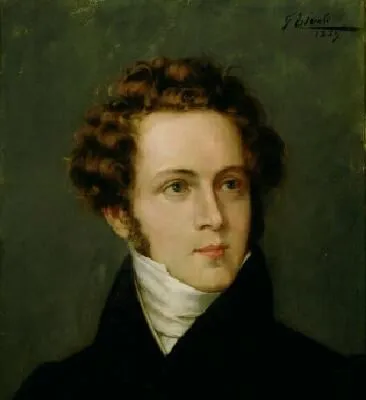
Vincenzo Bellini
Human Design Chart
Biography
His first opera was performed in 1825, leading to his major works, "La Sonnamubula" in 1831, his famed "Norma" also in 1831 and "I Puritani" in 1835.) Bellini and Chopin were close friends.
Died on 23 September 1835, Puteaux, France.
Vincenzo Bellini as a Generator 4/6 in Human Design
Generator 4/6 — Design at a Glance
Vincenzo Bellini revealed himself as someone who possessed enormous, enduring strength – comparable to a workhorse that unleashes its power when given the right task. His design indicated that this energy was not released through self-initiative or proactive action but solely in response to external impulses. The central mechanism of his generator involved waiting for signals from life and then intuitively responding from the gut.
This strategy of reacting was key to his endurance and effectiveness. When he responded to an impulse and his sacral center gave a clear “yes,” he could act with deep satisfaction and fulfillment. Conversely, ignoring this dynamic – such as by constantly taking initiative or working on things without inner resonance – led to frustration and a lack of energy. A particular danger lay in being held back from his heart project while still full of power; such an interruption cost him valuable strength. His path toward materializing ideas thus did not involve pushing forward but rather skillfully utilizing incoming life impulses that set his inner energy into motion.
Sacral Authority
Vincenzo Bellini exhibited a fundamental stance of reactive vitality: his energy was ignited not through self-initiated action, but as a direct response to external stimuli. As a generator, he possessed sacral authority, an internal decision-making center manifesting in a physical “gut feeling” or a palpable surge of power. This reaction occurred only when an external stimulus engaged his inner motor; then he felt alive and had inexhaustible energy for his tasks, driven by pure enthusiasm without compulsive purposefulness.
His strategy was to respond rather than initiate. This greatly simplified his decision-making process since the sacral authority also served as his internal guidance – a configuration unique to generators with an open emotional center. He learned to pay attention to bodily signals like grunts or affirming sounds to distinguish resonance from non-resonance.
Additionally, his activated spleen center supported this sacral leadership. Through the connection between spleen and sacral centers, Vincenzo Bellini had rapid, spontaneous reaction capability. He could make decisions based on immediate physical well-being and instinctive perception. This physiological intelligence served him as a reliable compass: when his body responded positively, he knew the path was right. Thus, he lived in a state of natural contentment by fully immersing himself in tasks to which his inner voice joyfully responded.
The 4/6 Profile — Opportunist / Role Model
Vincenzo Bellini exhibited a pronounced tension between a deep need for belonging and an equally strong drive for detached overview. His design as Profile 4/6 indicated that his heart (Line 4) sought experimental behavior in relationships, always cautiously avoiding opening up to the wrong people who might hurt him. This conflicted with the head (Line 6), which demanded reflection on humanity’s entire experience and required withdrawal to gain wisdom and a comprehensive perspective.
In his first thirty years, Line 6 still appeared like Line 3; Vincenzo Bellini thus experimented freely in youth, particularly in friendships and partnerships. With the activation of Line 6, however, this inner conflict came to light: the desire for community connection versus the impulse to withdraw to ponder life’s meaning. This conflict between heart and head shaped his development. In later years, he was expected to meet high standards as a wise role model. His strength lay in cooperation with others while Line 4 of Gate 44 demanded honesty and direct communication without hypocrisy. Conversely, Line 6 of Gate 33 required time for renewal and letting go, away from pressure or counter-accusations. Vincenzo Bellini thus lived in balance between the tight network of his heart and the detached perspective of his head.
Single Definition — Defined & Open Centers
Vincenzo Bellini was marked by a defined G Center, which gave him a firm inner identity and a clear sense of direction in life. This stable self-love allowed him to provide guidance to others without being dependent on their expectations. At the same time, he had a defined Sacral Center, a constant source of vital energy based on reactions: His strength was only reliably available when asked and responded with internal agreement.
This firm foundation stood in contrast to his numerous open centers – Head, Ajna, Throat, Heart, Solar Plexus, Spleen, and Root were undefined. This openness made him vulnerable to external influences. His open Head Center tended to take on mental confusion or the questions of others as its own, which could distract from his inner clarity. Similarly, his open Solar Plexus absorbed the emotions of the environment; he had to learn not to personalize these waves to avoid emotional decisions that would later cause regret.
The open Heart Center often drove him to want to prove his worth through promises or competition – a trap since he lacked consistent willpower for this. Instead, it was crucial for him to let go of this need and not identify with the desire for recognition. His open Spleen Center also made him sensitive to well-being; he tended to cling to unhealthy situations just to feel the false sense of security from defined people nearby rather than trusting his own intuition.
The pressure of his open Root Center amplified external stress, which could easily push him into a cycle of hyperactivity and exhaustion as he tried to dispel this non-self adrenaline rush through action. His open Throat drew attention when he waited; the attempt to actively engage in conversation or be at the center often led to unpredictable statements and frustration.
Bellini's design therefore required strict boundaries: He had to respect the silence of his open centers and not try to compensate for mental answers, emotional security, or willful control from the environment. His truth lay in patience – waiting until life asked (Sacral) and being guided by his inner direction (G Center), rather than interpreting the noise of open windows. Only then could he protect his energy and act authentically without falling into conditioning traps of confusion, emotional overflow, or constant proof-seeking.
Channels for discovery, endurance and self-directed path.
Vincenzo Bellini showed himself to be someone who delved deeply into experiences without wanting to control them through pre-judgment. His design tended towards letting go of expectations and instead trusting the persistence of his inner strength. This was particularly marked by Channel 29-46, connecting the Sacral Center with its Gate of Saying Yes (29) as a wellspring of endurance, to the G Center and its Gate of Self-Determination (46). The mechanics of this channel require one to completely immerse in experience to be at the right place at the right time. Success for Vincenzo Bellini did not come through planning but rather an unshakable commitment to the process, even if the significance of a situation only became clear at the end. There was no room for sudden course corrections; instead, he had to learn that only through correct reaction and patience over years could deep discoveries be made that changed collective perception.
Additionally, further energies influenced him. Gate 44 brought awareness and the ability to transform through interaction without conditions. Gate 24 added the rhythm of mental mutation, focusing on discovering which knowledge held personal significance. Gate 33 enabled reflection and active withdrawal to process experiences and avoid repetition. Gate 19 connected him with resources and territory as well as a need for a safe environment for spirituality in community. On a personality level, Gate 34 represented great individual power that needed guidance to serve the greater good while Gate 59 symbolized a genetic strategy for bonding and overcoming relationship barriers. Gate 7 projected leadership patterns and hierarchies, Gate 25 promoted spiritual innocence and centering, and Gate 1 emphasized uniqueness as well as creative expression at the right moment of here and now.
Collective Circuitry — Circuit Signature
Vincenzo Bellini showed himself to be someone who tied his identity inseparably with his deepest emotional currents. His design knew no separation between who he was and his inner emotional world; these two areas formed a single, closed circuit.
This connection resulted from the Meaning-Finding Circuit, which in him was activated by the Discovery Channel. This channel connected the Identity Center directly to the Sacral Center. While the Sacral Center represented the source of his vital energy and emotional waves, this power flowed directly into his self-understanding. For him, emotions were not just transient states but formed his essence.
The Meaning-Finding Circuit works cyclically and strongly relates to the past. In Vincenzo Bellini's case, this meant that he experienced events in wave-like patterns – with clear beginnings, peaks, and endings. This energy was often illogical and hard to rationalize as it stemmed from the realm of feelings, not reason. His mechanism involved finding meaning in past occurrences and sharing these emotionally condensed insights with others. Through sharing these felt truths, he could learn together with his environment from the past. Since no specific historical events are mentioned in the raw content, the description focuses on this mechanical function: a constant presence of discovering and sharing emotional meanings from within.
Right Angle Cross of the Four Ways 3
Vincenzo Bellini's design carried the structural imprint of the right cross of the four paths 3. This configuration formed a specific architectural framework for his energetic alignment, even though the concrete content nuances of this mechanism are not further specified in the available data. The right cross of the four paths functioned as a fixed basic pattern that structured certain life areas and actions without providing a detailed narrative description. It was a purely structural factor that laid the foundation for his experiential world, independent of external events or biographical details. The absence of specific content filling in this category does not mean that this level was unimportant; rather, it shows that the design here took on a neutral but defining form. Vincenzo Bellini moved within this framework whose mechanics are to be seen as given and constant. The analysis is limited to establishing this structural fact since no further descriptions or events were linked with this specific cross. It remains a pure skeleton in the Human Design chart that asserts its existence without carrying additional semantic weight.
Saturn Return — Life Cycles
Vincenzo Bellini's design set a tendency for inner talents to be validated only through external structure and recognition. This was concretely evident in 1829: At the age of 28, he experienced the premiere of „La Straniera“ at Teatro alla Scala in Milan. For his Human Design, this marked a typical moment of the first Saturn Return cycle. This period marks the transition from young adulthood to established maturity as an artist. It is a phase of consolidation where the individual learns not only to live out their skills but also to stabilize them through substantial external results. The premiere at such a prestigious venue as Milan's Scala served as a necessary validation process. It confirmed inner competence through public resonance and institutional integration. Without this confirmation, potential often remained unstructured; with it, it became a tangible reality. This cycle underscores that for Vincenzo Bellini the path to maturity led through the integration of inner creative power and external recognition. The structure of Saturn Return helped him anchor his artistic identity in a stable framework, which was fundamental for further development of his work.
Generator · Sacral Authority — Synthesis
Vincenzo Bellini's design reveals a central red thread of reaction and deep immersion. As a generator with sacral authority, he lived in harmony with his energy when reacting to external impulses (Sacral Center) and then fully immersing himself in the process (Channel 29/46). This allowed him to make significant discoveries through persistence and deep experience – an achievement that was already evident in early works (Saturn Return in 1829). His open definition across several centers points to a capacity for perceiving and amplifying others' energies, making him a resonant channel for emotional depth and creative impulses.
A central paradox lies in the tension between his need for connection (open Heart Center) and the inner call for individuation (Gate 1). While he potentially allowed himself to be influenced by the emotions of others, there seemed to be a strong drive to find unique forms of expression and authentically shape them. This dynamic likely manifested as an interplay between adaptability and the pursuit of an unmistakable artistic voice.
1 Defined Channel
Incarnation Cross - Right Angle Cross of the Four Ways 3
Solar Return
The Solar Return shows the moment when the sun returns to its exact birth position - your personal solar year.
Life Cycles
Discover the life cycles with a detailed triple view (birth chart, cycle chart, composite).
Human Design Profile
- Type
- Generator
- Strategy
- To respond - wait for something to respond to
- Authority
- Sacral Authority
- Profile
- 4/6 - Opportunist / Role Model
- Definition
- Single Definition
- Incarnation Cross
- Right Angle Cross of the Four Ways 3
- Date of Birth
- 03.11.1801 10:15
- Place of Birth
- Milan, Italy
Frequently Asked Questions
What was Vincenzo Bellini's Human Design type?
Which Profile did Vincenzo Bellini have?
What Authority did Vincenzo Bellini possess?
What incarnation cross did Vincenzo Bellini have?
When was Vincenzo Bellini born?
Discover your own Human Design
Are you also a Generator? Find out in a personal reading how to use your sacral energy correctly and discover deep satisfaction.
More Personalities
Back to overviewAaliyah

Alexia

Alizée

Angèle

Anne-Marie

Arcángel