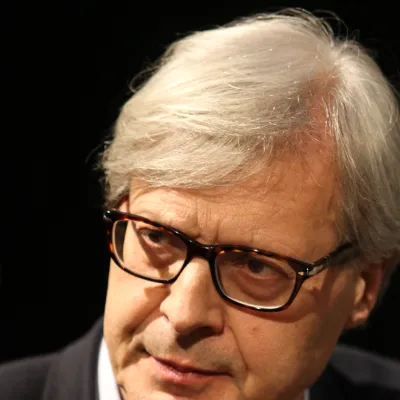
Vittorio Sgarbi
Human Design Chart
Biography
Human Design Analysis: Vittorio Sgarbi as Projector 5/1
Projector 5/1 — Design at a Glance
Vittorio Sgarbis design points to a tendency towards a focused, penetrating perception. As a projector, his aura acted like a bright flashlight, directing itself specifically towards weaknesses in systems or in others. This configuration grants the ability to immediately recognize where processes are not functioning or where there is a 'blind spot'. However, the challenge lay in the manner of addressing these issues: pointing out these flaws directly could be perceived as unpleasant or confrontational, much like shining a light directly into someone's face.
The mechanics of his design show that projectors are meant to bring 'light into the dark' for others and illuminate the path. Yet, instead of immediately intervening critically, the more elegant strategy for him was to attract others through his own harmonious presence. When he himself acted as a shining example, people sought him out to seek advice. Therefore, his best approach was to wait for a respectful and sincerely meant invitation before sharing his insights.
Since projectors do not have a defined Sacral Center, Vittorio Sgarbi lacked a constant, intrinsic source of life energy. Instead, he experienced phases of high efficiency and speed, followed by necessary rest phases to prevent burnout. Living according to this rhythm and his strategy of invitation, he was rewarded with success. Ignoring this structure led to the non-self theme of bitterness, a sign that he was acting against his natural design.
Emotional Authority
Vittorio Sgarbis design points to a tendency towards emotional volatility, which significantly influenced his perception and decision-making. He appeared as someone whose view of the world was strongly colored by his current mood. In one moment, he could be totally enthusiastic about something, in the next, he could view the same matter completely negatively. These fluctuations were not mere mood swings, but an expression of his inner authority: Emotional Authority.
This authority resides in the defined Solar Plexus Center. A central mechanism of Human Design states that this center, once defined, always carries the inner authority – regardless of which other centers are also defined. Vittorio Sgarbi was subject to a constant emotional wave, a rise and fall of feelings. However, his immediate feeling was only a snapshot, a first impression, which did not necessarily represent his truth. Quick, spontaneous decisions made in this emotional heat could therefore have negative consequences.
The mechanics required patience. The more time Vittorio Sgarbi took to let a decision mature, the deeper and more comprehensive he could understand the situation. This required repeatedly sleeping on decisions and allowing intense feelings to subside. Only when emotional distance was gained, clarity and calmness set in. This process was particularly crucial for long-term, life-defining decisions, as it allowed the distinction between transient emotion and deeper insight.
The 5/1 Profile — Heretic / Investigator
Vittorio Sgarbis design points to a tendency towards authoritative, yet often overwhelming knowledge dissemination. As a 5/1, the Hero and Researcher, he used his deep, individually acquired expertise (Line 1) to support others as problem solvers (Line 5). This configuration created a nearly magnetic aura that urged others to seek answers from him. The challenge lay in the balance: While he could strategically think and provide direction (Gate 2, Line 5), there was a risk that without clear boundaries, he would be exhausted, as the projection of his abilities often exceeded his actual capacity for constant availability.
The mechanics of Profile 5/1 describe exactly this balancing act. Line 1 requires time for personal research and understanding of the 'laws of necessity' (Gate 49) before action can be taken. Simultaneously, Line 5 draws the person into service to the community. If Vittorio Sgarbi did not learn to say no, he risked being overwhelmed by the abundance of inquiries and expectations, much like a scientist after a long conference. His design thus promoted a stance that offered revolutionary principles and strategic intelligence, but only worked sustainably if he waited out the emotional wave and protected his resources, rather than blindly succumbing to demand.
Single Definition — Defined & Open Centers
Vittorio Sgarbi's Human Design profile indicated a tendency towards deep, time-intensive processing. His defined Solar Plexus center acted as an internal authority that did not make decisions in the moment but only after experiencing the emotional wave. This mechanism required patience to gain clarity rather than acting impulsively. This was complemented by his defined Spleen center, which gave him a spontaneous, intuitive body intelligence that worked in the present moment and ensured well-being and survival instincts. Additionally, he had a defined Root center, which provided a constant internal pressure to deal with stress and move forward in the material world.
At the same time, Sgarbi was marked by several open centers, making him susceptible to certain conditioning. His open Head center meant he did not have a constant mental inspiration; he tended to get stuck in doubts or questions that were not his own, rather than trusting his inner authority. His open Ajna center allowed for a flexible mind that could take in many concepts, but often led him to interpret answers as his own opinions rather than seeing them as transient thoughts. His open Throat center was evident in the uncertainty of when and how to speak; he risked forcing attention or communicating unpredictably, rather than waiting for the natural invitation.
Further open centers included the G center, which did not give him a fixed identity or direction but made him adapt to the environment and find the right direction through the right place. His open Heart center lacked constant willpower, leading him to want to prove his worth through promises or competition, rather than listening to his authority. Finally, his Sacral center was open, meaning he did not have constant generative energy and was prone to being overwhelmed by the energy of others, rather than respecting his own limits and resting. This configuration described a person navigating between deep emotional and intuitive clarity on one hand and being tempted by mental, communicative, and energetic external stimuli on the other.
Channels for synthesis, transformation and emotional release.
Vittorio Sgarbi showed a deep emotional bond with what he defined as his 'tribe' or community. His design indicated a tendency to experience belonging not as a logical decision but as an emotional necessity that must be secured through clear principles and mutual loyalty.
This trait is marked by the Synthesis Channel 19-49. It connects the pressure of the Root with the emotional wave of the Solar Plexus. Gate 19 urges towards closeness and cohesion, while Gate 49 strictly rejects what does not meet the highest ideals. This channel is the emotional glue that determines who belongs to the tribe and who does not. For Vittorio Sgarbi, family – in whatever form – was his central enterprise. He sought a balance between feasibility and fairness, with the protection of resources and the inviolability of territory being key factors. The emotional frequency of this channel does not allow for rational discussion about belonging; it is either there or not, guided by a wave of acceptance or rejection.
Parallel to this, the Transformation Channel 54-32 was at work. It connected the ambition of the Root center with the instinctive perception of the Spleen. Vittorio Sgarbi was driven by the desire to improve his position and be seen. Gate 54 brings ambition through constant effort, motivated by the fear of the tribe's failure. Gate 32 instinctively seeks talents and opportunities for improvement. This channel drives one to work harder than others to prove value and significance. The transformation here does not occur in isolation but through the support of the tribe, which in turn expects loyalty and results.
The channel of Emotional Release 39-55 added a layer of individual moodiness. It connected the provocation of the Root with the mind of the Solar Plexus. Vittorio Sgarbi knew how to tease out the nature of others' minds. His impact was heavily dependent on his own emotional wave, which swung between ecstatic joy and melancholic uncertainty. This channel requires authenticity: if he was not in the mood, he withdrew to nurture his inner muse. Through this provocation, he opened others to mutative qualities but also created tensions if the emotional depth was not lived authentically.
Additionally, Gates like Gate 2 (Receptivity, new directions), Gate 1 (Uniqueness, creative expression at the right time), and Gate 4 (Formulation, logical processes for future security) were at play. Gates 30 (Feeling recognition, longing) and Gate 18 (Correction, discriminating between what is important and what is not) added a layer of emotional control and political correction. Gate 57 (intuitive clarity) enabled individual self-awareness, while Gate 48 (Depth, pattern recognition) and Gate 44 (Awareness, resource management) underpinned the ability to analyze and persevere. This configuration created a person who was emotionally deeply rooted, ambitious, and provocative, always seeking the right balance between tribal loyalty and individual expressiveness.
Tribal Circuitry — Circuit Signature
Vittorio Sgarbi's design indicated a tendency towards emotionally driven, impulsive communication. His system showed someone who directly translated inner wave movements into words or actions without much hesitation. This configuration results from the simple definition that creates a direct, uninterrupted energetic connection between the Root, Solar Plexus, and Spleen centers in him.
The Knowledge Circuit was at work in Vittorio Sgarbi through the channel 'Emotional Release' (Gates 55-39). This channel connected the Solar Plexus center with the Root center. As a result, emotional waves emerged in the Root as sudden impulses or acoustic outbursts. It was about expressing a pulsating, creative individuality where feelings immediately turned into energy.
Parallel to this, the Ego Circuit was at work. Here, the channel 'Transformation' (Gates 32-54) connected the Spleen with the Solar Plexus. This promoted an intuitive, tasteful perception of resources and support, filtered emotionally. Additionally, the channel 'Synthesis' (Gates 49-19) also connected Spleen and Solar Plexus, describing a capacity for intuitive differentiation and synthesis of information on an emotional level.
Since all these channels lie within the same group, they formed a cohesive flow. Vittorio Sgarbi showed himself through this connection as a person whose intuitive perception (Spleen) and emotional processing (Solar Plexus) were directly translated into action-oriented impulses (Root). There was no separation between what he intuitively recognized as valuable, what he felt, and what he impulsively expressed.
Left Angle Cross of Defiance 1
Vittorio Sgarbis Human-Design legt eine grundlegende Tendenz zur inneren Dissonanz und zur Notwendigkeit, sich durch Widerstand zu definieren, fest. Diese Konfiguration, das linke Kreuz der Herausforderung 1, beschreibt keinen harmonischen Prozess der Selbstfindung, sondern einen, der durch Reibung entsteht. Vittorio Sgarbi zeigte sich als jemand, dessen Identität sich nicht durch Bestätigung, sondern durch aktive Auseinandersetzung mit Grenzen formte.
Die Mechanik dieses Kreuzes impliziert, dass das Selbst erst durch das Überwinden von Hindernissen klar wird. Es geht nicht um das Vermeiden von Konflikten, sondern um die Nutzung von Spannungen als Katalysator für Wachstum. Vittorio Sgarbi war dazu angelegt, Situationen zu suchen oder zu akzeptieren, die ihn herausforderten, da nur in diesen Momenten seine eigentliche Natur zum Vorschein kam. Stille oder Ungezwungenheit wären für dieses Design oft als leer oder unproduktiv empfunden worden.
Die Herausforderung 1 bedeutet, dass der Weg zur Selbstverwirklichung über die Konfrontation mit dem führt, was man nicht will oder was schwer fällt. Vittorio Sgarbi nutzte diese Energie, um aus der Disharmonie neue Strukturen zu schaffen. Es war kein Zustand des Leidens, sondern ein dynamischer Prozess der Formgebung durch Widerstand. Die innere Unruhe trieb ihn an, nicht zur Ruhe zu kommen, sondern ständig neu zu beginnen, zu brechen und zu formen. Diese ständige Bewegung war der Kern seiner Ausdrucksweise und seines Handelns.
Saturn Return · Uranus Opposition · Chiron Return · 2nd Saturn Return — Life Cycles
Vittorio Sgarbis Human-Design zeigt eine klare Strukturierung durch zyklische Reifungsprozesse, in denen innere Entwicklung mit konkreten beruflichen Stationen korrespondiert. Sein erstes Saturn-Return markierte 1978 im Alter von 26 Jahren das Ende seines Studiums an der Universität Bologna. Dieser Zyklus verdichtet oft langjährige Lernphasen zu einer stabilen Grundlage, was hier im Abschluss der akademischen Laufbahn sichtbar wurde. Die darauffolgende Uranus-Opposition 1994, als er 42 Jahre alt war, brachte den Eintritt in die Abgeordnetenkammer. Diese Phase fordert typischerweise eine Neuorientierung und den Bruch mit alten Strukturen, was sich in diesem Karrieresprung manifestierte.
Der Chiron-Return 2001, im Alter von 49 Jahren, fiel mit dem Ende seiner Amtszeit als Abgeordneter im Europäischen Parlament zusammen. Dieser Zyklus signalisiert in der Human-Design-Mechanik eine Blütephase, in der sich der Lebenszweck entfaltet und Sinn erfahrbar wird, nicht als Heilung, sondern als Erfüllung. Schließlich schloss das zweite Saturn-Return 2008 im Alter von 56 Jahren mit der Wahl zum Bürgermeister von Salemi ab. Dieser letzte Zyklus vertieft die zuvor erarbeiteten Strukturen und führt zu einer neuen, oft verantwortungsvolleren Positionierung. Sgarbis Weg veranschaulicht, wie diese planetaren Einflüsse seine beruflichen Übergänge strukturierten: von der Bildung über politische Etablierung und Transformation hin zu lokaler Führung. Jeder Schritt entsprach der jeweiligen zyklischen Aufgabe, Wissen zu festigen, Strukturen zu erneuern oder den eigenen Zweck zu verwirklichen.
Projector · Emotional Authority — Synthesis
Ein zentrales rotes Faden zieht sich durch das Design: die Fähigkeit, tiefgreifende Fehler oder Ungleichgewichte zu erkennen (Projektor, Gate 11) und dieses Wissen anderen zugänglich zu machen (Profile 5/1). Die emotionale Autorität (Solar Plexus Center) verstärkt diesen Prozess, indem sie eine Zeit der Reifung und des Abwartens erfordert, bevor Erkenntnisse geäußert werden können. Der Kanal der Synthese (Gate 19/49) unterstreicht die Verbindung zwischen dem Erkennen von Bedürfnissen und der Ablehnung von Inkompatibilitäten, was auf eine ausgeprägte Fähigkeit hindeutet, Werte zu definieren und Zugehörigkeit zu gestalten. Diese Konstellation deutet auf einen Menschen hin, der dazu bestimmt ist, durch scharfe Beobachtung und geduldige Reflexion Orientierung zu geben und Veränderungen anzustoßen.
Gleichzeitig offenbart sich ein zentrales Paradox: die Notwendigkeit, tiefes Wissen zu teilen (Profile 5/1, Wissens-Schaltkreis) kollidiert mit der Art und Weise, wie dieser Prozess am besten funktioniert (Projektor). Das direkte „Projizieren“ von Erkenntnissen kann Widerstand hervorrufen, während das Abwarten der emotionalen Welle (emotionale Autorität) im Widerspruch zum Bedürfnis steht, Wissen schnell und wirkungsvoll zu verbreiten. Diese Spannung zwischen dem Drang zu teilen und der Notwendigkeit, den richtigen Zeitpunkt abzuwarten, prägt die Dynamik, in der sich die Person bewegt und erfordert ein sensibles Navigieren zwischen dem eigenen Impuls und den Bedürfnissen des Gegenübers.
3 Defined Channels
Incarnation Cross - Left Angle Cross of Defiance 1
Solar Return
The Solar Return shows the moment when the sun returns to its exact birth position - your personal solar year.
Life Cycles
Discover the life cycles with a detailed triple view (birth chart, cycle chart, composite).
Human Design Profile
- Type
- Projector
- Strategy
- Wait for the respectful invitation
- Authority
- Emotional Authority
- Profile
- 5/1 - Heretic / Investigator
- Definition
- Single Definition
- Incarnation Cross
- Left Angle Cross of Defiance 1
- Date of Birth
- 08.05.1952 02:00
- Place of Birth
- Ferrara, Italy
Frequently Asked Questions
What is Vittorio Sgarbi's Human Design type?
What Profile does Vittorio Sgarbi have in Human Design?
Which Authority guides Vittorio Sgarbi's decisions?
Which incarnation cross is Vittorio Sgarbi associated with?
When was Vittorio Sgarbi born?
Discover your own Human Design
Are you also a Projector? Find out in a personal reading how to unfold your leadership qualities and recognize the right invitations.
More Personalities
Back to overviewSissy Spacek

Alain-Fournier

Anémone

Ann-Margret

Bourvil
Hergé