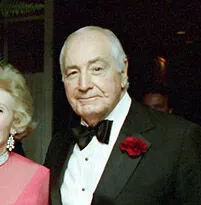
Walter H. Annenberg
Human Design Chart
Biography
The only son among seven daughters of publisher Moses Annenberg, he inherited the Philadelphia Inquirer and two racing publications from his dad and went on to build Triangle Publications into a multi-billion-dollar business encompassing newspapers, magazines, and radio and television stations. In 1988, he sold remaining Triangle properties, including TV Guide, to magnate Rupert Murdoch for $3 billion. In 2002, Forbes magazine listed him as one of the wealthiest Americans, #39, with an estimated net worth of $4 billion.
Annenberg became a noted art connoisseur who in 1991 donated a collection of impressionist and early modern masterpieces valued at $1 billion to New York's Metropolitan Museum of Art. He spent five years in London as ambassador to the Court of St. James, appointed by President Nixon in 1969.
Annenberg died of complications from pneumonia on 1 October 2002 at his home in suburban Wynnewood, Pennsylvania, with his wife, Leonore, by his side.
Human Design Analysis: Walter H. Annenberg as Manifestor 1/3
Manifestor 1/3 — Design at a Glance
Walter H. Annenberg revealed himself as a pioneer and visionary whose task was to lead the world into new futures. His design corresponds to the Manifestor type, akin to a Roman emperor: He possessed the vision of a great whole but did not wage the necessary wars himself; instead, he sent others out to conquer lands for him. This role brought with it a central conflict. As he often thought further ahead than his environment, he was misunderstood and polarized strongly. Some people loved his big dreams and followed him, while others rejected or even hated him because of these visions.
To manage this dynamic and find the right following, it was crucial for Walter H. Annenberg to inform his surroundings precisely about his intentions in a timely manner. This formed his strategy. By informing before acting, he could minimize friction and attract those who aligned with his direction. If he followed this path of informing in harmony with his inner authority, he was rewarded with a sense of internal peace. Conversely, if he lived against his design and failed to inform as necessary, he felt instead a persistent, deep-seated anger. His life thus revolved around the tension between radiating his vision and the necessity of clearly communicating it to transform polarization into constructive leadership.
Emotional Authority
Walter H. Annenberg exhibited a decision-making stance that required time and emotional distance. His design featured an Emotional Authority carried by the defined Solar Plexus Center. This configuration meant that his inner truth did not lie in spontaneous reactions but was revealed through the course of emotional waves.
People with this authority experience their feelings as constant ups and downs. The current mood heavily colored their perception of the world: What appeared inspiring at one moment could seem negative the next. However, this immediate emotional reaction was only a snapshot, not yet the deeper clarity. Quick decisions made directly from this first wave risked being based on transient impulses rather than lasting insight.
The mechanics of his authority thus demanded patience and conscious dwelling in indecision. By sleeping on decisions, he allowed initial emotional intensity to subside. Only when these waves subsided did he gain the necessary distance from himself. In this phase of calmness, true clarity emerged. This process of waiting was not an obstacle but the essential path to proper orientation, especially for questions of great significance in his life course. Spontaneity gave way here to a mature, time-ripened understanding.
The 1/3 Profile — Investigator / Martyr
Walter H. Annenberg revealed himself as someone who gained authority through living through crises and practical tests. His design established a fundamental stance that united theory and practice inseparably: He was a researcher who deeply learned but also an experimenter willing to make mistakes. This tension between the need for complete preparation and the necessity of acting despite incompleteness shaped his path.
Profile 1/3 defined his life task as a cyclical process of theoretical exploration (Line 1) and practical testing through trial and error (Line 3). The energy of Line 1 sought knowledge, sometimes leading to fear of action. Yet Line 3 compelled him to try out ideas to test their validity. His judgment was considered trustworthy because he understood insights both cognitively and empirically 'on heart and gut'. Resistance and crisis were not obstacles for him but the foundation for progress. Without the willingness to overcome uncertainty, no real learning would have occurred. Thus, his authenticity did not arise from pure planning alone but from a combination of deep understanding and lived experience.
Single Definition — Defined & Open Centers
Walter H. Annenberg was characterized by a consistent ability to express himself, marked by emotional depth and inner drive. His defined Throat Center served as a reliable anchor point, transmuting energies into clear communication and action. This voice was fueled by two additional defined sources: the Solar Plexus Center, which provided emotional passion and authority that required time to gain clarity, and the Root Center, offering a steady, adrenalized pressure for progress and correction. This configuration created a foundation of emotional intensity and assertive action capability.
At the same time, his design was highly responsive to the environment. His open G Center meant identity and direction were not set; he tended to reflect in relationships and places to find what was correct rather than having an internal compass needle. The open Heart Center made him vulnerable to pressure to prove his worth or make promises, despite lacking the consistent energy to do so. Additionally, his open Sacral Center absorbed the life force of others, posing a risk of exhaustion if he did not listen to his own authority. Open Spleen, Head, and Ajna Centers hindered spontaneous intuition or mental inspiration; here there was a danger of losing oneself in foreign concepts or acting impulsively to dispel uncertainty. His strength lay in waiting for the emotional wave and directing internal pressure through the throat without being overwhelmed by conditioning environmental energy.
Channels for emotional openness and the release of feelings.
Walter H. Annenberg emerged as someone whose social impact and provocation power were inseparable from the rhythm of his emotional wave. His design inclined towards mutative communication, which only became effective when he waited for the right timing.
This dynamic was shaped by Channel of Openness 22-12. This channel connected Solar Plexus to Throat and translated individual moodiness into transformative language. Gate 22 brought passion and drama while Gate 12 acted as a filter, directing articulation towards those with the greatest potential for change. Walter H. Annenberg used this mechanism to move others through his voice – but only when he was in the right frame of mind. Forced action here would have led to misunderstandings; patience was key so that his words could serve as catalysts.
Parallel to this, Channel of Emotion Release 39-55 operated. Through Gate of Provocation (39) and Gate of Mind (55), he set the pulsating wave between joy and melancholy in motion. This configuration served to activate the minds of others and express authentic emotional depth. Walter H. Annenberg could find out who truly fit through this provocation by testing reactions to his own emotional authenticity.
Additionally, Gates like Gate 36 (Crisis as Movement), Gate 11 (Visual Memory), and Gate 38 (Resistance for Preserving Individual Integrity) contributed to his internal structure. They underscored the need to accept crises as cyclical development and set clear boundaries. Walter H. Annenberg lived this mechanism by not rationalizing his uniqueness but existing in the alchemy of his moods – always dependent on whether the emotional wave carried him or not.
Individual Circuitry — Circuit Signature
Walter H. Annenberg was someone who walked his own path, emotionally processing new insights to authentically carry them outward. His design connected Throat Center with Solar Plexus and Root Centers in a continuous flow. This configuration formed the core of the Knowledge Circuit within him.
The mechanics of this circuit focused on developing a unique identity through gaining, transforming, and expressing new knowledge. Walter H. Annenberg had two channels within this field: Channel of Openness (Gates 12-22) as well as Channel of Emotion Release (Gates 55-39). Both channels directly linked his Throat Center with Solar Plexus and Root Centers.
This resulted in a pulsating, acoustic energy anchored in the 'now'. The task was to emotionally process internal mutations and creative impulses – where melancholy was integrated as a natural part of the emotional wave – and bring this authentic expression to the world. Through this connection, Walter H. Annenberg could initiate change by not only mentally forming his new knowledge but communicating it through the emotional depth of Solar Plexus into physical space. The energy was always directed towards 'now' and served to reinforce his individual mode of expression.
Right Angle Cross of Eden 1
Walter H. Annenberg's Human Design profile carried the signature of the right cross from Eden 1. This configuration marks a specific archetypal path often associated with themes of responsibility, structure, and building stable systems. In Human Design, this 'cross' refers to a particular combination of energetic channels that work together to form a distinct life pattern. It is not about random events but rather a deeper structural imprinting of the personality.
For Walter H. Annenberg, this meant that his inner nature was marked by a strong impulse to create order and security – both for himself and his surroundings. The right cross from Eden 1 indicates that he tended to take on great responsibility and fulfill it with a certain seriousness and discipline. It is a pattern often found in people who are capable of building complex structures and sustaining them over the long term.
This energetic alignment was not just a tendency but a fundamental life task. Walter H. Annenberg lived within a framework that was marked by the necessity to establish solid foundations and secure these against external influences. The design suggested that his success and satisfaction depended heavily on how well he maintained this structural integrity. It was a path of constancy, where the ability to carry burdens and keep systems stable was paramount. Walter H. Annenberg followed this inner compass by dedicating himself to tasks requiring precision, reliability, and long-term planning. His life was defined by his deep connection with structure and responsibility.
Manifestor · Emotional Authority — Synthesis
Walter H. Annenberg was a pioneer whose life was marked by a constant interplay between inner exploration and the drive towards external manifestation (Manifestor type, defined Throat). This rhythm reflected in his ability to develop visions – fueled by deep emotional processing (emotional authority, defined Solar Plexus) – and express these through his voice. The openness of certain centers (Head, Heart, Sacral, Spleen) points to a high sensitivity towards the environment, coupled with the ability to recognize patterns and adapt to changing circumstances. The profile as researcher/experimenter underscores this process of learning through experience, where he worked out insights both theoretically and practically.
A central paradox in Annenberg's design lies in the tension between the need for inner peace and the inherent provocation that comes with his individual circuitry (Channel 39-55). While his emotional authority required time for clarification, the connection of Root and Solar Plexus centers points to an energy seeking expression. This dynamic led to a constant struggle with personal boundaries and the search for authentic connections to live out his unique identity and send transformative impulses into the world.
2 Defined Channels
Incarnation Cross - Right Angle Cross of Eden 1
Solar Return
The Solar Return shows the moment when the sun returns to its exact birth position - your personal solar year.
Life Cycles
Discover the life cycles with a detailed triple view (birth chart, cycle chart, composite).
Human Design Profile
- Type
- Manifestor
- Strategy
- To inform others before acting
- Authority
- Emotional Authority
- Profile
- 1/3 - Investigator / Martyr
- Definition
- Single Definition
- Incarnation Cross
- Right Angle Cross of Eden 1
- Date of Birth
- 13.03.1908 13:30
- Place of Birth
- Milwaukee, WI, United States
Frequently Asked Questions
What was Walter H. Annenberg's Human Design type?
Which Profile did Walter H. Annenberg have?
What Authority guided Walter H. Annenberg?
What incarnation cross did Walter H. Annenberg have?
When was Walter H. Annenberg born?
Discover your own Human Design
Are you also a Manifestor? Find out in a personal reading how to use your initiation power peacefully and dissolve resistance.
More Personalities
Back to overviewChristian-Jaque
Kesha

Lucebert
Marilyn

Masaccio

Papus