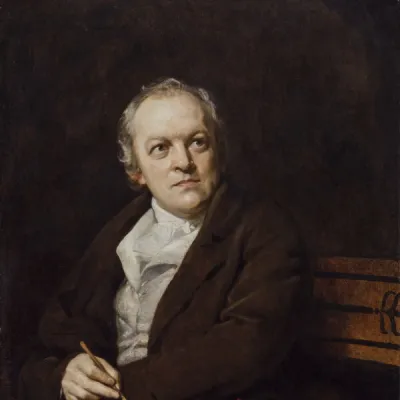
William Blake
Human Design Chart
Biography
Although Blake was considered mad by contemporaries for his idiosyncratic views, he came to be highly regarded by later critics and readers for his expressiveness and creativity, and for the philosophical and mystical undercurrents within his work. His paintings and poetry have been characterised as part of the Romantic movement and as "Pre-Romantic". He was hostile to the Church of England (indeed, to almost all forms of organised religion), and was influenced by the ideals and ambitions of the French and American Revolutions. Although later he rejected many of these political beliefs, he maintained an amicable relationship with the political activist Thomas Paine; he was also influenced by thinkers such as Emanuel Swedenborg. Despite these known influences, the singularity of Blake's work makes him difficult to classify.
The Human Design of William Blake: Generator 2/4
Generator 2/4 — Design at a Glance
William Blake had a high and enduring sacral energy that was activated not by his own initiative but exclusively through reacting to external impulses. His design indicated he functioned as a Generator: a person with immense power potential, comparable to a workhorse whose strength could only be fully unleashed when responding to signals from the environment rather than initiating action on their own.
The central mechanism of his life involved waiting until an internal “yes” – confirmation from his sacral center – was felt before acting. When William Blake acted in harmony with this inner signal, it led to deep satisfaction and a sense of fulfillment. Initiating actions independently or working against his will without responding to external impulses resulted in frustration, energy loss, and the risk of burnout.
Two key pitfalls shaped his dynamics: persistently doing things he lacked intrinsic motivation for, wasting his energy; and holding back from his heart’s project despite still wanting to continue working. His most successful strategy was reacting to a life signal and then responding with concrete action. Only this way could he utilize his immense endurance without falling into ongoing frustration or energy deficiency. His design required this reactive stance to effectively materialize ideas.
Emotional Authority
William Blake's design established a specific decision-making structure: his inner truth did not emerge in the first impulse but only after emotional waves subsided. The defined solar plexus center carried his authority and was subject to constant ups and downs of feelings; the world appeared colored by current mood, enthusiasm could quickly turn into rejection. This initial impression was not a final truth but merely a snapshot. Spontaneous reactions from this immediate emotion were thus unreliable and risky.
The mechanism required patience. William Blake had to give himself time for intense emotions to subside. Only through multiple nights of reflection did he gain the necessary emotional distance. This process was essential to achieve clarity and calmness. Emotional authority always took precedence over other defined centers in his chart, regardless of further configurations. Only once the initial wave subsided did a deeper, more comprehensive understanding emerge. William Blake thus appeared as someone who hesitated on important questions and asked himself multiple times before acting. This delay was not an obstacle but the necessary path to the right decision. Through waiting, inner certainty set in, which was required for long-term life decisions.
The 2/4 Profile — Hermit / Opportunist
William Blake exhibited a pronounced dynamic between his deep need for withdrawal into internal clarity and the simultaneous urge to move within a familiar social network. His design suggested he experience these seemingly contradictory states not as conflict but as necessary sequence: first isolation of line 2, followed by exchange in line 4.
This structure required him to clearly communicate his needs to his environment. He needed secure spaces for uninterrupted reflection and detailed problem-solving – a process supported by Gate 9 on line 2, yet also carrying the risk of focus softening or depression if Jupiter influences blurred detail focus. In this solitude, he condensed his thoughts. Only after this phase of withdrawal did he actively seek contact with his “favorite people”.
Here came Gate 40 in line 4 into play, emphasizing the importance of correct opportunities within the network. William Blake had to learn to balance willpower and necessary rest phases to prevent burnout through overwork or neglecting quality. His success depended on evaluating knowledge gathered during his alone time within the community to develop brilliant ideas from it. The tension between hermit and networker was thus not a deficit but his specific path to insight: withdrawal for processing, then re-emergence in social context for exchange.
Triple Split Definition — Defined & Open Centers
William Blake's Human Design creates a massive internal stability, characterized by six defined centers: Sacral, Heart, G Center, Throat, Solar Plexus, and Root. This configuration establishes a reliable vital energy source (Sacral), paired with clear identity and direction (G) as well as personal will (Heart). His expression was consistent (Throat), while decisions were made through emotional clarity (Solar Plexus Authority) under constant inner pressure (Root). This structure allowed him to speak his truth easily and honestly, since the Throat was directly powered by these motor centers.
At the same time, Head, Ajna, and Spleen were open. This meant that William Blake did not have his own consistent thoughts or intuitions; these areas acted as mirrors for the environment. He tended to question whether he was inspired enough or needed to find answers, which is typical of the mental pressure of an open Head Center. The open Ajna Center also allowed him to take in concepts and opinions from the environment without necessarily identifying them as his own truth. The open Spleen Center made him vulnerable to fears about survival security and well-being that were conditioned from outside. Rather than following spontaneous decisions or getting entangled in foreign worries, his design required waiting for inspiration as well as distinguishing between personal intuition and absorbed environmental fears. This openness stood in stark contrast to the inner firmness of his defined energy and will structure.
Channels for leadership, focus and communal connection.
William Blake exhibited a leadership stance that did not rely on authority but rather on logical competence and collective recognition. His design marked him as someone who could only act effectively when invited by his community. This dynamic arose from Channel 7-31, which connected the G Center with the Throat Center. Gate 7 provided the logical role – often described as the "power behind the throne" – while Gate 31 represented the voice of the collective leader. Blake had to demonstrate his ability to understand existing patterns and identify trends in order to gain the trust of the majority. He did not lead as a sole ruler but shared responsibility as long as the community followed his path. His influence depended on being chosen by people who shared the same context; without this invitation, his leadership potential remained untapped.
Parallel to this, Channel 52-9, connecting the Root and Sacral Centers, created a format energy that compelled Blake to focus precisely on details and facts. Gate 52 promoted non-action – a passive stillness to avoid distractions – while Gate 9 maintained focus. Blake gathered energy through restraint and carefully evaluated relevant aspects before acting. This process of refining patterns was essential for him to confirm or refute his logical conclusions. His strength lay in fully dedicating himself to a task and deepening it with calm discipline, rather than superficially touching many things. Only when his inner self responded did he direct his attention to what truly mattered.
Collective Circuitry — Circuit Signature
William Blake's design points to a tendency towards structured, rational future planning paired with a focus on clan-oriented cooperation. His triple definition created three separate yet parallel operating energetic streams that were not directly connected to each other. The Understanding Circuit linked the Throat and Identity Centers (Channel 31-7), enabling clear articulation of strategic visions. At the same time, it also connected Sacral and Root Centers (Channel 9-52) within the same circuit, providing focused energy for concrete improvements. This served to use logic and structure to optimize societal conditions – an "emotionless ratio" that acted without conditioned feelings.
Parallel to this, the Ego Circuit operated through the channel between Heart and Solar Plexus Centers (37-40). This stream regulated the balance of giving and taking within a community based on mutual support and resource management. Since this circuit did not connect to the Sacral Center, this dynamic interaction required regular pauses for regeneration of clan strength. Thus, William Blake is shown as someone who shared rational insights and nurtured cooperative structures, with both areas – strategic future planning and clan-oriented cooperation – functioning as independent yet coexisting forces in his design without forming a common energetic flow.
Right Angle Cross of Planning 4
William Blake's Design inclined towards strategic alignment and long-term vision. He demonstrated the ability to see through complex connections and develop a clear plan for the future. This fundamental approach stemmed from his configuration of the right cross of Planning 4.
This specific structure in Human-Design describes an inner architecture designed not only to grasp immediate events but also to understand their deeper logic and future development. William Blake possessed a natural toolkit to bring seemingly chaotic or multifaceted situations into a coherent framework. Instead of being driven by the immediacy of the moment, he could take steps towards a broader goal.
The mechanics of this cross supported him in recognizing patterns that were hidden from others and translating these insights into action-oriented strategies. He was less concerned with spontaneous impulses than with thoughtful paths. William Blake lived with an inner confidence that his planning rested on a solid foundation, allowing him to reduce uncertainties and provide direction. This ability shaped his approach to challenges: he sought the overarching meaning to derive concrete steps from it, thereby guiding his actions always by a clear, visionary intent.
Saturn Return · Uranus Opposition · Chiron Return · 2nd Saturn Return — Life Cycles
William Blake's creative phases followed a clear cyclical structure that condensed into three pivotal life stages. His design inclined towards channeling creative impulses through astrological cycles and transforming them into concrete works.
In 1784, at the age of 27, he opened a printing shop in London. This marked his first Saturn return, a time when years of groundwork often coalesce into a solid professional foundation. It was the moment when his technical proficiency and desire for independence took their first stable form.
Ten years later, in 1795 at age 38, he began work on "Vala or The Four Zoas." This coincided with his Uranus opposition, a cycle of expansion and breaking away from the old. Here, his drive to shatter established boundaries and explore new, more radical modes of expression became evident, far removed from conventional expectations.
In 1804, at age 47, he started creating "Jerusalem." This aligned with his Chiron return, a fulfillment cycle of blooming. During this phase, the individual's incarnation cross unfolds increasingly; meaning and purpose become experiential. Blake did not appear here as a healer of old wounds but as someone whose life mission found its deepest resonance. His strategy and authority enabled him to pour this inner clarity into his most comprehensive work. The cycles were not external events but internal rhythms that structured and propelled his creativity.
Generator · Emotional Authority — Synthesis
William Blake lived a life deeply marked by an internal dynamism: the interplay between creative energy and the need for withdrawal. As a Generator, he responded to impulses from his environment, with his defined authority in the Solar Plexus Center bringing clarity only through emotional waves. This waiting period shaped his process of refining ideas and bringing them into the world – a rhythm amplified by his Profile as a Natural Talent/Networker, oscillating between solitude for reflection and exchange with others.
The connection between G-Center and Throat Center gave him a constant voice to express his visions, while his defined Root Center supplied the necessary energy to manifest these ideas.
A central paradox in Blake’s design lay in the tension between his desire for community and his wish for isolation. The 2/4 Profile demanded a continuous shift between social interaction and withdrawal into himself, while an open Head Center made him receptive to external influences. This openness, combined with emotional authority, led to a profound engagement with both internal and external stimuli – a process that fueled his creativity but also left him vulnerable to emotional turbulence.
3 Defined Channels
Incarnation Cross - Right Angle Cross of Planning 4
Solar Return
The Solar Return shows the moment when the sun returns to its exact birth position - your personal solar year.
Life Cycles
Discover the life cycles with a detailed triple view (birth chart, cycle chart, composite).
Human Design Profile
- Type
- Generator
- Strategy
- To respond - wait for something to respond to
- Authority
- Emotional Authority
- Profile
- 2/4 - Hermit / Opportunist
- Definition
- Triple Split
- Incarnation Cross
- Right Angle Cross of Planning 4
- Date of Birth
- 28.11.1757 19:45
- Place of Birth
- London, England, United Kingdom
Frequently Asked Questions
What was William Blake's Human Design type?
What profile did William Blake have?
Which authority guided William Blake's decisions?
What incarnation cross was assigned to William Blake?
When was William Blake born?
Discover your own Human Design
Are you also a Generator? Find out in a personal reading how to use your sacral energy correctly and discover deep satisfaction.
More Personalities
Back to overviewAaliyah

Alexia

Angèle

Anne-Marie

Arcángel

Arno