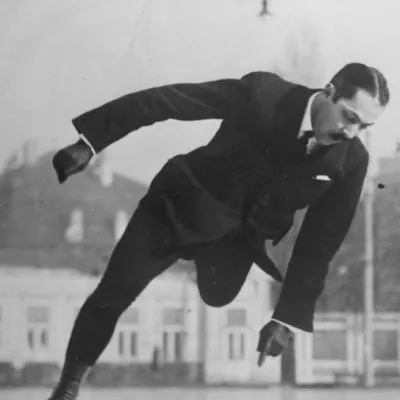
Willy Böckl
Human Design Chart
Biography
The invention of the inside Axel jump (an Axel jump taking off from an inside edge rather than the normal outside edge) has been credited to Böckl and called the "Böckl jump".
After retiring from skating, he moved to the United States and became a coach at the Skating Club of New York. In 1937, he published an illustrated instructional book, Willy Boeckl on Figure Skating, which included descriptions of compulsory figures and free skating, but also included chapters on pair skating, ice dance, and carnival (ice show) skating. He published a second book in 1940, How to Judge Figure Skating, which was primarily about judging compulsory figures.
In 1938, Willy Boeckl (the spelling was changed sometime after he arrived in the United States) was one of thirteen prominent figure skating instructors from the United States and Canada, who met in Lake Placid, New York, for the purpose of forming an association of figure skating instructors. This distinguished group became known as the American Skaters Guild (the name was later changed to the Professional Skaters Guild of America in 1950, and again to the current name of the Professional Skaters Association). Willy became the first president of the guild; Willie Frick its first vice-president, and Walter Arian, second vice-president.
Willy Böckl as a Manifestor 1/3 in Human Design
Manifestor 1/3 — Design at a Glance
Willy Böckl's design marked him as a pioneer and visionary whose energy was aimed at leading the world into a new future. His character matched the dynamics of a Roman emperor: He possessed the grand vision for an empire but did not lead the necessary wars himself, instead delegating their execution to others. This superior foresight inevitably led to misunderstandings and polarization; while some loved his dreams and followed him, he encountered rejection or hatred from others.
To minimize these frictions and attract the right followers, it was essential for Willy Böckl to inform others about his intentions in a timely and precise manner. This strategy of informing served to reduce resistance and create clarity. When he lived by this principle, he was rewarded with a deep sense of inner peace. Violating this principle and acting without prior communication resulted in lasting, deep anger. His design thus showed a clear mechanism: The balance between visionary leadership and necessary transparency significantly determined his emotional well-being and impact on the environment.
Splenic Authority
Willy Böckl's design featured an immediate, intuitive reaction to his surroundings. He possessed a fine inner voice that signaled whether a situation or person was beneficial for his well-being in each moment. This Spleen Authority rested on deep survival intelligence: His physical sensations and intuition served as a direct compass for health and safety.
Since the Spleen Center acted as his alarm system, Willy Böckl had to make decisions at the moment of first impulse. This spontaneous spark was the only reliable indicator of what was right. Because this impulse was extremely subtle and occurred only once, it required high vigilance not to be drowned out by external noise or excessive overthinking. A brief retreat often helped him perceive this delicate message more clearly.
Long-term commitments stood in opposition to this mechanism. Since his inner truth could change according to situation and moment, rigid plans were counterproductive for him. Instead, his design showed a need for great flexibility and freedom. He best cared for himself by rigorously distancing from harmful influences and acting spontaneously rather than getting entangled in lengthy obligations. His strength did not lie in foresight but in the ability to distinguish between healthy and harmful elements in the here and now and react accordingly.
The 1/3 Profile — Investigator / Martyr
Willy Böckl's design featured a learning process through trial and error. His Profile 1/3, the Researcher/Experimentator, created an internal tension between the need of Line 1 to prepare theoretically and the impulse of Line 3 to practically try things out. Often, the energy of Line 1 led him to fear moving from planning into implementation because he felt he did not know enough yet. This conflicted with Line 3's push to gather experience and learn from mistakes.
Line 1 brought themes like mutual dependence and resource orientation. It emphasized successful approaches under acceptance of individual peculiarities without loss of identity. At the same time, it demanded recognition of differences within a community as long as everyone contributed their part. One-sided dependencies were perceived as a danger to losing one's own identity.
Line 3 focused on adaptation and dealing with illusions. It required awareness of others' egos and willingness to enter or break bonds. Awareness alone was not enough; it needed support from the community along with assertiveness. Mistakes were considered necessary parts of the process to gain self-earned insights. Only when Willy Böckl had tested something both theoretically and practically, his judgment could be trusted. This combination shaped him as someone who validated knowledge through direct experience.
Triple Split Definition — Defined & Open Centers
Willy Böckls design points towards a tendency for constant internal pressure and clear willpower. His defined Head and Ajna centers generated a persistent mental drive to question and form concepts, often perceived as inspiring or pressurizing by others. This mental activity was consistently present; however, it could lead to concern if the pressure was not accepted but rather fought against. His defined Throat center enabled him to reliably express these thoughts, whether from understanding (Ajna) or identity (G Center).
Additionally, Willy Böckl had a defined G Center, which provided a firm sense of self-identity and clear direction; he knew who he was and where he was going without needing confirmation from others. His defined Heart center also offered him a constant source of willpower and ego strength; he could make promises and keep them, reinforcing his self-esteem. The defined Spleen gave him a reliable instinct for health and well-being in the present moment, while the defined Root center provided the necessary pressure to move forward in the world and process stress.
This strong internal structure was contrasted by the openness of his Sacral and Solar Plexus centers. Without inherent generative energy, Willy Böckl tended to absorb the vitality of others and amplify it, which could lead to exhaustion under overload. He had to learn to set boundaries and not remain trapped in the conditioned pattern of 'having to'. Similarly, his open Solar Plexus absorbed the emotions of his surroundings; he acted as a barometer for emotional climate but was vulnerable to interpreting other people's moods as his own. The challenge lay in using his defined inner authority to avoid falling into patterns of exhaustion and emotional instability.
Channels for meaning, inspiration, pioneering spirit and intuition.
Willy Böckls design points towards a tendency for deep rooting within the community, with security and resources serving as the foundation for spiritual well-being. This need for territory and supportive relationships shaped his approach to the mystical not as an isolated search but as a process within partnership and social structure.
His inner architecture is reflected in the Channel of Awareness 61-24, which fosters a specific way of thinking: sudden insights arise not through logical planning but as spontaneous mutations in the mind when the intellect quiets down. Willy Böckl was inclined to process and make these intuitive truths accessible to others without needing to control the thought process.
Parallel to this, the Channel of Wave 48-16 establishes a connection between deep, instinctive intelligence and technical perfectionism. Here, there is a drive to master skills through repeated practice, with recognition and resources needed to further develop this talent. The combination of inner depth and outer skillfulness allowed him to refine complex patterns and express his unique potential.
The Channel of Life Struggle 38-28 imbued his existence with stubborn determination to apply personal meaning, even against resistance. This struggle served not for destruction but for individuation and maintaining one's integrity in a frequently conflict-ridden world.
Additionally, the Channel of Initiation 51-25 brings competitive energy aimed at awakening Higher Self through moments of shock. Willy Böckl could inspire others to exceed their limits and reach new levels of consciousness, always connected with universal love from the spirit.
Individual Gates like Gate 19 emphasize the need for a safe environment for his spiritual practice, while Gate 33 creates space for reflection to process experiences. Gate 44 promotes awareness in relationships, and Gate 46 connects him through surrender to the physical here and now. Gate 18 helped him distinguish between necessary corrections in the collective and personal attacks.
Individual Circuitry — Circuit Signature
Willy Böckls design points towards situational adaptation. His triple definition means that his energies do not flow constantly but are activated by external environments. He is someone who primarily uses knowledge and rational strategies as a reaction to context.
The Knowledge Circuit connects Head with Ajna center, as well as Spleen with Root center in him. This creates separate segments: innovative flashes of insight (Channel 24-61) and emotional waves of life struggle (Channel 28-38). Without connection to Throat center, there was no constant expression of this transformation; new identity aspects were learned or adopted when the environment required it.
The Centering Circuit connects Identity with Heart center (Channel 25-51), strengthening inner individuality and self-worth as well as firm convictions. However, without Throat connection, these deep convictions were hard to communicate, shaping him into a solid but inwardly focused personality.
The Mind Circuit connects Throat with Spleen center (Channel 16-48). Here, rational, emotionless logic works towards improving the future. This energy served strategic analysis and sharing of insights free from conditioning.
Together this results in a profile that situatively uses knowledge, inner strength, and rational planning. The isolated groups prevented an uninterrupted flow; instead, Willy Böckl adapted by making specific energies effective as required by the environment's demands.
Right Angle Cross of the Four Ways 4
Willy Böckl's design points towards a tendency for strategic orientation, characterized by the configuration of the right cross of the four paths. This structure described the ability to navigate complex situations by integrating various perspectives and solution pathways. It was about the art of strategic thinking as well as adaptability in dynamic environments.
The emphasis on this mechanism lay in developing an holistic view. It allowed challenges to be viewed from multiple angles, enabling innovative solutions to be found. This required a high degree of flexibility and openness towards new ideas and approaches. Willy Böckl thus showed himself to be someone who did not remain fixed on one path but utilized the dynamics of different paths to find his way in changing contexts. The integration of these four aspects formed the foundation for how he dealt with complexity. Rather than rigid guidelines, he followed an inner logic of adaptation and strategic overview. This configuration shaped his approach when dealing with uncertainty and diversity by helping him choose the best path from a range of options without losing sight of the overall situation.
Saturn Return · Uranus Opposition · Chiron Return · 2nd Saturn Return — Life Cycles
Willy Böckl's design points towards a tendency for structural consolidation and the assumption of adult responsibility, which was particularly evident in his first Saturn return cycle. This transition from youth to established identity marked a turning point where inner maturity became visible externally. The mechanics of this cycle promoted a solidification of self-image and recognition by the environment.
In 1922, at the age of 29, Willy Böckl crowned himself as European champion in figure skating. This success was no coincidence but rather a typical expression of Saturn energy: years of groundwork and inner development culminated in a concrete, measurable result. The title confirmed his position and solidified his identity in public space. For his design, this moment represented the anchoring of his true nature in reality. Recognition by others reflected what he had already built internally. This cycle showed itself as a phase of confirmation where potential transformed into stable performance. Willy Böckl used this energy to prove his competence and establish a solid foundation for subsequent years of life. The victory was thus not only a sporting triumph but an expression of his mature, structural orientation in Human Design.
Manifestor · Splenic Authority — Synthesis
Willy Böckl's design reveals a deep inner logic, fueled by the combination of a manifesting type with a Spleen authority and the shaping influence of the Knowledge circuit. This constellation points to someone driven by internal visions that he refined through intuitive perception and continuous experimentation – a researcher and trailblazer whose judgments stemmed from profound understanding. The defined mental structure, combined with the defined Throat and Heart Centers, gave him a strong inner voice and the ability to express and defend his convictions. The right cross of the four paths underscores this orientation towards individuality and the pursuit of new insights, while cyclical influences emphasized the need for phases of withdrawal and reflection to connect inspiration from the Head Center with practical implementation.
A central paradox in Willy Böckl's design lies in the tension between his manifesting nature – the drive to initiate initiatives and pursue visions – and the necessity to listen to his spontaneous Spleen authority. While he was destined to set the direction, his inner navigation system required waiting and intuitive assessment of the right moment. This dynamic held potential for internal conflicts as the desire for action clashed with the need for spontaneous confirmation – a constant balancing act between trailblazing role and inner guidance.
4 Defined Channels
Incarnation Cross - Right Angle Cross of the Four Ways 4
Solar Return
The Solar Return shows the moment when the sun returns to its exact birth position - your personal solar year.
Life Cycles
Discover the life cycles with a detailed triple view (birth chart, cycle chart, composite).
Human Design Profile
- Type
- Manifestor
- Strategy
- To inform others before acting
- Authority
- Splenic Authority
- Profile
- 1/3 - Investigator / Martyr
- Definition
- Triple Split
- Incarnation Cross
- Right Angle Cross of the Four Ways 4
- Date of Birth
- 27.01.1893 18:15
- Place of Birth
- Klagenfurt, Australia
Frequently Asked Questions
What was Willy Böckl's Human Design type?
What Profile did Willy Böckl have?
What Authority did Willy Böckl have?
What incarnation cross did Willy Böckl have?
When was Willy Böckl born?
Discover your own Human Design
Are you also a Manifestor? Find out in a personal reading how to use your initiation power peacefully and dissolve resistance.
More Personalities
Back to overviewAldair

Cafu

Christian-Jaque
Joelinton

Kaká

Kesha