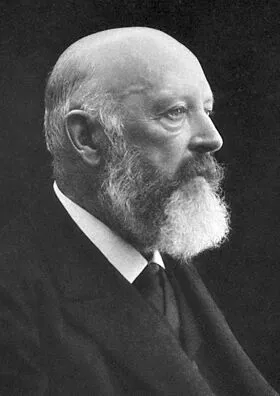
Adolf von Baeyer
Human Design Chart
Biography
He died on 20 August 1917 at age 81 in Starnberg, Germany.
The Human Design of Adolf von Baeyer: Generator 1/3
Generator 1/3 — Design at a Glance
Adolf von Baeyer had an immense sacral energy reserve that gave him high endurance. His design functioned like that of a workhorse: strong and steady, but only effective when he had the energy for his specific tasks. This power was not available through sheer willpower alone, but primarily released in the moment of reacting to external impulses. Therefore, the motto of his system was clear: Not initiate, but react.
For Adolf von Baeyer, the strategy was crucial to wait for signals from life and only act when his inner self gave a clear „Yes! Let’s get started!“. When he acted in harmony with this inner confirmation, he was rewarded with a feeling of deep satisfaction. Conversely, two specific pitfalls threatened: Either he wasted his energy on things without intrinsic interest, leading to burnout, or he was prevented from continuing work on his heart project even though the energy was still there. Both scenarios resulted in frustration and lack of energy. His success therefore did not depend on his ability to initiate projects independently but rather on his ability to use his enormous endurance precisely when life invited him to do so and his gut feeling agreed.
Emotional Authority
Adolf von Baeyer showed an inner structure that led him to avoid making decisions based on the first impulse, instead letting emotional waves mature them. His design carried Emotional Authority, meaning that the Solar Plexus Center was defined and thus always had priority over all other internal signals, regardless of further definitions in his chart. He was subject to a constant up-and-down of emotions; his perception was always colored by the current mood. What appeared inspiring at one moment could seem negative in the next. This immediate feeling was only a snapshot and not necessarily his deeper truth. Quick, spontaneous reactions from this emotional heat often would have misled him. Instead, his path required patience: He had to take time to gain clarity. The strategy consisted of letting decisions „sleep“ multiple times over. Over time, intense feelings subsided, an emotional distance set in, bringing with it calmness. Only then, after going through this process, could he see what was truly right. This was particularly crucial for long-term decision-making as only such a delay avoided emotional deception and enabled a well-founded orientation. Adolf von Baeyer therefore had to endure teasing and wait until the wave subsided to see his true direction.
The 1/3 Profile — Investigator / Martyr
Adolf von Baeyer showed himself as a person who sought the process of learning through practical experimentation and failure. His design tended to connect theoretical foundations with empirical experience, holding back judgment until after intense scrutiny. This attitude stemmed from Profile 1/3, the Researcher and Experimenter. Here arises a tension between Line 1, which demands the gathering of knowledge and theoretical preparation, and Line 3, which drives implementation and learning from mistakes. Adolf von Baeyer lived this inner arc: The fear of insufficient knowledge could hold him back, but the urge to experiment was stronger. His life revolved around this dynamic of trial and error. When he deemed something good, he had rigorously tested it both intellectually and practically beforehand. This profile bestows the quality of a scientist who is also an adventurer – similar to the archetype Indiana Jones. The absolute reliability of his judgment rested on the fact that insights were not only thought but validated through experience. Thus, the necessity of making mistakes and learning from them became a source of profound, self-earned wisdom grounded in solid foundations.
Split Definition — Defined & Open Centers
Adolf von Baeyer's Human Design profile indicated a tendency towards consistent expression and stable identity. His defined Throat Center served as a focal point, transforming messages from the body into clear communication. This was complemented by his defined G Center, which provided him with a reliable sense of self-understanding and direction in life. He possessed an inner security that allowed him to feel loved without becoming dependent on others.
His defined Sacral-Motor generated constant vital energy, driving him to engage with life through reactive responses rather than proactive initiatives. This power was guided by his emotional authority in the Solar Plexus Center. Adolf von Baeyer made decisions not in the moment but waited for an emotional wave to clarify before acting. His defined Root Center also provided a steady pressure that propelled him forward in the material world and helped him cope with stress.
In contrast, his Head, Ajna, and Heart Centers were open. This made him receptive to external inspiration but vulnerable to mental confusion or the pressure of finding answers that weren't truly his own. His open Heart Center meant he was not designed for willpower or competition; instead, he tended to prove his worth through performance rather than simply possessing it. The open Spleen Center posed a risk of making spontaneous decisions out of fear of survival issues or developing unhealthy dependencies to feel secure. Adolf von Baeyer lived in the tension between his stable inner structure and the need to distance himself from external conditioning in mental and instinctive areas.
Channels for inspiration, focus and emotional clarity.
Adolf von Baeyer was characterized by a tension between inspirational leadership and analytical precision. His design suggested that he acted as a creative authority, drawing others in through his mere presence while internally maintaining a strong energy to logically perfect details.
The Channel of Inspiration 1-8 shaped the way he presented himself to the world. Through Gate 1 of Self-expression and Gate 8 of Contribution, he served as an innovative role model. He lived out his individual direction, attracting public attention through authentic, exemplary living that inspired others to express their unique selves.
Parallel to this, the Channel of Concentration 52-9 in his design acted as a constant formative energy. This channel connected Gate 52 of Non-action with Gate 9 of Focusing. It created a quiet pressure to hold back and avoid distractions, focusing unwaveringly on facts and patterns. This energy drove him to logically penetrate, correct, and perfect any chosen matter with discipline, requiring stillness in the body so that the energy could be precisely utilized.
Additionally, Gates like 44 (Awareness) and 24 (Mental Mutation) pointed towards transformation through interaction and renewal in the pulse rhythm. Gate 33 promoted reflection while Gate 19 emphasized the need for resources and community. In his personality, Gates such as 14 (Power) and 53 (Freedom for New Cycles) played a role supporting direction-finding and pioneering spirit. In his design, Gate 62 complemented his love of detail work and logic while Gate 16 promoted experimental mastery.
This configuration combined the power to lead through individual presence with an inner discipline to formulate complex connections with utmost care. Adolf von Baeyer used this synthesis not only to express his uniqueness but also to justify it with logical rigor and focused depth.
Collective Circuitry — Circuit Signature
Adolf von Baeyer was someone who walked a unique path, contributing new insights towards transformation. His design featured a split definition, meaning two independent energy blocks existed in parallel without directly flowing into each other, often creating an internal tension between these separate forces.
The Knowledge Circuit connected his Throat Center with the Identity Center through the Channel of Inspiration. This configuration promoted creative flashes and the acoustic expression of unique individuality. Adolf von Baeyer used this energy to generate entirely new knowledge and share it with the world through his voice or work. The pulsating formative energy of this circuit emphasized the need for self-truthfulness and initiating change.
Parallel to this, the Understanding Circuit connected his Sacral Center with the Root Center. Here focused concentration was paramount. Adolf von Baeyer could develop logical structures and think strategically, driven by a constant source of energy. This enabled him to analyze complex connections and share rational insights free from emotional influence.
A third block formed in the Sense-making Circuit, which linked his Solar Plexus Center with the Root Center. This area was characterized by cyclical emotional waves. Adolf von Baeyer reflected on past experiences and sought meaning behind events. These emotionally colored insights served to learn from the past and share these lessons with others. The combination of these three separate circuits shaped his work: creative inspiration, rational structuring, and emotional reflection existed as parallel but not directly connected forces in his design.
Right Angle Cross of the Four Ways 3
Adolf von Baeyer's Human Design profile laid a profound, often unconscious motivation to seek the essential. It was not about superficial appearances but rather penetrating the illusions of the world to reach the fundamental truth. This configuration marked him as someone who aimed to look beyond the facade of the visible and uncover the essence of things.
The structure of the 'Right Cross of Four Paths' precisely defines this existential orientation. It describes an inner drive to find authenticity and penetrate to the core essence. This process is often associated with a necessary letting go of superficialities or false identifications. For Adolf von Baeyer, this meant constant internal work: he had to detach from what was not truly real in order to approach the underlying reality. This was less about an intellectual game than a spiritual necessity that profoundly influenced his perception and actions. His design challenged him to always seek the core, even if it required a laborious path of letting go. This fundamental stance shaped how he saw and moved through the world – always with an eye on what truly matters beyond all external appearances.
Saturn Return · Uranus Opposition · Chiron Return · 2nd Saturn Return — Life Cycles
Adolf von Baeyer entered a phase of serious life responsibility in 1860 at the age of 25, when he received his Habilitation in Berlin and began teaching Organic Chemistry. For his design, this marked the first Saturn Return, a cycle that demands self-image structuring and separation from origin. It was the transition from young adult to established individual, where inner clarity was reinforced through external commitments.
This mechanism requires discipline and the assumption of concrete tasks to lay one's foundation. Adolf von Baeyer did not appear as someone still searching but rather as one who solidified his position during this time. Taking up teaching was more than a career step; it was the practical realization of inner maturation. Through the practice of responsibility and structure, he gained stability in his life. The first Saturn Return serves to condense self-image; Adolf von Baeyer used this energy to distinguish himself both professionally and personally, creating a solid basis for further development. The connection between internal order and external action characterized this period significantly.
Generator · Emotional Authority — Synthesis
Adolf von Baeyer lived a life deeply influenced by the connection between inner authority and sacral drive. As a Generator, he responded to impulses from his environment, but his emotional authority urged him not to rush decisions until clarity emerged through the emotional wave. This ability to perceive and follow internal signals allowed him to focus on areas that truly fulfilled him – a pattern evident in his concentration on specific research fields. The connection between G Center and defined Throat Center indicates a strong identity expressed authentically, inspiring others.
A central paradox in his design lay in the tension between the need for deep emotional clarification and the drive towards concentration from the defined Root Center. While the emotional center required time for maturation, the link to the sacral center demanded clear reactions to external impulses. This led to an internal interplay between waiting for emotional clarity and the need to proceed focused and goal-oriented, a tension that shaped his work style and forced him to develop both patience and determination.
3 Defined Channels
Incarnation Cross - Right Angle Cross of the Four Ways 3
Solar Return
The Solar Return shows the moment when the sun returns to its exact birth position - your personal solar year.
Life Cycles
Discover the life cycles with a detailed triple view (birth chart, cycle chart, composite).
Human Design Profile
- Type
- Generator
- Strategy
- To respond - wait for something to respond to
- Authority
- Emotional Authority
- Profile
- 1/3 - Investigator / Martyr
- Definition
- Split Definition
- Incarnation Cross
- Right Angle Cross of the Four Ways 3
- Date of Birth
- 31.10.1835 22:30
- Place of Birth
- Berlin, Germany
Frequently Asked Questions
What was Adolf von Baeyer's Human Design type?
What Profile did Adolf von Baeyer have in Human Design?
What Authority guided Adolf von Baeyer?
What incarnation cross did Adolf von Baeyer have?
When was Adolf von Baeyer born?
Discover your own Human Design
Are you also a Generator? Find out in a personal reading how to use your sacral energy correctly and discover deep satisfaction.
More Personalities
Back to overviewAaliyah

Alexia

Angèle

Anne-Marie

Arcángel

Arno