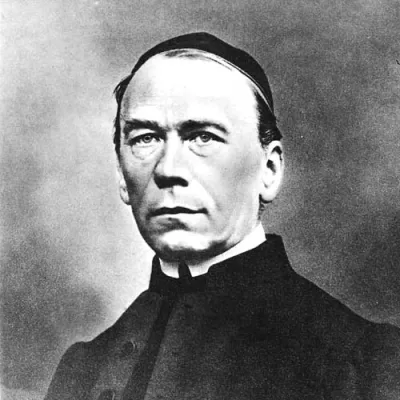
Adolph Kolping
Human Design Chart
Biography
Born into poverty, Kolping was one of eight children of a community shepherd. The family was close and nurturing of their large brood, instilling a social conscience. Kolping remembers his youth with his family as a happy time. He was a bright student but he had to interrupt his education at age 12 to enter a trade. He became an apprentice shoemaker. After working for 16 years, he resumed his education at age 28 and began his formal studies for the priesthood at the University of Munich, then later at Bonn and Cologne. He was ordained a priest in Cologne, Germany at age 31.
On 6 May 1849, he established the first ‘family’ of workingmen - a Society of Journeymen, to help implement his life’s work - the implementation of Catholic social justice. The society has over 370,000 members today with vocational centers and community families all over the world.He died on December 4, 1865 in Cologne, Germany, age 51.
Kolping's life embodied an essential message of his Christian beliefs. His goal was not the state but the individual, the improvement and perfection of oneself, spiritually, morally and physically in the name of Christ, thus affecting and changing ultimately one's own family, community and the world. He was beatified on 27 October 1991 in St. Peter’s, Vatican City, Rome.
Adolph Kolping as a Manifestor 6/2 in Human Design
Manifestor 6/2 — Design at a Glance
Adolph Kolping emerged as a trailblazer and trendsetter. His design inclined him towards a pioneering role and visionary thinking – he was a Manifestor. Such individuals act like emperors in ancient Rome: they carry great plans within them but do not engage in every battle themselves. Instead, they send others to realize their goals. Adolph Kolping encountered resistance because his far-reaching ideas were often misunderstood. He polarized people: some followed him enthusiastically while others rejected or even hated him due to his grand dreams. To find the right followers, it was crucial for him to inform others about his visions early and precisely. This strategy of informing before acting was key to his success. When he adhered to this approach, his design rewarded him with a sense of inner peace. If he lived against his nature, however, he felt persistent anger. Thus, Adolph Kolping lived in tension between his leading role and the necessity to clearly communicate his intentions to avoid misunderstandings and attract those who truly wanted to follow him.
Emotional Authority
Adolph Kolping displayed an internal decision-making structure characterized not by immediate clarity but by a wave-like fluctuation of emotions. His emotional authority, carried by the defined Solar Plexus Center, shaped his perception: the world appeared colored through his current mood state. What was inspiring in one moment could turn negative in the next. This fluctuating perspective did not mean that the first impression was true; quick, spontaneous judgments based on transient emotion often proved misleading and could have negative consequences.
Given that the Solar Plexus Center carried his internal authority, he was subject to a specific mechanism: every decision required time for maturation. Patience here was no optional feature but a mechanical necessity. By hesitating and rethinking decisions multiple times – ideally after a night's sleep – intense emotional waves subsided. Only when an emotional distance had been gained did clarity and calm set in. This cooling-off process was essential for long-term realignments in his life. Through this delay, he could discern what lay beyond the momentary mood as his true reality. Emotional authority took precedence over other defined centers; it dictated the rhythm of his responses to life.
The 6/2 Profile — Role Model / Hermit
Adolph Kolping's design was marked by two phases: initially experimentation, later wise detachment. In his youth, he acted like a 3-line – trying, wandering, and retreating to learn from mistakes. This matched the nature of Line 6/2 before Saturn's return: a process full of unforeseen events requiring acceptance of uncertainty.
Around thirty years in, the sixth line fully activated. Kolping metaphorically retreated into a 'cave' to view his earlier experiments with great distance. This period served intense reflection, healing, and deep self-awareness. The second line of his configuration contributed an aspect of ambition and projection outward; it helped him escape entanglements by seeking redemptive activity. However, this line could not look deeply inward – its purpose lay in the ripening process towards sanctity.
When Kolping finally emerged from this introspective phase, he did so as a person with acquired wisdom. Others recognized this depth and sought his counsel to partake in his ability for self-reflection. His development followed the universal flow: unforeseen events strengthened him while he learned that true contentment arises not from control but from accepting life's course.
Single Definition — Defined & Open Centers
Adolph Kolping revealed himself through a defined Throat Center as someone who possessed a consistent and reliable way of carrying messages into the world. His voice was not a product of the moment, but an expression of an inner structure that transformed information from his body into clear communication. This worked closely with his defined Solar Plexus Center, which served as his internal authority. Kolping did not live by impulsive decisions but waited patiently until the emotional wave had clarified itself before making decisions. This gave him a deep sensitivity and emotional clarity that he used in his relationships and tasks.
This stable inner life contrasted with the openness of several other centers. His open Head Center made him vulnerable to mental pressure and the risk of getting entangled in questions that were not his own. He tended to be overwhelmed by doubts when trying to find answers through pure intellect rather than trusting his emotional clarity. Similarly, his open Ajna Center allowed him to flexibly take on different concepts but carried the trap of holding foreign opinions as truths or feeling compelled to appear logical.
His open G Center meant that he did not have a fixed identity or direction but found it through interaction with his environment and the right places. He relied on others to initiate him to recognize his place. The open Heart Center hindered him from using willpower as a primary drive; he had to learn not to constantly prove what he was worth. Finally, his open Sacral and Root Centers absorbed energy and stress from the environment. Kolping needed to set conscious boundaries and rest to avoid being exhausted by the generative power or pressure of others. His strength lay in using these open fields as mirrors for wisdom rather than compensating them.
Channels for emotional drama and resilient transformation.
Adolph Kolping revealed himself as someone whose social impact was strongly determined by his inner emotional wave. His design laid a tendency towards selective openness: He did not compulsively seek connection but created spaces for transformative consciousness changes in others when his mood was ready. This dynamic was shaped by the Openness Channel 22-12, connecting Solar Plexus to Throat Center. Here, the caution of Gate 12 regulated the passion of Gate 22; Kolping used the quality of his voice to emotionally touch and transform people only if he felt like it. Compulsion in social situations could have made him abrupt while waiting patiently for the right moment turned his words into a catalyst for love and change.
Parallel to this, the Ephemeral Channel 36-35 drove him, an emotional manifestor between Solar Plexus and Throat. This channel resists logical restriction and actively seeks new experiences often by creating crises (Gate 36) to generate movement. Kolping learned wisdom through this restless desire for experience which he later passed on as advice. His focus was on using the moment and giving himself fully to every correct experience, inspiring others to communicate.
Additionally, Gate 47 worked at a collective level by creating meaning from past experiences and transforming confusion into clarity. This promoted sharing of distress for common resolution. In the background, Gate 5 structured his life rhythm through fixed habits that built energy and perfected patterns. Leadership found him through Gate 31 as pure energetic transmission of his power to others. Finally, Gate 33 served reflection and active withdrawal to process experiences and avoid repetition, strengthening his position before new cycles.
Individual Circuitry — Circuit Signature
Adolph Kolping revealed himself as someone whose expression was closely linked with emotional waves. His simple definition connected the Throat and Solar Plexus Centers into a single, continuous flow. This meant that his communication did not stem from cool logic but sprang from the rhythm of his feelings.
In the Knowledge Circuit, he activated the Openness Channel (Gates 12–22). This channel directly linked his Throat to his Solar Plexus Center. Thus, he could immediately articulate his unique, pulsating impulses and creative ideas without them being filtered or delayed by other centers. It was about expressing his individual identity in the here and now.
Parallel to this, the Meaning Circuit worked through the Ephemeral Channel (Gates 35–36). Here too, there was a direct connection between Throat and Solar Plexus Center. This configuration marked him by the necessity of reflecting on experiences from the past. The resulting emotional insights were cyclically processed and then shared. Adolph Kolping used this energy to collectively learn from past events. His words thus always carried the burden and wisdom of past emotions that he now brought into the world. Both circuits amplified this effect: One focused on new, individual creativity, the other on sharing historical emotional truths. Both flowed from the same source – his emotional center – directly into his expression.
Left Angle Cross of Separation 2
Adolph Kolping's design indicated a tendency towards clear demarcation and the protection of personal boundaries. This configuration, known as the left cross of separation, shaped his inner attitude with a strong desire for autonomy and independence from external influences or group pressures.
In Human Design, this mechanism describes an energy designed to sever connections or maintain distance in order to preserve one's integrity and clarity. It was not an aggressive rejection but rather a protective function: Adolph Kolping showed himself as someone who knew when to withdraw to avoid diluting his own values and decisions through compromises with others. This ability to separate served to maintain inner peace and focus by avoiding unnecessary emotional or social entanglements.
The energy of this cross acted as an internal compass, helping Adolph Kolping distinguish between what served him and what burdened him. He lived with a natural inclination to create spaces for himself where he could act undisturbed. This disposition supported him in following his own paths without being led by collective expectations. The separation was thus not an act of isolation but a strategic necessity to preserve his personal truth and ability to act in a complex environment.
Saturn Return · Uranus Opposition · Chiron Return — Life Cycles
Adolph Kolping's life path was marked by clear milestones of validation and institutional anchoring. His design indicated a tendency towards structured buildup, reacting to external recognition and formal legitimization. This became visible in 1841 at the age of 28: The first Saturn return marked the completion of his preparatory schooling with passing the Abitur and obtaining the certificate of maturity. This success condensed years of groundwork into a solid foundation for his further path.
The dynamics shifted in 1852 when the Uranus opposition occurred. At the age of 39, Kolping acquired a property at Cologne's Breite Street 110 for the journeymen's association. This event not only disrupted the status quo but created physical and organizational stability for his career-relevant goals. It was a strategic investment that materialized his vision.
The peak of this development was the Chiron return in 1862. At age 49, Kolping traveled to Rome and presented his work to the Pope. This cycle of fulfillment confirmed his life purpose at the highest level. It was not a moment of healing but of bloom: His long-term work found its final meaning and public validation through the highest ecclesiastical authority. Thus, his design led him from personal qualification over institutional foundation to ultimate confirmation of his mission.
Manifestor · Emotional Authority — Synthesis
Adolph Kolping lived a lifestyle deeply marked by an inner rhythm. As a Manifestor (with emotional authority) in his design, he was destined to give impulses and initiate changes – yet always after careful internal deliberation. The connection between the defined Throat Center and its associated channels (especially 22-12) suggests that he communicated his visions through powerful, emotional communication affecting others. This pattern manifested in the willingness to make personal experiences and later pass them on as wise counsel – a process marked by phases of experimentation followed by intense reflection (6/2 Profile).
Central for Adolph Kolping was the tension field between the drive towards innovation and transformation (Knowledge Circuit) and the necessity of emotional clarity. His emotional authority required time to mature decisions, while his type urged him to become active and explore new paths. The repeated documented events of success following inner maturation (Saturn return, Chiron return) underscore this shift between trying out new paths and subsequent integration of experiences. He was a pioneer whose impact was strengthened by the quality of his emotional authenticity.
2 Defined Channels
Incarnation Cross - Left Angle Cross of Separation 2
Solar Return
The Solar Return shows the moment when the sun returns to its exact birth position - your personal solar year.
Life Cycles
Discover the life cycles with a detailed triple view (birth chart, cycle chart, composite).
Human Design Profile
- Type
- Manifestor
- Strategy
- To inform others before acting
- Authority
- Emotional Authority
- Profile
- 6/2 - Role Model / Hermit
- Definition
- Single Definition
- Incarnation Cross
- Left Angle Cross of Separation 2
- Date of Birth
- 08.12.1813 15:00
- Place of Birth
- Kerpen, Germany
Frequently Asked Questions
What was Adolph Kolping's Human Design type?
What Profile did Adolph Kolping have in Human Design?
What Authority did Adolph Kolping possess?
What incarnation cross did Adolph Kolping have?
When was Adolph Kolping born?
Discover your own Human Design
Are you also a Manifestor? Find out in a personal reading how to use your initiation power peacefully and dissolve resistance.
More Personalities
Back to overviewBaekhyun

Balthus

Beyoncé

Christian-Jaque

Fergie

Halston