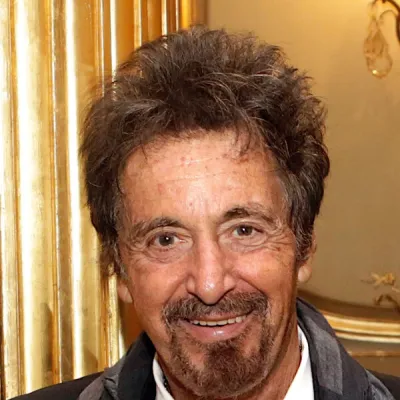
Al Pacino
Human Design Chart
Biography
A method actor, Pacino studied at HB Studio and the Actors Studio where he was taught by Charlie Laughton and Lee Strasberg. Pacino went on to receive the Academy Award for Best Actor for his role in Scent of a Woman (1992). His other Oscar-nominated roles were in The Godfather (1972), Serpico (1973), The Godfather Part II (1974), Dog Day Afternoon (1975), ...And Justice for All (1979), Dick Tracy (1990), Glengarry Glen Ross (1992), and The Irishman (2019).
Human Design Analysis: Al Pacino as Manifestor 4/6
Manifestor 4/6 — Design at a Glance
Al Pacino's design points towards an inclination for pioneering leadership and visionary thinking. As a Manifestor, he acted like an emperor in ancient Rome: He had the vision of a great whole but did not lead the necessary battles himself; instead, he sent others to build his empire. This configuration brought with it a specific dynamic. His far-reaching plans naturally encountered resistance; he polarized strongly. While some people loved his big dreams and followed him, others disliked or even hated him because of these enormous visions. The central pain point of this design lay in misunderstandings as his thinking was often faster than that of his surroundings.
To find the right following, it was crucial for Al Pacino to inform others timely and precisely about his intentions. This formed the ideal strategy for his type. If he adhered to this requirement and held onto his inner authority, he was rewarded with a sense of inner peace. Living against this design likely made him feel persistent, deep anger inside. His path was thus not only marked by radiance but significantly depended on how clearly and early he communicated his visions to minimize friction and gain support.
Ego Authority
Al Pacino's design presents an unusual configuration: authority in the ego. This structure requires defined willpower alongside open emotional, sacral, and spleen centers, leading to high susceptibility to external influence. His truth did not lie in calculated strategies or gut feelings but in his immediate will, which was revealed through speaking. Crucial was listening to himself: Spontaneous, uncensored talking marked his inner direction while the mind often only represented others' interests.
This mechanism shaped a stance where following one's own will consistently could appear egoistic outwardly. For Al Pacino, it was essential to stand by himself and ensure that his engagement benefited him personally – whether through material success or the claim to surpass limits and be first. This authority allowed him to guide others into new directions but required strict pauses after achieving goals. Continuous tension without regeneration did not lead to desired results but threatened to turn into exhaustion. His path involved using his own willpower as a compass rather than being distracted by the openness of other centers.
The 4/6 Profile — Opportunist / Role Model
Al Pacino's design points towards an inclination for intense experimentation in the first decades of life, particularly in the realm of relationships and friendships. As a 4/6er, the sixth line still appeared like a third during this early phase: a field of testing and learning through direct experience. This created a foundation of curiosity before life structurally condensed.
With the activation of the sixth line, a central conflict emerged: the contradiction between the deep need for belonging (line 4) and the impulse to distance oneself to reflect on the greater meaning (line 6). This inner tension between heart and head shaped his development. The fourth line at Gate 27 promoted a generous, almost noble way of sharing within his network. However, this always required the ability to discern whom one opens up to; blind sharing risked exhaustion or loss of strength.
At the same time, the sixth line on Gate 41 brought in a transformative quality: transmission and transcendence. Al Pacino showed himself as someone who not only developed new perspectives for himself but also passed these on as trendsetters to others. The challenge was to strategically use this newly gained superiority or insight – sometimes through secrecy to maintain special advantages. In later years, it was expected of him to translate these experiences into a wise role model, always mindful of protecting the great heart of line 4 from false bonds and consciously engaging in cooperation.
Single Definition — Defined & Open Centers
Al Pacino's design points to a strong and independent expressive style that is fueled by inner willpower. His defined Heart Center provided him with a constant source of ego strength and the desire to determine his own life path. He tended to take promises seriously and use his resources wisely, seeking recognition for his contributions. This energy flowed directly into his also defined Throat Center, allowing him to express himself with clarity and honesty. His voice was not just a reflection of fleeting thoughts but a reliable instrument of manifestation that spoke from the will to act.
At the same time, his chart revealed high vulnerability to external influences in areas of identity and emotion. His open G Center lacked a fixed personal identity; he relied on interactions with the environment and the right place to discover who he was in a specific context. This connected with his open Solar Plexus Center, which absorbed and amplified other people's feelings. Instead of having his own emotional wave, he reflected the emotional climate of those around him, leading him to lose himself in relationships or roles to find security.
His open Head Center also contributed to mental flexibility. He was not driven by constant inner inspiration but could take in and process ideas from the environment without identifying them as personal truth. This openness allowed him to adopt various perspectives while there was a risk of getting lost in other people's mental noise or trying to solve false problems. The combination of defined willpower and open identity created a profile that acted strongly, yet often adopted its role and emotional coloring from the environment.
Channels for bold initiative and clear self-assertion.
Al Pacino's design points towards a dominant and controlling presence that closely links material resources with authority. This is primarily shown through the Money Line 21-45. This channel connects the Heart Center to the Throat Center, creating an internal conflict between the drive for control (Gate 21) and the need for loyalty as well as having the "last word" (Gate 45). Al Pacino had to learn to use his willpower in a way that allowed him to act independently—often as his own boss—to avoid stress. The mechanics of this channel require a balance between hard work and the ability to lead the tribe or organization through clear hierarchies, with Gate 45 representing the authoritative voice that decides whether something is realized or not.
In addition to this material dominance, other energetic streams were at play. The prioritized gates point towards a deep rooting in care and self-preservation (Gate 27), paired with the ability to take risks in the here and now (Gate 28). This created a foundation of genetic warmth and courageous decision-making joy. At the same time, Gate 41 propelled him evolutionarily forward by using emotional crises as a source of feeling to grow from experience to experience. The leadership dynamics were supported by Gate 31, which transfers power onto others, while Gate 26 in the Heart Center provided the ability to implement innovations even within conservative structures—often through persuasive salesmanship and pauses.
The personality level complemented this with change through interaction (Gate 35), bringing mastery only through slow experience. Gate 23 added the ability to translate internal processes into language and explain difference, while Gate 51 offered a strong, almost amoral willpower without social bonds that reacted to shocks with adaptation. Finally, Gate 56 allowed for the abstraction of mental processes into figurative stories that could structure narratives from beginning to end. Together, these elements formed a profile that linked material power with narrative depth and risk-taking intuition.
Tribal Circuitry — Circuit Signature
Al Pacino's design inclines towards strategic resource management, driven by a desire for material security and mutual support. His simple structure connects the Heart Center and Throat Center directly, blending actionability with clear communication. Within the ego circuitry, which belongs to the family group and promotes cooperation, his specific "Money Line" (Channel 21-45) was active. This channel links the Heart Center – the engine for willpower and agreements – with the Throat Center, the place of expression. As a result, he demonstrated an ability to create or secure material values through decisive action and words. Since there was no connection to the Sacral Center, constant life force was lacking; instead, his system required rest periods for energy regeneration for the family group. The mechanics of this circuitry emphasize giving and taking as well as traditional structures. Al Pacino utilized this configuration to gain resources in exchange, with his actions always grounded in reliability and material foundation, despite the absence of a continuous energy source.
Right Angle Cross of the Unexpected 1
Al Pacino's Human Design reveals a tendency towards unpredictable turning points that often come out of nowhere. This configuration, the right cross of the Unexpected, describes a life dynamics where external circumstances or internal impulses suddenly and without much prior warning become effective. It is not about planned strategies but spontaneous reactions to situations that prove decisive. Al Pacino was marked by this mechanism with a capacity to act quickly in moments of uncertainty or sudden change, without prior consultation or detailed planning. The right cross of the Unexpected 1 emphasizes the aspect of surprise – both for the person themselves and their environment. It is about events or decisions that cannot be anticipated but can still have profound effects. This dynamic requires flexibility and an open attitude towards the unknown, as rigid plans often hit their limits here. Al Pacino's chart indicates that he was particularly reactive in such moments, although the source of these impulses is not always clear. The energy of this cross acts like a catalyst for unexpected developments that can change the previous path.
Saturn Return · Uranus Opposition · Chiron Return · 2nd Saturn Return — Life Cycles
Al Pacino's Human Design reveals a tendency towards late but lasting structuring. His journey did not show as stormy early work but rather as a process of gradual densification and anchoring. This reflects the mechanics of Saturn Returns: A cycle of about 29 years, in which inner values are reconciled with external realities to lay solid foundations for the next life phase.
In 1971, at the age of 31, he received a role alongside Kitty Winn in 'Panic in Needle Park'. For his design, this first Saturn Return marked a turning point: The years-long groundwork condensed into a concrete career-relevant step. It was not an unexpected breakthrough from nowhere but rather the result of a long-term development that now took visible form and created a new professional structure.
This process of stabilization repeated itself in the second Saturn Return in 1994. At age 54, he received the Golden Lion at the Venice Film Festival for his life's work. This success was not an isolated accolade but rather the logical consequence of a consistently lived strategy over decades. The design shows how inner integrity and external recognition synchronize over time. The second Saturn Return confirmed the previously created structures and gave them final weight and significance in his professional cosmos.
Manifestor · Ego Authority — Synthesis
Al Pacino's chart reveals a deep red thread of initiation and action, fueled by the Manifestor type (Design) and authority in the ego (Authority). He is destined to initiate things and set direction – a pioneer whose voice is channeled through the defined Throat Center (Centers). This drive towards action finds its material counterpart in Channel 21-45 (Channels/Gates), which enables him to gather resources and exercise tribal leadership, with decisions springing from an unfiltered expression of the ego center. The Line 6 in Profile (Profile Role) strengthens this pull towards reflection and wisdom, yet with the inner tension between belonging and individuality.
A central paradox lies in the combination of this strong initiatory force and the open Emotional, Sacral, and Spleen Centers (Centers). While he is destined to act as a Manifestor, he is simultaneously vulnerable to influence and distraction (Authority), which forces him to listen to himself while speaking. This leads to an internal conflict between the desire for control and the necessity of responding to external stimuli – a tension field that manifests in verifiable events like the beginning of a role (Saturn Return 1) and the recognition of his life's work (Saturn Return 2).
1 Defined Channel
Incarnation Cross - Right Angle Cross of the Unexpected 1
Solar Return
The Solar Return shows the moment when the sun returns to its exact birth position - your personal solar year.
Life Cycles
Discover the life cycles with a detailed triple view (birth chart, cycle chart, composite).
Human Design Profile
- Type
- Manifestor
- Strategy
- To inform others before acting
- Authority
- Ego Authority
- Profile
- 4/6 - Opportunist / Role Model
- Definition
- Single Definition
- Incarnation Cross
- Right Angle Cross of the Unexpected 1
- Date of Birth
- 25.04.1940 11:02
- Place of Birth
- New York, New York, United States
Frequently Asked Questions
What is Al Pacino's Human Design type?
What profile does Al Pacino have in Human Design?
What authority guides Al Pacino?
What is Al Pacino's incarnation cross?
When was Al Pacino born?
Discover your own Human Design
Are you also a Manifestor? Find out in a personal reading how to use your initiation power peacefully and dissolve resistance.
More Personalities
Back to overviewSissy Spacek

Anémone

Ann-Margret

Arletty

Arno
Artus