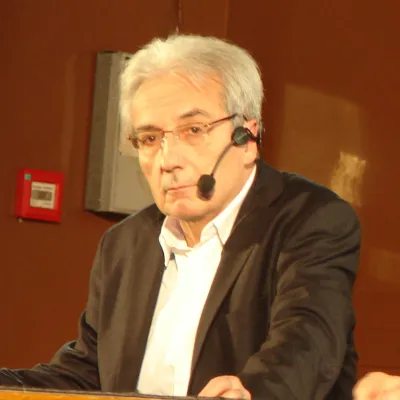
Albert Fert
Human Design Chart
Biography
What does Generator 6/2 mean for Albert Fert?
Generator 6/2 — Design at a Glance
Albert Fert's design revealed a tendency towards great endurance and inner drive. As a Generator, he had plenty of sacral energy, which made him extremely strong and resilient – provided this power was used for tasks that truly mattered to him. His path wasn't marked by initiating projects actively but rather by a fundamental responsiveness to impulses from the outside world. The motto of his design was clear: not initiate, but react.
This mechanism meant that Albert Fert utilized his energy most efficiently when he waited for a signal from life and acted upon it as soon as his inner self – the sacral center – gave a clear “yes.” This strategy of reacting was key to his effectiveness. Following this rhythm led him to a deep sense of satisfaction and fulfillment. Conversely, frustration and energy depletion threatened if he worked against this natural flow, for instance by compulsively initiating things or holding back from his heart project despite the inner power still being present. His design thus showed that true strength lay in his ability to respond instinctively to what came his way rather than swimming against the current.
Sacral Authority
Albert Fert demonstrated decision-making based on direct physical resonance. As a Generator, his strategy was identical with his inner authority: sacral authority. This mechanism simplified his process since he didn't have to choose between different internal voices but trusted one impulse alone. A prerequisite for this was an open emotional center, meaning he didn't need to wait for emotional waves to gain clarity. Instead, he reacted immediately to external stimuli through a “gut feeling” – felt as a surge of energy or heard as grunts and hums. Once this sacral motor kicked in, he felt vitalized with inexhaustible energy for his tasks. This enabled him to work with great enthusiasm and without compulsive purposefulness. Additionally, an activated spleen center supported this reaction. Through the connection to the sacral center, Albert Fert could make particularly quick and spontaneous decisions. He had immediate access to his instinctive perception and physical well-being, which he could reliably trust. This configuration marked him as someone who lived by spontaneously powerful responses to life and found inner satisfaction.
The 6/2 Profile — Role Model / Hermit
Albert Fert emerged as someone whose early years were characterized by intense experimental enthusiasm. Before the age of 30, the dynamics of Line 2 dominated: trial and error, often followed by a retreat after failures to learn from painful experiences. This phase served to create a foundation for later wisdom through personal life experiences, while he tended to unconsciously exaggerate situations or adjust his perception without realizing it.
With Saturn's return around age 30, a fundamental shift occurred in his design. The energy of Line 6 became active, prompting him to withdraw temporarily – metaphorically into a “cave” on a mountain – to look back at his past experiments with great distance. This period of intense reflection was for Albert Fert both a process of healing and deep self-discovery. He used this phase to overcome old doubts and ask new, valuable questions rather than merely nostalgically looking back.
From this introspective depth, he later emerged as a wise leadership figure. Others sought him out to partake in his life wisdom and learn from his ability for profound introspection. His development led to achieving mutation in his individual circuitry and helping others understand hidden connections.
Split Definition — Defined & Open Centers
Albert Fert's Human Design shows a tendency towards constant mental pressure and a specific kind of conceptual thinking. This configuration between the Head Center and Ajna Center created an ongoing inner drive to ask questions and understand connections. However, since these centers do not have their own energy for implementation, it was crucial for Albert Fert not to misinterpret this mental process as a direct call to action but rather use it as a source of inspiration that encourages others to think.
At the same time, he had a defined Sacral Center and a defined Root Center. The Sacral provided a continuous vital energy source that worked best when responding to external stimuli. Initiating actions from the mind would quickly deplete this energy; instead, waiting for the right question or invitation allowed him to act with full force and satisfaction. His defined Root Center added a firm, adrenalized foundation that delivered the pressure needed to move forward in the material world and establish existential security.
In contrast, Albert Fert showed several open centers, making him susceptible to conditioning. His open Throat Center meant he could not communicate consistently; under pressure, he tended to force attention through speaking rather than waiting for the right timing. The open G Center left him without a fixed identity or direction; often seeking validation from his environment and reflecting the traits of those around him instead of having a stable core. Furthermore, his open Heart Center led to not feeling compelled towards will formation or competition on his own; he risked making promises just to prove his worth and suffered when unable to keep them due to lack of energy. His open Solar Plexus absorbed the emotions of the environment, making him emotionally vulnerable and personalizing foreign moods as his own. Finally, his open Spleen Center brought a fundamental survival anxiety and uncertainty in spontaneous decisions; he tended to hold onto things that did not serve him just because they gave a false sense of security.
Channels for evolutionary change and mental abstraction.
Albert Fert's basic attitude was shaped by a deep inner rhythm: patience while waiting for sudden, unexpected insights. His design featured the Mutation Channel 60-3, connecting Root and Sacral Centers. This energy brings evolutionary change through a pulsing process from chaos to order. Albert Fert had to learn to accept the limitation (Gate 60) and not fight against times of stillness or melancholy but patiently wait for new mutations to emerge from below. This channel generates a powerful frequency that requires innovation but only works effectively when following the natural reaction from the Sacral Center and not trying to force change through willpower.
Parallel to this, he was marked by the Abstraction Channel 64-47 between Head and Ajna Centers. This channel filters every experience through kaleidoscopic mental images to uncover hidden connections and stories. Albert Fert felt pressure to understand the past and gain a perspective that could be passed on further. The mental confusion (Gate 64) was not an error but rather the necessary starting point for the process of understanding (Gate 47). His strength lay in patiently enduring these fleeting thoughts until a clear picture formed, which he then shared as inspiring insights. Here, the mind served not to solve personal problems but as a tool to recognize complex patterns and open new perspectives for the collective.
Individual Circuitry — Circuit Signature
Albert Fert was marked by two separate, parallel energetic poles. On one hand, there was pulsating power from the Sacral and Root Centers aimed at mutation and deviation from the known. This corresponded to the Knowledge Circuit: it was about going on an innate path and forming a new identity through radical change. The energy was acoustically grounded in the present.
Independently of this, another pole existed from Head and Ajna Centers. This part of his design served abstraction and meaning-making. It turned towards the past, reflected experiences, and sought hidden connections in what had already occurred. This visual, cyclical energy was geared to emotionally prepare insights for later sharing with others.
As Albert Fert had a Split Definition, these two systems did not merge. The innovative, mutating power of the body and the reflective, sense-making intelligence of the mind existed side by side as independent forces. They did not form a continuous bridge from idea to action but shaped his essence as two separate yet equally important dimensions: on one hand, the urge towards newness and otherness; on the other, deep contemplation about the significance of the past.
Left Angle Cross of Dominion 1
Albert Fert was characterized by a deep-rooted inclination to bring order and structure into his environment. His design is marked by the energy associated with the left cross of Authority 1. This configuration suggests that he had a strong desire for control over his immediate surroundings, not out of power hunger but from a wish to create stability and clarity.
The mechanics of this cross reveal a person who gains security through the creation of rules and boundaries. Albert Fert likely acted as someone who enjoyed setting the framework within which others could operate. He sought ways to reduce chaos and establish functioning systems. This tendency did not manifest as domineering behavior towards others but rather as an inner discipline that helped him navigate complex situations.
His life task was to consciously apply this organizing force to create a reliable space for himself and his fellow human beings. Through understanding this energetic orientation, he could learn when it is helpful to prescribe structure and when it is better to give others room to breathe. This balance between leadership and restraint was crucial for his personal well-being and effectiveness in social contexts.
Saturn Return · Uranus Opposition · Chiron Return · 2nd Saturn Return — Life Cycles
In his youth, Albert Fert emerged as someone who sought deep personal connections and entered into them with great seriousness. His design indicated a tendency towards long-term commitments that not only fostered emotional closeness but also structural stability in life. This was particularly evident during his first Saturn Return, a cycle often seen as a phase of maturation and consolidation. During this period, years of experience coalesced into durable results that laid the foundation for future developments.
In 1967, at the age of 29, Albert Fert married Marie-Josée Ortega – an event typical for this life stage: a decision with both emotional and practical far-reaching consequences. The Saturn Return often marks a turning point where one consciously chooses certain paths and then pursues them consistently. For Albert Fert, this meant entering into a partnership that was not only private but possibly also professionally formative. His ability to build and maintain relationships reflects his inner order – a trait strengthened by his Human Design.
Generator · Sacral Authority — Synthesis
A central red thread in this design is the deep connection between creative energy and the process of self-discovery. The sacral authority (Sacral Center) drives an unstoppable force towards activation through external stimuli, while the defined Head Center (mental pressure) constantly seeks understanding and new perspectives. This cycle of energetic reaction and intellectual curiosity is reinforced by the Channel of Mutation (3-60), which harbors potential for evolutionary change – a continuous search for one's own format and expression (Knowledge Circuit). The Line 6 in Profile indicates that this process is marked by intense experience followed by reflection to gain wisdom and pass it on.
The central paradox lies in the tension between the pulsating, present drive of the sacral center and the melancholic nature of the Channel of Mutation. While the energy urges activity, each new step also involves letting go of the old and a certain confusion (Gate 3). This creates a dynamic equilibrium between the urge for change and the necessity to accept limitations – an ongoing navigation between creative unfolding and introspective processing. A documented event points to a phase of intense personal experience (Saturn Return at age 29), which paved the way for deeper self-awareness.
2 Defined Channels
Incarnation Cross - Left Angle Cross of Dominion 1
Solar Return
The Solar Return shows the moment when the sun returns to its exact birth position - your personal solar year.
Life Cycles
Discover the life cycles with a detailed triple view (birth chart, cycle chart, composite).
Human Design Profile
- Type
- Generator
- Strategy
- To respond - wait for something to respond to
- Authority
- Sacral Authority
- Profile
- 6/2 - Role Model / Hermit
- Definition
- Split Definition
- Incarnation Cross
- Left Angle Cross of Dominion 1
- Date of Birth
- 07.03.1938 11:00
- Place of Birth
- Carcassonne, France
Frequently Asked Questions
What is Albert Fert's Human Design type?
What Profiles does Albert Fert have?
What Authority does Albert Fert possess?
Which incarnation cross is assigned to Albert Fert?
When was Albert Fert born?
Discover your own Human Design
Are you also a Generator? Find out in a personal reading how to use your sacral energy correctly and discover deep satisfaction.
More Personalities
Back to overviewAaliyah

Alexia

Angèle

Anne-Marie

Arcángel

Arno