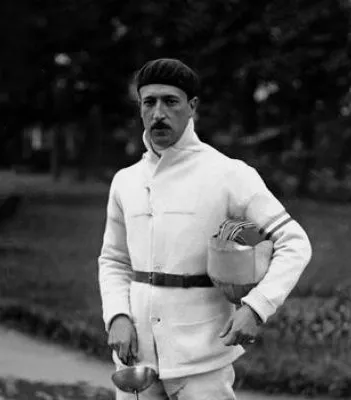
Photo: Wikimedia Commons
Alexandre Lippmann
Human Design Chart
Biography
Through his mother, Marie-Alexandrine-Henriette Dumas, he was the grandson of Alexandre Dumas fils and great-grandson of French writer Alexandre Dumas, author of The Three Musketeers.
He died on 23 February 1960, aged 78, in the 8th arrondissement of Paris. He was inducted into the International Jewish Sports Hall of Fame in 1984.
Alexandre Lippmann — Manifestor with Profile 4/1
Manifestor 4/1 — Design at a Glance
Alexandre Lippmann's design was characterized by a driving force that positioned him as a pioneer and visionary. His nature was geared towards leading the world into a new future, much like an emperor in ancient Rome who had a vision of a great empire but did not fight in the battles himself, instead using others to achieve his goals. This style of leadership often led to Alexandre Lippmann being misunderstood, as he thought further ahead than most of his contemporaries. This polarized people: some were inspired by his big dreams and followed him, while others rejected or even hated him because of these visions.
To find the right followers, it was crucial for Alexandre Lippmann to inform others about his plans at the right time and precisely. This strategy of informing was the key to his success. When he followed this strategy and trusted his inner authority, his design rewarded him with a sense of inner peace. If he lived against this principle, he felt a persistent, deep-seated anger. His path was therefore marked by the necessity to communicate clearly to minimize resistance and effectively use his visionary energy.
Emotional Authority
Alexandre Lippmann's inner authority was emotional, carried by his defined Emotional Center. This configuration fundamentally shaped his decision-making: he was subject to a wave movement of feelings that colored his perception of the world through the current mood. What appeared inspiring in one moment could seem negative in the next. His immediate feeling was only a snapshot, not the final truth. Quick, spontaneous decisions made in this emotional heat often proved detrimental.
The mechanics of his authority required patience and time. Alexandre Lippmann had to let decisions mature to gain deeper insights. Sleeping on decisions and questioning his first impulses multiple times were necessary for the intense feelings to subside. Only with this emotional distance did clarity and calmness set in. This process was particularly crucial for long-term, life-defining decisions.
As an emotional authority, this center always took precedence over all other defined centers in his design. Regardless of further definitions, the emotional wave was the central filter for his life decisions. Alexandre Lippmann lived this dynamic by learning to trust his emotional flow but not to act on its first impact, but rather to wait for the ensuing calm.
The 4/1 Profile — Opportunist / Investigator
Alexandre Lippmann's design established a deep, unchangeable rooting. As a 4/1-Networker/Researcher, he possessed a nature that barely deviated from his individual course. This rare profile marked the transition from
Single Definition — Defined & Open Centers
Alexandre Lippmann's design revealed a tendency towards deep emotional resonance and reliable expressive power. His defined Solar Plexus Center determined his inner authority: decisions required time to clarify within the emotional wave. He tended to avoid impulsive action by waiting until emotional clarity emerged. This patience allowed him to fully utilize the depth of his feelings, rather than swinging between highs and lows. Simultaneously, his defined Throat Center acted as a steady channel for communication. His voice reflected directly the source of his energy, giving him an honest and clear way of expression. He spoke not out of compulsion, but from a stable inner connection that allowed him to articulate his truth with ease.
These defined structures contrasted sharply with his open centers. His open Head Center made him vulnerable to mental pressure and the temptation to take on foreign questions. He tended to question whether he was inspiring enough or sought answers that were not his own. The open Ajna Center amplified this mental flexibility; he took on ideas without identifying them as personal truth, keeping him open to new perspectives but also vulnerable to confusion. His open G Center meant he did not carry a fixed identity but defined himself through relationships and places. He did not actively seek a direction but waited for the right path to be shown to him. The open Heart Center freed him from the burden of proving his worth, while the open Sacral Center made him susceptible to exhaustion when taking on foreign energy. The open Spleen Center required him to go through fears to gain intuitive wisdom, and the open Root Center absorbed external stress that he was not allowed to experience as his own.
Channels for emotional openness and creative passion.
Alexandre Lippmann's design revealed a tendency towards rhythmic, mood-driven communication. His social impact depended less on constant availability and more on the quality of the moment when he spoke. This dynamic was significantly shaped by the Openness Channel 22-12. This channel connected the Solar Plexus Center with the Throat Center and was subject to the emotional wave. Openness was not constant friendliness but an expression of passion, melancholy, and drama, effective only when the inner mood matched. Gate 12 functioned as a filter, limiting spontaneous openness from Gate 22 to those with high mutational potential. Lippmann used the quality of his voice to achieve emotional impact on others, not just to convey information.
This individual expression stood in tension with collective dynamics. Gate 45 connected him to the tribal level and the hierarchy of blood, where the attraction of like forces was beneficial. At the same time, Gate 26 in the Heart Center enabled the sale of innovations within conservative structures but also required pauses. Emotional depth was regulated by Gate 6, which provided fertility and friction as a motor for further development. Gate 36 showed that crises for him were impersonal, cyclical movements creating new ground for experiences. Finally, Gate 8 carried the impulse for individual contribution and the promotion of group goals, where the awakening of uniqueness required attention. Lippmann's mechanics described a person who only used his social and mutational power when his emotional authority allowed it, thereby creating transformative moments rather than exhausting himself in forced interactions.
Individual Circuitry — Circuit Signature
Alexandre Lippmann's design revealed a tendency towards emotional authenticity. He was someone who directly translated his inner feelings into words without filtering or delaying them. This direct connection between his Solar Plexus Center, the seat of emotions, and his Throat Center, the place of expression, created an uninterrupted flow.
This mechanism was shaped by the Knowledge Circuit, which specifically activated the Openness Channel in him. This channel connected Gates 12 and 22 and allowed him to openly and honestly communicate his emotional truth. The energy of this circuit aimed to initiate change through the expression of his unique identity. For Alexandre Lippmann, this meant that his creativity and drive to transform the new were closely linked to his ability to emotionally open up.
As he had a Simple Definition, these centers formed a coherent unit. There were no separate or conflicting energetic blocks within this connection. His life energy thus naturally flowed from emotional feeling through processing to spoken or expressed result. This shaped his way of interacting with the world: through a pulsating, acoustic, and often melancholic resonance based on immediate perception of his own feelings. He lived this dynamic by carrying his inner emotional wave directly outward, which helped him walk his unique path and gain new knowledge through personal expression.
Juxtaposition Cross of Possession
Alexandre Lippmann's design was marked by the configuration of the Juxtaposition Ownership Cross. This structure conveyed a specific attitude towards resources and values: it was not about mere accumulation, but rather the ability to distinguish the essential from what merely seemed important. Lippmann was someone who intuitively recognized which goods, ideas, or relationships were sustainable and which merely offered fleeting appeal.
The Juxtaposition Ownership Cross arises from the combination of certain energetic channels, allowing a clear distinction between material and immaterial security. Those with this configuration tend to see possession not as a status symbol, but as a tool for creating stability and freedom. Lippmann's design suggested that he valued things based on whether they gave him freedom to act or constrained him. This mechanism fostered a pragmatic but not greedy approach to what one has. It was an inner clarity that helped let go of the superfluous and focus on what truly stood the test of time. For Lippmann, this meant that his approach to possession was always also a question of inner order and long-term perspective.
Saturn Return · Uranus Opposition · Chiron Return · 2nd Saturn Return — Life Cycles
Alexandre Lippmann's design conveyed a clear orientation towards physical presence and direct effectiveness. His life path was marked by moments where inner discipline condensed into outer mastery. This was especially evident during his first Saturn phase. The first Saturn return often marks the transition from experimental youth to established adulthood, where years of groundwork condense into sustainable results. In 1908, at the age of 27, Lippmann won the gold medal in sabre fencing with the French team and a silver in the individual event. This success confirmed the maturity of his design, uniting structure and performance at the highest level.
Later came a phase of transformation and renewal, characteristic of the Uranus opposition. This aspect often demands adaptation to new realities or liberation from old patterns to achieve a higher level of self-realization. In 1924, at the age of 43, Lippmann won his second Olympic gold medal in team fencing. This later triumph underscored the ability of his design to shine again after years of establishment and maintain success in changed contexts. His successes were no accidents but expressions of a mechanism that relied on precise execution and timely adaptation.
Manifestor · Emotional Authority — Synthesis
Alexandre Lippmann lived a life marked by a profound inner dynamism. As a Manifestor with emotional authority (and the rare 4/1 profile), he was destined to initiate and lead the world in a new direction, yet this impulse always had to mature through the emotional wave. His defined Throat, connected to the Solar Plexus, points to an expression of feelings and creative energy transformed through interaction with the world. The Fixed profile reinforced this tendency to adhere to his own path and protect himself from influences that questioned his inner truth. The Olympic successes (1908, 1924) could be interpreted as expressions of this inner power unfolding in moments of clarity and resolve.
Central to Alexandre Lippmann was the tension between his drive for initiation and the need for emotional clarity. He was a pioneer with visions, yet his emotional authority required time to test and refine these visions. The Juxtaposition Ownership Cross suggests a tendency to identify with what he had created while maintaining a certain distance. This dynamic between the desire for influence and the protection of his individuality shaped his actions and created a complex interplay of energy and restraint.
1 Defined Channel
Incarnation Cross - Juxtaposition Cross of Possession
Solar Return
The Solar Return shows the moment when the sun returns to its exact birth position - your personal solar year.
Life Cycles
Discover the life cycles with a detailed triple view (birth chart, cycle chart, composite).
Human Design Profile
- Type
- Manifestor
- Strategy
- To inform others before acting
- Authority
- Emotional Authority
- Profile
- 4/1 - Opportunist / Investigator
- Definition
- Single Definition
- Incarnation Cross
- Juxtaposition Cross of Possession
- Date of Birth
- 11.06.1881 13:00
- Place of Birth
- Paris Arrondissement 17, France
Frequently Asked Questions
What was Alexandre Lippmann's Human Design type?
What Profile did Alexandre Lippmann have in Human Design?
What Authority did Alexandre Lippmann have?
What incarnation cross did Alexandre Lippmann have?
When was Alexandre Lippmann born?
Discover your own Human Design
Are you also a Manifestor? Find out in a personal reading how to use your initiation power peacefully and dissolve resistance.
More Personalities
Back to overviewAldair
Cafu

Christian-Jaque

Joelinton

Kaká

Kesha