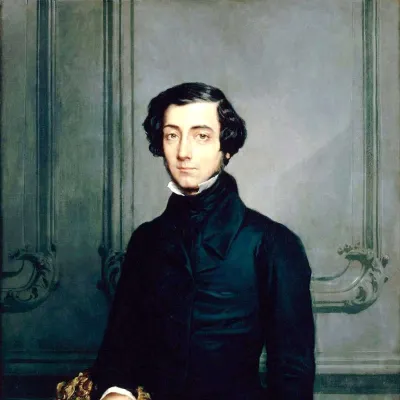
Alexis de Tocqueville
Human Design Chart
Biography
Diminutive in stature, acutely sensitive and plagued by severe bouts of anxiety and illness since childhood, Tocqueville remained close to his parents through his life, though outwardly proud and cold. He found it difficult to form deep and lasting relationships but was skilled in his influence of those close to him in small groups. As a youth, he became a lawyer in 1835 and moved easily into government service as the son of a royalist and a peer of France.
The July Revolution of 1830 that put the citizen king Louis-Philippe of Orleans on the throne was a turning point, convincing Tocqueville that France was moving toward social equality. He and his friend Beaumont made a journey to America to study the prison system and reforms, 1831-32. Hailed for his writings as a political scientist, he found the following years prestigious and happy.
In 1835, he married an Englishwoman, Mary Mottely. Returning to France, he continued to write, and entered politics by winning public election in 1839 to the Chamber of Deputies. From then on, he won every election by a wide majority, though his career in public office was generally mediocre.
The Revolution of February 1848 brought about an improvement of his political situation. In 1850 he was named President of the Assembly. Briefly imprisoned for opposing Louis-Napoleon's coup d'etat on 2 December 1851, he was deprived of all political offices for refusing his oath to the new regime.
Returning to his Norman estate and to writing, Tocqueville's new book, "The Old Regime and the Revolution" in 1856 made him, once again, a public figure. He died in 1859 just at the onset of a revival of liberalism in France and his reputation in the 19th century reached its high point during the decade following his death.
Human Design Analysis: Alexis de Tocqueville as Generator 4/6
Generator 4/6 — Design at a Glance
Alexis de Tocqueville was someone with considerable inner endurance. His design indicated a tendency towards constant work capacity, comparable to that of a strong working horse. However, this energy was not freely available to him without limit but followed a specific rhythm.
As a Generator, he had access to significant sacral power which was only released through reactions to external impulses. The motto of his design was not to initiate but to react. When a signal from life came and his inner self responded with a clear 'yes', he could act. In these moments, his energy was efficient and sustainable.
If Alexis de Tocqueville did not live up to this pattern, for example by doing things that did not bring him joy or initiating actions against his internal resistance, he risked frustration and energy deficiency. His design presented two stumbling blocks: on the one hand, squandering power on disliked tasks which could lead to exhaustion; on the other hand, holding back from heart projects even though the energy was still available.
Successful use of his nature required patience and attention to inner signals. When he acted in harmony with these impulses, his system rewarded him with a sense of deep fulfillment. This satisfaction did not arise solely from activity but because his actions were based on an authentic reaction. Thus, his endurance became the source of constancy rather than the cause of overloading.
Sacral Authority
Alexis de Tocqueville displayed a basic attitude that was based on immediate physical resonance. As a Generator, he possessed sacral authority which simplified his decision-making process: strategy and inner guidance were identical. This mechanism worked through the open emotions center, allowing him not to act impulsively but wait for clear internal confirmation.
His reactions appeared as gut feeling or surge of energy triggered by external stimuli. He learned to interpret these physical signals – such as grunting, humming, or a soft 'mmh' – which activated his sacral motor when he felt vital and alive. Then, he had access to inexhaustible energy that enabled him to tackle tasks with great enthusiasm without the need for an imperative purpose.
Additionally, his activated spleen center acted as supportive authority. Likely directly connected to the sacral center, Alexis de Tocqueville could react particularly quickly and spontaneously. He possessed immediate access to his physical well-being and instinctive perception, allowing him to reliably guide himself from these deep instincts which strengthened his ability for quick and correct decisions in moments of encountering the outside world.
The 4/6 Profile — Opportunist / Role Model
Alexis de Tocqueville's design inclined towards using the first three decades of life as a phase of intense experiments in relationships and friendships. During this early period, his 4/6 Profile configuration still resembled Line 3: he actively sought success through social exchange and was willing to take risks for recognition. This experimental attitude served to explore personal boundaries in interaction with others before life structured itself.
With maturity, especially after the return of Saturn, this dynamic fundamentally changed. Alexis de Tocqueville then showed the characteristic internal conflict of his profile: the tension between a deep desire for belonging (Line 4) and the need for detached wisdom (Line 6). While his heart yearned for connection, his head demanded a sober, almost dispassionate perspective. This contradiction shaped his later stance as someone who cooperatively acted but always remained cautious not to open up to the 'wrong' people.
His Gate 27 on Line 6 promoted realistic altruism. Instead of blindly being generous, he learned to combine compassion with fairness and protection against abuse. Criticism of his influence he did not take personally but saw as a necessary part of the process for improving his role. Thus, Alexis de Tocqueville developed into a networker who worked through trusting cooperation while maintaining a clear standard of awareness and purposefully deploying generosity to provide productive assistance.
Single Definition — Defined & Open Centers
Alexis de Tocqueville was someone who drew his strength from a deep, physical intuition and a constant inner energy source. His defined Sacral Center gave him vital endurance; he had a daily supply of life force that only became effective when he responded to external impulses rather than initiating action himself. This mechanical truth served as a compass: An immediate internal affirmation signaled availability, while an internal 'no' protected against overload. Simultaneously, his defined Spleen Center guided his decisions through spontaneous, non-rational instincts in the present moment. He trusted this existential perception for health and well-being rather than seeking logical explanations. The pressure of his defined Root Center drove him forward, especially when combined with his intuitive spleen energy, helping him to master material or survival-relevant challenges through a persistent yet stressful progression.
At the same time, Alexis de Tocqueville was prone to mental and emotional confusion due to several open centers. His open Head Center lacked its own source of inspiration; if he sought answers or meaning in his mind, he could get caught in a whirlwind of doubts and unnecessary questions that distracted him from his true path. Similarly, his open Ajna Center absorbed concepts from the environment but couldn't process them consistently. If he tried to appear intellectually secure by constructing theories, he risked falling into false beliefs that did not carry personal truth. His open Throat Center drew attention without active pursuit; if he sought to stand out through speaking or acting, he often spoke from uncertainty and lost his authenticity. Additionally, his open Solar Plexus acted as a barometer for others' emotions; he absorbed their moods, making him emotionally vulnerable and prone to clinging to feelings that did not belong to him unless he let them go. His open G Center also meant he lacked a fixed identity or life direction, finding these through interaction with the right environment and people.
Channels for intuitive sovereignty and growing maturity.
Alexis de Tocqueville was someone who combined sharp, instinctive awareness with a deep desire for completed experiences. His design inclined towards intuitive self-preservation paired with the need to see life cycles fully lived and reflected upon.
The Power Channel 34-57 linked the generative life force of the Sacral Center with the existential intelligence of the Spleen. This configuration created an archetype of individualized survival: Alexis de Tocqueville possessed a defensive, intuitive intelligence that allowed him to react spontaneously to dangers or vibrations in his environment. This energy kept him physically fit and acutely aware by using his sacral reaction to reinforce his spleen consciousness. It served not for mental planning but for immediate protection from threats without time constraints.
Parallel to this, the Ripe Channel 42-53 shaped his experiential world. It connected Gate of Beginnings (53) in the Root Center with Gate of Growth (42) in the Sacral Center. This drove him to enter new cycles and carry them through to satisfying resolution. For Alexis de Tocqueville, it was essential not to prematurely end experiences but to complete them fully and reflect upon them afterward. This process allowed him to learn from empirical history and share gained wisdom. Each new experience built on the previous one; without this closed cycle, frustration would have arisen.
Additionally, individual Gates like Gate 31 (Transfer of Power), Gate 41 (Evolutionary Development Through Crisis), and Gate 27 (Nurturing Warmth) influenced his design. They supported his ability to transfer identity and care for the collective while guiding him through changes. The combination of intuitive awareness and cyclical ripening shaped a lifestyle that relied on spontaneous reactions and deep, completed experience absorption.
Individual Circuitry — Circuit Signature
Alexis de Tocqueville's design inclined towards cyclical emotional processes. His Meaning-Finding Circuit connected his Sacral with his Root Center via the Ripe Channel (Gates 42 and 53). This generated wave-like emotional waves from the past that had a clear beginning, middle, and end. These experiences served to find meaning behind events and share insights with the collective for mutual learning. Simultaneously, his Integration Circuit ensured survival through the Power Channel (Gates 34 and 57), which linked Sacral with Spleen Center. Here he responded to life, gained strength from this response, and channeled it through intuitive knowledge. As Alexis de Tocqueville had a Simple Definition, these energies - Sacral, Root, and Spleen Centers - formed one continuous flow. There were no separate groups; all defined centers worked directly with each other. His energy was thus marked by the reflexive processing of past emotions as well as the intuitive, powerful reaction to immediate present moments. This configuration described a life task: emotionally understanding hidden connections from the past and intuitively making these insights effective in the current moment.
Right Angle Cross of the Unexpected 2
Alexis de Tocqueville’s Human Design profile indicated a tendency towards unexpected turns arising from the configuration "The Unexpected Right Cross 2." This structure did not describe a linear progression but rather a pattern where external circumstances or internal impulses often seemed unpredictable, disrupting the usual flow. For him, life was not characterized by predictable continuity but by moments when situations suddenly changed or new perspectives emerged without his active intervention. This mechanism meant he had to be prepared for surprises, as they were an integral part of his experiential world. Rather than striving for control, his nature showed a willingness to accept these unpredictable elements and integrate them into his process. The configuration conveyed a kind of flexibility that allowed him to deal with the unexpected without losing balance. It was not chaos but a specific dynamic where the unforeseen acted as a driving force. Alexis de Tocqueville lived in a rhythm dictated by these sudden insights or changes, which significantly shaped his way of acting and thinking. This trait required an open attitude towards what might come, as every situation held the potential to develop unexpectedly.
Saturn Return · Uranus Opposition · Chiron Return — Life Cycles
Alexis de Tocqueville revealed himself as someone who anchored his inner structure through external confirmation and shared experience. His design laid a tendency to find meaning only through exchange with others—not merely as information but as living resonance. This became clear in 1835, at the age of 30: Entering into marriage with Mary Motley marked his first Saturn return. In this cycle, years of inner development crystallized into a stable life structure; the relationship was not just personal but an architectural act that stabilized his identity and allowed him to translate observations from the world into a personal order.
Later, in 1856 at the age of 51, he experienced his Chiron return. This was not a moment of healing old wounds but one of deep fulfillment: The publication of the first volume of "L’Ancien Régime et la Révolution" signaled the bloom of his incarnation purpose. If he had lived according to his strategy and authority up until then, his life's meaning now unfolded visibly. The publication was proof that his long-term work on analyzing social structures was not just intellectually but existentially rooted. His Chiron return confirmed that he had reached the core of his mission—the ability to name complex connections so they became experiential for others. His mechanics here served as completion: What began as an inner search now became public truth, impacting beyond him and solidifying his place in history.
Generator · Sacral Authority — Synthesis
He was a Generator whose life was marked by deep, sacral energy. This power source, combined with the ability to endure and the need for fulfilling activity (Sacral Center), seemed to always draw him towards tasks that truly mattered to his heart. The connection of the Power Channel (34-57) pointed to a strong intuition that warned him of threats while also enhancing his capacity to devote himself fully to his interests. His Profile as Networker/Role Model (4/6) revealed a person who both desired community and longed for independent thought and reflection – an interplay between heart and head that shaped his life.
A central paradox in his design lay in the interplay of sacral authority and the cyclic nature of the Perceiver Circuit. While his inner voice guided him through immediate reactions to external stimuli, the cycles indicated that he was always engaged in reflecting on past experiences and finding meaning from them. This led to an internal tension between acting impulsively from sacral energy and the need to understand the significance behind events – a cycle of action and reflection that repeated throughout his life and culminated in important moments (such as the appearance of a work).
2 Defined Channels
Incarnation Cross - Right Angle Cross of the Unexpected 2
Solar Return
The Solar Return shows the moment when the sun returns to its exact birth position - your personal solar year.
Life Cycles
Discover the life cycles with a detailed triple view (birth chart, cycle chart, composite).
Human Design Profile
- Type
- Generator
- Strategy
- To respond - wait for something to respond to
- Authority
- Sacral Authority
- Profile
- 4/6 - Opportunist / Role Model
- Definition
- Single Definition
- Incarnation Cross
- Right Angle Cross of the Unexpected 2
- Date of Birth
- 29.07.1805 03:00
- Place of Birth
- Paris, France
Frequently Asked Questions
What was Alexis de Tocqueville's Human Design type?
Which Profile did Alexis de Tocqueville have?
What Authority guided Alexis de Tocqueville?
What incarnation cross did Alexis de Tocqueville have?
When was Alexis de Tocqueville born?
Discover your own Human Design
Are you also a Generator? Find out in a personal reading how to use your sacral energy correctly and discover deep satisfaction.
More Personalities
Back to overviewAaliyah

Alexia

Angèle

Anne-Marie

Arcángel

Arno