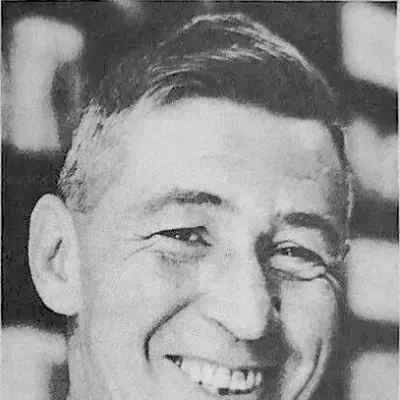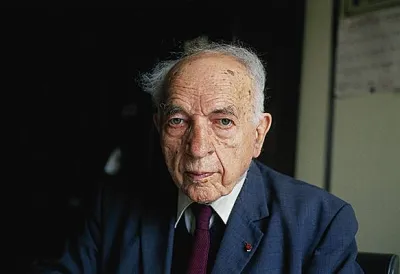
Alfred Sauvy
Human Design Chart
Biography
Alfred Sauvy died on 30 October 1990 at age 91 in Paris.
Alfred Sauvy — Projector with Profile 1/3
Projector 1/3 — Design at a Glance
Alfred Sauvy was someone who immediately recognized system flaws in his environment. His Human-Design type, the Projector, gave him a focused aura, similar to a bright flashlight that pointed directly at weaknesses in others. This ability to instantly see through the 'dark' or malfunctioning aspects formed his core characteristic.
However, this design required restraint. Directly addressing identified flaws would have triggered resistance from others, much like shining a bright light into someone's face. Instead, Alfred Sauvy was most effective when he shone by example through his own harmony and competence. This radiant presence drew others in, who then sought advice on their own accord. His strategy involved waiting for a respectful invitation rather than imposing his insights.
Since Projectors lack a defined Sacral Center, Alfred Sauvy lacked a constant energy source. He experienced phases of high productivity followed by necessary rest periods to regenerate. Adhering to these rhythms was crucial to avoid burnout. Living according to this design—through attraction rather than enforcement and respect for his energy waves—he was rewarded with success. Ignoring it led sooner or later to bitterness as an expression of his non-self. His path lay in patiently waiting for the right invitation, not in constant struggle for attention.
Splenic Authority
Alfred Sauvy oriented himself by an inner authority deeply rooted within his body: the Spleen Center. His design specified that this defined Spleen Center served as an immediate decision-making instance while the Emotional and Sacral Centers remained open—a configuration unique to Projectors or Manifestors. For Alfred Sauvy, this meant that survival intelligence and physical well-being were his primary navigational aids. His instinct signaled spontaneously whether a situation, environment, or person was health-promoting or not.
This Spleen voice manifested as a fine, singular impulse in the here and now. Alfred Sauvy had to remain vigilant to catch this first signal, as it could easily be drowned out by other influences. The initial spontaneous urge was always the right path for maintaining his health and allowed rigorous demarcation against harmful factors. Since his perception of what was right only clarified at the moment of occurrence, long-term commitments were counterproductive for his system. His design required high flexibility; plans could change on short notice, prompting him to avoid binding himself too much. Spontaneity and freedom were not preferences but mechanical necessities to allow the intelligence of the Spleen Center to function effectively. A retreat for clarification served as a tool to ensure he did not miss this fine impulse.
The 1/3 Profile — Investigator / Martyr
Alfred Sauvy combined theoretical depth with practical experimentation. His design inclined him towards validating knowledge not just through study, but also by direct experience and mistakes. As a 1/3 Profile (Researcher/Experimentor), he lived in tension between the need for thorough preparation and the urge to try things out. Line 1 drove him to learn more, while Line 3 compelled him to test insights in everyday life. This created double validation: his judgments were credible because they were both analytically and empirically tested.
In his Ego Center, Gate 44 was present, which relied on agreements and clear hierarchies to secure economic success and harmony. It mattered to him to create enforceable structures that ordered power in the collective. At the same time, elements of Line 3 shaped his development: a retreat for reflection was necessary, followed by stepping outwards to take responsibility and share insights. Alfred Sauvy embodied the scientist-adventurer type. His value lay in generating secure knowledge through trial and error and connecting it with others. He learned from failures to later provide well-founded recommendations based on solid study and practice.
Split Definition — Defined & Open Centers
Alfred Sauvy was characterized by a stable foundation of defined identity and intuitive clarity. His defined G Center provided him with a reliable inner direction and confidence in his own charm, while the also defined Spleen Center offered spontaneous, momentary intuitions for health and well-being. This combination allowed him to make decisions from the present without having to rationalize them. His defined Root Pressure ensured necessary forward movement, which through the defined Throat Center led to consistent communication and manifestation. Thus, his voice was not an arbitrary product of reason but rather an expression of his deep identity and intuitive perception.
At the same time, Alfred Sauvy was strongly influenced by several open centers from his environment. His open Sacral Center meant that he did not have a constant work rhythm; his energy fluctuated depending on those around him, making him vulnerable to overloading when he amplified foreign generative power instead of trusting his own inner authority. The open Heart Center led him to take willpower and ego from the environment rather than owning them himself, which could make him try to prove himself through promises that he couldn't keep. Additionally, his open Solar Plexus acted as a barometer for emotional climate; he absorbed and amplified foreign emotions, causing him to be pulled between others' emotional waves without always recognizing these as not his own. The open Head and Ajna Centers allowed him to react flexibly to inspiration but also confused him with mental pressure waves that did not originate from him. Alfred Sauvy's design therefore required a careful distinction between his own intuitive truth and the energies he absorbed from the world.
Channels for inspiring presence and ambitious transformation.
Alfred Sauvy oscillated between two fundamental impulses: the need for individual radiance and an instinctive drive for social anchoring. His design was marked by Channel of Inspiration 1-8, a mechanism that generated effect not through words but through authentic presence. This valve between G Center and Throat Center challenged him to courageously stand out from the crowd to act as a living role model. Alfred Sauvy was designed to attract attention simply by living his unique identity, inspiring others to live their own creativity. However, this kind of leadership required not explanation but consistent visible radiance.
At the same time, Channel of Transformation 54-32 acted as a juxta-channel, generating situational ambition for social ascent. This channel connected Root Center with Spleen Center and pushed Alfred Sauvy to secure his position in the collective through constant effort and talent. Here it was less about individual skill than recognition by the tribe; instinct sought support to rise from his own level and gain security. The conflict lay in the tension between simply being authentic (1-8) and proving himself through performance and loyalty within the social fabric (54-32). While inspiration radiated inwardly, transformation searched for external validation and upward mobility opportunities. Alfred Sauvy navigated this dynamic by using his individual radiance to generate the necessary social resonance for professional advancement. The priority was on inspirational impact as primary expression while ambition towards status functioned as a secondary instinctive drive guiding him toward material security and tribal support.
Individual Circuitry — Circuit Signature
Alfred Sauvy's design presented two separate, parallel existing energetic systems. In the Knowledge Circuit, Channel 1-8 connected Throat Center with Identity Center. This enabled inspired, acoustic creativity and the expression of a pulsating, individual identity in the present.
Completely independently, in the Ego Circuit, Channel 32-54 between Spleen and Root Centers operated. This part of the design referred to traditional cooperation, exchange logic, and collective resource building within a tribe or group. Since this circuit did not connect with Sacral Center, constant life force was lacking; pauses for regeneration were therefore essential to build necessary forces for this traditional support.
This divided definition created a tension field: on one side stood the spontaneous, inspired search for the unique path and new insights. On the other side lay the more conservative, earthly task of giving and taking in service to the community. Alfred Sauvy navigated between these two poles – the impulsive, creative individuality and the need-oriented traditional cooperation – without these areas directly transitioning into one another. They remained as separate forces existing alongside each other, each setting their own rhythms and demands.
Right Angle Cross of the Four Ways 3
Alfred Sauvys design carried the imprint of the right cross of the four paths. This configuration established a specific inner dynamics that was less characterized by external control and more by a deep, often unconscious search for meaning and connection. It was an energetic background that structured Alfred Sauvy's experience: a constant back-and-forth between the desire for security and the necessity to find his own path.
The right cross of the four paths describes in Human Design a life task that involves going through various experiences and relationships to achieve a deeper unity with oneself and the world. For Alfred Sauvy, this meant that his life was marked by an inner tension that could not always be explained rationally. He sought answers beyond the visible, driven by an instinctive need to understand the greater connection.
This mechanism worked as a constant companion influencing his perception and actions. Alfred Sauvy lived in a world that often seemed like a labyrinth to him, yet precisely therein lay his strength: the ability to work through uncertainties and develop his own authentic perspective. His design challenged him to practice patience with himself and accept the process of self-discovery as a central part of his existence.
Saturn Return · Uranus Opposition · Chiron Return · 2nd Saturn Return — Life Cycles
Alfred Sauvy established the term 'Third World' in 1952 at the age of 54. For his design, this moment marked the second Saturn return. This cycle represents a phase of maturation and consolidation. Here, long-term experiences condense into structures or definitions that are meant to have an impact beyond one's own life. It is a time when authority arises through accumulated experience. Alfred Sauvy used this energetic configuration to formulate a concept with far-reaching effects. The second Saturn return demands not only inner order but also the ability to carry and document this order externally. At this age, personal strategy and authority are usually well internalized, allowing insights to be expressed with weight that stands up over time. In this phase, Alfred Sauvy showed himself ready to cast his analytical conclusions into a concise form. The introduction of the term was not an impulsive act but the result of a mature penetration of matter. The Saturn cycle supports transforming transient ideas into sustainable categories. Alfred Sauvy lived this dynamic by naming a complex geopolitical reality and thereby creating a lasting reference point.
Projector · Splenic Authority — Synthesis
Alfred Sauvy was a projector who, through his ability to recognize patterns and expose weaknesses (Gate 1), developed a natural inclination towards research and experimentation (Profile 1/3). This profile drove him not only to work out knowledge theoretically but also to test it in practice – a process strengthened by the open throat and connection to the G Center, enabling him to share insights publicly (Channel 1-8). He thus lived a cycle of observation, analysis, and the need to express his insights.
A central paradox in his design lay in the interplay between inner authority over the spleen and the projector strategy of waiting for an invitation. While his spontaneous knowledge gave him a clear impulse whether something was right for him, his nature as a projector required patience and recognizing the right moment to offer this knowledge. This led to a tension between the inner urge for immediate clarity and the necessity to wait on others' energy to effectively communicate his perspectives.
2 Defined Channels
Incarnation Cross - Right Angle Cross of the Four Ways 3
Solar Return
The Solar Return shows the moment when the sun returns to its exact birth position - your personal solar year.
Life Cycles
Discover the life cycles with a detailed triple view (birth chart, cycle chart, composite).
Human Design Profile
- Type
- Projector
- Strategy
- Wait for the respectful invitation
- Authority
- Splenic Authority
- Profile
- 1/3 - Investigator / Martyr
- Definition
- Split Definition
- Incarnation Cross
- Right Angle Cross of the Four Ways 3
- Date of Birth
- 31.10.1898 06:30
- Place of Birth
- Villeneuve-de-la-Raho, France
Frequently Asked Questions
What was Alfred Sauvy's Human Design type?
What profile did Alfred Sauvy have?
What authority did Alfred Sauvy possess?
What incarnation cross was assigned to Alfred Sauvy?
When was Alfred Sauvy born?
Discover your own Human Design
Are you also a Projector? Find out in a personal reading how to unfold your leadership qualities and recognize the right invitations.
More Personalities
Back to overviewSissy Spacek
Alain-Fournier
Anémone
Ann-Margret

Bourvil
Hergé