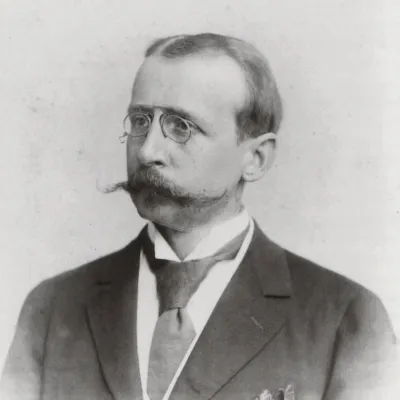
Alfred Schliz
Human Design Chart
Biography
The Human Design of Alfred Schliz: Generator 3/5
Generator 3/5 — Design at a Glance
Alfred Schliz's design was characterized by immense, enduring strength, which only became effective when he responded to external impulses. As a Generator, he had a great deal of sacral energy, making him an extremely strong and persistent 'workhorse' as long as he had energy for his task. His life strategy did not lie in initiating but in reacting: He waited for a signal from life and acted only when his inner self gave a clear 'yes'.
This mechanism carried two specific risks. If Alfred Schliz continuously did things that did not bring him joy, he wasted his strength and was prone to burnout. Conversely, he suffered when he was prevented from working on his heart project, even though he still had plenty of power to continue. Living in harmony with this design, by responding instinctively to offers, he was rewarded with deep satisfaction and a sense of fulfillment. Ignoring this inner resonance and instead trying to force or initiate things led to persistent frustration and a lack of energy. His strength lay not in anticipation but in the powerful response to what life offered him. Only then could no one stop him and fully unleash his material creative power.
Emotional Authority
Alfred Schliz's inner decision-making structure was marked by an emotional dynamics that required patience and temporal distance. His inner authority lay in the defined Solar Plexus Center. This configuration meant that he was subject to emotional waves that showed in a constant up and down of his feelings. The world appeared to him always colored by his current mood; at one moment he could be totally enthusiastic about something, in the next he could see the same thing completely negatively.
This design indicated that his immediate feeling was merely a snapshot, not a final judgment. Spontaneous decisions made directly from such an emotion carried a high risk of negative impact, as the first impression was not yet his true insight. For Alfred Schliz, it was therefore mechanically necessary to take time to let decisions mature. This process required him to properly deliberate and ask himself multiple times.
Over time, the intense feelings subsided, allowing him to gain emotional distance. Only then did clarity and calmness set in. This mechanism was particularly crucial for long-term decisions that could have a significant impact on his life course. Emotional authority always took precedence over other defined centers in his chart, regardless of what else was defined. His path to truth did not lie in quick intuition but in going through the emotional cycle until calmness was reached.
The 3/5 Profile — Martyr / Heretic
Alfred Schliz was someone who learned through personal experimentation and then provided his accumulated experiences to others. His design matched Profile 3/5, the Experimentor and Hero. Line 3 gave him a basic attitude of not believing in given truths; he had to experience and fail at things himself to learn from them. This process of adaptation and building and breaking of bonds was essential for him, even if it came with cycles of loyalty and rejection.
Line 5, the Hero Line, used this practical knowledge to solve others' problems. Alfred Schliz was attractive to his surroundings through his authenticity and wealth of life experience. Others sought his proximity to benefit from his insights. This role of the rescuer flattered him, but also carried the burden of public failure when experiments in front of the community failed.
His mechanics were marked by pragmatism and caution. He learned to find the right moments for social interactions and to withdraw when necessary. The experience with human projections and the associated expectations led him to avoid certain people or situations to avoid deep pain. Alfred Schliz navigated between the urge to prove himself through connection and the need to protect himself from overexposure through withdrawal. His path was that of a learner who gained wisdom through direct confrontation with reality and then offered it as a pragmatic solution for others.
Split Definition — Defined & Open Centers
Alfred Schliz's design established a tendency towards constant, vital expressive strength, which emerged from the connection of his defined centers. His defined Sacral Center generated a constant energy source, marking him as a Generator. This power was available to him only through reaction, not through initiation. Simultaneously, his defined Throat Center served as a reliable channel for communication and action, transmuting this sacral energy into the world. Thus, his voice spoke from a reliable source, connected to the ability to express himself clearly and honestly.
This mechanical structure was deepened by additional defined centers. His defined Solar Plexus Center functioned as an inner authority, meaning that Alfred Schliz did not make decisions in the moment but waited for the emotional wave to clear until clarity arose. His defined Spleen Center provided spontaneous, intuitive impulses in the present, while his defined Root Center supplied a constant, adrenalized push that propelled him forward and nourished existential awareness.
In contrast to this inner strength stood his open centers, making him vulnerable to certain conditioning. His open Head Center tended to absorb mental pressure from the outside, leading to doubts or a search for inspiration that did not align with his own truth. His open Ajna Center amplified this by reflecting ideas and concepts from the environment rather than conceptualizing them independently. Particularly defining was his open G Center: it lacked a fixed identity or direction, instead adopting the qualities of its surroundings and the people around him. Alfred Schliz tended to mirror in relationships and places, making him vulnerable to "borrowed" identities. His open Heart Center lacked consistent willpower, which could lead him to feel the need to prove himself unnecessarily rather than trusting his inner authority. This configuration described a person who found strength in reaction and waiting, while learning not to take external mental and identity influences as his own truth.
Channels for intimacy, intuitive clarity and emotional dynamics.
Alfred Schliz revealed himself through a profound ability to establish deep interpersonal connections, paired with a sharp, intuitive sense for the immediate present. His design was marked by a strong emotional and energetic dynamic that promoted both intimacy and clear, momentary perception.
Channel 59-6 connected his Sacral Center with his Solar Plexus. This configuration rooted him in a powerful energy of sexuality and emotional wave, known as "Intimacy." Alfred Schliz possessed the natural ability to quickly penetrate the aura of others and ease confidentiality. His emotional wave determined the timing for friendships and relationships; he needed time to gain clarity before diving into deeper, intimate realms. This patience allowed him to foster fertility in creative endeavors and partnerships while learning not to misinterpret his intensity.
Parallel to this, Channel 57-20, connecting the Spleen Center with the Throat Center, gave his intuitive insight a clear voice in the present moment. Alfred Schliz could articulate penetrating self-awareness and encourage others to awaken their own inner survival intelligence. His spontaneous verbal outbursts often reached the core of a matter faster than the rational thinking of others. By living in the moment and speaking his truth, he overcame the fear of the unknown and acted from a deep, instinctive trust.
Additionally, Channel 39-55 shaped his experiential world. It connected the Root Center with the Solar Plexus and set a pulsating wave of moods, joy, and melancholy in motion. Alfred Schliz learned to accept this emotional alchemy rather than rationalize it. Through provocation, he could tease out the minds of others and find suitable people for himself. He understood that there was a right mood or time for everything and enjoyed his alone time to explore his mature, emotional creative depths before bringing them into the world.
Individual Gates like 36 (Crisis as Movement), 12 (Hesitation and Poetry), and 11 (Visual Remembrance) complemented this picture with themes of cyclical development, creative mutation, and harmonious assessment.
Individual Circuitry — Circuit Signature
Alfred Schliz's design showed a split structure: two independent, side-by-side energy blocks. The first block connected the Sacral, Solar Plexus, and Root Centers. Here, the life force of the Sacral worked together with the wave-like emotions of the Solar Plexus and the instinctive urgency of the Root Center. This configuration generated a primal, timeless energy focused on protection and preservation. The Protector Circuit, represented by the Channel of Union, directly connected Sacral and Solar Plexus in him. This emphasized themes like care, defense, and the preservation of one's genetics or family. It was a powerful, instinctive foundation that did not communicate with the second block.
The second block included the Throat and Spleen Centers, connected by the Knowledge Circuit. Here, innovative flashes of insight (Channel 20-57) flowed directly into expression through the Throat Center. At the same time, the Channel of Released Emotions (55-39), which connects Solar Plexus to Root, was present – but since these centers belonged to the first block, this emotional wave remained energetically separate from the creative expression in the second block. Alfred Schliz thus showed a clear separation: on one hand, a deep, protective, emotional life force (Sacral-Solar Plexus-Root), and on the other, a pulsing, creative, and individual expression (Throat-Spleen) that charted new paths and transformed knowledge, without being directly fed by the deep emotional wave. These two systems ran parallel without mixing.
Right Angle Cross of Eden 3
Alfred Schliz's design carried the signature of the right cross of Eden 3, a configuration that placed him in a specific energetic context. This structure connected him with archetypal patterns often associated with themes of creation, order, and the preservation of values. In Human Design, the right cross of Eden 3 marks a particular alignment of energy centers and channels that fosters inner discipline and a strong sense of responsibility. Alfred Schliz lived with this energetic imprint, which gave him a certain stability and reliability, but also the burden of expectation to fulfill certain roles or tasks. The mechanics of this cross point to a nature strengthened by structure and clear boundaries, while chaos or unpredictability were felt as burdensome. It was not a choice, but an innate disposition that significantly shaped his way of experiencing and reacting to the world. Alfred Schliz was seen within this framework as someone capable of functioning under pressure and creating order, with the energy of this design often associated with the preservation of traditions or established systems. This configuration shaped his inner attitude and the way he interacted with his environment, without necessarily needing to be visible in external, documented events. The energy of the right cross of Eden 3 worked as a constant background influencing his decisions and reactions.
Saturn Return · Uranus Opposition · Chiron Return · 2nd Saturn Return — Life Cycles
Alfred Schliz's design laid a tendency towards structured buildup and anchoring within the community. This configuration promoted a stance that took responsibility and stabilized existing systems. In 1877, at the age of 28, he took up the position of city doctor in Heilbronn. For his design, this first Saturn return marked a turning point where years of groundwork condensed into a solid professional foundation.
His second Saturn return around 1904 (age 55) was evident in the initiation of the restoration of the historical Seven-Pipe Fountain. This corresponds to the mechanics of this cycle, which often leads to consolidation and the preservation of cultural or infrastructural values. Alfred Schliz used this phase to preserve the connecting and existing.
The Chiron return around 1898 (age 49) served as a fulfillment cycle. In this phase, where his incarnation cross unfolds, he received the task to describe the lineage and development of the population in the Oberamt Heilbronn. This was not a moment of healing old wounds, but a bloom where his specific life purpose became tangible: the documentation and understanding of origins and developments. Through this task, his sense of structure and history became concretely effective and linked his medical expertise with the capture of collective connections.
Generator · Emotional Authority — Synthesis
Alfred Schliz was a Generator, whose life was marked by a deep, sacral energy. This energy, coupled with emotional authority, led him through a wave of feelings that needed time to mature and gain clarity. His profile as an experimenter and hero (3/5) revealed a personality that learned through personal experiences and shared this knowledge willingly. The connection of the Sacral Center and emotional wave points to a work style that, while powerful, was also determined by the necessity of inner consent and mature deliberation – a process that enabled him to act from the depth of his experiences.
A central paradox in his design lay in the tension between the need for deep, emotional validation (emotional center) and the drive to try new things and learn (line 3). He thus lived in a constant interplay between waiting for the inner truth to become clear through the emotional wave and the need to act and gather experiences. Documented events in his career cycles, such as taking up the position of city doctor or initiating the fountain restoration, showed that he only found lasting action through his own exploration and experience.
3 Defined Channels
Incarnation Cross - Right Angle Cross of Eden 3
Solar Return
The Solar Return shows the moment when the sun returns to its exact birth position - your personal solar year.
Life Cycles
Discover the life cycles with a detailed triple view (birth chart, cycle chart, composite).
Human Design Profile
- Type
- Generator
- Strategy
- To respond - wait for something to respond to
- Authority
- Emotional Authority
- Profile
- 3/5 - Martyr / Heretic
- Definition
- Split Definition
- Incarnation Cross
- Right Angle Cross of Eden 3
- Date of Birth
- 18.09.1849 10:00
- Place of Birth
- Heilbronn, GER
Frequently Asked Questions
What was Alfred Schliz's Human Design type?
What profile did Alfred Schliz have?
What authority guided Alfred Schliz?
What incarnation cross did Alfred Schliz have?
When was Alfred Schliz born?
Discover your own Human Design
Are you also a Generator? Find out in a personal reading how to use your sacral energy correctly and discover deep satisfaction.
More Personalities
Back to overviewAaliyah

Alexia

Angèle

Anne-Marie

Arcángel

Arno