
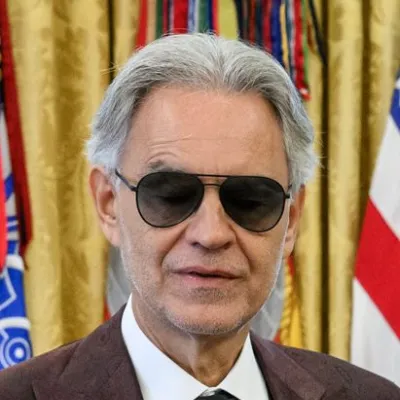
Andrea Bocelli
Human Design Chart
Biography
Since 1994, Bocelli has recorded 15 solo studio albums of both pop and classical music, three greatest hits albums, and nine complete operas, selling over 90 million records worldwide. He has had success as a crossover performer, bringing classical music to the top of international pop charts. His album Romanza is one of the best-selling albums of all time, while Sacred Arias is the biggest selling classical album by any solo artist in history. My Christmas was the best-selling holiday album of 2009 and one of the best-selling holiday albums in the United States. The 2019 album Sì debuted at number one on the UK Albums Chart and US Billboard 200, becoming Bocelli's first number-one album in both countries. His song "Con te partirò", a duet with Sarah Brightman taken from his second album Bocelli, is one of the best-selling singles of all time.
In 1998, Bocelli was named one of People magazine's 50 Most Beautiful People. He duetted with Celine Dion on the song "The Prayer" for the animated film Quest for Camelot, which won the Golden Globe Award for Best Original Song and was nominated for the Academy Award for Best Original Song. In 1999, he was nominated for Best New Artist at the Grammy Awards.
What does Projector 1/3 mean for Andrea Bocelli?
Projector 1/3 — Design at a Glance
Andrea Bocelli revealed himself through an aura that resembled a bright flashlight: dense and focused. This quality allowed him to immediately recognize systemic errors in his environment. Instead of addressing these flaws directly – which projectors often find uncomfortable, like being hit by a beam of light – his mechanism was designed to attract others through his own harmonious glow. When he radiated harmony, other people automatically sought his advice and asked for his knowledge.
This magnetic pull is central to his design as a projector. His strategy involved waiting for an honest, appreciative invitation rather than going into direct confrontation. This prevented bitterness, the typical non-self theme of this type, and instead led to success. Since projectors do not have a defined sacral center, they lack a constant intrinsic energy source. Instead, they experience cyclical phases of high activity followed by necessary rest periods. Without these pauses, there was a risk of burnout, as societal structures are often not attuned to this rhythmic energy flow. Andrea Bocelli's design thus suggested that his work was most effective when he maintained his inner order and guided others without lecturing.
Self-Projected Authority
Andrea Bocelli's design inclined towards extreme openness, coupled with the risk of being distracted by external motoric energies. His internal compass was the rare 'authority in self', a configuration unique to projectors. This structure made him susceptible to losing himself in his own expansiveness and constantly seeking energy rather than conserving it.
His decision-making did not rely on logical analysis but on two specific inner processes. First, through spontaneous self-dialogues or conversations with others when invited. Crucial was distinguishing between the spontaneous expression of true essence and the reflective constructs of the mind. This spontaneous speaking made his uniqueness recognizable to others.
Secondly, a physical feeling that drew him geographically or thematically in a certain direction – whether towards something or away from it. His success potential lay in recognizing this inner direction and following it faithfully. By not being overwhelmed by the distractibility of his open energy structure but acting as a consequent directional guide for others, he utilized the full potential of this rare authority. The danger always lay in losing oneself through constant pursuit of stimuli; the strength in remaining true to one's own, physically and intuitively experienced truth.
The 1/3 Profile — Investigator / Martyr
Andrea Bocelli's design inclined towards grasping knowledge not only theoretically but validating it compulsively through practical application and mistakes. His inner structure combined a deep, hidden yearning for dedication with the necessity of proving oneself in the outside world. This created a dynamic tension: the urge to understand everything perfectly before acting conflicted with the biological imperative to learn through trial and error.
The Profile 1/3, the Researcher and Experimenter, defines this life path as a process of deep theoretical knowledge (Line 1) and practical verification (Line 3). Line 1 brings the energy of dedication in secrecy; it seeks potential and artistry often without immediate recognition. But this depth alone is not enough. Line 3 demands testing, even if that means making mistakes or choosing extreme strategies to be effective.
For Andrea Bocelli, the combination of these lines was crucial: self-acquired and tested insights formed his foundation. When he made a decision or chose a path, it was based on double validation – intellectually penetrated and practically tested. His design showed that true authority for him could only arise when the hidden dedication of Line 1 was confirmed through the harsh process of learning in Line 3. Only then did judgment emerge that one could absolutely trust, as it was both theoretically grounded and existentially proven.
Split Definition — Defined & Open Centers
Andrea Bocelli shows himself to be shaped by a design characterized by inner clarity and mental restlessness potential. His defined centers Head, Ajna, and Throat created a constant architecture of inspiration and expression. This did not mean continuous energy for implementation but rather a permanent mental pressure to question and form concepts. This process required patience; ideas matured in the mind before being communicated through the defined Throat. Parallel to this, his defined G Center offered a stable identity and inner direction. Andrea Bocelli had a deep sense of self-love and intuitively knew where he belonged, independent of external confirmation. This reliable foundation stood in contrast to his open centers Heart, Sacral, Solar Plexus, Spleen, and Root. These functioned as antennae for external energies like willpower, vitality, or stress that did not align with his own nature. In his open Heart Center, constant willpower was lacking; he tended to question himself in the non-self whether he accomplished enough to be valuable rather than trusting his inner authority. His open Sacral Center made him vulnerable to overload through "borrowed" energy from others, which could lead to exhaustion if he did not pause. Emotional waves from the environment were absorbed and amplified by his open Solar Plexus, putting him at risk of interpreting foreign moods as his own. Additionally, his open Spleen Center was sensitive to fears and well-being in the environment, making spontaneous decisions risky. Finally, his open Root Center took on external stress that he did not generate himself. The challenge lay in trusting mental inspiration without having to prove oneself through a lack of constant energy in the Heart or Sacral. His strength lay in the ability to use these open fields as information sources rather than personalizing them and following his stable G direction as a compass.
Channels for abstract comprehension and conscious expression.
Andrea Bocelli demonstrated a fundamental stance of radical self-acceptance: His design indicated that his survival and prosperity directly depended on living as himself and loving himself. This solar presence did not work through actively seeking validation but rather as a constant, inner clarity that passively inspired others to accept their own uniqueness.
This dynamic was primarily shaped by the Awakening Channel 10-20. This channel connects the G Center with the Throat Center and expresses the essence "I AM! I live NOW!" It transforms individual knowledge into right action (Gate 20), tempered by an underlying behavioral code that ensures safe interactions (Gate 10). For Andrea Bocelli, this meant that his potential as a living expression of awakened self-love and trust had to be fulfilled for him to thrive. Others sensed this awareness in him; they often recognized his clarity more clearly than he did himself. By simply being himself, he elicited genuine invitations from others that protected him from resistance and neutralized criticism. His self-affirmation was the direct result of accepting himself in every moment.
In his Personality design lay the Abstraction Channel 64-47. This channel connects the Head Center with the Ajna Center through the Gates of Confusion (64) and Understanding (47). Since this channel is not part of the actual design but only of the personality, mental confusion or intense searching for meaning could not be an ongoing, authentic trait in Andrea Bocelli's life. Instead, it appeared more as situational pressure or projection while the solar presence of awakening was absolutely central and defined his identity.
Collective Circuitry — Circuit Signature
Andrea Bocelli's Human Design suggests a tendency towards emotional reflection paired with a clear inner voice. The Meaning-Finding Circuit connected his Head Center and Ajna Center through the Abstraction Channel (Gates 64/47). This connection created a cyclical energy: emotions from the past were not only felt but abstracted and visually structured. It was about finding meaning behind past events and sharing these insights with the collective to learn together. The experience unfolded in waves – with beginning, middle, and end – more intuitively than purely rationally.
Parallel to this, the Integration Circuit secured his own survival. Here Andrea Bocelli connected Throat Center and Identity Center through the Awakening Channel (Gates 20/10). This allowed him to draw strength from reactions to life and guide them through proper behavior and intuitive knowledge. The result was a manifestation in the present: an extremely individual form of expression that became acoustically effective.
As Andrea Bocelli has a Shared Definition, these two systems existed as separate groups. Emotional meaning-finding (Head/Ajna) and identity-forming integration (Throat/Identity) were not directly energetically connected but rather worked alongside each other. This created a duality: on one hand reflecting on the past for collective learning, on the other hand reinforcing individual self in the present moment through correct behavior and intuition. Both forces shaped his essence as parallel, independent streams.
Right Angle Cross of the Vessel of Love 3
Andrea Bocelli's Human Design shows a configuration of the right cross of the Love Vessel. This structure sets a fundamental orientation towards unconditional devotion, often linked with the necessary letting go of ego in service to a higher connection or another being. It is a path of transformation through the 'Love Vessel', meaning he was ready to give everything, even if it came at personal cost.
This configuration describes a paradoxical nature of this devotion: it demands total self-sacrifice and can be experienced as painful or lonely. At the same time, however, it leads to the deepest spiritual fulfillment and understanding of universal connection. It is a path of service that runs through one's heart. Andrea Bocelli was thus marked by this profound, often painful experience where individual identity recedes to make room for all-encompassing love. This was not an everyday choice but an inherent dynamic of his design driving him towards a connection beyond the individual defined by readiness to sacrifice.
Saturn Return · Uranus Opposition · Chiron Return · 2nd Saturn Return — Life Cycles
Andrea Bocelli's Human Design shows a developmental line marked by clear phases of structuring and reorientation. In 1987, he met his future wife – an event coinciding with his first Saturn Return. This cycle often marks a transition into greater life responsibility and emotional anchoring, here visible through the establishment of a partnership.
Ten years later in 1998 at age 40, he debuted as Rodolfo in La Bohème at Teatro Comunale in Cagliari. This corresponds to his Uranus Opposition, a period of deep transformation and new identity formation. Instead of just breaking away, Andrea Bocelli used this energy for a decisive career leap that redefined his artistic profile.
In 2007 during his Chiron Return at age 49, he performed at Wembley Stadium and released the album Pagliacci. In Human Design mechanics, this cycle is not a healing phase but a blooming time: one's essence unfolds in full power and purpose. Andrea Bocelli here showed the mature radiance of his artistic essence on an international stage.
Finally, he reached his singing conclusion at Conservatorio Giacomo Puccini in 2013 at age 55. This fell during his second Saturn Return, often bringing confirmation and institutional anchoring of earlier achievements. The structure of his career reflects the archetypal patterns of these four major astrological cycles: from private binding over professional break to public mastery and final validation.
Projector · Self-Projected Authority — Synthesis
A central red thread runs through the chart: the dynamic interaction between inner perception and projection outward. The defined mental center (Head & Ajna) generates a constant stream of questions and concepts, which however cannot be directly manifested. Instead, this internal wealth is channeled by the defined Throat Center – a glow that touches others and invites reflection (Channel Awakening). Openness in lower centers amplifies this tendency: energy is taken in, processed, and returned in a form tailored to the needs of the environment. The profile as researcher/experimenter underscores this process of continuous review and refinement, both in personal experience (Gate 46) and through taking on others' experiences.
The central paradox lies in the tension between internal pressure for mental clarity and the necessity to wait for invitation. The design is geared towards recognizing patterns and generating knowledge (Channel Abstraction), yet the manifestation of this knowledge depends on environmental reaction. Openness to external influences, while high sensitivity to others' needs, also carries the risk of losing one's inner compass in conditioning. The chart points to a person who finds their greatest strength as a catalyst for insight – if they act in alignment with their strategy and await the right opportunities.
2 Defined Channels
Incarnation Cross - Right Angle Cross of the Vessel of Love 3
Solar Return
The Solar Return shows the moment when the sun returns to its exact birth position - your personal solar year.
Life Cycles
Discover the life cycles with a detailed triple view (birth chart, cycle chart, composite).
Human Design Profile
- Type
- Projector
- Strategy
- Wait for the respectful invitation
- Authority
- Self-Projected Authority
- Profile
- 1/3 - Investigator / Martyr
- Definition
- Split Definition
- Incarnation Cross
- Right Angle Cross of the Vessel of Love 3
- Date of Birth
- 22.09.1958 05:15
- Place of Birth
- Pisa, Italy
Frequently Asked Questions
What is Andrea Bocelli's Human Design type?
What Profile does Andrea Bocelli have in Human Design?
What authority determines Andrea Bocelli's decisions?
What is Andrea Bocelli's incarnation cross?
When was Andrea Bocelli born?
Discover your own Human Design
Are you also a Projector? Find out in a personal reading how to unfold your leadership qualities and recognize the right invitations.
More Personalities
Back to overviewSissy Spacek

Aaliyah

Alain-Fournier

Alexia

Alizée

Anémone
