
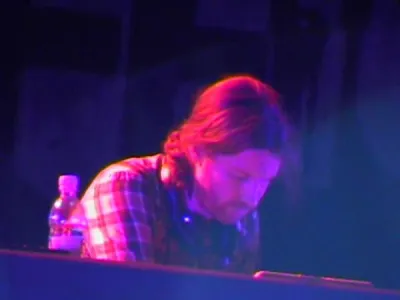
Aphex Twin
Human Design Chart
Biography
Raised in Cornwall, James began performing as a rave DJ at local clubs and free parties in the late 1980s. In 1991 his debut EP Analogue Bubblebath was released on Mighty Force, a local independent label, winning him acclaim and a cult following. James co-founded the independent label Rephlex Records the same year. He attracted wider praise for his 1992 debut album Selected Ambient Works 85–92, released by Belgian label Apollo. He signed to the UK label Warp in 1993, and his music became increasingly well known with the charting albums Selected Ambient Works Volume II (1994) and ...I Care Because You Do (1995), and singles "On" (1993), "Come to Daddy" (1997), and "Windowlicker" (1999). The latter two singles, accompanied by music videos directed by Chris Cunningham, brought James attention in the US market.
James has also recorded under aliases including AFX, Caustic Window, and Polygon Window. After releasing the Aphex Twin album Drukqs in 2001, James spent the following years releasing music mostly under other aliases, including the 2005 Analord EP series as AFX, a pair of 2007 releases as the Tuss, and archival material such as an unreleased 1994 LP in 2014 as Caustic Window. He returned as Aphex Twin in 2014 with the album Syro, which won the Grammy Award for Best Dance/Electronic Album. He has since released further charting EPs, including Cheetah (2016) and Collapse (2018).
What does Manifesting Generator 1/3 mean for Aphex Twin?
Manifesting Generator 1/3 — Design at a Glance
Aphex Twin's Human Design shows a tendency towards lightning-fast, parallel creative power. As a Manifesting Generator, he had constant sacral energy, allowing him to draw things into his life by skipping steps. This hybrid configuration combined the endurance of a Generator with the initiating power of a Manifestor.
However, the mechanics reveal two central risks: the danger of being too fast and missing important steps, which required backtracking, and the tendency to start multiple projects simultaneously. Without paying attention to strategy – reacting to impulses rather than initiating himself – this complexity could quickly turn into frustration, the non-self theme of this type.
When his inner authority was on board and his sacral center said a clear 'yes', the joy of creation turned into deep satisfaction. In this state, parallel work was not chaos but a conscious play mode. Aphex Twin thus showed himself to be someone whose energy worked most effectively when he responded to external stimuli and used the variety of multiple simultaneous projects as a source of his satisfaction, rather than limiting himself to a single task. This required constant checking whether the projects still resonated to make his own speed helpful rather than hindering.
Emotional Authority
Aphex Twin's Human Design shows a tendency towards emotional wave movement. His inner authority lies in the defined Emotional Center. In Human Design mechanics, once this center is defined, it takes the lead in decision-making, regardless of other defined areas. This means that Aphex Twin was subject to permanent emotional fluctuations. The perception of the world was always colored by the current mood. A moment of enthusiasm could quickly turn into a negative outlook.
This emotional wave is, however, only a snapshot, not a final truth. Spontaneous decisions made directly from such an emotional state carried the risk of proving false. The mechanics of his authority required patience. Decisions had to mature, often over several nights. Only when the intense feelings subsided and emotional distance was gained, clarity set in. This process of 'sleeping on it' was essential to recognize the deeper truth lying beneath the surface of the first impressions. Only through this delay could calmness arise and a well-founded choice be made. This was particularly true for long-term steps that significantly influenced his life course. The necessity to take time and ask multiple times was not an obstacle but the central mechanism of his inner guidance.
The 1/3 Profile — Investigator / Martyr
Aphex Twin's Human Design shows a tendency towards deep, self-examined scrutiny. His Profile 1/3, that of the Researcher and Experimenter, shapes an attitude that must necessarily connect theoretical knowledge (Line 1) with practical application (Line 3). For him, learning was not an abstract process but a life-necessary exercise in trial and error.
The mechanics show a clear dynamic here: Line 1 initially gathers experiences and needs time to grow. It can tend to hesitate before implementation, out of fear of not knowing enough yet. But Line 3 drives to try things out and learn from mistakes. Aphex Twin used this tension by testing his insights both theoretically and practically to the core. A judgment from him was thus the result of a double validation.
Additionally, specific line energies were at work: The first line of Gate 29 brings the energy of the recruit, who takes on commitment and learns when to endure and when to hold back. This contrasts with the third line of Gate 8, which stands out for its adaptability and focus on style over content. Here it's about disciplining one's nature and avoiding hypocrisy by acting authentically. The combination results in a person who finds his truth through hard, personal experience and constant adaptation to new situations. His trust in something only arose when it passed this rigorous, dual validation process.
Split Definition — Defined & Open Centers
Aphex Twin's Human Design shows a tendency towards a clear, consistent identity paired with an enormous daily energy source. His defined G-Center gave him a firm sense of self-love and direction, so he wasn't dependent on others' approval. This inner security directly affected his communication: The defined Throat Center served as a reliable channel to carry this identity and the resulting messages into the world without constantly adapting.
The power behind this expression came from the defined Sacral Center, a motor that continuously generated vital energy. For Aphex Twin, it was essential to react to impulses rather than initiate them to avoid overloading this energy. Once he reacted, a persistent force was available, leading through phases of stagnation until a breakthrough occurred. This sacral endurance was supported by the defined Root Center, which provided a constant pressure to move forward and master existential challenges.
Simultaneously, a complex emotional dynamic was revealed through the defined Solar Plexus Center. It functioned as an inner authority that demanded not making decisions in the moment but waiting for the emotional wave to pass. Only in the calm after the emotional ups and downs could he gain clarity.
In contrast, the undefined centers revealed specific vulnerabilities. The open Head and Ajna Centers meant that mental inspiration and concepts were not consistent; he tended to get entangled in questions that weren't his or to be swayed by others' confusion. The open Heart Center made him vulnerable to the pressure to prove his worth through promises or competition, even though he didn't consistently possess this energy. Finally, the open Spleen Center was a source of survival fears and the temptation to make spontaneous decisions or cling to uncertain situations just to gain a false sense of well-being.
Channels for determination, powerful manifestation and emotional clarity.
Aphex Twin's Human Design shows a tendency towards intense, self-driven activity paired with a deeper search for hidden connections. This configuration is someone who is driven by inner energy but only achieves satisfying results when he waits for his own reaction rather than following mental expectations.
Channel of Charisma 7-20 connects the Sacral Center (Gate of Power) with the Throat Center (Gate of Now). Here, raw, physiological life force meets the ability to speak or act in the moment. The Sacral exerts pressure to bring the Throat Center to immediate expression. This speed can lead to Aphex Twin having trouble sitting still; the energy acts like a rocket that, without inner guidance, can easily veer off course. It's about self-endorsement: The energy is only effective when used for things that truly bring joy, not for the "shoulds" of the mind.
Parallel to this, the Discovery Channel 29-46 connects the Sacral Center (Gate of Saying Yes) with the G-Center (Gate of Self-Determination). Gate 29 is the wellspring of endurance, accessible only through positive reaction. Gate 46 ensures being in the right place at the right time. This channel demands letting go of expectations and fully immersing in the experience. Only at the end of the process does the meaning reveal itself. Aphex Twin had to learn not to be swayed by others but to trust the persistence of the Sacral to make discoveries that could change collective understanding.
Additionally, the Recognition Channel 41-30 shapes the emotional landscape. It connects the Root Center (Gate of Limitation) with the Solar Plexus Center (Gate of Recognizing Feelings). The drive for new experiences (Gate 41) is fueled by emotional waves (Gate 30). This creates an intense need to seek the new, but also the necessity to wait for the emotional wave to pass before clarity emerges. Without this patience, restlessness and superficial jumping from one desire to the next threatens.
Supporting this profile are Gate 8 (Contribution, Leadership) and Gate 14 (Power, Direction Finding), which offer a powerful, directed energy, as well as Gate 62 (Logic, Details) for precise pattern recognition and fact-finding. Gates 55 (Emotional Awareness) and 3 (Mutation, Order) in the design emphasize the need to create new structures from confusion, while Gate 6 (Friction, Emotional Waves) serves as a biological motor for growth.
Collective Circuitry — Circuit Signature
Aphex Twin's Human Design shows a tendency towards emotional wave movements that cyclically repeat and are strongly marked by the past. This structure is revealed through the Meaning-Making Circuit, which in him formed two separate, not directly connected parts. One part connected the Identity with the Sacral Center, meaning a deep, bodily anchoring of personal essence. The other part linked the Solar Plexus with the Root Center, through which emotional impulses and survival energy directly interchanged. This configuration promoted a way of processing experiences that was less based on cool logic and more on felt insights that ebbed and flowed in waves.
Parallel to this, the Integration Circuit, which in Aphex Twin connected the Throat with the Sacral Center, came into play. This channel, called Charisma, allowed drawing power from reacting to life and channeling it through proper behavior. Since Aphex Twin had a split definition, these energetic groups existed as separate, parallel standing forces. There was no continuous flow between the emotional waves of the Solar Plexus and the communicative power of the Throat, but two distinct areas of expression and survival instinct that each worked independently.
Right Angle Cross of Contagion 3
Aphex Twins Design shows a tendency towards an intense, almost physical infectious power. This configuration, the right infection cross 3, does not describe a passive radiation but an active, energy-rich transmission of impulses. It is a specific Human-Design mechanism where internal states or ideas are carried outward with such intensity that they immediately resonate with others.
The energy of this cross acts like an electric spark: it jumps the distance between sender and receiver and often triggers spontaneous, unconscious reactions in the recipient. Aphex Twin was shown in this context as someone whose creative output was not just consumed but experienced. The music or the underlying energy infusion had the potential to directly change moods, rhythms, or thought patterns in his environment without the need for a rational explanation.
This pattern emphasizes the power of direct, unfiltered transmission. It is not about convincing through arguments but about an energetic infection that occurs through sheer presence and expressive power. The effect is often profound and lasting, as it occurs on a level that lies beyond conscious resistance. Aphex Twins chart thus shows a structure designed to create waves through its mere existence and radiation that directly touch and move other people.
Saturn Return · Uranus Opposition · Chiron Return — Life Cycles
Aphex Twins Design shows a tendency towards cyclical, intensifying moments of success that correlate with specific astrological transits. In 1999, at the age of 28, the first Saturn Return occurred. This cycle often marks the crystallization of years of groundwork into a viable result. Indeed, Aphex Twin received the Prix Ars Electronica in the Digital Music category that year, alongside Chris Cunningham. This success demonstrates how the Saturn Return makes internal structure effective outwardly.
Later, in 2014 at the age of 43, the Uranus Opposition came into play. This transit signifies a break with the old and a need for new freedom or innovation. The album 'Syro' was released that year and reached the top 10 of the British music charts. Here it shows how the Uranus transit can lead to sudden public recognition of new forms of expression.
The Chiron Return, a fulfillment cycle around the 49th year of life, brings the personal incarnation cross to bloom, provided strategy and authority are observed. In 2018, at the age of 47, the EP 'Collapse' was released. This period falls into the phase where personal meaning and purpose increasingly unfold and become experiential. The release marks this transition into a phase of mature self-realization, driven by the inner logic of the design.
Manifesting Generator · Emotional Authority — Synthesis
A central red thread runs through the design: the dynamic processing of impulses and the resulting creative power. The combination of sacral energy (centers) and the ability to act quickly (Manifesting Generator) indicates a constant readiness to react to the world and transform it through the voice (Throat Center). This process is reinforced by the line 1/3 of the profile – a deep need to try things out and validate through experience, always searching for the 'right' path. The Meaning Finder circuit emphasizes the necessity of reflecting on past experiences and drawing insights for the shaping of the present.
The design reveals a central paradox between speed and maturity. The ability to react instantly to impulses (Channel of Charisma) stands in tension with emotional authority, which requires time and the experience of emotional cycles. This tension is further intensified by the profile 1/3: the urge to experiment collides with the need to research and understand sufficiently before implementation. Successes (documented events) seem to arise when this inner conflict is transformed into creative energy.
3 Defined Channels
Incarnation Cross - Right Angle Cross of Contagion 3
Solar Return
The Solar Return shows the moment when the sun returns to its exact birth position - your personal solar year.
Life Cycles
Discover the life cycles with a detailed triple view (birth chart, cycle chart, composite).
Human Design Profile
- Strategy
- To respond - wait for something to respond to
- Authority
- Emotional Authority
- Profile
- 1/3 - Investigator / Martyr
- Definition
- Split Definition
- Incarnation Cross
- Right Angle Cross of Contagion 3
- Date of Birth
- 18.08.1971 05:00
- Place of Birth
- Limerick, Ireland
Frequently Asked Questions
What is the Human Design type of Aphex Twin?
What is Aphex Twin's Profile?
What is Aphex Twin's Authority?
What is Aphex Twin's incarnation cross?
When was Aphex Twin born?
Discover your own Human Design
Are you also a Manifesting Generator? Find out in a personal reading how to unfold your multi-talents and direct your energy wisely.
More Personalities
Back to overviewAaliyah

Aldair

Alexia

Alizée

Angèle

Angeli
