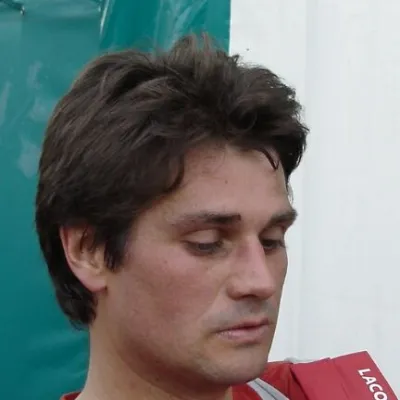
Arnaud Boetsch
Human Design Chart
Biography
Boetsch began to play tennis at the age of eight. At the end of 1994, he was 53rd on the ATP list and twelve months later he had reached the best ranking of his career - fourteenth. He was winner (team) of the 1996 Davis Cup. Formerly a member of Scientology.
He married on 3 December 1991.
Human Design Analysis: Arnaud Boetsch as Generator 3/5
Generator 3/5 — Design at a Glance
Arnaud Boetsch's design shows a tendency towards high endurance and fundamental responsiveness. His inner self has a reservoir of sacral energy that makes him appear like a strong workhorse, provided he uses this power correctly. The central mechanics of his design are not initiating actions but responding to impulses from the environment. His energy only fully ignites when he responds to an external signal and gives a clear 'yes' internally.
This process significantly determined his well-being. When Arnaud Boetsch listened to this inner confirmation and acted accordingly, he experienced deep satisfaction and fulfillment. His energy then flowed freely, allowing him to push forward with great endurance on projects. Conversely, ignoring these signals or forcing initiatives without internal resonance led to frustration and a noticeable lack of energy. It was especially dangerous for him when he engaged in tasks that went against his inner inclinations – here burnout quickly loomed as his energy was wasted senselessly. Equally frustrating was being prevented from pursuing heart projects despite still having an inner drive full of ambition. His path to confirmation thus lay in patiently waiting for life impulses and then acting from the gut, rather than anticipating or forcing.
Sacral Authority
Arnaud Boetsch demonstrated decision-making based on internal, physical resonance rather than intellectual analysis. His design suggests that he waited for external stimuli and then received spontaneous gut reactions like a grunt or surge of power as responses. This mechanism corresponds to sacral authority, which is only available to the Generator type. Since this authority also served as his strategy, his decision-making process was simplified: He did not react through deliberation but through immediate physical confirmation.
The authenticity of these reactions served as a gauge for energy flow. When Arnaud Boetsch felt vital and alive with enthusiasm about what he was doing, it confirmed the correctness of his path. The absence of these signals signaled a wrong decision to his body. He was meant to perform tasks with joy and satisfaction without constantly questioning their purpose.
Additionally, supportive spleen activation worked in tandem. This gave sacral reactions additional speed and spontaneity. Arnaud Boetsch had an immediate access to his instinctive perception and physical well-being, allowing him to make decisions quickly and reliably. This combination of sacral confirmation and spleen-supported intuition shaped the way he moved through the world: reactive, alive, and trusting in his own inner compass.
The 3/5 Profile — Martyr / Heretic
Arnaud Boetsch displayed a basic attitude of an experimenter: He initially believed little in preordained answers and sought to test things himself. This Line 3 of his Profile 3/5 shapes the learning path through trial and error, often accompanied by confrontations with superior forces or experiences of helplessness. It was crucial here to avoid dependencies and follow his own path to prevent falling into passive states.
From these practical experiences developed his role as a hero for others (Line 5). Self-acquired knowledge made him attractive; others sought orientation from him because he could solve problems based on personal experience. This heroic role flattered his design but became painful when experiments in public failed.
At the same time, his Line 5 carried the theme of alienation and isolation. In times of crisis, he acted as a lone fighter who brings about mutations through isolated actions. The greatest challenge was not being cut off from others but preventing himself from doing so. This tension between the need for independence during experimentation and the burden of public heroic roles shaped his dynamics. Isolation served as a protective mechanism to preserve the integrity of his individual solutions in chaotic situations without being overwhelmed by external influences.
Split Definition — Defined & Open Centers
Arnaud Boetsch's Human Design shows a massive, constant internal structure. Five defined centers – G (Identity), Heart (Willpower), Sacral (Vitality), Spleen (Instinct) and Root (Pressure) – created a person with clear self-love, high physical endurance, and strong autonomy needs. This energy was present consistently and not dependent on the environment. The combination of defined G- and Heart Centers formed a personality that felt itself lovable and carried this security outward. As a 'motor' with defined Sacral, he generated energy only through correct reactions, not initiation. His Spleen Center provided spontaneous protective mechanisms in the moment, while his Root Center delivered constant background pressure. The challenge was to avoid directing this power against the environment or exhausting it through mental initiation.
This contrasted with his open centers: Head, Ajna, Throat and Solar Plexus. Open Head and Ajna were receptive to inspiration but not steady; he had to learn to observe mental pressure waves as temporary without taking them personally or seeking answers. His open Throat Center meant that he should not speak proactively but wait for invitations to communicate authentically. The open Solar Plexus made him an emotional barometer: He absorbed the emotions of his surroundings, but did not have his own emotional wave. This required discipline not to personalize emotions and withdraw when overloaded to regain clarity.
Channels for change, pioneering spirit, life purpose and maturation.
Arnaud Boetsch's energy carried evolutionary change by accepting limitation and going beyond the confusion of a new beginning. This mechanism was primarily shaped by Channel Mutation 60-3, which connects Root Center with Sacral Center. It brings melancholic, pulsing on/off energy. The internal pressure of the Root Center created tension and melancholy in pauses between impulses; this moodiness had to be accepted mechanically, not fought against, as a sign that something new is emerging underground. Patience while waiting for the right pulse was crucial, rather than rationalizing moods.
Channel Initiation 51-25 added a competitive component: Through 'shock' he brought about individualization and encouraged others when invited. Channel Life Struggle 38-28 provided stubborn determination to fight for personal meaning, while Channel Ripening 53-42 emphasized the cyclical process of experience, conclusion, and reflection.
Additionally, Gates like Gate 21 (Control of material things), Gate 48 (Pattern recognition, depth) and Gate 39 (Provocation as fuel for mutation) were at work. Gate 46 promoted dedication in the process, Gate 5 set the basic rhythm. Gate 18 worked on corrections, Gate 14 handled power skillfully with self-control. This configuration fostered an approach that enabled change through inner work and cyclical experience without forcing external pressure.
Individual Circuitry — Circuit Signature
Arnaud Boetsch's design tended towards internal stability and cyclical reflection. His Identity Circuit connected the G- with the Heart Center (Channel 25-51, Initiation). This created a stable foundation of self-worth and deep convictions. Since there was no connection to Throat Center, these inner certainties often remained hard to verbalize; strength showed more in aura than in speech flow.
Parallel to this, his Knowledge Circuit worked. Here he connected the Sacral-, Root- and Spleen Centers (Channel 3-60, Mutation; Channel 28-38, Life Struggle). This configuration promoted a drive for individual transformation and new expression. The energy was pulsing and focused on unique identity as well as innovative deviations from the known.
The Meaning Circuit connected Arnaud Boetsch's Sacral with his Root Center (Channel 42-53, Ripening). This directed focus towards emotional experiences from the past. Processing occurred in wave-like and cyclical form: Emotions went through a natural process from start to finish, drawing collective learning outcomes and reflecting on past events.
As someone with split definition, these energies existed as two parallel, not directly connected systems. One half (Sacral-Root-Spleen) drove innovation and emotional meaning-making forward, while the other half (Identity-Heart) provided inner anchoring. Arnaud Boetsch thus navigated between the drive for external transformation and the need for internal validation, with both areas working independently.
Right Angle Cross of Tension 1
Arnaud Boetsch's Human Design reveals a tendency towards deep-seated tension that often remains unconscious. This internal tension did not act as a blockage but rather as a constant driving force, promoting endurance and perseverance. In Arnaud Boetsch, this dynamic was evident as a characteristic state: an ongoing inner pressure that propelled actions forward even in the absence of external necessity.
This configuration is described in Human Design as the 'Tension Right Cross 1'. It refers to a specific energetic structure implying a fundamental internal conflict or persistent tension. For Arnaud Boetsch, this meant his energy did not rest but was activated by this permanent tension. The mechanics of this cross focus on the dynamics of tension and its resolution or pure endurance.
Thus, Arnaud Boetsch's experiential world was marked by the necessity to live with this internal dissonance and use it as motivation. It wasn't about avoiding stress but integrating a constant characteristic tension. This energy form shaped his essence through continuous inner movement that propelled him forward without always needing conscious control over its source. The tension was part of his natural physiology, an engine working from within that determined his endurance.
Saturn Return · Uranus Opposition · Chiron Return · 2nd Saturn Return — Life Cycles
Arnaud Boetsch's Human Design points towards a tendency to solidify into a clear adult identity around the age of 27 years old. This first Saturn Return cycle marks the transition from youth to stable structure and the foundation of self-understanding.
In 1996, at the age of 27, Arnaud Boetsch won the Davis Cup with the French team. This success was not coincidental but a typical expression of this mechanism: at this life point, years of groundwork coalesced into a sustainable outcome. The Saturn cycle here acts as a structuring force that cements previous development and enables a new, mature level of identity.
For Arnaud Boetsch, this process was concretely manifested in his sporting triumph. Winning the Davis Cup underscores how the first Saturn Return serves to clearly define one's position in the world and secure it. It is a moment of affirmation where the individual no longer just tests their role but recognizes and lives it as a firm part of their existence. This phase lays the groundwork for subsequent years, creating stability and clarity about one's potential.
Generator · Sacral Authority — Synthesis
Arnaud Boetsch’s Human Design reveals a deeply rooted process of experience and transformation. The combination of a defined Sacral Center, which serves as a constant energy source, with Channels of Mutation and Ripening (53/42, 60/3) points to someone marked by cyclical phases of activity, reflection, and renewal. This dynamic is further strengthened by the connection to the Root Center, signaling strong inner strength and endurance – an ongoing absorption and release of energy to shape oneself and one's environment. The open design of Perception Centers (Spleen, Head, Ajna) allows him to take in information from his surroundings and integrate it into his individual process, making him a dynamic learner and communicator.
A central paradox lies in the tension between the need for individuation – driven by Life Struggle Channels (38/28) and Initiation (51/25) – and the ability to fully immerse oneself in the present moment as suggested by the Sacral Center. While he tends to embrace challenges and new paths, he is also dependent on listening to his body's inner authority and only becoming active when the Sacral Center signals available energy. This interplay between the drive for innovation and the necessity of defining one’s own limits shapes his character and lifestyle.
4 Defined Channels
Incarnation Cross - Right Angle Cross of Tension 1
Solar Return
The Solar Return shows the moment when the sun returns to its exact birth position - your personal solar year.
Life Cycles
Discover the life cycles with a detailed triple view (birth chart, cycle chart, composite).
Human Design Profile
- Type
- Generator
- Strategy
- To respond - wait for something to respond to
- Authority
- Sacral Authority
- Profile
- 3/5 - Martyr / Heretic
- Definition
- Split Definition
- Incarnation Cross
- Right Angle Cross of Tension 1
- Date of Birth
- 01.04.1969 08:30
- Place of Birth
- Meulan, France
Frequently Asked Questions
What is Arnaud Boetsch's Human Design type?
What profile does Arnaud Boetsch have in Human Design?
What authority determines Arnaud Boetsch's decisions?
Which incarnation cross is active for Arnaud Boetsch?
When was Arnaud Boetsch born?
Discover your own Human Design
Are you also a Generator? Find out in a personal reading how to use your sacral energy correctly and discover deep satisfaction.
More Personalities
Back to overviewAaliyah

Aldair

Alexia

Angèle

Anne-Marie

Arcángel