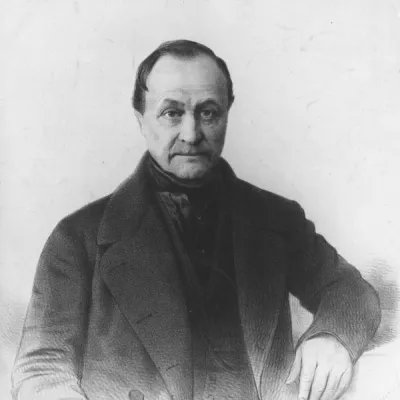
Auguste Comte
Human Design Chart
Biography
His work was widely promulgated by Europe’s intellectuals and influenced the thinking of Karl Marx, John Stuart Mill, George Eliot and Michel Houellebecq.
Comte died of stomach cancer on 5 September 1857, Paris.
What does Generator 4/6 mean for Auguste Comte?
Generator 4/6 — Design at a Glance
Auguste Comte had an enormous endurance, which was fueled not by self-initiative but rather through reacting to external impulses. His Generator design dictated that his energy – similar to that of a workhorse – flowed effectively only when he responded to signals from his environment. The key to his effectiveness lay in "reacting from the gut."
This tension shaped his life: When he undertook tasks that did not resonate with him internally, he wasted his energy and tended towards exhaustion. Conversely, frustration arose when he was prevented from engaging in activities for which his inner self clearly said "yes." His successful strategy involved waiting for life events to occur and then acting only when the sacral center confirmed it.
When Auguste Comte lived in harmony with this mechanism by reacting rather than initiating, he was rewarded with a deep sense of fulfillment. Deviations from this approach led instead to persistent frustration and energy depletion. Thus, his fundamental work style was not constant pushing forward but rather an enduring readiness to respond to impulses, which when properly applied could not be stopped by anyone.
Sacral Authority
Auguste Comte did not base his decisions on cognitive analysis but rather on physical signals as a measure of truth. His inner authority was defined by the Sacral Center, which is specific to the Generator type and integrates its strategy with decision-making. This mechanism required an open Emotional Center; the sacral authority manifested through gut feelings or bursts of energy in response to external stimuli. Auguste Comte learned to pay attention to sounds like grunts, hums, or groans. A positive "Mhm" signaled resonance, while a negative "Hm-hm" meant warning.
When his sacral motor kicked in, he felt vital and alive. He had an inexhaustible supply of energy and tackled his work with great enthusiasm. This configuration allowed him to move through life with joy and satisfaction, fully immersed in activities without aimlessness. Additionally, the Spleen Center as a supporting authority activated his spontaneous responsiveness. This gave him immediate access to instinctive perception and physical well-being, which he relied on reliably for guidance. Thus, this quick decision-making was based on the direct connection between Sacral and Spleen Centers, fostering intuitive assessments.
The 4/6 Profile — Opportunist / Role Model
Auguste Comte's design set an evolution from experimental searching in his youth to the role of a wise role model later in life. In his first three decades, he was driven by a strong desire for community and relationships, experimenting with various social constellations. This phase was marked by the dynamics of Line 4, making him sensitive to boundaries and helping him increase his potential within these constraints to prepare for mutations.
Over time, an internal conflict emerged: His Heart Center pulled him into circles of like-minded individuals, while his Head Center sought distance and questioning. This contradiction between belonging and wise superiority characterized his middle life phase. Eventually, this tension was resolved through the activation of Line 6. Auguste Comte now oriented himself towards consistent values and took on a leadership role based on the importance of these values. He became a role model who did not rely on authority but rather on cooperation and wise distance. His large Heart remained cautious to avoid injuries from false attachments, while he carried his insights as generated mutations into the world.
Split Definition — Defined & Open Centers
Auguste Comte revealed himself as someone with deeply rooted inner substance and clear mental structure. His design indicated a tendency towards persistent, inspiring thought, coupled with a firm identity and potent energy source. The defined Head and Ajna centers generated constant pressure to question and form concepts; however, this was not a motor for direct implementation but rather an inspiration for others. His defined G Center gave him reliable self-identity and the feeling of being lovable, while his Sacral Center functioned as a powerful engine. This energy required reaction instead of initiation: Only by waiting for invitations could he fully unleash his vitality without frustration. The defined Root Center provided constant pressure that propelled him forward.
At the same time, his design revealed specific vulnerabilities in open centers. His open Throat meant he couldn't control when or how he spoke; under pressure, he tended to force attention rather than wait for natural invitations to speak. His open Heart Center made him vulnerable to trying to prove his worth through promises or willpower – a trap often leading to disappointment as he was not designed to maintain such commitments consistently. The open Solar Plexus absorbed and amplified the emotions of his surroundings; he risked personalizing foreign moods, feeling emotionally unstable instead of merely perceiving them as information. Finally, his open Spleen Center led him to mistrust spontaneous decisions, often driven by conditioned fears or a false sense of security from others. His mechanics required channeling massive inner clarity and energy through patience and trust in his own authority rather than fighting the pressure of open centers.
Channels for change, focus, self-expression and mental clarity.
Auguste Comte was marked by pulsating, often melancholic energy of transformation. His design included Channel of Mutation 60-3, a format-energy between Root and Sacral Centers. This connection linked Gate of Limitation (60) with Gate of Order (3). It generated evolutionary change through a process from chaos to order. The mechanics described an on/off frequency: In the pauses between impulses, inner tension and melancholy arose as if nothing was happening. For Auguste Comte, this silence wasn't a malfunction but a necessary phase of internal development. The key lay in accepting limitation without trying to rationalize or act prematurely. Instead, he needed to patiently wait for the correct reaction from his Sacral Center.
Additionally, Channel of Concentration 52-9 was at work. It linked Gate of Non-action (52) with Gate of Focusing (9). This format-energy promoted a calm, logical tension that kept focus on details and facts. It supported staying still and avoiding distractions to perfect patterns.
Channel of Exploration 34-10 connected the Sacral Center with the G Center via Gate of Power (34) and Gate of Self-behavior (10). This strengthened individual conviction and self-love through authentic behavior based on sacral reaction.
Channel of Abstraction 64-47 linked Head and Ajna Centers via Gate of Confusion (64) and Gate of Understanding (47). It drove an active, experience-based mind seeking meaning and perspective, often accompanied by mental unrest until sudden clarity.
Individual Gates like 56 (Inspiration), 50 (Protection Reflex/Tradition), 13 (Continuity), 63 (Doubt) as well as 39 (Provocation/Mutation) and 5 (Rhythm) rounded out the profile, with channels forming the dominant structure.
Individual Circuitry — Circuit Signature
Auguste Comte's design indicated a tendency towards individual identity seeking, manifesting through emotional waves and a desire for transformation. As a Generator with shared definition, his energy consisted of two parallel, non-directly connected streams: a powerful base (Sacral, Root, G Center) and an intellectual Head aspect (Head, Ajna Centers).
The Knowledge Circuit in him linked Sacral and Root Centers. This propelled the innate path to acquire new knowledge and introduce deviations from the existing through mutation via Channel 3-60. This energy supported expressing entirely new insights emotionally grounded, thus making change effective for others.
Parallel to this, the Centering Circuit connected Identity and Sacral Centers. It fostered strong personal traits with firm inner convictions. However, lacking a connection to Throat Center, these firm beliefs often remained hard to articulate or communicate outwardly.
In the Understanding Circuit, he again linked Sacral and Root Centers (separate from Knowledge aspect). This channeled energies towards logic, structure, and strategy to improve things and share rational insights free of conditioning. The focus here was on future-oriented clarity.
Finally, the Meaning-Finding Circuit connected Head and Ajna Centers. Here experiences revolved around emotions and reflecting past events to grasp their meaning. These wave-like, often inexplicable insights should be shared with the collective to learn together from the past.
Right Angle Cross of Laws 4
Auguste Comte's Human Design showed a deeply rooted inclination to seek the fundamental principles of order that govern human coexistence and societal progress. He was someone who was not satisfied with arbitrary or individual solutions but always strived to identify universal laws that could be followed to ensure stability and prosperity. This attitude stemmed from the configuration of the right cross of Laws 4 in his Human Design chart.
This specific structure in the chart describes a life task focused on laying the foundation for cultural and social systems. It is not about spontaneous innovation or personal freedom as the highest good, but rather about creating clear rules and ethical guidelines that must be accepted by the community. Auguste Comte was programmed to create order out of chaos by showing that true development is only possible based on solid, understandable principles.
His energy was directed towards formulating these laws not just theoretically but establishing them as a binding foundation for social cohesion. The design challenged him to take responsibility for the welfare of the group through the implementation of these structures. It was a strong inner drive to ensure that society does not get stuck in arbitrariness, but instead orientates itself toward overarching truths that enable progress for all. This mechanism shaped his entire approach to life and the world around him.
Saturn Return · Uranus Opposition · Chiron Return · 2nd Saturn Return — Life Cycles
Auguste Comte lived his life as a sequence of clear maturation and transformation phases, structured by the cyclical influence of Saturn and Chiron. His design showed a tendency towards deep commitments and structural breaks at these planetary turning points.
In 1825, at age 27, he entered his first Saturn return – a phase of consolidation and responsibility. This marked his step into marriage with Caroline Massin, where years of inner development condensed into a solid life structure. The first Saturn return cycle functioned here as a catalyst for social anchoring.
A decade later in 1846 at age 48, he went through the Chiron return. In Human Design mechanics, this is not a healing process in a medical sense but rather an achievement cycle where the incarnation cross unfolds and meaning becomes experiential. This peak of his inner development coincided with the death of Clotilde de Vaux, whom he revered. The event underscored the transformative power of this cycle: encountering loss served to deepen his life purpose not as a wound but as a catalytic moment of finding meaning.
His second Saturn return in 1857 at age 59 signaled the end of a major life phase and the dissolution of earlier structures. Auguste Comte died that year from stomach cancer in Paris. His life illustrates how these planetary cycles – from commitment to the unfolding of meaning until final structural dissolution – shape and form the human path.
Generator · Sacral Authority — Synthesis
Auguste Comte lived deeply rooted in his sacral center (Generator type), driven by an inexhaustible energy source activated by external stimuli. This power unfolded especially when he worked on tasks that resonated with him internally – a life characterized by the interplay between the need for activity and the search for fulfilling work. His profile as 4/6 indicates that in his early years, he accumulated intense experiences to later aim at a role as an exemplar, always torn between the desire for community and the urge towards isolation and reflection.
A central paradox shaped Comte's life: the tension between the pulsating, mutative energy of his circuit (Channel 3-60) and the mental pressure exerted by his defined head center. He was destined to create new things and initiate changes, yet this process went hand in hand with melancholy and a constant search for understanding. The events of his life – from marriage to the death of loved ones and finally his own demise – manifested as an expression of this internal conflict between the desire for innovation and acceptance of limitations.
4 Defined Channels
Incarnation Cross - Right Angle Cross of Laws 4
Solar Return
The Solar Return shows the moment when the sun returns to its exact birth position - your personal solar year.
Life Cycles
Discover the life cycles with a detailed triple view (birth chart, cycle chart, composite).
Human Design Profile
- Type
- Generator
- Strategy
- To respond - wait for something to respond to
- Authority
- Sacral Authority
- Profile
- 4/6 - Opportunist / Role Model
- Definition
- Split Definition
- Incarnation Cross
- Right Angle Cross of Laws 4
- Date of Birth
- 19.01.1798 12:00
- Place of Birth
- Montpellier, France
Frequently Asked Questions
What is Auguste Comte's Human Design type?
Which Profile did Auguste Comte have?
What Authority did Auguste Comte possess?
What incarnation cross did Auguste Comte have?
When was Auguste Comte born?
Discover your own Human Design
Are you also a Generator? Find out in a personal reading how to use your sacral energy correctly and discover deep satisfaction.
More Personalities
Back to overviewAaliyah

Alexia

Angèle

Anne-Marie

Arcángel

Arno