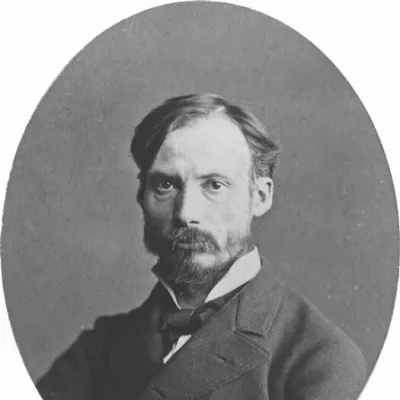
Auguste Renoir
Human Design Chart
Biography
He was the father of the actor Pierre Renoir (1885–1952), the filmmaker Jean Renoir (1894–1979) and the ceramic artist Claude Renoir (1901–1969). He was the grandfather of the filmmaker Claude Renoir (1913–1993), son of Pierre.
Auguste Renoir — Generator with Profile 1/3
Generator 1/3 — Design at a Glance
Auguste Renoir possessed immense endurance and acted as an energy carrier, comparable to a workhorse. His design indicated that he generated power only if it was available for his tasks. The central mechanism of his Generator type was not to initiate but to react to impulses from the environment.
This strategy required patience: Auguste Renoir had to wait for signals and respond with concrete action. When his sacral center – often described as gut feeling – gave a clear “yes,” he could find deep fulfillment through action. Living in harmony with this principle, he was passionate and satisfied.
Two stumbling blocks shaped the challenges of his design. The first occurred when he completed tasks without inner desire, leading to wasted energy and vulnerability to burnout despite his high potential for productivity. The second danger lay in being prevented from working on his heart project even though he still had plenty of power left to work with. If he fought against this internal resistance or was suppressed, it resulted in frustration and a lack of energy.
Auguste Renoir's path to satisfaction thus did not lie in constantly pushing forward his own plans but rather in the ability to react from the gut. Only through reacting to life could he effectively use his great energy and avoid turning it into frustration. His strength was therefore evident when he waited for the signal before taking the first step.
Emotional Authority
Auguste Renoir displayed an inner decision-making structure that necessarily required time. His design carried emotional authority, meaning his defined Emotional Center was the source of his deepest truth – regardless of which other centers were also defined in his graph. This configuration subjected him to a permanent wave motion of feelings. His perception of the world was always colored by the current mood: at one moment he could be totally enthusiastic about something, and in the next view it negatively.
For Auguste Renoir, however, immediate feeling was only a snapshot, not a reliable compass. Quick, spontaneous decisions from such an emotional height or depth proved risky and often misleading. The mechanics of his design demanded patience. He had to learn not to make important decisions immediately but to let them ripen. This required conscious waiting, often even multiple “sleeping on” the matter.
Only when intense feelings subsided and an emotional distance set in did true clarity and calm arise for him. This process of calming was necessary to move from a colored snapshot to deeper insight. Auguste Renoir therefore had to take his time until the emotional wave died down before making decisions that aligned with his true nature and positively influenced his life path, rather than being guided by fleeting moods.
The 1/3 Profile — Investigator / Martyr
Auguste Renoir's design tended towards collecting knowledge not just theoretically but validating it through practical experience and occasional failures. As a person with Profile 1/3, the Researcher and Experimenter, he showed himself to be someone who carried an internal conflict between the drive for complete preparation and the impulse to act. Line 1 strives for harmony and guideline formation, often leading to a certain fear of ignorance; Renoir may have felt uncomfortable when he did not know enough to act safely. At the same time, Line 3 demands experimentation through trial and error. This mechanism meant that mistakes were not just setbacks but essential learning moments. Only by overcoming obstacles and examining details – until “the drop that makes the bucket overflow” – could he gain reliable insights. His judgment was considered particularly credible because it rested on a double check: theoretical understanding and practical validation. Auguste Renoir thus learned not only through study but primarily by testing his theories in reality. This cycle of learning and experimenting shaped his path; self-earned insights were the result of this process. His sensitivity helped him maintain harmony in relationships, while the necessity to make mistakes propelled his development forward. So a deep trust in judgments honed by experience emerged.
Triple Split Definition — Defined & Open Centers
Auguste Renoir's design featured a nearly complete internal structure: All centers were defined except for the Throat Center. This created a closed system of high inner consistency and autonomy. He operated from a stable interior that included mental inspiration (Head/Ajna), stable identity (G Center), willpower (Heart), vital energy (Sacral), emotional depth (Solar Plexus), intuitive health (Spleen) as well as stress management (Root). This configuration meant he did not need external validation or direction; his energy sources and decision-making mechanisms were internally anchored. The challenge lay in integrating these strong internal forces – such as mental pressure versus emotional waves – without pitting them against each other.
The open Throat Center formed the only undefined element. Here, a constant impulse to express was missing; communication was reactive and occurred on invitation, not through initiated attention-seeking. While defined centers like Sacral or G Center provided him with reliable energy and direction, his open Throat Center tended to suffer under the pressure of needing recognition if it did not wait for natural invitations. This potentially led to fear of invisibility or attempts at forced speech to gain attention, which went against his mechanics and wasted energy. Instead, his open Throat Center naturally attracted attention when he waited.
The combination of full internal definition and an open throat marked him as someone with immense inner substance whose external manifestation was situational and reactive. He possessed the power to shape life (through defined motors), but the expression of this shaping had to be triggered by external incentives to stay true to his nature. This protected him from exhaustion through constant attention-seeking and allowed him to effectively employ his many internal resources – from mental clarity to emotional depth – in moments when he was invited to express himself.
Channels for community, logic, exploration, synthesis and life struggle.
Auguste Renoir exhibited a basic disposition arising from the tension between a skeptical mind and a deep, authentic reaction. His design featured a drive to logically analyze patterns while his true strength lay in loving oneself and following personal convictions.
Channel of Logic 63-4 connected Head Center with Ajna Center through Gate of Doubt (63) and Gate of Formulation (4). This channel permanently filtered patterns to test their consistency. Doubt was essential here, as logical formulations could be flawless but remain false if not practically verifiable. Auguste Renoir used this skepticism to question and predict for the collective. His fear manifested in doubts between question and answer; he needed proof through experimenting, as unfounded belief found little room.
Simultaneously, Channel of Exploration 34-10 linked Sacral Center with G Center. Through Gate of Power (34) and Gate of Self Behavior (10), he initiated behavior from the deepest inner self to accept and honor himself. This energy served not to impose but to creatively focus on staying centered in personal beliefs. Auguste Renoir exercised mutation power by authentically reacting rather than mentally planning, encouraging others to find their own self-love while challenging collective traditions.
Channel of Synthesis 19-49 underscored his emotional sensitivity for tribal belonging. It connected Root Center with Solar Plexus Center through Gate of Claims (19) and Gate of Principles (49). This created the emotional glue that determined who belonged to the tribe. Auguste Renoir sought balance between feasibility and fairness within his community.
Channel of Life Struggle 38-28 endowed him with stubborn determination in the fight for individual meaning. Through Gate of Fighter (38) and Gate of Player (28), he resisted external forces that wanted to distract him from himself. He found significance in the battles of his unique path, inspiring others to realize their own individuation process.
Tribal Circuitry — Circuit Signature
Auguste Renoir's design showed as a Triple Definition, creating three separate, parallel operating energetic blocks. The Knowledge Circuit connected Spleen and Root Center via Channel Life Struggle (28-38). This generated pulsating energy of survival instinct and individual constancy without direct connection to other areas.
The Centering Circuit linked Identity and Sacral Centers through Channel Exploration (10-34). Here, an inner, individualistic force directly connected self-worth and life energy with the core of personality. This connection fostered solid convictions but lacked a direct expression route to Throat Center.
In the Understanding Circuit, Head and Ajna Centers were linked by Logic Channel (63-4). This allowed focused rational thought processes and strategic planning separate from emotional waves. It was pure, emotionless ratio for improving future structures.
The Ego Circuit connected Heart, Solar Plexus, and Root Centers via Channels Community (40-37) and Synthesis (49-19). This created a dynamic unity of willpower, emotion, and survival pressure within tribal energy. As Sacral Center was missing here, this intense cooperation required regular rest pauses for resource renewal.
The Sensitivity Stream in Solar Plexus Center shaped emotional perception. These four circuits and the stream did not form a cohesive unit but acted as independent force fields in Auguste Renoir's life.
Right Angle Cross of Planning 1
Auguste Renoir's design placed a tendency towards strategic orientation and planning architecture as a central life theme. He was someone whose inner structure was strongly influenced by the need to maintain an overview of complex interconnections and to pave long-term paths. This configuration described a life task that did not lie in impulsive action, but rather in careful preparation and clear design of structures that could provide orientation for others.
The right cross of planning 1 refers to a specific energetic alignment where the root center was often driven by the need to find answers while the emotional center filtered the quality and timing of these answers. For Auguste Renoir, this meant that his greatest strength lay not only in solving problems but in creating systems in which solutions could have lasting impact. His energy focused on developing plans robust enough to withstand uncertainties.
This architecture of planning allowed him to transform chaos into order by drawing clear lines and setting priorities. It was not about rigid control, but a flexible strategy that left room for adjustments as long as the overarching goal remained clearly defined. Auguste Renoir lived this ability by continuously reviewing his environment and his own steps in terms of their long-term sustainability before fully committing to action.
Saturn Return · Uranus Opposition · Chiron Return · 2nd Saturn Return — Life Cycles
Auguste Renoir's life followed a clear rhythm of structuring, marked by the cyclical phases of his Saturn and Chiron retrogrades. These astronomical events not only signified biological aging but also profound turning points in his life task and social anchoring.
The first Saturn return around age 29 often brought confrontation with external reality. In 1870, Renoir volunteered for the cavalry regiment during the Franco-German War. This crisis forced him to question his previous boundaries and test structural durability under pressure. It was a moment of necessary toughness that laid the foundation for further development.
Decades later, around age 49 with the Chiron return, a phase of fulfillment began. If he had followed his strategy, this marked the condensation of his purpose. In 1890, Renoir married Aline Charigot. This relationship symbolized the bloom of his incarnation goal: The connection became the stable foundation on which his life task now rested and unfolded.
The second Saturn return around age 60 further solidified this structure. In 1901, his third son Claude was born. This was not just a family event but the concrete manifestation of his ongoing responsibility and passing down of structure to the next generation. Through these three phases – crisis, fulfillment, and consolidation – Auguste Renoir's design formed into a coherent life line where external events made inner maturation processes visible.
Generator · Emotional Authority — Synthesis
Auguste Renoir lived a life marked by a deep drive for knowledge and practical implementation of this knowledge. As a Generator with emotional authority and the Profile of Researcher/Experimentor (1/3), he continuously sought new patterns and possibilities that he both theoretically examined and experienced in practice. This process was intensified by the constant mental pressure of his defined Head Center (Head-Ajna), leading to an unceasing questioning – a logical filter (Channel 63/4) satisfied only when a pattern proved its consistency. His energy expressed itself in a knowledge circuit that drove him to create new things and express them through emotional depth.
A central paradox lay in the fact that while Renoir was driven by strong sacral energy urging action, he also experienced an emotional wave delaying decisions and leading to doubts. This tension between the need for immediate implementation and the necessity of mature reflection shaped his creative process. The experiences during phases of Saturn returns (1870) and Chiron returns (1890), as well as welcoming new life phases (1901), showed how he learned through crises and relationships, refining his insights.
5 Defined Channels
Incarnation Cross - Right Angle Cross of Planning 1
Solar Return
The Solar Return shows the moment when the sun returns to its exact birth position - your personal solar year.
Life Cycles
Discover the life cycles with a detailed triple view (birth chart, cycle chart, composite).
Human Design Profile
- Type
- Generator
- Strategy
- To respond - wait for something to respond to
- Authority
- Emotional Authority
- Profile
- 1/3 - Investigator / Martyr
- Definition
- Triple Split
- Incarnation Cross
- Right Angle Cross of Planning 1
- Date of Birth
- 25.02.1841 06:00
- Place of Birth
- Limoges, France
Frequently Asked Questions
What was Auguste Renoir's Human Design type?
What Profile did Auguste Renoir have?
What Authority did Auguste Renoir have?
What was Auguste Renoirs incarnation cross?
When was Auguste Renoir born?
Discover your own Human Design
Are you also a Generator? Find out in a personal reading how to use your sacral energy correctly and discover deep satisfaction.
More Personalities
Back to overviewAaliyah

Alexia

Angèle

Anne-Marie

Arcángel

Arno