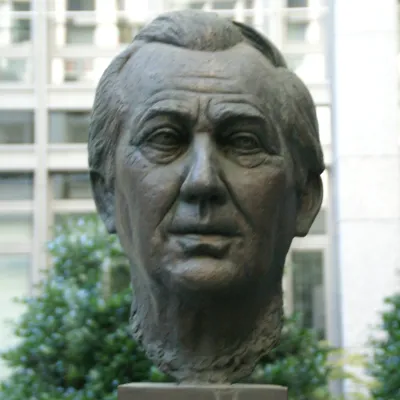
Axel Springer
Human Design Chart
Biography
The Axel Springer AG today is one of the major magazine, newspaper and online media companies in Europe with over 230 newspapers and magazines as well as more than 80 online offerings.
Springer's son Axel jr. was born on 7 February 1941, he became a photographer and photo journalist, working under the pseudonym Sven Simon. Sven Simon committed suicide on 3 January 1980 on a park bench in Hamburg.
Manfred Gregor writes that Springer consulted frequently with his astrologer, which probably was Hans Genuit, who also advised on the date for starting 'Bild'.
Axel Springer died in West Berlin on 22 September 1985 at age 73. His heiress was his fifth (and last) wife Friede Springer (born 1942).
Human Design Analysis: Axel Springer as Generator 5/1
Generator 5/1 — Design at a Glance
Axel Springer was someone who possessed immense, enduring strength, comparable to a workhorse that directs its energy specifically towards its tasks. His design as a Generator suggested that this strength was unleashed not through constant initiative but by responding to external signals. The mechanics of his sacral center worked most effectively when he responded to impulses from the environment rather than taking the first step himself. This strategy of 'responding' rather than 'initiating' was the key to his effectiveness.
If he encountered an incentive that his inner self responded to with a clear 'yes', he could act with full power. However, if he lived against this principle and constantly initiated himself or completed tasks without inner resonance, he fell into the typical pitfall of the Generator: energy was wasted, leading to frustration and a feeling of exhaustion. Conversely, it was also a risk if he was prevented from pursuing his heart's project, even though he was still full of drive.
When Axel Springer used his energy in harmony with his design – that is, by responding rather than initiating – it rewarded him with a deep sense of fulfillment. Deviations from this strategy, such as constantly pushing forward without inner confirmation, inevitably led to a lack of energy and persistent dissatisfaction. His endurance was therefore not automatic but dependent on whether he responded to life from the gut.
Sacral Authority
Axel Springer lived as a Generator whose inner compass needle was anchored in sacral authority. This configuration fundamentally simplified his decision-making process, as strategy and inner authority were identical: waiting for stimuli and then responding. His authority did not show through intellectual analysis but through an immediate physical response – a 'gut feeling' or a noticeable surge of energy. When his sacral center responded to an external impulse, he reacted with vital energy and great enthusiasm. He was born to lose himself in activities without necessarily needing a narrow sense of purpose; the joy of doing was the driving force.
Especially relevant was the activation of his spleen center, which functioned as a supporting authority. This connection allowed him to act particularly quickly and spontaneously. He had direct access to his instinctive perception and physical well-being. These instincts were reliable and guided him in moments when a slow emotional weighing – due to his open emotional center – was not possible or necessary. Axel Springer thus followed the impulsive 'yes' or 'no' of his body, which often manifested as a brief grunt or an inner twitch. This mechanism secured him an almost inexhaustible energy source, as long as he responded to the right stimuli and did not anticipate.
The 5/1 Profile — Heretic / Investigator
Axel Springer's design tended towards a dual role: on one hand, he was the deep researcher who gathered knowledge, and on the other, the hero who offered this knowledge to others for problem-solving. As a 5/1, he had a nearly magnetic presence that urged others to use his knowledge treasures. People often sought him out for solutions to their own problems. This was based on Line 1, which promoted empathy and listening. It allowed him to learn secrets and take in stories from various sources. However, this open attitude could also be a burden, as he could engage with everyone indiscriminately. Line 5 demanded the courage to admit past mistakes and make this confession an act of justification. In crisis situations, this line was most effective, especially with strangers. The challenge for Axel Springer was to set clear boundaries. Without the risk that constant demand for solutions and the absorption of others' problems would lead to exhaustion. When he learned to say no, he could maintain the balance between research for himself and problem-solving for others. Thus, he used his gifts optimally without sacrificing himself.
Split Definition — Defined & Open Centers
Axel Springer was a person driven by a constant inner vitality that manifested as a steady hum of energy. His defined Sacral Center provided this powerful source, but he could only effectively use it when he waited for and responded to external invitations rather than initiating on his own. Simultaneously, the definition between his Head and Ajna Centers created a permanent mental pressure. This state generated a continuous inspiration in him, often manifesting as questions, doubts, or confusion – not as immediate answers, but as impulses that challenged consciousness. His mental function was fixed and reliable, but it did not provide energy for direct implementation; instead, it served to inspire others to think.
Another defining characteristic was his defined G Center, which gave him a clear, unchanging self-identity and a deep sense of his own life direction. He knew who he was and where he belonged, without imposing this on others. Yet, these inner strengths stood in contrast to his open centers, which made him vulnerable to conditioning. His open Heart Center led to him not being naturally willful; he tended to prove himself and make promises he could not keep, driven by the feeling that he had to prove his worth.
Furthermore, his open Solar Plexus absorbed the emotions of his surroundings, causing him to personalize foreign feelings and often feel emotionally overwhelmed, even though these moods did not belong to him. His open Throat Center put him under pressure to demand attention through constant talking, rather than waiting for the right invitation to speak. Finally, his open Root Center took on external stress, which put him into a cycle of hyperactivity and trying to relieve unbearable pressure through overwork. This combination of defined inner strength and open receptivity to external stimuli significantly shaped his actions.
Channels for resource management and rational clarity.
Axel Springer was someone who used material resources to push innovative directions while his mind sought sudden insights. This dynamic arose from the Channel of the Beat 14-2, connecting the Sacral Center with the G Center. Gate 14 focused on the availability of material means to drive mutation, while Gate 2 as a driver directed movement through space and time. This configuration allowed him to forge new, strengthening paths through trust in the Sacral reaction, without needing to predict the exact outcome.
Parallel to this, the Channel of Awareness 61-24, connecting the Head Center with the Ajna Center, was at work. Here, his mind processed inspiration from Gate 61, the secrets, through the rationalization of Gate 24. This created an individual thinker who gained knowledge not through logical patterns but through spontaneous Satori experiences. His mind was geared to inspire others with unique insights that broke old cycles by surrendering to the inner truth whenever it arose.
Additionally, priority gates shaped his essence: Gate 44 promoted awareness and transformation through unconditional interaction, while Gate 13 secured collective memory and continuity. Gate 7 projected leadership patterns and hierarchies for the future. In the background, Sacral gates like 5 (Rhythm), 29 (Persistence), 9 (Detail Work), and 42 (Completion) directed his energy towards pattern perfection, goal-oriented focus, and the completion of processes to enable new commitments.
Individual Circuitry — Circuit Signature
Axel Springer's design leaned towards innovative, creative flashes of insight, paired with a strong orientation towards his unique, individual identity. This configuration appeared as two separate, parallel existing forces, as he had a Split Definition.
In the Knowledge Circuit, his specific active channels were the Channel of Awareness (Gates 24-61) and the Channel of the Beat (Gates 2-14). The first connected the Head with the Ajna Center, promoting intuitive, innovative ideas that were structured by the mind. The second channel connected the Identity with the Sacral Center, where the driving force for implementing these ideas was powered by an inner rhythm and the affirmation of his individuality.
Although both parts belonged to the same circuit, they were not energetically directly connected. Inspirational impulses from Head and Ajna did not automatically flow into the action-guiding energy of Identity and Sacrum. Instead, these abilities existed as independent poles: on one side, the ability to generate new knowledge and creative solutions, on the other, the power to manifest and stabilize his identity through active action. This separation meant that the connection between mental inspiration and physical implementation was not given as an automatic, flowing process, but as two different yet coexisting potentials in the design.
Left Angle Cross of Incarnation 1
Axel Springer's design carried the imprint of the left incarnation cross, which characterized his fundamental orientation towards the visible and the material world. In Human Design, this cross represents the impulse to translate ideas and visions into tangible, physical forms. It was not about abstract philosophy but about the concrete realization of concepts in reality.
The energy of this cross promoted a stance that sought to make the invisible visible. Axel Springer showed himself to be someone who was concerned with bringing inner impulses to the outside and pouring them into structures that could be perceived by others. It was a process of manifestation in the literal sense: thinking became action, and action became visible results.
This mechanism suggested a tendency towards pragmatic creation. The focus was on what could be touched, seen, and measured. Abstract theories were less interesting than their practical application. Axel Springer's chart indicated that his strength lay in establishing visions not just in thought but in the physical world. This created a bridge between the inner world of ideas and the outer world of objects and structures. The energy of this cross thus supported a lifestyle based on concrete results and visible impact.
Saturn Return · Uranus Opposition · Chiron Return · 2nd Saturn Return — Life Cycles
Axel Springer entered a new phase of life around 1939, at the age of 27, with his second marriage to Erna Frieda Berta Holm. This marked his first Saturn return, a cycle in which early ambitions often crystallize into concrete, binding structures.
Ten years later, in 1952 at the age of 40, the first edition of the tabloid newspaper Bild appeared. This fell during the Uranus opposition, a period of sudden upheavals and innovations, often accompanied in Human Design by disruptive, groundbreaking actions that break old structures.
In 1961, at the age of 49, Axel Springer separated from his wife Rosemarie. This corresponded to his Chiron return, a fulfillment cycle in which the meaning and purpose of one's incarnation cross, if lived according to strategy and authority, become increasingly apparent. It was a time of flourishing and clarification of one's orientation.
Five years later, in 1966 at the age of 54, he opened the new publishing house in Berlin-Kreuzberg. This fell during his second Saturn return, a phase of consolidation and the building of lasting structures, in which the insights and achievements gained previously are poured into stable, long-term institutions. This sequence shows how his life phases rhythmically oriented themselves to astrological cycles.
Generator · Sacral Authority — Synthesis
He was a Generator whose life was marked by an unstoppable flow of sacral energy (sacral authority, Generator type). This energy always sought engagement, something to set the inner motor in motion (Sacral Center). The profile as a Hero and Explorer (5/1) intensified this drive by creating a deep need for knowledge building and its dissemination to others. The ability to forge new paths through questions and inspiration (defined Head Center) was central, as was the readiness to push innovations and initiate changes through the channel of the Beat (14/2). This led to a life characterized by constant activity and the pursuit of new insights.
A central tension arose from the interplay of deep engagement and the associated pressure. The sacral energy challenged him to throw himself fully into projects, while the defined Head Center generated an unrelenting mental pressure to answer questions and understand (mental pressure). The cycles showed that professional successes (1952, 1966) often went hand in hand with personal crises (1961), as the energy he invested in his work could also become a burden. He thus lived in a constant dynamic between creative power and the need to set limits.
2 Defined Channels
Incarnation Cross - Left Angle Cross of Incarnation 1
Solar Return
The Solar Return shows the moment when the sun returns to its exact birth position - your personal solar year.
Life Cycles
Discover the life cycles with a detailed triple view (birth chart, cycle chart, composite).
Human Design Profile
- Type
- Generator
- Strategy
- To respond - wait for something to respond to
- Authority
- Sacral Authority
- Profile
- 5/1 - Heretic / Investigator
- Definition
- Split Definition
- Incarnation Cross
- Left Angle Cross of Incarnation 1
- Date of Birth
- 02.05.1912 09:42
- Place of Birth
- Hamburg, GER
Frequently Asked Questions
What was Axel Springer's Human Design type?
What Profile did Axel Springer have in Human Design?
Which Authority guided Axel Springer in Human Design?
What incarnation cross did Axel Springer have in Human-Design?
When was Axel Springer born?
Discover your own Human Design
Are you also a Generator? Find out in a personal reading how to use your sacral energy correctly and discover deep satisfaction.
More Personalities
Back to overviewAaliyah

Alexia

Angèle

Anne-Marie

Arcángel

Arno