Barry Bonds
Human Design Chart
Biography
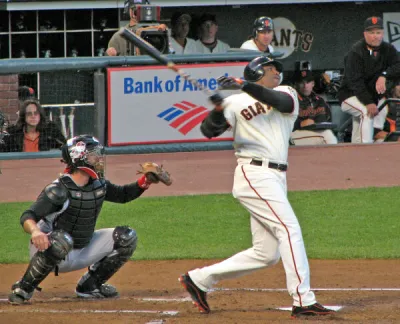
Most notably, through 2005, Barry Bonds has hit 708 home runs, nearly tying Babe Ruth's record (714). Bonds’ stellar record is not admired by everyone. He has been embroiled in a debate over whether the illegal use of steroids enhanced his show-stopping performance at bat. Nevertheless, he has been named Most Valuable Player seven times, won eight Golden Glove awards and led his team to the 2002 World Series, where the Giants were defeated in the seventh game. In 2001 he set the record for number of home runs in a season (73). He has played in 12 All-Star games. According to one writer, the combination of power and speed that he displays has only been seen in the performance of his godfather Willie Mays.
The oldest of four children, Bonds was drafted into pro baseball in 1982 but opted to complete college first. He began his major league career with the Pittsburgh Pirates in 1986. A 6'2" (1.88 m) left-handed slugger, he opted to sign with the San Francisco Giants in 1993. Since then he has established new records, in 2001 breaking two of Babe Ruth's records, one for most walks and the other for the highest slugging percentage in one season. The following year, he broke Ted Williams' single-season record for percentage of time on- base and at the same time established a new record for number of walks in a season. He broke his own record in 2004 with 232 walks for the season.
Health and other problems have beset the slugger. In 1999 he was treated for knee injuries and other problems.
Barry Bonds as a Projector 1/3 in Human Design
Projector 1/3 — Design at a Glance
Barry Bonds revealed himself as someone with a dense, focusing aura that identified flaws and weaknesses in his environment like a bright flashlight. This ability to immediately recognize system errors was characteristic of his Projector type. However, directly addressing these issues often led to friction, similar to shining bright light directly into another's face. More elegant was when he radiated harmony through himself; this attraction drew others automatically to seek his advice.
Central to his success was the strategy of waiting for a valuing invitation. Without this explicit request, he risked the non-self theme of bitterness. With an undefined Sacral Center in his design, Barry Bonds did not have a constant source of intrinsic life energy. Instead, he experienced phases of high activity followed by necessary rest periods to prevent burnout. This rhythmic energy profile conflicted with societal structures that expect continuous performance. Living according to this design and waiting for the invitation rewarded him with success; ignoring this dynamic led bitterness to emerge as his central emotional pattern.
Splenic Authority
Barry Bonds showed a tendency towards spontaneous, moment-based decisions based on his inner survival intelligence and physical well-being. His design suggested he could rigorously protect his health by distancing himself from harmful influences. This stance stems from the authority in the Spleen Center, which functions as a health and alarm system. For this authority to be effective, both the Emotional and Sacral Centers must be open – a configuration only Projectors or Manifestors exhibit.
The Spleen provides a fine, unique signal about whether a situation or environment is right. Barry Bonds’ first spontaneous impulse thus served as a reliable indicator of his own safety and personal well-being. However, this impulse was subtle and could easily be overshadowed by external influences, requiring high vigilance not to ignore it. A brief retreat for decision-making could help him perceive this clear inner call.
Long-term planning was difficult for Barry Bonds since the right thing only became apparent in the moment and plans could change short notice. His design emphasized flexibility and freedom over rigid commitments. Through this spontaneous orientation, he could optimally adapt to changing circumstances and prioritize his individual well-being without being constrained by long-term obligations.
The 1/3 Profile — Investigator / Martyr
Barry Bonds’ design was characterized by a dynamic unity of theoretical knowledge and practical application. His essence core, defined by Profile 1/3 (Researcher/Experimentor), combined the need for thorough understanding with the urge to experiment. The energy of Line 1 promoted logical leadership and the pursuit of deep, rational comprehension – comparable to Indiana Jones as a scientist. Simultaneously, Line 3 drove the impulse to test boundaries through trial and error.
This interplay created a specific tension field: Fear of insufficient knowledge could impede implementation, yet judgment only formed once something was both intellectually understood and practically tested on an emotional level. Gate 31 (Line 1) emphasized the quality of leadership in a complementary relationship between light and darkness – form creation on one side, mental depth on the other.
Concurrently, Gate 27 (Line 3), which addressed adaptation processes through binding and their dissolution, came into play. This was about the compulsion to have more than necessary as well as secret information needed for care of others. Barry Bonds’ life path was thus marked by the process of not just acquiring knowledge but validating it through personal experience. His trust in something rested on having previously analyzed it theoretically and tested it practically.
Single Definition — Defined & Open Centers
Barry Bonds showed himself to be marked by a design characterized by constant existential intuition and persistent inner pressure. His defined Spleen Center served as personal authority, allowing for an immediate, non-rational perception of what was correct for health and well-being in the moment. This intuitive ability to make spontaneous judgments worked only in the "now"; it could not be rationalized or explained afterward. Simultaneously, his defined Root Center provided a constant, adrenaline-fueled survival pressure that propelled him to rise materially and correct what did not work. This pressure was not a passing reaction but a fixed energy source for his advancement in the world.
In contrast, Head, Ajna, Throat, G, Heart, Sacral, and Solar Plexus were open. This configuration meant that Barry Bonds lacked a consistent mental, communicative, or emotional structure, instead situatively absorbing these fields from his environment. His open Head and Ajna Centers made him vulnerable to mental pressure and confusion; he tended to engage with questions that were not his own, or sought inspiration to quiet the inner noise. Without a fixed identity (open G), he adapted to the people who initiated him, meaning his "who" depended strongly on the right environment.
His open Heart Center meant he was not designed to consistently prove willpower but often felt the pressure to demonstrate his worth through performance – a trap of non-self. His open Sacral Center lacked a constant energy flow; he absorbed the generative power of others, which could lead to overexertion if he did not pause. Finally, his open Solar Plexus absorbed emotions from the environment, leading him to personalize moods and feelings of others rather than merely observing them. The wisdom of his design lay in trusting the quiet intuition of the Spleen and the constant Root pressure while disengaging from the mental, emotional, and identity-related conditioning of his open centers.
Channels for critical mind and logical proof power.
Barry Bonds exhibited a fundamental nature characterized by an insatiable drive to question existing patterns and continuously perfect them. His design inclined him towards accepting challenges in pursuit of an ideal of mastery – always driven by the impulse for "better and more."
This dynamic was significantly shaped by Channel 58-18, which connects the Root Center with the Spleen Center: Gate 58 provided vital life energy and stability, while Gate 18 acted as a sentinel checking what was healthy or in balance. This combination nourished the art of control. Barry Bonds’ logic had to prove that it offered the best answers; he compared current patterns to past ones to judge whether something was harmonious for the collective.
Additionally, other energetic streams influenced him. Gate 31 emphasized the transmission of power and leadership, while Gate 41 propelled the evolutionary process of feeling and changing. Gate 27 added a genetic role of care that enriched activities with warmth. Gate 28 called for decisions in the here and now as well as taking risks according to his strategy. Finally, Gate 52 demanded self-imposed pauses to focus on pattern correction, where stress could arise without clear goals.
The mechanics of Channel 58-18 meant for Barry Bonds that perfection was an ongoing process since patterns were constantly changing. When this corrective drive became personal or applied uninvited, it could be perceived as a perpetual search for flaws. In the positive case, however, he found joy in being asked to find solutions for societal problems and make corrections, thereby wisely deploying energy.
Collective Circuitry — Circuit Signature
Barry Bonds' Design shows a tendency towards strategic and logical analysis, driven by the desire to improve structures and communicate rational insights. This attitude manifests as "emotionless ratio," since the Solar Plexus Center is not involved; the energy remains free from emotional coloring or conditioning.
Central to this orientation is the Understanding Circuit, which in Barry Bonds' case is activated through the Judgement Channel (Gates 18/58). This channel connects the Spleen Center with the Root Center. The Spleen Center provides intuitive perception and strategic sensitivity to details, while the Root Center supplies the necessary energy and impulse for implementation. Through this connection, a direct flow between intuitive strategy and action-oriented power is established.
Since Barry Bonds has a simple definition and only these two centers are connected by a channel, there is no further energetic branching within this circuit. The energy remains focused on visually grasping connections and logically structuring them. The central motive is sharing these rational insights to optimize things or design a better future. The left chart side represents forward-looking energies, meaning that this strategic focus is always directed towards upcoming developments, not past experiences.
Right Angle Cross of the Unexpected 2
Barry Bonds revealed a design that embraced unpredictability as an ever-present companion. His life did not follow a straight, predictable path but was marked by sudden turns and surprising situations. This structure aligns with the mechanics of the Unexpected Right Cross (Cross 57). It describes a life dynamic where the element of surprise is central.
Instead of linear development, constant adaptation to new, often unexpected circumstances dominated. Barry Bonds had to continuously adjust to changes that lay outside any previous planning. This cross signals no control over the life course but an openness for what spontaneously arises. The challenge was not to seek fixed patterns but to cultivate flexibility to constructively deal with each new, unforeseen event.
The impact of this configuration was abstract and potential, as no specific Gates or Channels were activated in its raw content. Nevertheless, this fundamental attitude shaped how Barry Bonds reacted to his environment: not through rigid predictions but with a readiness to integrate the unexpected as an integral part of his reality. It was less about reaching a fixed goal than about the process of dealing with constant reorientation within a changing context.
Saturn Return · Uranus Opposition · Chiron Return · 2nd Saturn Return — Life Cycles
Barry Bonds emerged in a phase of radical transformation, marked by a deep desire for individual autonomy through breaking away from established structures. This Uranus Opposition marks a life period where rebellion against the known and the demand for personal freedom come to the forefront. It is a moment of upheaval when old bonds are dissolved to make way for new, independent paths.
In 2007, at age 43, Barry Bonds hit his 756th home run, surpassing Hank Aaron's record. This event exemplifies the power of this constellation: A historical milestone that not only documents sporting success but also symbolizes the triumph of individual destiny over collective norms. The break with the past manifested here as a concrete achievement that broke existing boundaries and created a new reality. Uranus energy acted as a catalyst for this profound change by fostering the courage to break free from traditional expectations and forge one's own path. Thus, the internal tension between old and new became visible through groundbreaking action.
Projector · Splenic Authority — Synthesis
A central red thread runs through the design: the ability to recognize patterns and make corrections (Channel 58-18), coupled with an open perception of the environment (open Centers). This manifests in a continuous process of learning and experimenting (Profile 1/3), where information is taken in, evaluated, and—if invited—passed on. The Spleen Authority underscores the need to heed inner impulses while the undefined Sacral Center signals adaptability to changing energies but lacks a constant internal source. This combination of analytical sharpness and flexible reaction shapes a character that is both critical and open to new things.
The central paradox lies in the tension between the desire for correction and the lack of a consistent internal energy source. The defined Root Center provides the pressure to act, yet the open Centers make it dependent on external influences. This leads to a dynamic interaction: a strong impulse to improve things is tempered by the necessity to wait for the right environment and invitation. This tension requires constant adaptation and recognizing when it's time to withdraw and recharge before becoming active again with renewed energy.
1 Defined Channel
Incarnation Cross - Right Angle Cross of the Unexpected 2
Solar Return
The Solar Return shows the moment when the sun returns to its exact birth position - your personal solar year.
Life Cycles
Discover the life cycles with a detailed triple view (birth chart, cycle chart, composite).
Human Design Profile
- Type
- Projector
- Strategy
- Wait for the respectful invitation
- Authority
- Splenic Authority
- Profile
- 1/3 - Investigator / Martyr
- Definition
- Single Definition
- Incarnation Cross
- Right Angle Cross of the Unexpected 2
- Date of Birth
- 24.07.1964 17:13
- Place of Birth
- Riverside, CA, United States
Frequently Asked Questions
What is the Human Design type of Barry Bonds?
What Profile does Barry Bonds have in Human Design?
What Authority guides Barry Bonds' decisions?
What incarnation cross is assigned to Barry Bonds?
When was Barry Bonds born?
Discover your own Human Design
Are you also a Projector? Find out in a personal reading how to unfold your leadership qualities and recognize the right invitations.
More Personalities
Back to overviewSissy Spacek

Alain-Fournier

Aldair

Anémone

Ann-Margret

Bourvil