
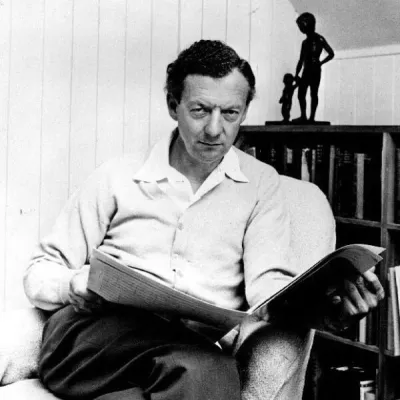
Benjamin Britten
Human Design Chart
Biography
He studied and from age seven and from age 14, composed music that was straightforward and conservatively modern with a dramatic flair. In 1937, then 24 years old, he made his mark outside England with the premiere at the Salzburg Festival of his "Variations on a Theme of Frank Bridge," a work of stunning brilliance.
The son of a dentist, Britten was raised in the seaside town of Lowestoft. He went to boarding school and later fell into the raffish company of W.H. Auden and Christopher Isherwood in the London '30s. According to his letters, the gay writers took him to bath houses and urged him "to decide something about my sexual life." Neither was able to crack his physical reserve, nor was his relationship with the tenor Peter Pears consummated until they reached a hotel in Grand Rapids, Michigan, in June 1939.
For most of Britten's life, homosexual contact between consenting adults was an imprisonable offense. It was during Britten's time in America during World War II that his relationship with Pears deepened to become a nearly 40-year partnership. They were baited by homophobes among their colleagues and taunted by other musicians over their pacifism and socialism. Becoming hyper-sensitive to criticism and paranoid about his privacy, Britten was a timid but deeply ambitious man, fortified in his resolve by the two people who loved him most, his mother and his lover. When his adored and adoring mother died in 1937, he lost "the grandest mother a person could have." It was within weeks that Pears entered his life. It was noted that Pears, a lyric tenor, had a voice "exactly like Britten's mother."
Pears was the active partner, and the one with a roving eye. Britten never wavered in his devotion and was often fearful that his lover may stray, though his love was essentially more emotional than carnal.
The Human Design of Benjamin Britten: Manifesting Generator 6/2
Manifesting Generator 6/2 — Design at a Glance
Benjamin Britten emerged as someone who united a hybrid energy: the constant power of a Generator paired with the lightning-fast impact of a Manifestor. His design suggested that he could draw things into his life by skipping steps and acting quickly. This speed was, however, a double-edged sword. Often, he tended to move too fast and skip important stages, which inevitably led him to return later to make up for what was missed. This could cause frustration as his Non-Self theme precisely lay in this unrest. Additionally, he reacted to numerous impulses simultaneously and started several projects at once. Without strictly adhering to his strategy—namely waiting for a clear inner impulse before acting—his creative enthusiasm quickly faded. Crucial for him was the "testing": Only when his Sacral Center responded with a clear yes should he proceed. Regular checks to see if the projects still received this internal approval were essential. If he followed this strategy and entered into a playful mode, he could draw deep satisfaction from his work. The requirement to focus on one thing until it was completed before moving on to the next did not suit his nature; variety and parallel working were sources of strength for him when applied correctly, not obstacles.
Emotional Authority
Benjamin Britten exhibited a decision-making approach that was characterized by the necessity of temporal distance. His design featured emotional authority, meaning his defined Emotional Center served as the sole inner guiding force – regardless of which other Centers were also defined in his chart. This configuration involved a constant wave motion of feelings: Perception of the world was always colored by current mood, so enthusiasm and rejection often only represented fleeting moments, not ultimate truth.
Quick, spontaneous judgments from this emotional heat would have misled him. Instead, his mechanics required patience and conscious hesitation. Decisions had to "sleep on it" to give intense emotions time to subside. Only when the emotional distance was gained and clarity as well as calmness entered could a well-founded choice be made. This process of maturation was particularly crucial for long-term life decisions, as only then did deeper, more comprehensive insight become accessible, which lay hidden behind initial, often deceptive impressions.
The 6/2 Profile — Role Model / Hermit
Benjamin Britten's design shows a tendency towards experimental learning in early years, followed by a profound phase of isolation and reflection after the thirtieth year of life. As Profile 6/2 – the Role Model or Natural Talent – his energy initially acted like a 3-line: through trial and error he gathered experiences, withdrew when making mistakes, and learned from them. This period served to acquire wisdom through direct confrontation with challenges.
After about thirty years, Line 6 activated. Benjamin Britten then showed a strong desire for withdrawal, metaphorically into a "cave on the mountain." During this time of distance, he intensely reflected upon his earlier experiments. This process was healing and fostered deep self-knowledge. Only when this inner maturity was reached did he re-emerge – now as a wise person whose insights attracted others.
The underlying mechanics connect Gate 14 (Line 6) with themes such as spiritual insight and humility towards material or existential questions. Here, it wasn't about superficial success but understanding divine guidance in life. Simultaneously, Gate 59 (Line 2), which describes shyness and self-erected walls, created psychological barriers that restricted interactions until the right external invitation to intimacy came along. Benjamin Britten could not break down these walls alone; he waited for the appropriate impulse from outside to share his depth. Thus, out of initial reticence later emerged a conscious, wise presence that served as an example to others.
Single Definition — Defined & Open Centers
Benjamin Britten revealed himself as someone whose expressive power was guided by a profound inner authority that did not reside in the mind but rather in an emotional wave. His design was characterized by defined centers: The Sacral Center provided a constant source of vital energy and fertility, while the Solar Plexus Center served as an emotional authority. This meant that true clarity for him could only be achieved through patiently waiting for the movement of emotional waves; impulsivity led to chaos, whereas endurance allowed for deep insights. His defined Throat center acted as a reliable channel to convey these processed emotions and sacral power into the world – not as spontaneous reactions to mental concepts but as an authentic voice of a thought-through inner truth.
At the same time, Benjamin Britten was exposed to several open centers that made him vulnerable to external conditioning. His open Head Center tended to be overwhelmed by mental pressure and others' questions; he could easily get entangled in problems not his own or seek inspiration where none was needed. The open Ajna Center amplified this through a flexible but unstable mental processing, taking on concepts without fixing them as personal truth. Particularly defining was the open G Center: It lacked a fixed identity or direction, reflecting its environment instead. This led to him losing himself in relationships and places when they were not right, trying to adopt borrowed identities for security. The lack of consistent willpower in his open Heart Center made it hard for him to keep promises he had given, attempting to prove his worth through performance which resulted in a cycle of self-doubt. Additionally, his open Root Center absorbed external stress, making him vulnerable to overburdening when unaware of environmental pressure. His path involved navigating these open fields not as personal problems but by using the emotional clarity of Solar Plexus and sacral reactions.
Channels for intimacy and the courage to change.
Benjamin Britten revealed himself as someone whose design had a deep tendency towards merging in relationships coupled with an insatiable drive for new experiences. This configuration created a tension between the need for intimate connection and restless search for change.
The Channel of Union 59-6 connected his sacral life energy directly to his emotional wave. Through Gate of Sexuality (59) and Gate of Friction (6), a powerful, intimate energy emerged that made relationships personal and penetrating. This connection required patience; true intimacy could only develop through waiting for the emotional wave cycle rather than causing confusion with conditioned spontaneity. Britten had a natural availability for closeness which allowed him to quickly penetrate into others' aura and ease confidentiality.
Simultaneously, the Channel of Transience 35-36 drove him constantly to seek novelty. This channel connected his Solar Plexus Center to his Throat Center through Gate of Crisis (36) and Gate of Change (35). He resisted restrictive patterns and actively sought adventures to collect experiential values. Often this resulted in a feeling of instability when new experiences did not meet expectations. However, the emotional depth of this search served collective progress by generating wisdom through lived experience.
Additionally, individual Gates influenced his design: Gate 14 (Power and Direction) as well as Gate 8 (Contribution and Leadership) promoted adept handling of influence. In Solar Plexus, Gate 55 caused extreme mood swings and emotional awakening, while Gate 22 (Openness) in the social field supported calm waiting. Gate 34 (Power and Integration) provided much energy but needed guidance to serve the common good. Further Gates like 16 (Experimentation), 45 (Hierarchy), 62 (Logic/Details) and 56 (Narrative) rounded off his Profile by providing experimental mastery, structural clarity, and the ability for figurative storytelling. Britten lived these mechanisms through balancing intense intimacy with experience-seeking change.
Collective Circuitry — Circuit Signature
Benjamin Britten was marked by a simple, coherent energetic structure. His defined centers – Solar Plexus, Sacral, and Throat – formed one single flowing stream. This connected emotional depth to the ability of directly expressing this inner experience.
The Seeker Circuit worked through the Channel 'Transience', linking the Throat with the Solar Plexus Center. Here it was not about cold logic but emotions and experiences from the past. Britten processed past events in wave-like patterns; each emotional cycle had a clear beginning, middle, and end. These felt insights served to share with the collective to learn together from history. The energy was visual and tended to be inexplicable for pure reason.
Parallel to this, the Archer Circuit worked through the Channel 'Union' between Sacral and Solar Plexus Center. This connection united the life force of the Sacral with the strong, wave-like emotions of the Solar Plexus. It was a primal energy that protected family survival and genetic continuity. Themes like union, care, preservation, and nourishment were central. This small circuit colored his entire design and emphasized the instinctive drive to defend and nurture his kin. Both circuits used the Solar Plexus Center as an emotional core but connected different aspects: on one hand, reflexive meaning-making from the past, on the other hand, timeless, instinctual protective impulses.
Left Angle Cross of Uncertainty 2
Benjamin Britten's design establishes a foundational stance of the open question. He did not present himself as someone who offered pre-fabricated answers or defended dogmatic certainties. Instead, a state of constant searching and questioning characterized his inner orientation. This configuration, known in Human Design as the left cross of uncertainty 2, describes an energetic structure defined by the absence of firm convictions. It is not about weakness or confusion but rather a conscious stance of non-commitment to specific ideologies or truths. Those who carry this configuration remain true to the process of recognition without the pressure to render a final judgment. The strength lies in the ability to shift perspectives and not get locked into one single truth. This created for Benjamin Britten a space where doubt was no obstacle but rather the actual tool of understanding. He lived with uncertainty instead of fighting against it. This attitude allowed him to examine complex relationships from various angles without prematurely committing himself. The energy of this cross acts like an open field that can absorb new information without immediately pressing them into rigid categories. Thus, uncertainty became the driving factor in his development, keeping him flexible and adaptable.
Saturn Return · Uranus Opposition · Chiron Return · 2nd Saturn Return — Life Cycles
Benjamin Britten revealed himself as someone whose life path was structured by clear milestones where inner maturity and outer confirmation converged. His design showed a tendency towards cyclical deepening that condensed into concrete actions.
In 1942, at the age of 29, he returned to Britain. This coincided with his first Saturn Return. During this phase, years of groundwork often condense into a solid result; it is a moment of structuring and strengthening where one redefines or anchors their position. Britten's return marked such a point of clear alignment.
Later, in 1962 at the age of 49, he completed the War Requiem for the new Coventry Cathedral. This coincided with his Chiron Return, a fulfillment cycle or "blossoming period." During this time, one’s incarnation cross unfolds increasingly; if one has lived according to their strategy and authority, meaning and purpose become experiential. It is not healing of old wounds but rather the blossoming of life's task where the essential becomes visible.
In 1970, at age 57, he conducted the premiere performance of Shostakovich’s 14th Symphony outside Russia. This fell on his second Saturn Return. During this phase, there is often a further deepening and confirmation of established structures. Britten's actions at these points show how abstract design mechanics translated into concrete, historically documented steps: structuring, blossoming, and re-anchoring.
Manifesting Generator · Emotional Authority — Synthesis
He was a Manifesting Generator whose life was marked by deep sacral energy (Sacral Center) and the urge for creative expression. The connection to the Throat Center indicated a voice speaking from his inner essence, taking form through interaction with the world – an ongoing translation of bodily sensations into expressive forms. This pattern manifested in a life characterized by impulse-driven creative outbursts, often quickly initiating things (Manifestor aspect), followed by refining and deepening them later on. However, this required time for emotional decisions to mature, creating an internal oscillation between swift action and the need for emotional clarity.
A central paradox lay in the tension between his natural inclination towards initiation (through the manifesting aspect) and the wisdom of responding to sacral impulses (Generator aspect). This led to a life path marked by a zest for experimentation (6/2 Profile), followed by phases of intense reflection and self-discovery. The ability to learn from experiences and pass on this wisdom stood in contrast to a tendency to skip important steps – a cycle of rapid progress and necessary correction that repeated throughout his lifespan, leading to significant outcomes at certain moments (defined event).
2 Defined Channels
Incarnation Cross - Left Angle Cross of Uncertainty 2
Solar Return
The Solar Return shows the moment when the sun returns to its exact birth position - your personal solar year.
Life Cycles
Discover the life cycles with a detailed triple view (birth chart, cycle chart, composite).
Human Design Profile
- Strategy
- To respond - wait for something to respond to
- Authority
- Emotional Authority
- Profile
- 6/2 - Role Model / Hermit
- Definition
- Single Definition
- Incarnation Cross
- Left Angle Cross of Uncertainty 2
- Date of Birth
- 22.11.1913 19:00
- Place of Birth
- Lowestoft, United Kingdom
Frequently Asked Questions
What was Benjamin Britten's Human Design type?
Which Profile did Benjamin Britten have in Human Design?
What Authority did Benjamin Britten have?
What incarnation cross did Benjamin Britten have?
When was Benjamin Britten born?
Discover your own Human Design
Are you also a Manifesting Generator? Find out in a personal reading how to unfold your multi-talents and direct your energy wisely.
More Personalities
Back to overviewAaliyah

Aldair

Alexia

Alizée

Angèle

Angeli
