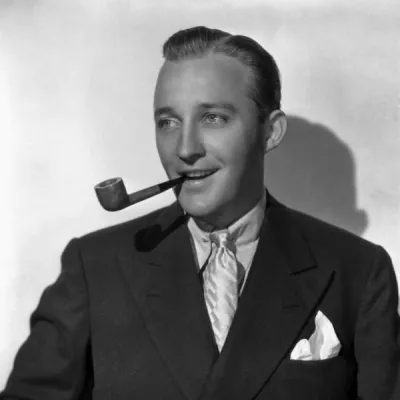
Bing Crosby
Human Design Chart
Biography
Crosby's early career coincided with recording innovations that allowed him to develop an intimate singing style that influenced many male singers who followed, such as Frank Sinatra, Perry Como, Dean Martin, Dick Haymes, Elvis Presley, and John Lennon. Yank magazine said that Crosby was "the person who had done the most for the morale of overseas servicemen" during World War II. In 1948, American polls declared him the "most admired man alive", ahead of Jackie Robinson and Pope Pius XII. In 1948, Music Digest estimated that Crosby's recordings filled more than half of the 80,000 weekly hours allocated to recorded radio music in North America.
Crosby won the Academy Award for Best Actor for his performance in Going My Way (1944) and was nominated for its sequel, The Bells of St. Mary's (1945), opposite Ingrid Bergman, becoming the first of six actors to be nominated twice for playing the same character. Crosby was the number one box office attraction for five consecutive years from 1944 to 1948.
Bing Crosby as a Generator 6/2 in Human Design
Generator 6/2 — Design at a Glance
Bing Crosby was someone who effectively utilized his immense endurance and strength primarily when responding to external impulses. His Generator design endowed him with abundant sacral energy, making him extremely strong and enduring – but only under the condition that he had energy for his task. This energy did not release through spontaneous initiatives but rather by his inner self reacting to signals from life. Therefore, the motto of his design was clear: Not initiate, but react.
His most successful strategy involved waiting for a signal and then, when his sacral center internally said "Yes! Let's get started!", responding with concrete action. Living in harmony with this principle rewarded him with a deep sense of fulfillment; no one could stop him then. However, if he went against this design – such as by doing things that did not interest him and only drained his energy – he tended towards burnout or persistent frustration. Also, holding back from his heart project despite still wanting to continue working was a significant stumbling block. Crosby thus had the potential to bring things into his life, but this happened not through sheer willpower alone, but by reacting intuitively to what truly spoke to him.
Sacral Authority
Bing Crosby lived as a Generator whose decision-making was marked by Sacral Authority. This inner voice did not manifest in his head but rather as an immediate physical reaction to external stimuli – a spontaneous grunt or surge of energy signaled interest and vitality. With his open Emotional Center, he could clearly hear this gut feeling without being overshadowed by mood swings. This simplified his process: He followed what made him vital and alive instead of logically weighing options.
Additionally, his activated Spleen Center acted as a supportive instance. It connected with the sacral authority and enabled quick, spontaneous reactions as well as direct access to instinctive perception. Bing Crosby could thus reliably guide himself by this physical sense of wellbeing. When his sacral motor kicked in, he had inexhaustible energy and tackled tasks with great enthusiasm. He moved through life with joy and contentment, immersed in his activities without rigid purposefulness. This configuration described a person born to move intuitively and bring energy where it naturally flowed.
The 6/2 Profile — Role Model / Hermit
In his youth, Bing Crosby appeared as someone who learned through intense experimentation and diverse life experiences. His design, marked by the Profile Line 6/2, set a tendency towards trial and error; withdrawals after failures served as driving principles before turning thirty. This phase was characterized by a quest for mutative knowledge that should enable new life directions. Simultaneously, there was a risk of not recognizing impulses for change in time or missing important opportunities due to irrational suspicion and uncertainty about his own development. Depression often accompanied this period as an expression of inner unrest.
Around thirty years old, the sixth line of his profile activated metaphorically. Bing Crosby withdrew into a 'cave' to reflect on his earlier experiments with distance. This phase of intense reflection served for healing and deep self-awareness. The previously selective attitude, which could be marked by prejudices and hindered access for others, transformed. Through listening as a collective process, he gathered experiences that led to greater openness. From this seclusion, he emerged as a wise person sharing his life wisdoms. Others recognized this maturity and sought his advice to learn from his ability for deep introspection. His journey illustrated the transition from the impulsive experimentation of young years to shared wisdom in later life.
Split Definition — Defined & Open Centers
Bing Crosby revealed himself as someone with a deeply rooted inner direction and clear self-awareness. His defined G Center gave him a constant identity; he knew who he was and where his life was leading, without needing to prove it to others. This internal security allowed him to bring others along on his journey or simply let them go if their paths did not align.
His energy source lay in reaction rather than initiative. The defined Sacral Center generated a constant vital force that was only available when he responded to an invitation or question. By waiting and listening for the inner 'yes' or 'no', he avoided frustration and exhaustion. He did not act impulsively from the mind but let himself be guided by this sacral response, which gave him sustained endurance in his endeavors.
This energy flowed through his defined Throat Center, serving as a pivot point for his communication. His voice and actions were not arbitrary expressions of the mind but carried the truth of his inner structure. He spoke from a reliable source, giving him clear and honest expression.
At the same time, he was vulnerable to external influences in areas without personal definition. The open Head Center made it easy for him to be distracted by foreign questions or mental confusion; he tended to engage with problems that were not his own rather than trusting his inner compass. His open Ajna Center made his mind flexible but also vulnerable to conditioning from other opinions and concepts. He had to learn to see thoughts as transient information, rather than accepting them as personal truth.
The open Heart Center meant that he was not designed to give promises or prove his worth through willpower. Instead, his open Solar Plexus absorbed the emotions of his surroundings and amplified them. He acted like a barometer for the emotional climate around him, which could lead to experiencing foreign moods as his own if he did not maintain enough distance.
Channels for change, reflection and intuitive clarity.
Bing Crosby revealed himself as someone carrying deeply rooted impulses for evolutionary change. The Channel of Mutation 60-3 connected his Root Center with the Sacral and generated a pulsating energy between limitation (Gate 60) and order (Gate 3). This configuration brought inner tension and melancholy when no new idea was immediately visible. Crosby had to learn not to rationalize this moodiness but patiently wait for the next impulse from the sacral to bring innovations into the world.
Parallel to this, he gathered experiences with the attitude of the Lost Son. The Channel 13-33 connected his G Center (Gate 13) with his Throat Center (Gate 33). Here he listened, stored secrets and withdrew to reflect on memories before passing them on as wisdom. This gave him the ability to transform life stories into collective lessons by showing patience and waiting for the magic of completion rather than rushing to conclusions.
Spontaneous insights often broke through this reflection suddenly. The Channel of Brainwave 57-20 channeled intuitive truths from his Spleen Center (Gate 57) directly to his Throat Center (Gate 20). This allowed him to speak in the present and encourage others to use their survival intelligence. His verbal outbursts hit the core when he trusted the timing of his intuition.
Additionally, other gates were at work: Gate 24 sought inner silence through mental mutation; Gate 44 transformed relationships without conditions; Gate 7 projected future leadership patterns; Gate 48 recognized deep patterns but led to frustration if not implemented. Gate 45 gathered tribal energy, while Gate 19 searched for secure resources and partnerships, with Gate 15 adapting to collective rhythms.
Individual Circuitry — Circuit Signature
Bing Crosby revealed himself as someone who shaped his unique identity through creative impulses and deviations from the norm. His design featured a Shared Definition: Two energetic groups existed parallel without directly merging. One group connected Sacral with Root Center; the other linked Identity (G Center), Spleen, and Throat Center. This separation meant that his life energy did not flow as one stream but consisted of separate fields.
In the Knowledge Circuit, two channels activated specific forces. The Channel of Flash of Insight connected Throat to Spleen Center, promoting innovative, acoustically marked ideas. Parallel to this, the Channel of Mutation between Sacral and Root Center supported stability through change. However, these two parts were not interconnected; they formed separate energetic islands within this circuit.
The Meaning Circuit added another dynamic to Bing Crosby. Here, the Channel 'The Lost Son' connected Throat with Identity Center. This created a direct bridge between his emotional wave dynamics and self-expression. It was about reflecting past experiences and carrying these insights into the collective through voice or expression. The energy of this circuit was cyclical and visually marked, focusing on sharing felt truths. Together, these separate but clear connections formed a profile that linked creativity with deep, wavelike emotional processing without all areas overlapping.
Left Angle Cross of Incarnation 1
Bing Crosby had the Left Incarnation Cross 1 in his Design. This configuration established a specific energetic alignment that manifested as a deep connection with the material and physical aspects of life. In Human-Design, this cross marks the beginning of a large cyclical phase often understood as a period of foundation or structure-building. For Crosby, it meant a natural inclination to immerse himself in concrete reality and create something enduring.
The energy of this circle is not abstract or purely mental but tangible and earth-bound. It supports the creation of foundations that can have an impact beyond the individual life span. Crosby lived this tendency through strong engagement with the visible and tangible. It was less about theoretical concepts than about implementing them into something tangible that endures. This incarnation type promoted a sense of responsibility towards the physical environment and one's creations.
Without a specific event in raw content, the description remains on this structural level: Bing Crosby was bound by this cross to a process laying the groundwork for future developments. His energy served to pour ideas into real forms while ensuring a certain stability and durability. This shaped his way of interacting with his environment – always looking towards what endures and upon which others can rely.
Saturn Return · Uranus Opposition · Chiron Return · 2nd Saturn Return — Life Cycles
Bing Crosby exhibited a life rhythm marked by clear cycles of consolidation and breakthroughs. His Design indicated a tendency to set decisive milestones in specific age phases, profoundly shaping his professional identity.
In 1930, at the age of 27, he began his film career with short comedy films. This coincided exactly with his first Saturn Return. In Human-Design mechanics, this cycle often marks the transition from an experimental phase to a sustainable structure. Years of groundwork condensed here into a concrete and visible result: entering cinema as a firm foundation for his later career.
Later, in 1942 at age 39, he won an Oscar for Best Original Song with “White Christmas.” This success coincided with the Uranus Opposition. This configuration stands for sudden changes and breaking old patterns. Instead of merely conserving, this cycle allowed an innovative leap that redefined and expanded his established profile.
The peak of this development occurred in 1951 when he received another Oscar at age 48 for “In the Cool, Cool, Cool of the Evening.” This fell during his Chiron Return. This cycle is not a healing process emotionally but a phase of fulfillment and bloom. Here it was evident that life had been lived according to his inner strategy: The Incarnation Cross unfolded increasingly, and meaning as well as purpose became experiential and confirmed through repeated success.
Generator · Sacral Authority — Synthesis
Bing Crosby was a Generator whose life was marked by a deep connection to sacral energy. This power source fueled an inexhaustible endurance and joy in work as long as it aligned with his inner reaction (sacral authority). The profile of role model indicates that he initially learned through experimentation and life experience before withdrawing to reflect on the gained insights. From this distance, he could finally impart wisdom and inspire others – a pattern evident in documented successes (Oscar awards) after having gathered experiences (start of film career). The Channel of Mutation (3-60) underscored his ability for transformation and breaking conventional paths.
A central paradox lay in the combination of this generative power with the knowledge circuit. While sacral energy propelled him to act here and now and find joy in activity itself, the circuit demanded constant innovation and creation of new knowledge. This led to a tension between the pulsating, present format of the Generator and the need for creative unfolding and transformation – an interplay of melancholy and acoustics that shaped his unique identity.
3 Defined Channels
Incarnation Cross - Left Angle Cross of Incarnation 1
Solar Return
The Solar Return shows the moment when the sun returns to its exact birth position - your personal solar year.
Life Cycles
Discover the life cycles with a detailed triple view (birth chart, cycle chart, composite).
Human Design Profile
- Type
- Generator
- Strategy
- To respond - wait for something to respond to
- Authority
- Sacral Authority
- Profile
- 6/2 - Role Model / Hermit
- Definition
- Split Definition
- Incarnation Cross
- Left Angle Cross of Incarnation 1
- Date of Birth
- 03.05.1903 16:00
- Place of Birth
- Tacoma, Washington, United States
Frequently Asked Questions
What was Bing Crosby's Human Design type?
What profile did Bing Crosby have?
Which authority did Bing Crosby possess?
What incarnation cross did Bing Crosby have?
When was Bing Crosby born?
Discover your own Human Design
Are you also a Generator? Find out in a personal reading how to use your sacral energy correctly and discover deep satisfaction.
More Personalities
Back to overviewAaliyah

Alexia

Alizée

Angèle

Anne-Marie

Arcángel