
Blowfly
Human Design Chart
Biography
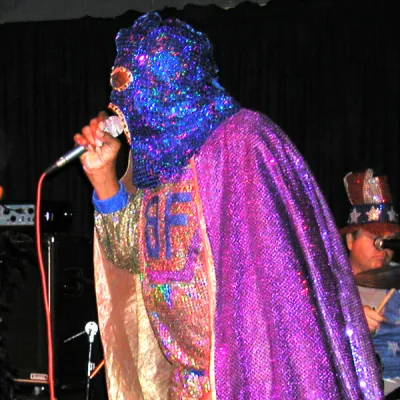
Reid first wrote sexually explicit versions of hit songs for fun but only performed them for his friends at parties or in the studio. In 1971, he along with a band of studio musicians, recorded a whole album of these songs under the name Blowfly. The album The Weird World of Blowfly features Reid dressed as a low-rent supervillain on its cover. Blowfly continued to perform in bizarre costumes as his Blowfly character and record sexually explicit albums throughout the 1970s and 1980s.
Reid claimed to be one of the first artists to perform in a mask, and transitioned from a "tuxedo like Dracula" or a "buttless" Clint Eastwood inspired outfit, to the spandex suits that he became known for in response to public demand. The albums were widely popular as "party records". He recorded the explicit version of his song "Rapp Dirty" (a.k.a. "Blowfly's Rapp") in 1980.
Clarence "Blowfly" Reid died on 17 January 2016 from cancer and multiple organ failure at the hospice facility in Lauderdale Lakes, Florida, aged 76. His daughter is former WNBA player Tracy Reid.
What does Manifesting Generator 1/3 mean for Blowfly?
Manifesting Generator 1/3 — Design at a Glance
Blowfly lived as a Manifesting Generator, a hybrid type that combines constant sacral energy with the ability to skip steps and achieve results quickly. This design fostered an attitude that included both immense creative power and the risk of frustration through rushed action or overloading oneself with parallel projects. Although Blowfly was among Generators with a defined Sacral Center, providing him with a steady energy source, his active connection between Motor Centers and Throat Center gave him additional Manifestor traits.
For Blowfly, it was crucial to follow the strategy of reacting to impulses rather than initiating them himself. Only through this filtering and waiting for inner approval - the sacral 'yes' - could he effectively utilize his energy. Without this protection, his design tended to skip important steps or start several projects simultaneously, often leading to frustration when strategy and authority did not align.
However, if Blowfly reacted correctly and regularly checked whether his authority still supported the paths he had begun, he reached a productive Play Mode. In this state, he drew deep satisfaction from his work. For him, the linear advice of finishing one thing at a time was counterproductive; instead, his energy flourished in variety and parallel pursuit of various interests as long as inner resonance remained.
Sacral Authority
Blowfly's decision-making did not occur through intellectual deliberation but rather through direct physical resonance. As a Generator, he possessed Sacral Authority, a configuration where strategy and inner guidance are identical: waiting for the inner impulse. His chart showed an open Emotional Center, making this sacral orientation the only valid source for yes or no decisions.
Instead of planning, Blowfly reacted to external stimuli with an immediate gut feeling. This manifested as physical bursts of energy or audible body sounds like grunting, humming, or a nodding 'Hmm'. As long as this response came, he felt vital and alive. His sacral motor kicked in, providing him with seemingly inexhaustible energy. He tackled his tasks with great enthusiasm and immersed himself entirely in his activities. For him, the act itself was the purpose; joy and satisfaction arose without external goal-setting or need for justification.
This mechanism greatly simplified his process as he did not require complex deliberations. The direct spontaneity of his body served as a reliable compass. Blowfly lived with the awareness of moving through life with joy, driven by inner confirmation of his own energy, not from external expectations or logical constructs. His authority lay solely in this physical response, which protected him from misinvestment and allowed him to thrive where his nature truly resonated.
The 1/3 Profile — Investigator / Martyr
Blowfly's design inclined towards a dual life task: theoretical exploration paired with practical experimentation. As a person with the Profile 1/3, the Explorer and Experimenter, he lived in a cyclical process of learning and doing. His inner self was marked by the tension field between the need for security before action and the urge to actively test.
Line 1, influenced by Gate 30, conveyed him calmness and the drive towards inner clarity. This energy emphasized the importance of safety and peace regardless of external circumstances. Blowfly often sought theoretical completeness before acting. Simultaneously, Line 3, represented by Gate 14, drove him to material power and individuality. Here it was about trial and error: Blowfly had to find ways to transform energy into material goods and learn from mistakes where he should direct his talent.
Authenticity through experience was central for him. He did not accept knowledge blindly but worked it out himself. His judgment was considered trustworthy as he tested things both theoretically and practically on heart and gut. Through selfless service for others, Blowfly preserved his individuality and integrated mistakes into his growth. His lifestyle resembled that of a scientist and adventurer who found a grounded, calm attitude through personal experience.
Split Definition — Defined & Open Centers
Blowfly's design established a foundation of constant, reliable energy and clear identity. With his defined Sacral Center, he had an immense source of vital energy that was activated not through initiation but through reaction to external impulses. This energy served as the motor for endurance and satisfaction, provided there was an external impulse to react to. This was supported by his defined Heart Center, which gave him willpower and control over his resources; he tended to make promises and keep them, bolstering his self-esteem.
His inner compass was formed by his defined G Center. It conveyed a firm sense of self-identity and direction or mission to Blowfly; intuitively, he knew who he was and where he was going without having to control it. This internal anchor flowed directly into his defined Throat Center, making his communication steady and authentic; he spoke from his identity rather than fleeting thoughts or emotions. Completing this stable system was his defined Spleen Center, which gave him a momentary intuitive perception of health and well-being in the present moment. His intuition was a reliable protective mechanism that made immediate judgments about what was useful.
In contrast to this inner stability stood the open centers as areas of receptivity. His open Head Center made him vulnerable to mental pressure and the need to find answers to questions that were not his own concern; he tended to be influenced by others' doubts or confusion rather than observing calmly. Similarly, his open Ajna Center allowed him to take on concepts and opinions from his environment but risked identifying with foreign theories or trying to secure himself unnecessarily.
His open Solar Plexus Center absorbed emotions from the surroundings. Blowfly could learn to distinguish between his own feelings and those of others; otherwise, he might personalize emotional waves and appear emotionally unstable. Finally, his open Root Center took on stress and adrenalized pressure. Instead of misunderstanding this as personal drive, its mechanics were designed either to use such external pressure or withdraw from it to avoid burnout. The challenge was to understand these open windows not as deficits but as mirrors reflecting the environment while relying on his defined inner resources.
Channel 8-1: Inspiration — Channels & Gates
Blowfly's presence and authentic demeanor influenced others more through his mere existence than through explanatory words, stemming from Channel of Inspiration 1-8. This channel connects G Center to Throat Center via Gate of Self-expression (1) and Gate of Contribution (8). It challenged him to show himself individually as an example for others. By living his unique identity openly, he inspired others to express their creativity; it was a co-creation between his dedication to individuality and recognition from the environment.
This effect was amplified by mutative energies. The Beat Channel 14-2 connected Sacral Center with G Center via Gate of Power Competence (14) and Gate of Higher Knowledge (2). This configuration provided resources for forcing innovative directions; Blowfly could carve out new paths through trust in his sacral reaction without needing to foresee the exact outcome. These channels' energy enabled him to instigate changes in the collective simply by reacting openly to life.
Furthermore, Blowfly had an entrepreneurial instinct via Channel of Devotion 44-26. This connected Spleen Center and Heart Center through Gate of Awareness (44) and Gate of Egoist (26). It gave him the ability to intuitively recognize what the tribe or market needed before it was consciously known; he could persuasively communicate products or ideas driven by deep tribal intelligence. His approach was direct: identifying needs and offering solutions while wanting appropriate compensation for his work's outcome. This combination of inspirational role-modeling, mutative direction-finding, and instinctive salesmanship shaped how he acted in the world and effectively utilized resources.
Individual Circuitry — Circuit Signature
Blowfly's design set a tension between individual expression discovery and collective resource security. As someone with split definition, his energy field consisted of two separate parallel power blocks that did not flow directly into each other.
The first block formed the Knowledge Circuit where Throat Center, Identity Center, and Sacral Center combined to create pulsing creativity through Channel of Inspiration (Gates 1-8) and Beat Channel (Gates 2-14). This configuration promoted transformation through individual innovation with emotional waves as driving force.
The second block included the Ego Circuit with Heart and Spleen Centers. Through Channel of Devotion (Gates 26-44), it influenced cooperation and resource management within the tribe; this area was conservative and tradition-bound without direct connection to Sacral's constant life energy. Instead, this part required rhythm changes: active support phases had to be balanced by rest pauses to maintain necessary reserves for giving and taking.
The mechanics showed a switch between Knowledge Circuit's acoustically oriented present-moment energy and Ego Circuit's timeless probing stability. Thus, Blowfly moved between the drive for unique identity and the necessity of tribe-oriented security.
Right Angle Cross of Contagion 1
Blowfly's design showed a tendency towards dynamic and often unconscious transmission of energies and emotional states. He was someone whose presence was marked by the ability to influence others or be 'infected' himself. This process of energy exchange was deeply rooted in his interaction with the environment.
This configuration is known in Human Design as the right cross of infection 1. It describes not a deliberate manipulation, but a natural life dynamic: energy flowed through him, was absorbed and passed on. Blowfly was part of an ongoing stream where interpersonal dynamics were less determined by rational agreements than by this immediate, almost physical transmission of moods and ideas.
For his design, this kind of 'infection' or being 'infected' was central. It was a mechanism that defined his relationships and his place in the group. He acted as a catalyst for emotional waves without having to consciously control them. The emphasis was on how this energy flowed – not as an isolated event but as a continuous background process of his existence. Blowfly lived in this space of exchange, where the boundary between what he gave and what he received was fluid. His presence triggered reactions that were less based on words than on the pure presence of this energetic transmission.
Saturn Return · Uranus Opposition · Chiron Return · 2nd Saturn Return — Life Cycles
Blowfly's design showed a tendency towards radical breaks with established structures to express an authentic, often provocative truth. This Uranus opposition cycle marked turning points where conventions felt oppressive and had to be replaced by individual, unconventional forms of expression. It was not just rebellion but the necessity to shatter old identities or roles when they contradicted inner integrity.
In 1980, at age 41, Blowfly recorded the explicit version of his song 'Rapp Dirty'. This event served as concrete evidence for this mechanism: The Uranus influence promoted a sudden breakthrough from conventional patterns. The recording represented a moment of liberation where societal taboos were consciously broken to achieve raw, unfiltered expression power. It was not a random step but the direct result of a cycle aimed at destruction and renewal. Blowfly used this pressure to push his own voice through against established norms. Music became the vehicle for this radical self-assertion, which was only possible because his design dictated that breaking with the known was a necessary path to true expression.
Manifesting Generator · Sacral Authority — Synthesis
Blowfly lived a life marked by an inner dynamic between creative energy and the need for recognition. His defined Throat Knot, connected with the G Center and Sacral Center, indicates a strong ability to express his inner truth while tapping into material resources (Channel 14-2). This combination, reinforced by the power of the Knowledge Circuit, drove him constantly to create new things and inspire others – a process deeply rooted in his identity. The defined sacral authority confirmed this impulse as long as he responded to his inner guidance rather than initiating it himself. His profile as Researcher/Experimentor (1/3) underscored this tendency towards learning through trial and error, sharing knowledge with others.
Despite this creative power and the ability for self-actualization, Blowfly seemed plagued by an internal paradox: the desire for individuality versus the need for validation. The open Solar Plexus and Root Center made him receptive to other people's emotions and vulnerable to external pressure, while the defined Ego Circuit signaled a strong desire for recognition. This tension between authentic expression of his inner direction and seeking validation from others created a field where he was both innovative and influenced by the expectations of his environment.
3 Defined Channels
Incarnation Cross - Right Angle Cross of Contagion 1
Solar Return
The Solar Return shows the moment when the sun returns to its exact birth position - your personal solar year.
Life Cycles
Discover the life cycles with a detailed triple view (birth chart, cycle chart, composite).
Human Design Profile
- Strategy
- To respond - wait for something to respond to
- Authority
- Sacral Authority
- Profile
- 1/3 - Investigator / Martyr
- Definition
- Split Definition
- Incarnation Cross
- Right Angle Cross of Contagion 1
- Date of Birth
- 14.02.1939 12:00
- Place of Birth
- Cochran, GA, United States
Frequently Asked Questions
What was Blowfly's Human Design type?
What Profile did Blowfly have in Human Design?
What Authority did Blowfly have?
What incarnation cross did Blowfly have?
When was Blowfly born?
Discover your own Human Design
Are you also a Manifesting Generator? Find out in a personal reading how to unfold your multi-talents and direct your energy wisely.
More Personalities
Back to overviewAaliyah

Aldair

Alexia

Alizée

Angèle

Angeli
