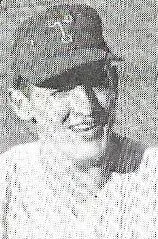
Bob Barton
Human Design Chart
Biography
Barton made his Major League debut at the age of 22 on September 17, 1965, in a 9–1 Giants loss to the Milwaukee Braves at County Stadium, entering the game in the seventh inning, replacing catcher Jack Hiatt. He batted once, going 0–1 with a foulout. His first hit came in his next at-bat on September 28 in a 9–1 loss to the St. Louis Cardinals at San Francisco's Candlestick Park. Pinch-hitting for Baseball Hall of Famer Warren Spahn in the ninth inning, he singled off Larry Jaster.
Barton was primarily a backup catcher, playing behind Tom Haller with the Giants and Baseball Hall of Famer Johnny Bench with the Reds. His best statistical year as a hitter was as a starter for the 1971 Padres; in 121 games, he hit .250 with five home runs and 23 runs batted in along with 17 doubles. On defense, in 1971 he led National League catchers in runners caught stealing (42), percentage of runners caught stealing (51.2%) and errors committed (15) and was second in assists (67).
Bob Barton as a Manifesting Generator 6/2 in Human Design
Manifesting Generator 6/2 — Design at a Glance
Bob Barton was someone who could act quickly and often skipped conventional steps. His design as an Manifesting Generator combined the constant energy of a Generator with the direct action of a Manifestor. This hybrid nature allowed him to draw things rapidly into his life but carried the risk of missing important phases due to haste, forcing him to backtrack and catch up – a potential source of frustration.
His path to satisfaction lay not in initiating actions but in responding to external impulses. Only when he responded to life and his sacral center gave a clear “yes” could his speed be constructive. Without this inner consent, Bob Barton tended to start several projects simultaneously, leading to overextension if there was no resonance.
In the correct flow, however, this design allowed him to operate in “play mode.” Here, parallel work was not an obstacle but a source of deeper satisfaction. The requirement to complete one thing before starting another did not fit his nature; instead, he gained creative power through variety and enjoyment of the process itself, as long as he had responded to his inner resonance.
Emotional Authority
Bob Barton showed himself to be someone who needed conscious time for important decisions to find internal clarity. His design forbade him from immediately following spontaneous impulses; instead, a phase of detachment was necessary before action could take place. This stance resulted from his emotional authority, located in the defined Solar Plexus Center. In Human Design mechanics: If this center is colored, it is always the decisive inner instance, regardless of other definitions in the chart.
Bob Barton experienced characteristic emotional waves, a permanent up and down of his feelings. The world appeared to him filtered through the lens of current mood. What was exciting at one moment could be negative the next. His immediate feeling was only a snapshot, not yet his deeper truth. Quick decisions based on this fleeting emotion often had negative consequences.
Therefore, his process required patience and conscious “sleeping over” of decisions. Bob Barton took time for intense feelings to subside. Only with increasing distance did he gain emotional detachment. Then calmness set in and the necessary clarity emerged. This mechanism was particularly central for long-term life decisions, as only then could true direction be recognized, free from distortion by transient moods.
The 6/2 Profile — Role Model / Hermit
Bob Barton's design established a clear development line from experimental action to reflective wisdom. In his youth, he primarily acted through the energy of the third line, which pushed him into a life full of trial and error. He accumulated numerous personal experiences, with retreats after mistakes being the driving principle. This phase served to build a broad base of life experience, often characterized by superficial interactions or conflicts resulting from lack of inner comparability.
After about thirty years, this dynamic fundamentally changed through the activation of the sixth line. Bob Barton metaphorically retreated into a “cave” to look back at his earlier experiments with great distance. This period of intense introspection was also one of healing and deep self-awareness. He sought absolute security and alignment between action and speech before re-emerging.
From this retreat, he emerged as a wise person who could impart profound insights to others. His ability for spontaneous adaptation and projection of new forms now transformed into tested leadership competence. Others sought him out to partake in his life wisdom and learn the art of deep introspection. His path demonstrated how early uncertainty and experimental enthusiasm can transition through detached reflection into authentic authority and role model function.
Single Definition — Defined & Open Centers
Bob Barton revealed himself as someone whose energy source was deeply rooted in his body: his defined Sacral Center served as a constant motor. His strength became effective when he waited and responded to inquiries; initiatives without prior questions led to exhaustion. This sacral response connected with his defined Throat Center, which shaped his voice and actions. He did not speak out of impulsive drive but transmuted information into lasting effect if the energy from the Sacral approved.
His defined Solar Plexus Center served as inner authority. Bob Barton learned to trust the emotional wave and make decisions only after experiencing emotions fully. This gave him depth and sensitivity, rather than impulsive reactions. Complementing this was his defined Spleen Center, which provided spontaneous intuition in the moment – an instinctive knowledge about health and safety that he used without rational analysis.
At the same time, Bob Barton was exposed to open centers that inclined him towards reflecting his environment. His open G Center meant no fixed identity; he adapted to the right place and people rather than pursuing a rigid direction. The open Heart Center made him vulnerable to pressure to prove his worth or make promises – a pattern he resolved through accepting his limits. The open mental centers (Head and Ajna) tended to interpret foreign questions as personal necessities, causing confusion if he did not rely on his authority. Finally, his open Root Center absorbed external stress; Bob Barton had to learn to distinguish this adrenalized pressure from the environment and protect himself from burnout by consciously recognizing its origin.
Channels for intimacy, care and emotional change.
Bob Barton was characterized by an energetic presence aimed at leadership and direct transmission. His Sun in Gate 31 drove this dynamic: it was pure energy conduction, where he transferred power onto others to achieve effect. This driving energy flowed through three tribal channels that structured his interactions.
The Channel of Union 59-6 connected sexual creativity with emotional friction. He sought intimacy as powerful quantum energy between the Sacral and Solar Plexus Centers. This connection required patience; only by waiting for the emotional wave did clarity arise about whether a relationship was fruitful or not.
Parallel to this, the Channel of Preservation 27-50 worked. It linked the care of the Sacral Center with the traditional values of the Spleen. Bob Barton acted as a provider who took responsibility for the tribe – be it through caring for the weak or defending shared laws. His aura attracted trust, yet he had to learn to give only when his own energy was sufficient and others explicitly asked.
The Channel of Transience 35-36 drove him towards experience-seeking. Through the Gate of Transformation in the Throat Center and the Gate of Crisis in the Solar Plexus, he sought newness, often provoking crises that brought movement to rigid patterns. This emotional manifestation served collective learning through direct experience.
Additionally, Gates like 41 (Evolution), 24 (Inner Silence) and 44 (Transformation) worked in the background. They promoted awareness of changes and the ability to learn from cellular memory. Bob Barton's design thus combined leading with nurturing and experiencing, always waiting for his inner authority to correctly apply these energies.
Tribal Circuitry — Circuit Signature
Bob Barton's design showed a tendency to emotionally process past experiences and share these insights with others. This did not happen through cool logic but through wave-like emotional currents originating from the past. The Meaning-Finding Circuit connected his Throat Center with his Solar Plexus Center in him. This connection allowed for expressing felt truths and emotional cycles – which have a clear beginning, middle, and end – to the collective. It was about learning from the past and making these lessons communal.
Parallel to this, a strong, instinctive power of the Protector Circuit worked strongly. Here, the Sacral Center, Solar Plexus Center, and Spleen Center were directly connected. This configuration created an ancient focus on protecting genetics and family. The energy flowed between life force (Sacral), emotions (Solar Plexus), and primal instinct (Spleen). It involved themes like pairing, care, nutrition, and preservation. Bob Barton revealed himself as someone whose actions were marked by this deep need to protect and nourish his line. Both circuits shaped his essence: on one hand, the emotional sharing of past experiences, on the other, the instinctive protection of life and family. These forces did not exist in isolation but as a cohesive unit within his simple definition, where centers of all four areas were energetically connected through channels.
Left Angle Cross of the Alpha 1
Bob Barton carried the design of the left cross of Alpha 1. This configuration was characterized by a deep, often unspoken connection to spiritual or esoteric currents that he not only studied but actively passed on. His chart indicated a role in which he served as a channel to make complex metaphysical ideas accessible to a broader audience. He lived with a fundamental curiosity about the hidden and always sought out the hidden connections behind visible phenomena. This energy drove him to accumulate knowledge, but also to shape it into forms that others could understand and apply. His path was marked by the task of building bridges between abstract spirituality and practical life. Bob Barton emerged as someone who conveyed this information with a certain authority without appearing dogmatic. His presence often seemed calm and thoughtful, creating space for deeper insights. He used his natural talents to support others in their personal development by helping them discover their own inner truths. This process was central; it wasn't about conveying doctrines but sharing insights that contributed to self-discovery. His influence lay in simplifying complex connections so they could be applied in everyday life. Bob Barton lived this role consistently and remained true to this task until the end of his life.
Saturn Return · Uranus Opposition · Chiron Return · 2nd Saturn Return — Life Cycles
Bob Barton showed himself in 1971, at age 30, during his best statistical season as a batter for the Padres and led National-League catchers in several categories. For his design, this was a typical moment of the first Saturn Return: a phase of structuring and maturation where years of groundwork condensed into a solid result. This cycle often marks the transition from experimental potential to defined, sustainable reality. Bob Barton took responsibility for his abilities here; previous uncertainty gave way to clear, measurable performance. The mechanics of this point favor making inner competencies visible and establishing them in concrete form. It was no coincidence that at exactly this age his skills found their greatest recognition – the Saturn Return acts like a litmus test showing what truly stands up. Bob Barton used this energy to solidify his position and clearly define his role on the team. The structure he built was not just short-term success but a foundation for future developments. His design suggested that this moment was crucial in how he later dealt with challenges: through discipline and focus. Recognition in statistics confirmed him that his path was right. It wasn't just about numbers, but confirmation of his own identity as a player. Bob Barton lived this phase intensively; it shaped his self-understanding sustainably.
Manifesting Generator · Emotional Authority — Synthesis
Bob Barton's life was marked by a deep inner dynamic between action and reaction. As an Manifesting Generator, he possessed the ability to quickly initiate things (Throat Center), yet his defined Sacral Center demanded that he react to life rather than be proactive. This combination led to a lifestyle where energy was present but only properly channeled through a sacral response – a constant balancing act between the urge for quick implementation and waiting for confirmation from the gut. The connection of emotional authority (Solar Plexus) strengthened this process by making decisions impossible in the moment, but only after a phase of inner clarification.
A central paradox in Bob Barton's design lay in the tension between his need for experience and his ability for deep emotional processing. The Channel of Transience (35-36) drove him to seek new things while an open Heart Center suggested a constant search for validation and identity. This dynamic likely led to a life full of intense experiences, which could only be truly understood and integrated through the emotional wave of the Solar Plexus – a dance between the urge for change and the necessity to digest these changes internally.
3 Defined Channels
Incarnation Cross - Left Angle Cross of the Alpha 1
Solar Return
The Solar Return shows the moment when the sun returns to its exact birth position - your personal solar year.
Life Cycles
Discover the life cycles with a detailed triple view (birth chart, cycle chart, composite).
Human Design Profile
- Strategy
- To respond - wait for something to respond to
- Authority
- Emotional Authority
- Profile
- 6/2 - Role Model / Hermit
- Definition
- Single Definition
- Incarnation Cross
- Left Angle Cross of the Alpha 1
- Date of Birth
- 30.07.1941 16:45
- Place of Birth
- Norwood, Ohio, United States
Frequently Asked Questions
What was Bob Barton's Human Design type?
What profile did Bob Barton have in Human Design?
Which authority guided Bob Barton's decisions?
What incarnation cross did Bob Barton have?
When was Bob Barton born?
Discover your own Human Design
Are you also a Manifesting Generator? Find out in a personal reading how to unfold your multi-talents and direct your energy wisely.
More Personalities
Back to overviewAldair

Alizée

Angeli

Arletty

Artus
Balthus