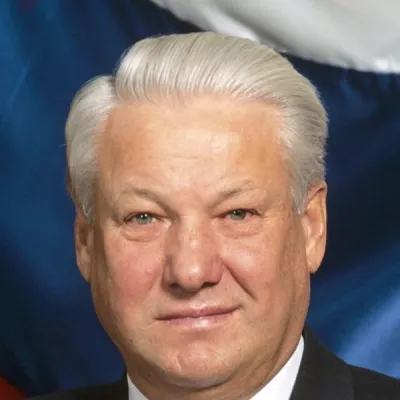
Boris Yeltsin
Human Design Chart
Biography
Boris Yeltsin as a Generator 5/1 in Human Design
Generator 5/1 — Design at a Glance
Boris Yeltsin's design indicated a tendency not to move through self-initiative but rather to respond to what was presented from the outside. His Aura type is that of a Generator: people with this constitution have enduring, consistent work energy, comparable to a working horse that is extremely resilient as long as it has real energy for a task. This power did not unfold in him through active going and leading, but by responding to signals from his life and then acting with full force when an inner yes was felt. Two pitfalls were set up in this configuration: constant action without genuine enjoyment, which exhausted his energy, and holding back on something he actually wanted to work on with strength. If he remained in contact with what his Sacral Center truly engaged with, he could hardly be stopped and experienced deep fulfillment. Acting instead constantly out of self-motivation rather than responding led more often to frustration or a feeling of lacking energy - a basic tension characteristic of his design.
Sacral Authority
Boris Yeltsin's design suggested decision-making that did not take place through weighing in the head but through a physical reaction: he carried sacral authority, supported by the defined Sacral Center. This form of inner authority was only open to a Generator - the sole type whose strategy could also be inner authority, which simplified his decision-making process significantly. A prerequisite for this was an open Emotional Center: there was no waiting period for clarity but rather an immediate bodily response to what was presented from outside. This response showed less as thought than as sound - a hum, groan or short hm-hm, depending on whether something appealed to him or repelled him. When his sacral motor responded positively to something, a feeling of vitality and seemingly inexhaustible energy set in, with tasks being completed with great enthusiasm without an external purpose needing to be present. His design was geared towards going through tasks with joy and satisfaction and becoming immersed in them rather than merely working on them for a purpose. Thus, the answer to every important decision did not lie in thinking but in listening inwardly to what his own body already clearly signaled at the moment of reaction.
The 5/1 Profile — Heretic / Investigator
Boris Yeltsin's design carried the profile 5/1 - a combination referred to as 'Hero/Researcher' in the Human-Design system. The first line (Gate 1) represents a thorough, inwardly calm knowledge base that develops through self-reflection independent of conscious will or ego and requires patience rather than upheaval as its driving force. This foundation did not retreat outwardly but appeared through the fifth line: people with this line act almost magnetically on others because they give the impression of having solutions for other people's problems ready. Others actively sought advice and orientation in such a configuration, which also brought high expectations and projections from outside. Without clear boundaries, there is a risk of being consumed by the concerns of others.
Additionally, the fifth line of Gate 19 brought a theme of readiness to sacrifice during crises: the willingness to stand up for a greater cause when this was in accordance with his own type-strategy and authority rather than from blind reflex. Together, the chart indicated a configuration where a solid, slowly ripened inner base met an external role as problem solver and reference point for others in times of crisis.
Single Definition — Defined & Open Centers
Boris Yeltsin's Human Design indicated a fundamental tendency: to react rather than initiate, driven by a powerful, consistent inner energy source. His Sacral Center was defined – the area that provided daily doses of drive, felt as an ongoing internal hum, which could also be experienced as restlessness. In Human Design language, this mechanism belonged to what is known as the Generator Type: the most reliable way to use this power lay in spontaneous yes or no responses to external stimuli, not in independent pushing forward. This was complemented by a defined Spleen Center, the seat of body awareness and instinct: sudden, momentary warning signals that did not repeat and thus demanded immediate attention. Added to these was a defined Root Center, providing a steady, adrenaline-driven push to move forward in the world – grounded as long as this drive came from his own reaction rather than external impetus.
These three stable areas were contrasted with several open centers. The open Throat Center meant no fixed, reliable way of speaking or acting – instead, it was vulnerable to the pressure to be heard and noticed, amplified by external factors. The open G Center brought no fixed identity or direction; both were more borrowed from the immediate environment and relationships, without a lasting personal anchor. And the open Solar Plexus Center absorbed the emotions of the surroundings and intensified them, lacking an inbuilt reliable way to handle this emotional wave – which typically led to avoiding confrontation rather than seeking it out.
Channels for ambition through endurance and mature growth.
Boris Yeltsin's Human Design indicated a tendency towards restless upward striving, coupled with an inner compulsion to fully experience every encounter before a new beginning was possible. This basic attitude could be traced back to two channels that both originated in the Root Center.
The Transformation Channel 54-32 connected the Gate of Ambition (54) with the Gate of Continuity (32), describing an ambition born from constant effort – driven by a desire to be seen and improve one's position. Those who carried this connection often worked harder than others voluntarily, to prove their worth; motivated simultaneously by fear of failure and social interactions that could lead upward.
In addition, the Maturity Channel 53-42 was active, linking the Gate of Beginnings (53) with the Gate of Growth (42). It described a process where every new experience had to be fully lived through and completed before wisdom could emerge – a cycle oriented not towards a goal but towards the full living itself. If such a cycle was prematurely broken off, it had to be repeated until actually finished.
On the level of individual gates, themes like resources, territory, and community (Gate 19), the ability to withdraw and reflect after each experience (Gate 33), a need for independent, contemporary creative expression (Gate 1) as well as openness to new directions and perspectives (Gate 2) shaped the picture. Additionally, intuitive clarity in dealing with survival questions (Gate 57) and an urge to force clarity through provocation and constant re-evaluation (Gate 39) were at work.
Collective Circuitry — Circuit Signature
Boris Yeltsin's Human Design showed a tendency to process past experiences in completed cycles and share the insights gained from them rather than keeping them for himself. This inclination was based on an active connection between the Root Center (drive, pressure) and the Sacral Center (life force), known as the Maturity Channel (Gate 42-53). Such cycles had a beginning, middle, and end and were more focused on reflecting on the past than planning for the future.
Parallel to this, as an independent second piece of his design, he carried a supportive element: a connection between the Root Center and the Spleen Center (physical, instinctive perception), known as the Transformation Channel (Gate 32-54). This circuit belonged to the group of tribal energies – oriented towards supporting others rather than purely individual goals – and was, unlike the cyclically bound energy before, always available.
Because both connections ran through the Root Center, Sacral, Root, and Spleen Centers formed a single interconnected whole in him – a simple definition. These energies were thus constantly and independently available to him without his needing other people to connect them for him.
Left Angle Cross of Refinement 2
Boris Yeltsin's Human Design profile suggests a life orientation that revolves less around a self-chosen, individual career path and more around a role within a larger context - carried by what is referred to in Human-Design language as the 'left cross'. Unlike those who bear crosses of the right angle, which are characterized by shaping their lives primarily through personal initiative, a left cross describes a transpersonal orientation: The path emerged less from personal choice and more from the interplay with the environment - encounters and circumstances that placed a person in a position beyond the purely personal. Additionally, Boris Yeltsin's cross carried the theme of 'Refinement' - a motif representing an ongoing process of fine-tuning in Human-Design terminology: It was not about achieving a single, finished result but rather repeatedly adjusting, discarding what proved to be unworkable and embracing what had proven effective. When read together, this cross paints the picture of someone whose life theme lay less in personal advancement than in serving through continuous adaptation and improvement of something or an environment that they were more assigned by external circumstances than by their own choice.
Saturn Return · Uranus Opposition · Chiron Return · 2nd Saturn Return — Life Cycles
Boris Yeltsin's Human Design profile showed a recurrence where bonds and positions condensed every 28 years with the Saturn cycle: Phases where external responsibility and the actual stability of one's life intersected, revealing what was capable of bearing weight and what wasn't. In 1956, at age 25, during his first Saturn return, he married Naina Iossifowna Girina - typical for this cycle: a binding decision that laid the groundwork for a stable structure over subsequent decades. The Saturn return is considered in Human-Design mechanics as a test to see if previous decisions hold up - marriage within this window fell precisely during the phase when bonds were being tested for durability.
In 1987, at age 56, he faced removal from his position as Moscow Party Chief during his second Saturn return - a crisis that showed the same mechanism from the opposite side: While the first return solidified a structure, the second confronted him with the loss of an external position. Both events fell exactly on recurring Saturn windows in Yeltsin's design and thus represent the same fundamental mechanics - phases where it becomes clear what truly holds weight in one's life and what can no longer be sustained.
Generator · Sacral Authority — Synthesis
Through Boris Yeltsin's Human Design, a pattern emerged of reacting rather than initiating. As a Generator with sacral authority, his strength did not lie in personal drive but in responding to external impulses. His Profile 5/1 amplified this pattern socially: Others sought solutions from him while he himself needed depth - an attraction that could lead to exhaustion without clear boundaries. The same logic of being used was evident in the need for resources and mutual dependence within a community (Gate 19) as well as in the ambition to gain recognition through constant effort and the desire to be seen (Channel of Transformation). His defined Root Center provided the steady, adrenalized pressure behind it - with the risk of projecting this unreflectively onto others if he did not act from strategy and authority.
At the same time, his design lived in a tension field between a solidified, physical-instinctive core and largely open personality levels. Defined was only the physical foundation from Sacral to Spleen to Root, providing constant power and quick instinctive reactions. Identity, thought, expression, willpower, and emotional world remained open, reflecting what came from outside. Paradoxically, it was precisely this openness in emotions that formed the basis for his sacral authority: His gut-based certainty rested on a region permeable to external moods.
2 Defined Channels
Incarnation Cross - Left Angle Cross of Refinement 2
Solar Return
The Solar Return shows the moment when the sun returns to its exact birth position - your personal solar year.
Life Cycles
Discover the life cycles with a detailed triple view (birth chart, cycle chart, composite).
Human Design Profile
- Type
- Generator
- Strategy
- To respond - wait for something to respond to
- Authority
- Sacral Authority
- Profile
- 5/1 - Heretic / Investigator
- Definition
- Single Definition
- Incarnation Cross
- Left Angle Cross of Refinement 2
- Date of Birth
- 01.02.1931 16:45
- Place of Birth
- Butka, Slovensko
Frequently Asked Questions
What was Boris Yeltsin's Human Design type?
What Profile did Boris Yeltsin have in Human Design?
What inner authority did Boris Yeltsin possess?
What incarnation cross did Boris Yeltsin carry?
When was Boris Yeltsin born?
Discover your own Human Design
Are you also a Generator? Find out in a personal reading how to use your sacral energy correctly and discover deep satisfaction.
More Personalities
Back to overviewAaliyah

Alexia

Angèle

Anne-Marie

Arcángel

Arno