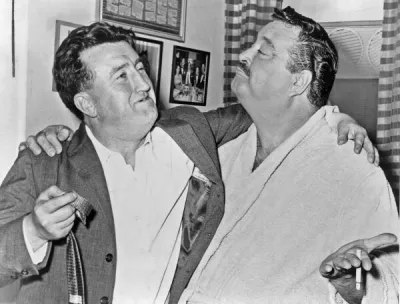
Brendan Behan
Human Design Chart
Biography
He died from liver damage caused by alcohol on 20 March 1964.
Brendan Behan — Generator with Profile 1/3
Generator 1/3 — Design at a Glance
Brendan Behan's design revealed fundamental endurance and high levels of sacral power. With the energy architecture of a Generator, he was endowed with great physical resilience – akin to a workhorse that remains strong as long as it burns for its task. However, his actions were not characterized by spontaneous initiatives but rather by responding to external impulses. His design's motto was: Do not initiate, wait until life sends a signal and then respond from the gut. When his sacral center responded with an inner 'yes', he could effectively materialize this energy and experience deep satisfaction.
This mechanism, however, contained two specific risks. First, frustration or energy depletion threatened if he acted against his natural rhythm and initiated things without receiving an internal response. Second, there was the danger of burnout if he wasted his energy on tasks that did not fulfill him or was prevented from working on his heart project while still full of power. Brendan Behan's design clearly showed: His strength lay in responding to authentic life impulses. Deviations from this – whether through forced initiatives or suppressing the urge to work on his own project – inevitably led to exhaustion and a sense of persistent frustration. His path to fulfillment consisted in listening to this inner compass and trusting it.
Emotional Authority
Brendan Behan's design indicated a tendency towards temporal distance when making decisions; spontaneous judgments were unreliable for him. He was someone who required patience and multiple considerations until clarity and calmness set in. This stance stemmed from his emotional authority: The defined Solar Plexus Center carried his inner authority. In Human Design, the Emotional Center is always the authority once it's defined – regardless of other defined centers in the chart. Brendan Behan was subject to a permanent emotional wave with strong ups and downs of feelings. The world appeared colored by his current mood; at one moment he was totally enthusiastic, in the next he saw the same thing negatively. His feeling in the moment, however, was only a snapshot, an initial impression that did not necessarily represent his truth yet. Quick, spontaneous decisions based on emotion could therefore have very negative effects. The more time Brendan Behan took to let a decision mature, the deeper and more comprehensive he could see. This required patience and multiple reconsiderations of decisions. He should take pride in this process and ask himself several times over. Over time, intense feelings subsided, he gained emotional distance, and clarity as well as calmness set in. Only then had he gone through the process – particularly important for long-term decisions with significant influence on his life course.
The 1/3 Profile — Investigator / Martyr
Brendan Behan's design indicated a tendency to swing between intensive theoretical preparation and pragmatic experimentation. His Profile 1/3, the Researcher and Experimenter, defined his life path as a cyclical process: Line 1 drove him towards study while Line 3 compelled him into practical implementation. This configuration created an internal dilemma. Often, the energy of Line 1 prevailed, leading to fear of becoming action-ready while still feeling there was not enough knowledge yet. However, this conflicted with the natural urge of Line 3 to learn through trial and error and adapt.
The Sun in Gate 49 dominated this pattern with a strong focus on revolutionary principles and emotional power. This gate demands the 'Law of Necessity': An idea must be theoretically grounded to find support. Yet, without cooling down the emotional wave, this could also be destructive. Brendan Behan's strength lay in synthesizing these forces. His judgments were only absolutely trustworthy when they had been intellectually scrutinized and practically tested. Through tolerating criticism and being willing to make connections – even faulty ones – he could validate insights. What he identified as correct was thus not mere theory but truth verified through personal experience.
Split Definition — Defined & Open Centers
Brendan Behan's design was characterized by a rare, almost fully internal structure: eight of the nine centers were defined. This created a constant, autonomous presence in all areas of life – from mental inspiration through emotional depth to intuitive security and vital endurance. His Head Center and Ajna Center generated a persistent mental pressure to question and understand, while his defined G Center gave him clear identity and direction. The vital energy of his Sacral Center provided the necessary power for expression, supported by the spontaneous intuition of his Spleen as well as the stabilizing stress pressure of his Root Center. His emotions flowed deeply and complexly from his Solar Plexus, all culminating in reliable communication ability through his Throat Center.
The only gap in this dense energy system was his open Heart Center. Brendan Behan did not have a continuous willpower or the energy for long-term commitments and competition. Instead, he situatively took on ego dynamics of his environment. This led him to question whether he had enough value to keep up with others or felt the need to prove loyalty and competence. The mechanism of an open Heart meant that promises were often hard to keep as the necessary energy was not structurally present. The challenge lay in channeling this massive internal activity through strategy and authority without proving himself under pressure or getting entangled in competitive dynamics his design did not support. His value lay not in asserting will but in authentically using his other, strongly defined energies.
Channels for logical intuition, focus and powerful self-assertion.
Brendan Behan's design tended towards skeptical pattern scrutiny paired with deep individual authenticity. His mind was not set up to blindly believe but constantly filtered for consistency. This attitude resulted from the Logic Channel 63-4 in his personality: Gate 63 (Doubt) connected with Gate 4 (Formulate), creating a mind that questioned and only accepted answers if they were logically verifiable. There was little room for unfounded belief; skepticism was the tool for truth-seeking.
At the same time, he was marked by the Research Channel 34-10. This channel connected Gate 34 (Power) in his Sacral Center with Gate 10 (Self Behavior) in his G Center. It gave him inner strength to hold onto personal convictions and love himself regardless of collective expectations. His authenticity was not a superficial pose but an existential necessity guided by sacral reaction.
These two forces – logical skepticism and intuitive self-love – were contextually supported by Juxta-Channels. The Perfect Form Channel 57-10 (Gate 57: Intuitive Insight) promoted moment-to-moment intuitively guided behavior, resolving unfounded future fears and enabling spontaneous clarity. This was complemented by the Concentration Channel 52-9, whose Format-Energy (Gate 52: Non-action, Gate 9: Focus) exerted a calm pressure to stay still and evaluate details precisely before acting.
In the background, tribal-oriented energies like the Synthesis Channel 19-49 (Gate 19: Claims, Gate 49: Principles), emphasizing emotional cohesion and loyalty within a group, and the Power Channel 34-57 worked. The latter connected sacral life force with the intuitive survival intelligence of his Spleen (Gate 57), making Brendan Behan vigilant for dangers in his environment and securing his individual vitality. His design was thus a tension zone between the collective need for logical validation and the personal imperative to be authentic.
Individual Circuitry — Circuit Signature
Brendan Behan's design set up a tension between extreme individual transformation and the necessity of cooperative resource creation. His Knowledge Circuit connected Ajna with Throat Center, giving him the ability to structure new insights into words. This stood in contrast to his Focusing Circuit: Here, the Research Channel linked Identity and Sacral Centers but lacked a direct expression channel, so firm convictions often remained internal.
The Mind Circuit formed two separate segments: Head and Ajna Centers allowed logical concentration for future strategies while Sacral and Root Centers focused physical energy. Parallel to this, the Ego Circuit connected Solar Plexus and Root Center through Synthesis, translating emotional impulses into tribal cooperation but requiring pauses of calmness.
Integration linked Identity, Spleen, and Sacral Centers. Through Perfect Form and Power Channels, Brendan Behan channeled intuitive power (Spleen) and life energy (Sacral) over proper behavior into his identity. This ensured survival through reacting to life in the present, driven by highest individuality. The split definition separated these energetic blocks: The creative, linguistic flow (Head-Ajna-Throat) existed parallel to a blocked but powerful inner life and tribal emotional processing without all centers forming one continuous stream.
Right Angle Cross of Explanation 1
Brendan Behan's Human Design profile featured the Right Authority Cross. This configuration established a foundational stance aimed at clarity and uncovering connections. It was not merely about knowledge but rather a deep inner drive to explain things and make them understandable.
The Right Authority Cross served as a structural framework for his energetic alignment. In Human Design mechanics, this specific cross marks an individual whose life path is characterized by the need to decipher complex issues and share these insights. This was not an optional feature but a fixed component of his inner architecture.
For Brendan Behan, this meant that his nature was geared towards finding answers or at least pointing the way toward explanation. The energy of this cross acted as a constant backdrop influencing his actions and perception. It created a tendency to engage with the 'why' and 'how' of things rather than passively accepting them.
This mechanical reality shaped how he experienced the world. It was less about simply gathering information and more about shaping it into a form that others could understand. The Right Authority Cross thus became the key to his specific way of operating: by explaining and enlightening, he took on his role in the system.
Saturn Return · Uranus Opposition — Life Cycles
Brendan Behan's design showed a tendency towards intense creative expression that condensed into clear cyclical turning points. His first Saturn Return marked the peak of this development: at age 31, in 1954, he wrote the play 'The Quare Fellow'. The premiere the following year was a great success and demonstrated how years of groundwork often culminated in a solid result during this life stage. This cycle underscores the power of structural consolidation in early adulthood.
A decade later, another dynamic became active: the Uranus Opposition at age 41, in 1964, brought an abrupt end. Brendan Behan died on March 20th in Dublin from the consequences of his excessive lifestyle and high demands as a sought-after author. This illustrates exhaustion through the dual role of successful writer and rebel, whose tensions often led to physical limits within this cycle. The contrast between the creative peak around 1954 and the exhaustion in 1964 shows the arc from unfolding to depleting energy capacities under these specific planetary influences.
Generator · Emotional Authority — Synthesis
Brendan Behan lived a life marked by a deep inner urge to be authentic and express his convictions (Channel 43-23). This desire for self-realization was fueled by strong, sacral energy (Generator Type), driving him passionately into projects as long as they brought joy. The combination of emotional authority and the ability to intuitively respond to life (defined centers: Sacral, Root, G Center, Head, Ajna, Throat) points to a person who experienced intense emotions but ultimately sought clarity and aligned decisions with an inner compass. This internal orientation strengthened his ability to recognize patterns (Channel 52-9) and develop perspectives that often deviated from conventions.
A central paradox in Brendan Behan's design lies in the tension between the need for expression and the necessity of waiting for the right timing. The defined Throat indicates he had a clear voice, yet emotional authority required patience and waiting out emotional waves. This may have led to an internal conflict between the impulsive desire to share thoughts with the world and the necessity to filter these impulses into a clear expression (Channel 19-49). This interplay of spontaneity and reflection shaped his creative process and life.
7 Defined Channels
Incarnation Cross - Right Angle Cross of Explanation 1
Solar Return
The Solar Return shows the moment when the sun returns to its exact birth position - your personal solar year.
Life Cycles
Discover the life cycles with a detailed triple view (birth chart, cycle chart, composite).
Human Design Profile
- Type
- Generator
- Strategy
- To respond - wait for something to respond to
- Authority
- Emotional Authority
- Profile
- 1/3 - Investigator / Martyr
- Definition
- Split Definition
- Incarnation Cross
- Right Angle Cross of Explanation 1
- Date of Birth
- 09.02.1923 10:00
- Place of Birth
- Dublin, Ireland
Frequently Asked Questions
What was Brendan Behan's Human Design type?
What Profile did Brendan Behan have in Human Design?
Which Authority guided Brendan Behan?
What incarnation cross did Brendan Behan have?
When was Brendan Behan born?
Discover your own Human Design
Are you also a Generator? Find out in a personal reading how to use your sacral energy correctly and discover deep satisfaction.
More Personalities
Back to overviewAaliyah

Alexia

Angèle

Anne-Marie

Arcángel

Arno