
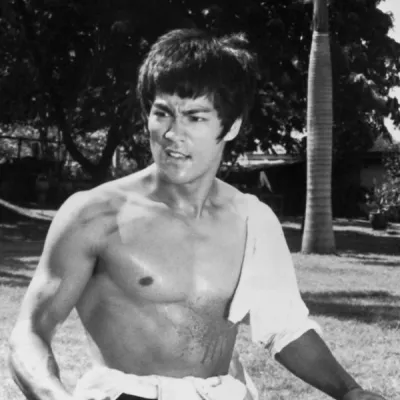
Bruce Lee
Human Design Chart
Biography
Bruce Lee as a Manifesting Generator 6/2 in Human Design
Manifesting Generator 6/2 — Design at a Glance
Bruce Lee revealed himself as a person with a unique combination of constant energy and lightning-fast implementation power. His design as an Manifestor Generator gave him the ability to skip important steps and draw unusual results quickly into his life. This speed, however, was a double-edged sword: Often he tended to juggle multiple projects simultaneously or omit necessary intermediate steps. Such leaps inevitably led him to return later and make up for missing foundations – an experience that could quickly lead to frustration in him as it contradicted his deep need for efficiency.
The solution lay in his specific strategy: Not initiating himself but reacting to external impulses. Only when his sacral center gave a clear "yes" did he deploy his immense power. This inner compass protected him from being overwhelmed by parallel tasks. When he followed this inner authority and entered into a playful mode, potential frustration transformed into deep satisfaction. His creative force flourished not through linear task completion but through variety and the pleasure of the process itself. The ability to act quickly only truly became beneficial when it was based on solid internal consent, allowing him to focus his energy without internal friction.
Emotional Authority
Bruce Lee exhibited an internal decision-making structure that required time and distance from emotional waves. His inner authority lay in the defined Emotional Center. This meant that his perception of the world was always colored by the current mood – sometimes enthusiastic, sometimes negative. A spontaneous judgment in this state was only a snapshot, not the deeper truth.
The mechanics of his emotional authority dictated that feelings moved in a constant up and down motion. Quick decisions made from such an emotion carried the risk of being proven wrong later on, as the initial impression had not yet matured. Therefore, Bruce Lee needed to take time. Clarity only emerged after intense emotions subsided.
This process required patience and consciously sleeping over important decisions. By hesitating and asking questions multiple times, he gained emotional distance over time. The initial coloring gave way to a calm overview. Only then was he through the internal process and could make an informed choice. This waiting strategy was particularly crucial for long-term life decisions, as it ensured that the decision made was based on deeper insight rather than transient excitement. Emotional composure only set in after the wave had subsided.
The 6/2 Profile — Role Model / Hermit
Bruce Lee's Human Design profile laid out a clear two-phase life path. In the first three decades, he was driven by an experimental urge characterized by trial and error. This phase served to gather raw experiences before around age thirty when the dynamics shifted. Then he metaphorically retreated into a "cave" – a period of intense reflection and distance from his past. This withdrawal was not an escape but necessary for healing and deep self-awareness. Only after this inner work did he emerge as a wise teacher, ready to share his accumulated knowledge with others.
This structure is derived from his Profile 6/2. Line 6 integrated common sense into his circuitry (Gate 34). It taught him early on that pure power was insufficient; authenticity required insight. Without this reflection, enthusiasm would have remained superficial. At the same time, Line 2 from Gate 40 emphasized decisiveness and willpower. Here, the quiet phase was crucial: Only through targeted rest could he restore his strength and avoid becoming a "paper tiger" – appearing weak because he was unprepared. His journey showed that true strength arises from the balance of active experience and reserved introspection.
Single Definition — Defined & Open Centers
Bruce Lee's design was revealed as a massive, constant structure of energy and expression. Six defined centers – Throat, G, Heart, Sacral, Solar Plexus, and Spleen – formed a reliable foundation of willpower, vital life force, clear identity, emotional depth, and intuitive health sensitivity. This configuration marked him as someone with direct manifestation capability and a strong ego, yet he had to rely on his inner authority.
The defined Sacral Center provided an enormous power source that acted as the motor. Bruce Lee possessed this vital energy but used it effectively only through reaction rather than initiation. His defined Solar Plexus worked as emotional authority; he was designed to wait for the ups and downs of the emotional wave before making decisions. Truth revealed itself to him over time, not in impulsive moments. The defined Heart Center gave him willpower and a desire to determine his own life, while the G Center offered a firm self-identity and direction. The defined Throat allowed him to reliably translate these inner states into communication and action.
At the same time, Head, Ajna, and Root Centers were open. This meant no constant mental processing or personal stress pressure. Bruce Lee tended to absorb inspiration or confusion from his environment without it being his constant self. He could get stuck in mental monologues or absorb external adrenaline impact, which could lead to a feeling of overburdening if he did not listen to his defined inner guidance. The mechanics of his design challenged him to ignore this external noise and instead trust the sacral response as well as emotional clarity to avoid resistance and exhaustion. His strength lay in the endurance of his energy with proper engagement, not in constant reaction to external questions or pressure.
Channels for powerful presence, intimacy and community values.
Bruce Lee showed himself as someone whose energy was driven by the Charisma Channel 34-20: immense physiological power (Gate 34) demanding immediate manifestation in the now (Gate 20). This dynamic created an internal conflict of speed; the driving energy met action so quickly that it almost bypassed the necessary sacral response. Without this conscious delay through inner guidance, the energy threatened to become obsessive or like a misdirected rocket uncontrollably breaking out. His design therefore required him to submit to this inner authority rather than follow his mind to avoid chaotic destruction and instead generate charismatic self-affirmation. This energy was not meant to be tapped by others but was intended for activities that genuinely brought him joy. Through self-absorbed, correct activity in the moment, he inspired others naturally – this was the true nature of his charisma.
Additionally, the Inspiration Channel 1-8 connected his unique identity (Gate 1) with contribution to the group (Gate 8). He lived his individual direction and inspired others through example rather than words. The Partnership Channel 59-6 brought intense intimacy (Gate 59) and emotional waves (Gate 6), requiring patience to gain clarity. The Preservation Channel 27-50 provided care (Gate 27) and protection of traditional values (Gate 50), while the Community Channel 37-40 sought recognition (Gate 37) and the right place in the whole (Gate 40). Further gates like Alertness (44), Risk Decision (28), and Logic (62) rounded out his profile by promoting transformation through interaction and detailed pattern recognition.
Tribal Circuitry — Circuit Signature
Bruce Lee's design leaned towards highest individuality and acoustic presence. He showed himself as someone who drew power from reacting to life and made it immediately effective in the moment. This configuration resulted from the Integration Circuit: The Channel 20-34 connected his Throat Center with his Sacral Center, allowing him to translate the energy of life force (Sacral) directly into the current moment (Gate 20) through reaction to circumstances – guided by intuition and correct behavior.
Parallel to this, the Knowledge Circuit worked through Channel 1-8. This connected his Throat Center with his Identity Center and promoted inspiration as well as the form of expression of his unique personality. Bruce Lee thus had a direct connection between his identity and his expression, emphasizing his individuality.
The Ego Circuit was active in him via Channel 37-40 connecting Heart and Solar Plexus. This stood for a relationship of giving and taking within cooperation. Since this circuit did not connect to the Sacral Center, rest periods were necessary for resource generation.
Finally, the Archer Circuit with Channels 27-50 (Preservation) and 59-6 (Partnership) shaped his design. These connected Sacral, Solar Plexus, and Spleen Centers into a unit that cared about protection, defense, and preserving genetics. All these centers belonged to one connected group in Bruce Lee, making these forces work as a cohesive flow.
Left Angle Cross of Duality 2
Bruce Lee lived in a constant tension between his inner will and the demands of his environment. His design established the basic structure of the left cross of Duality 2, which defined this dynamic friction as his central life engine. For him, the conflict between individual destiny and external resistance was not an obstacle but a necessary force for development.
This mechanism describes the state of being in-between, where identity is sharpened through friction rather than harmony. Bruce Lee moved continuously in a world that rarely matched his personal rhythm or expectations. This very discrepancy drove him forward. Duality acted as driving energy, demanding self-discovery by forcing him to constantly reposition himself.
It was not about overcoming resistance through ignorance but integrating this tension. His development took place in the confrontation with what came from outside and clashed against his inner self. This process shaped his way of moving in the world: actively, reactively, and always in dialogue with challenges. Duality was for him the source of sharpness from which he gained his own form by learning to dance with resistance rather than fighting it.
Saturn Return — Life Cycles
Bruce Lee appeared in the full-length Hollywood film 'Marlowe' in 1968 at the age of 28. For his design, this moment marked the first Saturn Return, a cycle signaling the end of youth and transition into serious adult responsibility. Years of groundwork condensed into a solid result that strengthened his personal character. This point was no coincidence but aligned with the mechanical logic of his Human Design: The first Saturn Return cycle served as a test stone and confirmation of what he had previously built up. By taking a significant step into the film industry in this year, it showed how his design embraced adult responsibility. The energy of this cycle helped him stabilize his identity and define his role in the world more clearly. It was a moment of consolidation where the foundation for future developments was laid. Bruce Lee used this phase not only to anchor himself professionally but also personally. His appearance in 'Marlowe' exemplified the maturation that his design underwent during this life stage. It was about recognizing one's strengths and applying them consistently rather than continuing to lose oneself in experimentation. This step marked the beginning of a new era characterized by clarity and determination.
Manifesting Generator · Emotional Authority — Synthesis
Bruce Lee was a Generator who developed an unusual dynamic through the connection between his Sacral Center and Throat Center. He possessed constant sacral energy, reacted to impulses, and could skip steps – acceleration that occasionally forced him to retreat and correct himself. This ability for quick action followed by reflection shaped his path, especially in his younger years when experimentation and exploring boundaries were paramount (Profile 6/2). He lived the continuous search for new insights and transformation through expression (Knowledge Circuit), where his voice served as a valve for creativity and leadership (Channel 1-8).
A central paradox in his design lay in the combination of emotional authority and the drive for rapid initiation. While he needed time to let decisions mature and fully experience the emotional wave, his Manifestor component allowed him to act swiftly. This led to tension between the need for inner clarity and the desire for immediate expression, a give-and-take that prompted him to gather experiences, withdraw, and eventually emerge as a wise role model.
5 Defined Channels
Incarnation Cross - Left Angle Cross of Duality 2
Solar Return
The Solar Return shows the moment when the sun returns to its exact birth position - your personal solar year.
Life Cycles
Discover the life cycles with a detailed triple view (birth chart, cycle chart, composite).
Human Design Profile
- Strategy
- To respond - wait for something to respond to
- Authority
- Emotional Authority
- Profile
- 6/2 - Role Model / Hermit
- Definition
- Single Definition
- Incarnation Cross
- Left Angle Cross of Duality 2
- Date of Birth
- 27.11.1940 07:12
- Place of Birth
- San Francisco, United States
Frequently Asked Questions
What was Bruce Lee's Human Design type?
What Profile did Bruce Lee have in Human Design?
What Authority did Bruce Lee have?
What incarnation cross did Bruce Lee have?
When was Bruce Lee born?
Discover your own Human Design
Are you also a Manifesting Generator? Find out in a personal reading how to unfold your multi-talents and direct your energy wisely.
More Personalities
Back to overviewSissy Spacek

Aldair

Alizée

Anémone

Angeli

Ann-Margret
