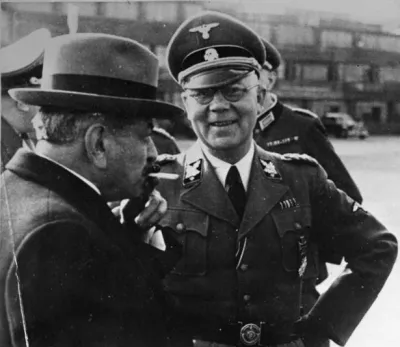
Carl Oberg
Human Design Chart
Biography
Carl Oberg as a Manifestor 2/4 in Human Design
Manifestor 2/4 — Design at a Glance
Carl Oberg was a Manifestor. His design established him as a pioneer and visionary whose task was to lead the world into new directions. He acted similarly to an emperor in ancient Rome: he had the great vision of an empire but did not wage wars himself. Instead, he sent others out to conquer foreign lands for him. This role brought with it a specific challenge. Since his thinking often reached further than that of his surroundings, Carl Oberg was frequently misunderstood and polarizing. Some people loved his huge dreams and followed him, while others rejected or even hated him precisely because of these visions. To find the right following, it was essential for him to inform others about his plans in a timely and precise manner. This formed the ideal strategy of his design. If he adhered to this strategy and trusted his inner authority, he was rewarded with a feeling of inner peace. Living against this design, however, led to a persistent, deep-seated anger within him. His leadership trait was thus inseparable from the necessity to communicate clearly in order to reduce resistance and gain support.
Emotional Authority
Carl Oberg exhibited an inner authority that was anchored in his defined Emotional Center. This configuration fundamentally determined his decision-making: he was subject to an emotional wave expressed through a permanent up-and-down of his feelings. The world appeared to him always colored by his current mood; still excited about something, he saw the same thing negatively moments later. His immediate feeling was only a snapshot, a first impression that did not necessarily correspond with his deepest truth. Quick, spontaneous judgments from such a situation could therefore often have negative consequences.
For Carl Oberg, it was a rule that the Emotional Center as inner authority always took precedence over all other defined centers, regardless of further configurations in his graph. This required patience and the conscious renunciation of immediate reactions. By taking time and reviewing decisions multiple times – often by sleeping on them – intense feelings subsided. Only with this distance did he gain emotional detachment, leading to clarity and calmness. This process of maturation was essential for long-term course settings that significantly shaped his life path. Through waiting, he reached the point where his inner truth became clear instead of following only a passing mood.
The 2/4 Profile — Hermit / Opportunist
Carl Oberg showed himself as someone who oscillated between a deep need for withdrawal and a desire for connected community. His design indicated a tendency to first gain clarity in isolation before sharing these insights deliberately with his closest circle. This dynamic stemmed from his Profile 2/4: Line 2 demanded time alone to deepen internal processes and recover from external stimuli. Only when this inner need was met did Line 4 activate the desire for social interaction with familiar people. For Carl Oberg, it was essential to clearly communicate these shifts – when he sought company and when he wanted solitude. Only then could he effectively utilize his network's knowledge: in isolation, he reflected on and evaluated gathered information to develop new ideas.
His inner service, shaped by Gate 19 on Line 2, was selective. He only gave something of himself if a genuine exchange between giving and receiving took place. This stood in tension with the direct, often blunt nature of Line 4 (Gate 44), which demanded honesty without hypocrisy. This truthfulness aimed less at individual desires than at the survival of the tribe. Carl Oberg had to learn to use this neutral, sometimes rejecting stance in extreme cases to obtain necessary support without endangering his own identity or resources. His strength lay in connecting the distance of the hermit with the directness of the networker, always searching for the right moment for service and exchange.
Single Definition — Defined & Open Centers
Carl Oberg revealed himself through a defined G Center as someone with a firm sense of self-identity and a clear direction in life. This inner grounding allowed him to lead others without needing their approval. His defined Throat Center gave this orientation a reliable voice; he did not speak impulsively but consistently articulated the truth of his identity and will. The combination of G Center and Throat created a coherent presence: what he said matched who he was.
At the same time, Carl Oberg had a defined Solar Plexus Center that served as his inner authority. His decisions were subject to an emotional wave; clarity only emerged after waiting for feelings to settle. This process lent depth and sensitivity to his judgments but required patience since spontaneous reactions often led astray. A further defined Root Center provided the constant pressure to move forward in the material world, infusing his actions with existential urgency.
In contrast, his open centers shaped his vulnerabilities. His open Head and Ajna Centers made him receptive to mental inspirations from others; he tended to get entangled in questions that were not of his own making or sought answers where none were needed. His open Heart Center lacked consistent willpower, leaving him vulnerable to the pressure of proving his worth through promises and performance – a cycle that could lead to self-doubt upon failure. Additionally, his Sacral and Spleen Centers were open: he absorbed the energy and fears of his surroundings, which could lead to exhaustion if he did not consciously set boundaries or make spontaneous decisions out of fear of uncertainty. His challenge lay in not interpreting these open fields as his own truth but rather relying on his emotional clarity and inner direction.
Channels for reflection, mystical synthesis and emotional change.
Carl Oberg revealed himself as someone who gathered experiences to transform them into a deeper truth later on. The Lost Child 13-33 combined his listening with withdrawal for reflection; he patiently waited for hidden connections to surface before sharing them. This observational distance shaped the way he understood the world: not through hasty action, but by sorting memories and secrets.
At the same time, an emotional drive towards new experiences propelled him forward. The Transience 35-36 linked his emotional center with the expression center; he actively sought changes and new experiences, often driven by a fear of stagnation or an inner crisis. This channel rejected restrictive patterns and fostered a restless desire to explore the depth of feeling, even if it sometimes led to instability.
In interpersonal relationships, he searched for belonging and emotional security. The Synthesis 19-49 connected the pressure of the Root with the emotional pulse; it determined through a sensitive weighing of acceptance or rejection who belonged to the "tribe." Loyalty and the feeling of being needed were essential for him to find inner peace.
Additionally, specific Gates influenced his development: Gate 44 promoted awareness and transformation through relationships; Gate 24 brought mental mutations and the search for inner stillness; Gate 7 projected leadership patterns for the future; Gate 60 taught accepting limitations as a prerequisite for transcendence. In his design, Gate 46 supported his dedication to the physical process and "here and now," while Gate 15 integrated him into collective rhythms. Finally, Gate 45 encapsulated the energy of the tribal level, connected with hierarchical order and material grounding.
Collective Circuitry — Circuit Signature
Carls Design links the Throat, Solar Plexus, and Identity Centers directly with the Root Center. This created a continuous energetic flow from emotional perception to physical manifestation. He lived in a world strongly influenced by feelings and past experiences. The Meaning Finder Circuit ensured that he experienced emotions in wave-like patterns—with clear beginnings, middles, and ends. These cycles served to learn from the past and share these insights with others.
At the same time, the Ego Circuit operated through the channel between Solar Plexus and Root Center. This was about cooperation and creating resources together. Since there was no connection to the Sacral Center, he lacked a constant life force. Carl therefore needed necessary rest periods to recharge his energy for social alliances. His design showed a tendency towards synthesis: He mediated between different perspectives and supported his environment through mutual give-and-take. The emotional wave from the Solar Plexus hit directly into root energy, meaning that his feelings often had immediate, tangible effects in his surroundings. It was not a logical-cold system but an emotional process aimed at deciphering hidden connections of the past and making them useful for the collective.
Right Angle Cross of the Four Ways 4
Carl Oberg carried the design of the right cross of the four paths. This configuration shaped an internal tension between a desire for deep spiritual experience and the necessity to translate this into practical reality. His chart indicated a tendency to grapple with the fundamentals of existence, not as abstract theory but as living practice. The mechanics of this cross suggest that Carl Oberg often oscillated between different life domains – the spiritual and material, the inner and outer worlds. This was not a lack of focus but rather a structural invitation to integrate these seemingly separate realms. His energy was directed towards making hidden connections visible and transforming them into tangible results. The right cross of the four paths demands synthesis: it is about leaving spiritual insight in the ivory tower and using it as a tool for everyday life. Carl Oberg thus showed himself to be someone who strove to build bridges – between the invisible and the visible. This dynamic created a unique perspective that allowed him to view complex topics from an integrative viewpoint. His design suggested that true fulfillment could only be achieved through the union of these four aspects: mind, soul, body, and matter.
Saturn Return · Uranus Opposition · Chiron Return · 2nd Saturn Return — Life Cycles
Carl Oberg's design pointed towards a tendency for strategic responsibility and structured action, which became particularly pronounced in middle age. This orientation was not spontaneous impulsiveness but rather a conscious assumption of commands within clearly defined hierarchies. The mechanics of his chart supported an attitude that created stability and order in complex situations, where authority stemmed from inner clarity about one's role.
A central aspect of this development was the Chiron Return, a cycle of fulfillment and bloom. During this period, typically between the ages of 49 and 51, the incarnation cross unfolds for those who have followed their strategy. This is not a phase of psychological wound healing but rather the concrete experience of one's purpose. Carl Oberg experienced a deepening of his life mission shortly before this peak.
In 1944, at age 47, he received a command in the Army Group Vistula. This event marked a point of highest operational responsibility and perfectly aligned with the dynamics of his design: the ability to make clear decisions under pressure and maintain structures. It was no coincidence but rather the logical consequence of a life increasingly oriented towards inner authority. Taking up this command confirmed the effectiveness of his strategic orientation in a moment of extreme challenge, before the full Chiron Return could unfold its effects.
Manifestor · Emotional Authority — Synthesis
Carl Oberg was a Manifestor whose life was marked by a constant oscillation between internal reflection and the need for exchange. His profile as a natural talent and networker (Line 2/4) points to a personality that sought both phases of isolation for internal processes as well as intense connections with a chosen community – a rhythm that helped him mature experiences and recognize deeper truths (Channel of the Lost Son). As a Manifestor with emotional authority, he needed time to process his feelings before making decisions, yet his design also implied a natural leadership role and a drive to chart new paths.
This interplay contained a central paradox: Carl Oberg lived in the tension between the need for autonomy and the desire for connection. The Manifestor energy called for taking initiative and setting direction, while the defined Heart Center (and thus the Meaning Finder circuit) prompted him to process experiences emotionally and share them with others. The Chiron Return at age 47, coupled with a career event, underscores this internal conflict – the necessity of acting independently as well as assuming responsibility for others.
3 Defined Channels
Incarnation Cross - Right Angle Cross of the Four Ways 4
Solar Return
The Solar Return shows the moment when the sun returns to its exact birth position - your personal solar year.
Life Cycles
Discover the life cycles with a detailed triple view (birth chart, cycle chart, composite).
Human Design Profile
- Type
- Manifestor
- Strategy
- To inform others before acting
- Authority
- Emotional Authority
- Profile
- 2/4 - Hermit / Opportunist
- Definition
- Single Definition
- Incarnation Cross
- Right Angle Cross of the Four Ways 4
- Date of Birth
- 27.01.1897 23:00
- Place of Birth
- Hamburg, GER
Frequently Asked Questions
What was Carl Oberg's Human Design type?
What profile did Carl Oberg have in Human Design?
What authority did Carl Oberg possess?
What incarnation cross did Carl Oberg have?
When was Carl Oberg born?
Discover your own Human Design
Are you also a Manifestor? Find out in a personal reading how to use your initiation power peacefully and dissolve resistance.
More Personalities
Back to overviewChristian-Jaque
Kesha

Laurent-Eynac
Lucebert
Masaccio

Papus