
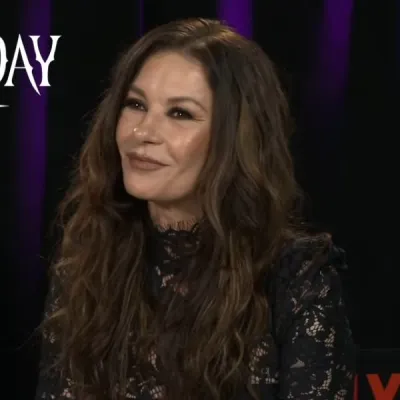
Catherine Zeta-Jones
Human Design Chart
Biography
Born and raised in Swansea, Zeta-Jones aspired to be an actress from a young age. As a child, she played roles in the West End productions of the musicals Annie and Bugsy Malone. She studied musical theatre at the Arts Educational Schools, London, and made her stage breakthrough with a leading role in a 1987 production of 42nd Street. Her screen debut came in the unsuccessful French-Italian film 1001 Nights (1990), and went on to find greater success as a regular in the British television series The Darling Buds of May (1991–1993). Dismayed at being typecast as the token pretty girl in British films, Zeta-Jones relocated to Los Angeles. She established herself in Hollywood with roles that highlighted her sex appeal, such as in the action film The Mask of Zorro (1998) and the heist film Entrapment (1999).
Zeta-Jones received critical acclaim for her performances as a vengeful pregnant woman in Traffic (2000) and Velma Kelly in the musical Chicago (2002), winning the Academy Award for Best Supporting Actress for the latter.
Human Design Analysis: Catherine Zeta-Jones as Manifesting Generator 5/1
Manifesting Generator 5/1 — Design at a Glance
197 words under the limit. Here's the chapter:
Catherine Zeta-Jones' design showed a dual nature: constant inner drive paired with the ability to skip individual steps on the path to the goal and quickly pull things into her life. This combination describes the Manifesting Generator, a hybrid of Generator and Manifestor. With an ever-active sacral center like a classic generator, she had consistent creative power that responded best to impulses from outside rather than initiating them herself. At the same time, the manifestor component allowed her to skip intermediate steps and move faster than a pure generator type could. This entailed two typical pitfalls: if important steps were skipped, they would need to be caught up on later – which easily turned into frustration, the non-self theme typical for this type. Similarly, this type tended to start several projects simultaneously, which without reconnection to strategy and inner authority could also turn into frustration. Conversely, if she consistently waited and reacted until her sacral center – even after an antest – continued to agree, deep satisfaction could arise from this speed. For her design, this meant: variety and a playful approach to multiple projects did not act as distraction but rather as the actual nourishment of her creative power – provided that several undertakings were allowed to run alongside each other instead of being compulsively closed one after another.
Emotional Authority
Catherine Zeta-Jones' design laid out deep emotional fluctuation: Her inner authority lies in the defined Emotional Center, which - when activated - always carries authority regardless of what else is defined in the chart. She was thus subject to an emotional wave, a permanent up and down of feelings through which she perceived the world colored by her current mood. In one moment, she could be completely enthusiastic about something, in the next view it negatively. A feeling at any given moment was for her just a snapshot, a first impression - not necessarily her true reality yet. Quick, spontaneous decisions directly from an emotion could therefore have negative effects.
For sustainable decisions, her design needed time: patience and multiple reconsiderations before a matter ripened. Only when the intense feelings subsided and she gained emotional distance did clarity and calm set in – the point at which the process was complete. This applied particularly to long-term decisions with significant influence on her life course, where procrastination and repeated questioning showed as part of the process before she truly committed.
The 5/1 Profile — Heretic / Investigator
Catherine Zeta-Jones' design laid out a dual role: outwardly the go-to person for others with their questions and problems, inwardly someone who preferred to delve deeply into something before expressing it. This combination describes Profile 5/1 in Human Design language - composed of the fifth and first lines. The fifth line ensures that other people are drawn to her magnetically and see her as someone who can solve their problems; the first line provides the foundation - a preference for thoroughly exploring a matter herself before passing it on outwardly. Those in this profile must learn to set boundaries, otherwise expectations from outside will quickly attach themselves.
Two activations underlie this pattern concretely. The one at Gate 46 in the fifth line stands for the sense of timing: the right rhythm brings success and favorable coincidences, combined with the ability to offer pragmatic solutions during crises when others project their expectations. The second, at Gate 52 in the first line, describes the need to pause before acting and focus instead of prematurely releasing energy - otherwise time and strength are wasted.
Split Definition — Defined & Open Centers
Catherine Zeta-Jones's design inclines her to avoid making important decisions in the moment and instead gives herself conscious time until clarity sets in. This is due to a defined Solar Plexus Center that also forms her inner authority: consciousness here does not arise in the present but only after an emotional wave has run its course through highs and lows. Mechanically, this means that a decision was only possible after at least one night's distance – spontaneous commitments made in the heat of an emotional outburst risked being regretted later.
Additionally, her G Center is defined, the seat of identity and direction. This describes a stable, reliable sense of who one is and where one is going, coupled with the ability to love others without needing their affirmation. Her Sacral Center was also defined – a constant daily work energy that finds its healthiest expression through answers to concrete questions rather than self-initiation.
Two centers remained open: Head and Ajna, which appear as a pair. An open Head-Ajna does not have a fixed way of processing thoughts – instead, there is the vulnerability to absorb external mental pressure, constantly seeking answers or inspiration and questioning under conditioning whether one understands enough or appears confident enough. Her Heart Center was also open: no inherent firm willpower or competitive energy, but rather the vulnerability to put oneself under pressure and prove one's worth through promises and performance. Both are mechanical triggers that open centers are exposed to, not fixed traits of the person themselves.
Channels for intimacy, self-expression, logic and emotional change.
Catherine Zeta-Jones's Design reveals a strong inclination to quickly become very close in personal encounters. This tendency is based on the Pairing Channel 59-6, which connects the Sacral Center with the Solar Plexus Center: Gate 59 opens easy access to intimacy, while Gate 6 delivers the emotional wave of attraction and restraint that determines the timing of each approach. This combination allows for rapid intrusion into others' aura and establishing closeness – it can be misinterpreted from outside as flirting without intending to.
In addition, there was a fundamental attitude of independent trust in her own convictions. The Research Channel 34-10 connects the Sacral Center with the G Center: Gate 10 stands for behavior stemming from one's inner self, accepting and honoring oneself, while Gate 34 provides the strength to hold onto these beliefs even if they seem unusual. Combined with an inviting aura, this drew attention regardless of whether it was always welcome.
A third element was the ability to question and correct patterns. The Judgment Channel 58-18 connects the Root Center with the Spleen Center: Gate 58 drives the desire for "better and more", while Gate 18 curbs this impulse by showing what is out of balance. Unrequested, it can appear externally as constant fault-finding; when asked about it, its application becomes appropriate.
Finally, the Transience Channel 36-35 shaped a search for new experiences. It connects the Solar Plexus Center with the Throat Center: Gate 35 pushes for change in the sense of "I know this already, what's next", while Gate 36 perceives missing experience as inadequacy and actively seeks it out. This emotionally driven journey only crystallizes into wisdom over time and retrospectively.
Additionally, Gates 25 (Innocence and an individual, independent stance), 52 (Concentration through conscious pausing), and 46 (Devotion to the moment and appreciation of one's body) served as the strongest single activations, followed by Gate 22 (Grace in waiting) and Gate 48 (Depth that can easily turn into frustration when lacking a framework).
Collective Circuitry — Circuit Signature
Catherine Zeta-Jones's Design establishes two separate energy fields that do not directly flow into one another: A region comprising Identity Center (Self-image), Sacral Center (Life Force), Solar Plexus (Feeling World), and Throat Center (Expression) forms a cohesive core, while Spleen Center (Instinct) and Root Center (Drive) create their own independent unit. In Human-Design terminology, this pattern is called split definition: two internally stable but unconnected areas that often only come into contact with each other through external people or topics in daily life rather than merging seamlessly from within.
Within the larger region, a Channel connects Identity and Sacral Centers directly: a solidified, individualistic power that acts from one's gut feeling and strengthens personal convictions without being heavily dependent on outward expression. Another Channel links Throat and Solar Plexus Centers: the need to communicate experienced emotions—felt in wave-like emotional cycles stemming from the past—and share them with others. A third Channel connects Sacral and Solar Plexus Centers, bringing an ancient theme of human connection and closeness into play.
In the second, separate region, a Channel links Spleen and Root Centers: instinctive judgment that immediately recognizes inconsistencies and connects them to focused energy aimed at improvement—a self-contained, parallel force that is not drawn from the first area.
Left Angle Cross of Healing 2
Catherine Zeta-Jones' design features the Healing Left Cross in its second manifestation, setting a foundational orientation where her path unfolded less from self-imposed goals and more as part of something beyond herself. In Human Design terminology, the Inkarnation Cross describes the overarching life theme derived from four gates in Sun and Earth between Personality and Design. A Left Cross marks a predetermined transpersonal destiny: The course unfolds not through sheer will but through interaction with environment, encounters, and external circumstances - the person becomes part of a larger pattern that unfolds through them rather than being solely determined by them. The keyword for this cross, Healing, describes a life direction focused on restoring wholeness: putting something back together that has fallen out of balance - not as an isolated individual effort but embedded in relationships and circumstances from which the person does not withdraw. For Catherine Zeta-Jones, this revealed a disposition whose power unfolded less through her own efforts than through contact with her immediate environment - an orientation that was given to her rather than chosen by herself.
Saturn Return · Uranus Opposition · Chiron Return — Life Cycles
Catherine Zeta-Jones' design showed itself in 1998 at the moment typical of her first Saturn Return: At age 29, she achieved breakthrough success as the lead role in The Mask of Zorro in international cinema. The first Saturn Return, occurring roughly between ages 29 and 30, marks a transition from an experimental phase to one where it becomes clear whether one's structure holds up: Saturn acts as a test stone for discipline, responsibility, and the substance built up so far - what was previously invested in experience and preparation often condenses into visible, sustainable results during this period. Not suddenly but as the harvest of a longer lead-up time. For Catherine Zeta-Jones, this cycle coincided precisely with that career step which introduced her to an international audience: a leading role demanding public weight and responsibility characteristic of the first Saturn Return. The configuration thus describes less a single event than a recurring mechanism: the moment when it is proven whether what has been built up so far is stable enough to bear public visibility.
Manifesting Generator · Emotional Authority — Synthesis
Across several chapters, Catherine Zeta-Jones' design portrays a strengthened, self-anchored center that magnetically draws others in. The defined Sacral Center carries a constant, palpable power felt by others who wish to benefit from it; the defined G-Center provides clear identity and direction followed willingly by others. Channel 10-34 in the Centering Circuit strengthens self-love and individuality, influencing others as well; Gate 25 reinforces this same centering in the G-Center. Profile 5/1 makes her own depth of knowledge (Line 1) into sought-after solutions for others' problems (Line 5, Gate 46), accompanied by an expectation to be constantly available.
Alongside stands a clear tension field: As a Manifestor Generator, energy is geared towards rapid reaction, skipping steps and tackling multiple things simultaneously. At the same time, emotional authority demands exactly the opposite - patience, multiple reconsiderations of decisions, waiting for the wave until initial impulses become real clarity. This patience aspect also confirms on line level: Gate 52 in Line 1 calls for pause and concentration, and even Gate 46 in Line 5 holds that only the right rhythm and timing lead to success - not haste. Both are present simultaneously: the pull forward and the necessity of trusting it only when it has ripened.
4 Defined Channels
Incarnation Cross - Left Angle Cross of Healing 2
Solar Return
The Solar Return shows the moment when the sun returns to its exact birth position - your personal solar year.
Life Cycles
Discover the life cycles with a detailed triple view (birth chart, cycle chart, composite).
Human Design Profile
- Strategy
- To respond - wait for something to respond to
- Authority
- Emotional Authority
- Profile
- 5/1 - Heretic / Investigator
- Definition
- Split Definition
- Incarnation Cross
- Left Angle Cross of Healing 2
- Date of Birth
- 25.09.1969 14:40
- Place of Birth
- Swansea, United States
Frequently Asked Questions
What is Catherine Zeta-Jones' Human Design type?
What are Catherine Zeta-Jones' Profiles?
What is Catherine Zeta-Jones' Inner Authority?
What incarnation cross does Catherine Zeta-Jones have?
When was Catherine Zeta-Jones born?
Discover your own Human Design
Are you also a Manifesting Generator? Find out in a personal reading how to unfold your multi-talents and direct your energy wisely.
More Personalities
Back to overviewSissy Spacek

Aldair

Alizée

Anémone

Angeli

Ann-Margret
