
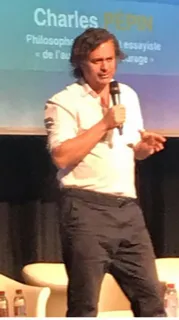
Charles Pépin
Human Design Chart
Biography
Charles Pépin as a Generator 5/2 in Human Design
Generator 5/2 — Design at a Glance
Charles Pépin's design points to a tendency towards great endurance, comparable to the strength of a workhorse. This energy was not available for arbitrary initiation but became effective when he responded to signals from his environment. The motto of his system was clear: Not to take the first step himself, but to wait and then act as soon as the inner signal – the 'gut feeling' impulse – clearly said yes.
This mechanism of reacting was crucial for his well-being. When Charles Pépin engaged in activities he did not have an intrinsic desire for or when he was distracted from his true interest, frustration and energy loss were imminent. Conversely, following this internal compass led to deep satisfaction. His success therefore depended not on how much he compulsively produced but whether he responded to the impulses life offered with his natural endurance. The danger lay in fighting against this rhythm – be it through forced quitting despite full power or ignoring a lack of enthusiasm for a task. His design challenged him to use energy only where it was released by reaction.
Emotional Authority
Charles Pépin's design points towards an emotional wave movement: His perception of the world was always colored by his current mood. In one moment, he could be totally enthusiastic about something, in the next view the same thing completely negatively. This up and down of his feelings was not a mistake but the mechanism of his defined Solar Plexus Center, which functioned as an inner authority.
This emotional authority followed a permanent wave. His feeling at any given moment was merely a snapshot, a first impression that did not necessarily represent his truth yet. Therefore, quick, spontaneous decisions based on emotion could have negative consequences. The mechanism required patience: The more time he took to let a decision mature, the deeper and broader his understanding became.
It was important to take one's time and ask oneself multiple times. Over time, intense feelings subsided, emotional distance grew, clarity and calm set in. Only then had he gone through the process. This rule had priority: Whenever the Emotional Center is activated, it also becomes the inner authority, regardless of what else is defined in his chart. This applied to long-term decisions with significant influence on his life course.
The 5/2 Profile — Heretic / Hermit
Charles Pépin's design shows an internal contradiction: the desire to help others and receive admiration clashes with a strong need for withdrawal and alone time. As a 5/2 Profile, he carries this tension within himself. Line 2 prompts him to initially hide his gifts in the 'cave' to work on himself undisturbed and prepare for the role of the hero when discovered by the world.
At the same time, line 5, which uses strategic thinking and intelligence to provide direction, is at play. The challenge here lies in using resources intelligently without falling into unconscious projections about his guiding power. If Charles Pépin only waits to be discovered, this can lead to frustration as being a 'hero' does not work as an isolated wolf. Instead, he must learn to step out and set boundaries. The selectivity of the second line carefully examines every possibility before deciding, often accompanied by a lack of patience for negotiations. Once he shows his presence and formulates clear insights, others will respect him – provided he maintains enough space for his necessary regeneration.
Split Definition — Defined & Open Centers
Charles Pépin's design was characterized by a reliable inner direction and powerful expression capabilities. His defined G Center gave him a stable self-image and a clear sense of his life mission, while his defined Throat Center translated these messages into the world. This combination allowed him to communicate with honesty and clarity without being dependent on external expectations.
At the same time, he possessed an immense vital energy source through his defined Sacral Center. This marked him as someone who did not initiate but waited for life to react to it. His satisfaction came from using his daily energy reserves for activities that found inner approval. This reactive strategy was deepened by his defined Solar Plexus Center: He was designed not to make decisions in the emotional moment, but rather patiently wait until the emotional wave had clarified itself. This protected him from impulsive misjudgments and gave his actions a profound, time-matured authenticity.
His defined Spleen Center provided spontaneous intuition in the present moment, while the defined Root Center maintained a constant pressure that propelled him forward in the material world and nourished existential awareness.
In contrast, his open Head and Ajna Centers revealed an openness to mental inspirations from the environment. Here, the typical trap was identifying with foreign doubts or concepts rather than acting as a neutral observer. His open Heart Center lacked consistent willpower; he tended to want to prove his worth through promises or competition, which led to frustration because this energy source was not continuously available. The mechanics of his design showed: Strength lay in preserving his inner direction and trusting his sacral response, rather than fighting for recognition or intellectual control.
Channels for inspired change, focus and logical transformation.
Charles Pépin's design exhibited a tendency towards exemplary leadership: he acted through the authentic life of his individual identity, inspiring others to express their own uniqueness. This mechanism stems from the Channel of Inspiration 1-8, connecting the G Center with the Throat Center. Gate 1 enables the bold expression of a creative perspective, while Gate 8 carries this contribution into public view. The effect is not through explanations but through role modeling; by living his direction, he potentially changed the perception of his environment.
Simultaneously, a deeper generative dynamic of change was evident. The Channel of Mutation 60-3 connects the Root Center with the Sacral Center and brings evolutionary change through acceptance of limitation (Gate 60) and order after confusion (Gate 3). This energy is unpredictable, pulsing, often accompanied by melancholy. It requires patience: Charles Pépin had to learn to accept inner pressure without rationalizing it away, waiting for the correct sacral response when new mutations took hold. This process creates spaces for innovation, forces adaptation, and brings renewal into his environment, even if phases of silence were felt as internal tension.
Additionally, the Channel of Concentration 52-9 shaped how he engaged with topics. As format energy between Root and Sacral Centers, it promotes focused attention on details (Gate 9), supported by a passive urge not to act (Gate 52). This created potential for pattern perfection if he was still enough to filter out distractions. His reactions revealed where his focus lay – whether lifelong dedication or shifting interests. Without this focus, restlessness could arise; with it, he enabled precise, logical investigations that served the world by challenging and perfecting form and structure.
Collective Circuitry — Circuit Signature
Charles Pépin's design showed a split structure: two independent energetic blocks existed parallel without direct exchange. The first block connected the G Center with the Throat Center; the second included Sacral, Root, Spleen, and Solar Plexus Centers. This created two separate experiential worlds that did not flow into each other.
In the Knowledge Circuit, two isolated segments worked: on one side, the Throat Center was connected to the Identity Center (G); on the other side, the Sacral Center with the Root Center. The Channel of Inspiration (1-8) promoted spontaneous insights, while Mutation (3-60) drove a desire for deviation and new creation. These energies pulse in the present moment and urge an acoustic expression of individuality, yet without direct connection between creative idea and emotional expression as these centers lie in different groups.
The Understanding Circuit connected Sacral, Root, and Spleen Centers into a coherent whole. Here, Channels Concentration (9-52) and Judgment (18-58) worked. This combination allowed focused visual analysis of the future free from emotional influence by the Solar Plexus Center, which was not involved here. It was about logical structuring and strategic planning based on intuitive perception by the Spleen.
In the Meaning Circuit, the Solar Plexus Center connected with the Root Center. The Channel of Recognition (30-41) directed emotional waves from the past into a cyclical reflection. This energy is wave-like and downward-directed, aiming to understand past experiences and find meaning behind events to derive collective lessons.
The Ego Circuit connected Spleen, Root, and Solar Plexus Centers. Channels Transformation (32-54) and Synthesis (49-19) promoted the joint creation of resources through cooperation. As there was no connection to the Sacral Center, this energy was timeless and required pauses for regeneration. It was based on tactile and olfactory senses, traditionally conservative in supporting others without the constant life force of the Sacral.
Left Angle Cross of Defiance 1
Charles Pépin was characterized by a fundamental attitude that saw constant friction and resistance not as obstacles but as necessary drivers for development. His design placed him in situations where he was constantly confronted with his own limits – a process that promised no quiet harmony, but was defined by the principle of the 'left cross of challenge 1'.
This configuration describes a dynamic in which progress only arises through active engagement with conflicts. It's not about avoiding problems but using them as catalytic forces to sharpen internal structures and gain clarity. Charles Pépin was thus continually challenged to question his assumptions and shape himself through resistance.
The mechanics of this cross imply that growth does not proceed linearly or comfortably, but occurs through repeated tests of resilience and integrity. Each resistance served as a mirror showing where there was still ambiguity or inner dissonance. Through this ongoing friction, his identity was not static but dynamically shaped – always redefined by how he dealt with the challenges thrown at him. This created an internal discipline based on the ability to endure tension and draw energy from it for the next stage of development.
Saturn Return · Uranus Opposition · Chiron Return — Life Cycles
Charles Pépins design tended towards sudden, profound shifts in perspective, often accompanied by a need for individual freedom and breaking old structures. This dynamic became concrete in 2011 when he was 38 years old: The publication of his book 'La Planète des sages' marked a decisive career step that coincided precisely with his Uranus opposition.
In Human-Design mechanics, this astronomical configuration signals a time of intense inner upheaval and external realignment. It forces established patterns to be questioned and new paths to be taken, often accompanied by a strong desire for autonomy. For Charles Pépin, this was not a chaotic break but a precise alignment of his intellectual work towards a broader audience. The Uranus energy here promoted the ability to make complex philosophical thoughts accessible while simultaneously finding his own unmistakable style. This cycle favored moments of clarity in which previous uncertainties dissolved and a new, self-determined life direction became apparent. The publication was thus not an isolated event but the visible expression of an inner maturation phase triggered by pressure for change. It confirmed his ability to find creative solutions during times of transition and share them with others without sacrificing his own integrity.
Generator · Emotional Authority — Synthesis
A central red thread in this design is the dynamic tension between inner maturity and the desire for recognition. The sacral energy (Generator type) seeks fulfilling work, while the emotional center requires thorough decision-making – both pointing to a deep process of self-discovery. This inner depth is reinforced by the Hero/Nature Talent Profile: A need for alone time and self-realization (Line 2) stands alongside the drive to accomplish something valuable and be seen by others (Line 5). The channel of inspiration (1-8) emphasizes the ability to express creative impulses and move others, which always arises from an authentic source in the G Center.
The central paradox lies in the combination of emotional authority and the knowledge circuit. Emotional wave demands time for decision-making while the circuit urges innovation and transformation – a constant oscillation between inner clarity and the desire to create something new. This creates tension between the need for emotional maturity (which can delay action) and the creative impulse to spread knowledge and initiate change. A notable event in 2011 showed how this dynamic manifested in the publication of a work.
7 Defined Channels
Incarnation Cross - Left Angle Cross of Defiance 1
Solar Return
The Solar Return shows the moment when the sun returns to its exact birth position - your personal solar year.
Life Cycles
Discover the life cycles with a detailed triple view (birth chart, cycle chart, composite).
Human Design Profile
- Type
- Generator
- Strategy
- To respond - wait for something to respond to
- Authority
- Emotional Authority
- Profile
- 5/2 - Heretic / Hermit
- Definition
- Split Definition
- Incarnation Cross
- Left Angle Cross of Defiance 1
- Date of Birth
- 08.05.1973 17:15
- Place of Birth
- Saint-Cloud, France
Frequently Asked Questions
What is Charles Pépin's Human Design type?
What Profile does Charles Pépin have in Human Design?
Which Authority guides Charles Pépin's decisions?
Which incarnation cross is active for Charles Pépin?
When was Charles Pépin born?
Discover your own Human Design
Are you also a Generator? Find out in a personal reading how to use your sacral energy correctly and discover deep satisfaction.
More Personalities
Back to overviewAaliyah

Alain-Fournier

Alexia

Angèle

Angeli

Anne-Marie
