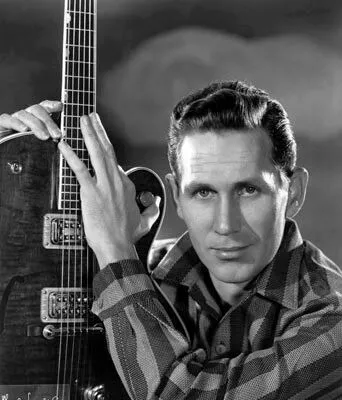
Chet Atkins
Human Design Chart
Biography
Growing up dirt-poor in Tennessee, Atkins was known for his easy-going style and total lack of arrogance, despite his towering stature and influence (on everyone from the Everly Brothers to Elvis). He had asthma as a kid, and suffered from stage fright.
He married Leona on 3 July 1946; one daughter, Merle. His autobiography was titled, "Country Gentleman."
After battling cancer for several years, Atkins died of cancer on 30 June 2001 at his country home in Nashville, TN.
Human Design Analysis: Chet Atkins as Generator 1/3
Generator 1/3 — Design at a Glance
Chet Atkins possessed immense and enduring strength that made him seem like a strong workhorse. His Generator design suggested that he efficiently utilized energy not by constant initiating but rather by reacting to external impulses. The central life strategy was to wait for signals from life and only then act when the sacral center—a common description of gut feeling—clearly signaled a “yes.”
This mechanism served as protection for his resources. If Chet Atkins acted against this inner compass or forced himself into tasks without internal resonance, he risked frustration and rapid energy loss up to burnout. Conversely, nothing could stop him when he followed his impulses; then deep satisfaction and a sense of fulfillment would set in.
The danger lay both in suppression as well as excess: If he was prevented from pursuing his heart project even though the energy was still present, or conversely did things that he had no interest in, he wasted his potential. The key to his effectiveness was not pushing forward against resistance but patiently waiting for the right moment and powerfully responding to it. Only through this gut reaction could he sustainably and fulfillingly apply his enormous endurance without depleting himself.
Emotional Authority
Chet Atkins exhibited a basic attitude where spontaneous impulses were recognized as deceptive. His design suggested that decisions required time and sleep cycles for emotional clarity, stemming from his Emotional Authority carried by the defined Emotions Center. In this center, he was subject to constant waves of emotional ups and downs. The world appeared colored by his current mood: A moment of enthusiasm could turn into a negative outlook in the next. This immediate emotional reaction was merely a snapshot, not yet the deep truth. Quick decisions based on transient emotions often had negative consequences.
The mechanics of his authority required patience and conscious sleeping over choice options. Only with time did intense feelings subside, creating emotional distance. This process allowed him to gain clarity and calmness before acting. It was particularly true for long-term decisions that shaped his life course. Chet Atkins lived the necessity of detaching from current mood to allow deeper perception. His inner guidance relied on letting the wave of emotions fade rather than immediately following it. Through this hesitation and multiple validation of feelings, he found proper orientation.
The 1/3 Profile — Investigator / Martyr
Chet Atkins was someone who not only collected knowledge theoretically but validated it through direct experimentation. His design suggested a tendency towards living a synthesis of careful examination and practical experimenting. As a 1/3 profile ("Researcher/Experimentor"), his life task was learning through trial and error. Line 1 (Gate 15) brought a striving for harmony and conscientiousness, but often led to fear of implementation because the feeling persisted that not enough was known yet. Simultaneously, Line 3 (Gate 25) drove him to act in the here and now, endure shocks, and accept setbacks as necessary learning experiences.
For Chet Atkins, success was not a primary goal but rather a byproduct of authentic action. His judgment was considered absolutely trustworthy because he had tested things both theoretically and practically down to his heart and gut. If he deemed something good, it was based on this double validation: the planning distance of Line 1 and the passionate experience of Line 3. This configuration marked him as someone who knew the danger of alienation through excessive demands but ultimately reached deeper insight through enduring setbacks. His path was characterized by a constant oscillation between the desire for complete information and the urge to simply start and learn from mistakes.
Split Definition — Defined & Open Centers
Chet Atkins revealed himself as someone with a massive internal foundation: defined G-, Sacral-, Spleen-, Solar Plexus- and Root Centers provided him with a firm identity, vital endurance, existential intuition, as well as emotional and physical stability. As a Generator, he reacted to life rather than initiating it; his strategy was to wait for invitations before his Sacral Motor released energy. This created tension between the urge to follow his clear direction (G-Center) and the necessity of waiting for external impulses.
His open Head and Ajna Centers meant missing constant mental inspiration; he tended to be influenced by others' doubts or seek answers that were not his concern. His open Throat Center led him to seek attention rather than wait for spontaneous invitations to speak. The open Heart Center showed a vulnerability to the pressure of having to make promises and prove willpower – a cycle that devalued him when commitments weren't met. Instead of mentally exhausting himself or proving himself, he relied on his inner authority: the intuitive present feeling of Spleen and emotional clarity of Solar Plexus after waiting for the wave. His strength lay in the persistence of his sacral energy with correct reaction, not mental planning or willful enforcement.
Channels for rhythm, synthesis, logic and emotional release.
Chet Atkins revealed himself as someone whose life flow was determined by a deep inner timing. His design tended towards firm structure but did not appear rigid; instead, it magnetically drew others into its rhythm. This impersonal attraction arose through the Rhythm Channel 5-15. Gate 5 held fast to fixed habits and rituals while Gate 15 leveled the playing field with his love for humanity's diversity. Energy flowed from Sacral Center to G-Center, enabling him to direct group energy without himself fluctuating emotionally. This universal magnetism bound him closely to the natural flow of life.
Alongside this rhythmic stability, the Judgment Channel 58-18 was at work. It connected Root with Spleen Centers and drove an insatiable urge to correct patterns and perfect them. Gate 58 provided liveliness and constancy while Gate 18 acted as a sentry judging what was in balance or needed correction. This gave him a sharp sense of what worked functionally, helping him wisely allocate energy by correcting only when it made sense.
Additionally, the Synthesis Channel 19-49 shaped his approach to community. It connected Root with Solar Plexus Center and created an emotional frequency for belonging. Gate 19 urged connection in the trunk while Gate 49 rejected anything not meeting the highest ideals. This fostered loyalty within his close circles based on a clear understanding of values and resource protection.
Individual Gates like the complex Gate 10 in G-Center supported his ability to integrate, while Gate 25 promoted spiritual innocence and centeredness. Gate 46 emphasized dedication to the process and care for the body as a temple. These configurations together created a profile that was both structured yet open to new experiences, with focus always on correct timing and authenticity.
Collective Circuitry — Circuit Signature
Chet Atkins revealed himself through a split definition: two independent energetic blocks existed parallel without direct exchange between them. The first block connected Identity- and Sacral Centers; the second included Spleen-, Root- and Solar Plexus Centers. This separation meant his strategic orientation did not directly merge with his emotional or intuitive perception.
In the Knowledge Circuit, only a partial piece was active: the connection between Solar Plexus- and Root Centers. This generated a pulsating acoustic energy form aimed at venturing new paths and initiating transformation through the expression of one's identity. The emotional wave from Solar Plexus found its rhythm in Root Energy, leading to an intense but time-limited creative phase.
The Understanding Circuit consisted for Chet Atkins of two separate components. One part connected Identity- with Sacral Center, enabling focused visual logic for improving the future – free from emotional influence. The other linked Spleen and Root Centers, connecting quick intuitive judgment with reactive energy. Both parts worked independently: one for strategic planning, the other for rapid instinctive decisions.
The Ego Circuit also contributed only a partial piece to Chet Atkins: the connection between Solar Plexus- and Root Centers. While this circuit generally promotes cooperation and resource creation in the trunk, it lacked the life force of Sacral Center here. Instead, an emotional dynamic aimed at exchange and mutual support was at work, requiring pauses for generating new resources. The synthesis energy from this channel helped unify different perspectives without overlaying individual identity.
Right Angle Cross of the Vessel of Love 2
Chet Atkins was marked by the right cross of the Love Vessel 2, a configuration that defined his deeper spiritual mission and life path. This archetypal orientation suggested that he did not see suffering or sacrifice as mere ends but rather as material for profound, healing love. His task was to carry emotional burdens—both his own and others'—and transform them into empathy.
The mechanics of this cross translated into a character disposition: pain served as a catalyst for empathy. The energy flowed where emotional vulnerability was used to build bridges. The 'vessel' symbolized his ability to receive and hold much; he could take in intense feelings without being overwhelmed by them, instead transforming them. Through his own experience of carrying burdens, he supported others in overcoming their emotional challenges. It was not about passive endurance but the active transformation of heaviness into connection. Chet Atkins thus showed himself as someone who, through understanding pain, could exert a healing influence. His presence was marked by this ability to use emotional vulnerability to guide others through their experiences and offer them support. This formed the foundation of his interpersonal dynamics: carrying burdens as an act of love.
Saturn Return · Uranus Opposition · Chiron Return · 2nd Saturn Return — Life Cycles
Chet Atkins' life followed a clear rhythm of structural consolidation and necessary breaks. His design indicated that recurring astrological cycles marked phases of success as well as fundamental shifts. This was evident in his first Saturn return in 1955: with 'Mr. Sandman,' he achieved his first hit, a success that condensed years of hard work. The Uranus opposition in 1965 brought 'Yakety Axe,' his biggest hit, a sign of the impulsive breakthrough often facilitated by this cycle.
The Chiron return around age 49 is not a healing process of old wounds in Human Design but rather an incarnation fulfillment cycle. In 1973, Atkins was inducted into the Country Music Hall of Fame. This induction marked the moment when his lifelong purpose and flourishing became tangible—confirmation that he had followed his design.
The second Saturn return around age 55 often brings a crisis of structure. In 1979, after 25 years of successful collaboration with Gretsch, Atkins parted ways. This break was not a defeat but the necessary dissolution of an old shell to make room for new, more mature structures. His path demonstrated how cycles not only bring success but also release old bonds so that the design can continue to evolve.
Generator · Emotional Authority — Synthesis
Chet Atkins' design reveals a deep inner rhythm fueled by the connection between sacral energy and a firmly anchored G Center (Channel 5-15). This combination points to a natural ability to connect with the flow of life and draw others in through his authentic expression. The defined emotional authority, coupled with the profile of an Explorer/Experimentor (Profile 1/3), underscores the need not to rush decisions but to clarify them within the depth of emotional waves and validate them through experience. The defined Root Center, connected with the Spleen Center (Channel 58-18), indicates a strong inner corrective ability—a need to recognize and adapt patterns to ensure survival and well-being. These elements together form a person deeply rooted in their own rhythm while constantly seeking new insights and possibilities to share with others.
A central paradox in Chet Atkins' design lies in the interplay of defined sacral energy and an open Throat Center. While the Sacral signals a constant source of life force and endurance, the openness of the Throat points to a certain receptivity to external influences—a need to express oneself without being driven by internal pressure. This tension between inner energy and outer expressive power might have led him to possess the ability to generate profound creative impulses but also wait for the right opportunity to carry them authentically outward.
4 Defined Channels
Incarnation Cross - Right Angle Cross of the Vessel of Love 2
Solar Return
The Solar Return shows the moment when the sun returns to its exact birth position - your personal solar year.
Life Cycles
Discover the life cycles with a detailed triple view (birth chart, cycle chart, composite).
Human Design Profile
- Type
- Generator
- Strategy
- To respond - wait for something to respond to
- Authority
- Emotional Authority
- Profile
- 1/3 - Investigator / Martyr
- Definition
- Split Definition
- Incarnation Cross
- Right Angle Cross of the Vessel of Love 2
- Date of Birth
- 20.06.1924 02:00
- Place of Birth
- Luttrell (Union County), TN, United States
Frequently Asked Questions
What was Chet Atkins' Human Design type?
What Profile did Chet Atkins have in Human Design?
Which Authority guided Chet Atkins?
What incarnation cross did Chet Atkins have?
When was Chet Atkins born?
Discover your own Human Design
Are you also a Generator? Find out in a personal reading how to use your sacral energy correctly and discover deep satisfaction.
More Personalities
Back to overviewAaliyah

Alexia

Alizée

Angèle

Anne-Marie

Arcángel