
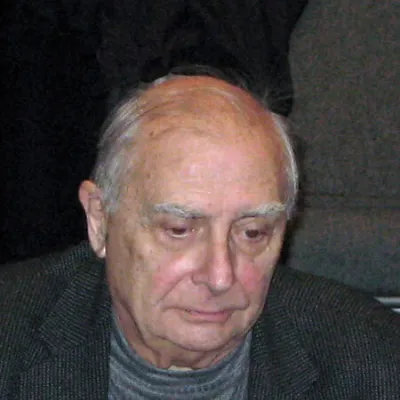
Claude Chabrol
Human Design Chart
Biography
Chabrol began his film career as a critic. An inheritance of his first wife enabled him to indulge his love for the silver screen by establishing a production company. Under its umbrella he wrote and produced his first film, a short, entiled "Coup de Berger" (1956). Two subsequent films, "Le Beau Serge" and "Les Cousins" are described as the beginning of the New Wave. Subsequent films include "Le Boucher" (1969), "Madame Bovary" "Violette." Among the star he directed are Isabelle Huppert, Gérard Depardieu and Jean-Paul Belmondo and his second wife, Stéphane Audran. .
Chabrol was married three times, first to Agnès Goute in 1952. Their marriage produced two sons. In 1964 he married Stéphane Audran, who starred in some of his movies. They had one son together and divorced in 1982. He married Aurore Pajot in 1983.
Hospitalized with "severe anemia" he died on September 12, 2010 in Paris.
Claude Chabrol as a Manifesting Generator 5/1 in Human Design
Manifesting Generator 5/1 — Design at a Glance
Claude Chabrol's design created a hybrid energy structure: As an expressing generator, he possessed the constant, sacral power of a generator paired with the lightning-fast implementation strength of a manifestor. This configuration allowed him to skip steps and quickly draw things into his life but fundamentally differed from pure initiating. His strategy did not consist in providing the initial impulse but rather in waiting for external impulses before acting when his inner authority—the sacral center—signaled a clear "yes."
This mechanism shaped his work behavior: He tended to push multiple projects forward simultaneously, as the linear requirement of finishing one thing before starting another contradicted his nature. Instead of narrowing down to a single focus, he drew deep satisfaction from variety and a playful mode of creation. The danger always lay in his own speed; if he skipped important intermediate steps, it inevitably led to the necessity of going back and filling gaps—a process that typically triggered his characteristic frustration. As long as he responded to impulses and regularly checked whether projects still resonated with him, however, he could leverage this multifaceted approach without falling into overload or dissatisfaction. His design thus required a balance between rapid execution and the patience to wait for the right inner impulse.
Emotional Authority
Claude Chabrol's design inclined towards emotional wave motion. His inner authority was Emotional Authority, carried by the defined Emotional Center. In Human Design mechanics, this authority always takes precedence over all other defined centers regardless of further configurations in the chart. This meant for him that decisions could never be based on first impressions.
The defined Emotional Center is subject to constant ups and downs of feelings. The world was always colored by the current mood: A moment of enthusiasm could quickly turn into negative evaluation. However, this emotional wave is only a snapshot, not the final truth. Spontaneous decisions made from such a situation often had negative consequences as they were based on fleeting impulses.
Instead, his mechanics required patience and time. Claude Chabrol had to take his time and sleep over decisions multiple times. Only when intense feelings subsided and emotional distance was gained did clarity set in. This process of maturation was essential for long-term positioning that significantly shaped the course of his life. Only through waiting for calmness could he recognize his deeper truth and act without being driven by passing moods.
The 5/1 Profile — Heretic / Investigator
Claude Chabrol's design inclined him towards deep, individual research that he later used to solve problems for his environment. As a 5/1 - Explorer/Researcher - he initially sought hidden connections and gathered knowledge within himself before making it accessible to others. This configuration gave him almost magnetic appeal: people instinctively turned to him for answers to their questions or solutions to complex issues.
This process, however, came with a specific challenge. Without clear boundaries, the energy of the 5/1 could become depleted as the need from his environment for advice often overwhelmed him and left him drained – similar to an expert who answers questions day after day only to find at night that their inbox is overflowing again. His design therefore required the ability to also say "no" in order to maintain a healthy balance between his private research process (Line 1) and public knowledge dissemination (Line 5).
Line 1 promoted openness to various opinions and a broad spectrum of theories, helping him grasp reality in its complexity. At the same time, his expression showed adaptability during crisis times (Line 5), where extreme stances or overcompensation could disrupt the natural flow. His path involved using this inner depth without being overwhelmed by the abundance of external inquiries.
Split Definition — Defined & Open Centers
Claude Chabrol's design inclined him towards clear communication and vital endurance. His defined Throat connected with the energy of his defined Sacral definition, giving him a consistent way to express himself and carry out projects. This configuration allowed him to manifest his truth easily and honestly as long as he trusted his inner authority.
At the same time, his defined Solar Plexus indicated that emotions played a central role in his decision-making process. He was designed to wait for the emotional wave before taking important steps. This patience helped him gain deeper insights and avoid impulses that were later regretted. His defined Spleen supported this approach through spontaneous intuition in the moment, helping him make healthy decisions for his well-being.
In contrast, his undefined centers revealed areas of vulnerability. His open Head Center made him susceptible to external mental inspirations, which sometimes led to confusion or distraction. Similarly, his open Ajna Center was flexible towards concepts and theories he absorbed from his environment without identifying them as personal truth.
His undefined G Center meant that Claude Chabrol did not have a fixed identity but could adapt to his surroundings. This allowed him to take on various roles and be initiated by others. His open Heart Center showed a tendency to want to prove his worth through promises or competition, which often led to frustration when he could not keep these commitments.
Overall, this interplay of defined vitality and emotional depth along with open mental and identity-related centers shaped his unique way of experiencing and shaping the world.
Channels for meaning, care, critical thinking and change.
Claude Chabrol's design inclined towards analytical sharpness and critical distance. The Channel of Judgment 58-18 connected the Root Center with the Spleen Center, creating an insatiable urge to logically question and correct patterns. This mechanism acted like a sentry that assessed whether perceived situations contributed to collective satisfaction or required correction. Chabrol emerged as someone who sought perfection by comparing what was internally consistent with past experiences. This ability to judge shaped his attitude: he questioned patterns not out of malice, but from the desire to make life more cheerful for the collective.
Alongside this logical sharpness, the Channel of Preservation 27-50, connecting the Sacral Center with the Spleen Center, also played a role. Through Gate Caring (27) and Gate Values (50), there arose a natural ability to take responsibility and nourish the clan. Chabrol automatically attracted trust; people looked up to him for support. However, this channel also demanded "enlightened selfishness": only those who properly cared for themselves could nurture others. His aura signaled reliability and the preservation of traditional values necessary to ensure order and protection for the community.
The Channel of Life Struggle 28-38 also connected Root and Spleen Centers. Here, it was not just about survival but finding meaning in daily struggles. Gate Fighter (38) pressed for integrity against external distractions, while Gate Player (28) recognized which battles were worth fighting. Chabrol possessed the stubborn determination to walk his own path and discover significance in difficulties. This energy propelled him to live out individuality even when others saw it as defiant.
Additionally, the Channel of Transience 35-36 between Solar Plexus and Throat Centers was at work. He sought new experiences to gain emotional depth. Gate Change (35) wanted to manifest something new, while Gate Crisis (36) perceived inexperience as inadequacy. Chabrol learned through emotional highs and lows; his wisdom emerged from understanding the transience of feelings. This restless desire for experience matured over time into a clear personal truth.
Individual Gates complemented this picture: Gate 15 organized around collective rhythms, Gate 10 integrated complex behaviors genetically predetermined, and Gate 17 taught logically for the future while upholding human rights. Gate 3 in the Sacral Center sought order through mutation, while Gate 31 understood leadership as an energetic transmission. Gate 37 promoted organic friendship structures, Gate 16 experimented with craftsmanship skills, Gate 59 followed a genetic pairing strategy without personal preference, and Gate 53 initiated new developmental cycles for freedom.
Collective Circuitry — Circuit Signature
Claude Chabrol's design showed a split structure in which two independent energetic blocks existed parallel to each other. The first block connected the Spleen, Root, and Sacral Centers; here instinctive survival energies worked together with the drive for preservation and maintenance (Channel 27-50). This created a deep, timeless foundation for protecting the near and dear. The second block connected the Throat and Solar Plexus Centers. Here emotional waves flowed directly into expression, driven by reflection on impermanence (Channel 35-36). This separation meant that rational future visions or abstract identity questions remained energetically isolated and did not interact with these powerful flows. Claude Chabrol thus lived from two clearly separated focal points: on the one hand, ancient physical care and protective drive, and on the other hand, emotionally colored articulation of past experiences. There was no bridge between cool reason or individual self-presentation and these two main streams. His energy focused on preserving what is necessary and vocally expressing emotions from the past without these areas being disturbed by logical planning or individual self-representation. This configuration shaped an existence deeply rooted in the here-and-now of survival and emotional resonance, while other aspects of consciousness remained uninvolved.
Left Angle Cross of Prevention 1
Claude Chabrol's design indicated a tendency towards strategic restraint and protection from external influences. This attitude stemmed from the influence of the left cross of prevention, a configuration often interpreted as the "cross of defense" or "of waiting." In Human Design, this cross marks a specific life task: not to advance through impulsive action but rather by patiently observing and waiting for the right moment.
People with this configuration tended to initially withdraw in order to fully assess the situation before reacting. This was not passivity in terms of inaction, but rather a conscious strategy of prevention – avoiding unnecessary risks through careful preparation. The energy of this configuration promoted a deep understanding of when it was wiser to wait instead of acting immediately.
Therefore, Claude Chabrol showed himself as someone who drew his strength from the ability to recognize dangers or mistakes beforehand and neutralize them through restraint. His design supported a kind of wisdom that did not announce itself loudly but quietly worked: by not acting at inappropriate times in order to conserve energy for decisive moments. This inner discipline shaped his approach to challenges and contributed to him often appearing stable and unshakable in complex situations.
Saturn Return · Uranus Opposition · Chiron Return · 2nd Saturn Return — Life Cycles
Claude Chabrol's Human Design profile indicated a tendency towards structural anchoring and later profound realignment. This dynamic was evident in his life: In 1956, at the age of 26, he founded a production company and realized his first short film "Coup de Berger". This coincided with his first Saturn Return, a cycle often marking the crystallization of years of groundwork into solid results. Here, the foundation for his creative autonomy was laid.
Later, in 1971 at the age of 41, he received the Bodil Award in the category Best European Film for "The Butcher". This event corresponded with his Uranus Opposition, a phase often characterized by unexpected breakthroughs or breaking old patterns. The success confirmed his position and brought new impulses to his work.
Another turning point occurred in 1982 when he was 52 years old and divorced from Stéphane Audran. This coincided with his Chiron Return. In Human Design, this is not a healing process in the medical sense but rather an actualization cycle where one's incarnation cross unfolds. During this period, existential questions and clarity are put to the test. The divorce was part of this deep inner maturation that helped him recognize and make his life purpose more tangible in everyday life.
Manifesting Generator · Emotional Authority — Synthesis
He was a Manifesting Generator with a defined sacral center and connection to the throat center, giving him an unusual dynamic. This configuration led to quick impulse absorption and skipping steps (Design), yet always filtered through deep emotional authority that required time for maturation. The Profile of Hero/Researcher (5/1) amplified this trait: he sought solutions, gathered knowledge, and shared it willingly – a process that put him in a position where others constantly expected answers from him. The Channel of Judgment (58-18) indicated an unrelenting drive to question and perfect patterns, shaping the quality of his work.
A central paradox lay in the tension between the speed of his design and the necessity for emotional clarity. He could initiate things quickly (Manifesting Generator), yet the defined emotional center demanded thorough engagement to avoid mistakes. This led to internal conflict between a desire for immediate implementation and the need to let decisions mature. The recurring crisis and success experiences (Cross, Cycles) showed that he often operated at the limits of his energetic capacity – always driven by a thirst for knowledge that propelled him forward while also burdening him.
4 Defined Channels
Incarnation Cross - Left Angle Cross of Prevention 1
Solar Return
The Solar Return shows the moment when the sun returns to its exact birth position - your personal solar year.
Life Cycles
Discover the life cycles with a detailed triple view (birth chart, cycle chart, composite).
Human Design Profile
- Strategy
- To respond - wait for something to respond to
- Authority
- Emotional Authority
- Profile
- 5/1 - Heretic / Investigator
- Definition
- Split Definition
- Incarnation Cross
- Left Angle Cross of Prevention 1
- Date of Birth
- 24.06.1930 22:00
- Place of Birth
- Paris Arrondissement 10, France
Frequently Asked Questions
What was Claude Chabrol's Human Design type?
What Profile did Claude Chabrol have in Human Design?
What Authority did Claude Chabrol have?
What incarnation cross did Claude Chabrol have?
When was Claude Chabrol born?
Discover your own Human Design
Are you also a Manifesting Generator? Find out in a personal reading how to unfold your multi-talents and direct your energy wisely.
More Personalities
Back to overviewAldair

Alizée

Angeli

Arletty

Artus

Balthus
